If you are choosing between cups and bottles for a race, the answer depends on the event. Some races still hand out paper cups. A growing number are “cupless”, which means you bring your own vessel and fill it at the aid station. For a 5K you can usually carry nothing. For a 10K, a half marathon or longer, a bottle, soft flask or vest is the safer choice, and a collapsible cup is a good backup for aid stations.
This guide covers how cupless races work, what each option costs you in time and comfort, how much fluid you need, and how to practise before race day.
TL;DR
- Check your race’s rules first. Cupless events expect you to carry your own bottle, flask or collapsible cup, and some will not serve you without one.
- Paper cups are quick to grab but hard to measure, and you tend to spill a lot. A bottle or flask lets you see what you actually drank.
- Short races (5K, and often 10K) rarely need fluid on you. Half marathons, marathons and trail races do.
- Practise with your chosen kit on long training runs. Carrying water changes how you move slightly, and it is easier to adapt in training than on race day.
- A soft flask or small vest bottle is the lightest way to stay self-sufficient. A belt or vest suits you if you also carry gels, a phone and keys.
Table of Contents
- What “cupless” actually means
- Paper cups at aid stations: the case for and against
- Bottles, flasks, cups, belts and vests compared
- How much fluid do you need?
- Do you need to carry anything at all?
- Does carrying water slow you down?
- Choosing your carry: handheld, flask, belt or vest
- A practical plan for race week
- Our view: why we favour carrying your own
- Kit from STRYQ for cupless races
- Common mistakes at cupless races
- FAQ
- Sources
What “cupless” actually means
A cupless race does not hand out disposable cups at aid stations. Instead, you carry a reusable vessel: a collapsible cup, a handheld bottle, a soft flask or a hydration vest. RunSedona’s sustainability page states that its events are cupless, and that a runner uses roughly 22 cups in a half marathon, around two per aid station. Multiply that by a field of thousands and you can see why organisers in the US are acting.
The rules differ from event to event:
- Fully cupless, bring everything. The Tuscazoar 100 tells runners to carry their own pack or handheld for water and electrolytes, plus a reusable cup for anything else served at aid stations, such as soda.
- Cup supplied, carrying required. The Bighorn Trail Run provides each participant with a reusable packable cup, but you must still carry a reusable cup or bottle for liquids at aid stations.
- Hybrid. Some organisers have rethought a blanket ban after participant feedback. According to the ORRC, a hybrid approach provides cups at road races but stays cupless on trails, where litter in remote areas matters most.
The lesson: read the race information page and the runner briefing. Do not assume cups will be there, and do not assume a cupless rule means you can go without carrying anything.
Paper cups at aid stations: the case for and against
Cups are what most of us grew up with. You slow slightly, grab one from a volunteer, squeeze the rim and drink on the move. There is nothing to carry, nothing to forget.
The drawbacks are practical, not only environmental:
- Spillage and crowding. Early in a road race, aid tables are busy. You can lose seconds, and some of the water ends up on your shirt.
- No sense of volume. A cup looks like a lot of fluid and is often only a few mouthfuls once you have squeezed and spilled it. Runners are not good judges here: in a study of runners before and after a one-hour summer run, participants greatly underestimated how much sweat they lost.
- Dependence on the course. If the aid station is short of cups, or the race goes cupless at short notice, you have no plan B.
That said, if your race supplies cups and you run 5K or 10K, there is no reason to carry anything extra. Walk through the station, take two cups if you need them, and move on.
Bottles, flasks, cups, belts and vests compared
| Option | Best for | Main advantage | Main drawback |
|---|---|---|---|
| Disposable paper cup (where supplied) | 5K, 10K on road | Nothing to carry | Spills, no volume tracking, may not be offered |
| Collapsible cup | Races with refill stations | Tiny, light, folds into a pocket | You must stop or slow to drink and refill |
| Handheld bottle | 10K to half marathon | Easy sips, easy to see how much is left | Occupies a hand, can tire your arm |
| Soft flask (in vest or belt) | Half marathon to ultra | Squashes as you drink, little bounce | Needs a vest pocket or belt holder |
| Running belt | 10K to half marathon, with a small bottle or phone | Hands free, stores keys and gels | A loaded belt can bounce if badly fitted |
| Hydration vest | Marathon, trail, hot weather | Carries fluid and fuel, spreads weight | More kit, needs a fit check |
None of these is the right answer for everyone. The right one is the one you have practised with.
How much fluid do you need?
The National Athletic Trainers’ Association position statement gives general guidance of 400 to 800 ml (15 to 30 ounces) of fluid per hour during exercise. It also says to individualise this by sweat rate, duration and conditions. Its example target is 200 to 300 ml (7 to 10 fl oz) every 10 to 20 minutes, aiming to keep body weight loss under 2%.

Two practical points follow.
Marked containers tell you more than cups. The same position statement notes that carrying water in individual, marked containers lets you track intake objectively, instead of drinking only when thirsty. A 500 ml flask with a clear fill line makes that simple: if you started with 500 ml and it is empty after 50 minutes, you know your rate.
Work out your own sweat rate. Weigh yourself before and after a training run, and check your urine colour afterwards. Hot, humid days push the number up, and humid weather makes running much harder, so the amount that worked in a cool spring race may not work in August. Treat the 400 to 800 ml range as a starting point, not a target.
If you are unsure about your needs, have a medical condition affecting fluid balance, or have had heat illness before, talk to your GP or a sports medicine clinician before a long race.
Do you need to carry anything at all?
For shorter efforts, not always. A study reported on PubMed Central looked at a 15 km trial: runners who only rinsed their mouths with water finished in times that did not differ significantly from runners who drank 355 ml. For runs of around an hour to an hour and a half, a mouth rinse at an aid station can take the edge off thirst without you carrying a system.
For longer races, the same source points to a lightweight, refillable vessel as necessary for consistent intake. That is where cupless rules and your own kit meet.
A simple rule of thumb by distance:
- 5K and Parkrun: nothing. Drink beforehand and afterwards.
- 10K: nothing in cool weather if water is provided. A small flask if it is warm or you like to sip.
- Half marathon: a flask, handheld or belt bottle, plus a collapsible cup if the race is cupless.
- Marathon and beyond: a vest or belt with 500 ml or more, plus fuel. Our marathon hydration options guide goes through bottles, belts, vests and aid stations in detail.
Does carrying water slow you down?
A little, in some ways, but less than most people fear. A study on running with water bottles and bottle belt holders found minor changes in mechanics such as pelvic rotation and elbow flexion. These did not significantly change oxygen use or energy expenditure over short durations. The authors’ practical advice is the useful part: practise with the gear you plan to race in, so your body adapts.
There is a flip side. Stopping for a cup costs seconds. A race write-up about a cupless road event noted that the runner lost close to 25 seconds queuing for fluid. If you are chasing a time, a flask you can sip from without breaking stride may save more than the load costs you.
Choosing your carry: handheld, flask, belt or vest
Handheld bottle or soft flask
Best if you want the simplest set-up and only need water. A soft flask collapses as you drink, so there is no sloshing. The STRYQ 500ml Running Soft Flask is made for this, and the collapsible running bottle packs down small once empty, which is handy when you refill at a cupless aid station and then need pocket space.

Running belt
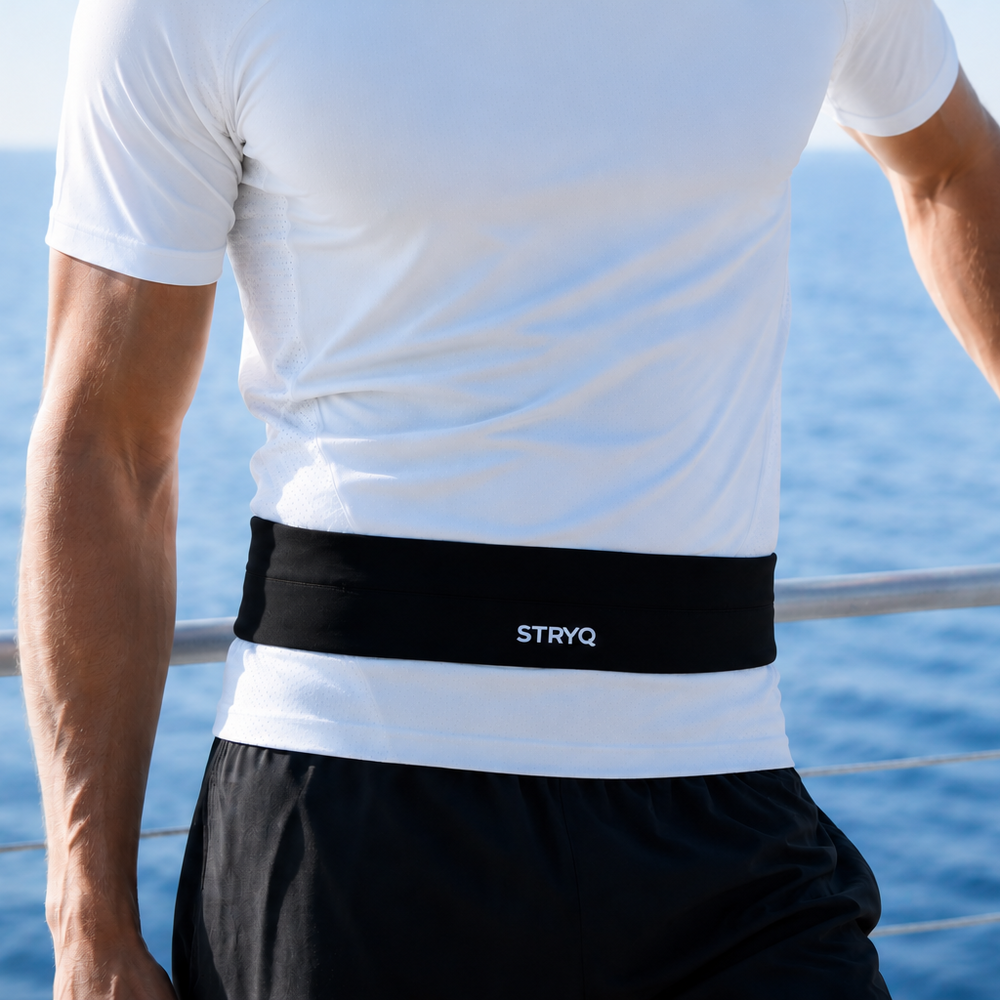
A belt works for 10K to half marathon distances if you carry a phone, keys, a gel or two and perhaps a small bottle. It keeps your hands free. Fit matters: it should sit snug on the hips and not ride up. If you are comparing a belt with a vest, our vest versus belt comparison walks through the trade-offs.
Hydration vest
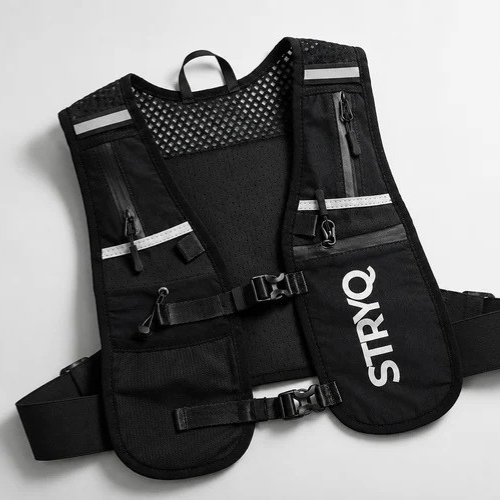
A vest spreads the load across your chest and back, which many runners find more stable than a belt on long runs. It holds flasks in front pockets for easy reach, and has space for fuel, a jacket and a phone. For longer distances, see our guide on belt or vest for a marathon, and for set-up, how to pack a vest with two 500 ml flasks.
Collapsible cup only
This is the minimalist cupless approach. It weighs almost nothing and works well when aid stations are frequent. The catch: you depend entirely on the stations, and you cannot sip between them. In heat, or on a course with long gaps, add a bottle.
A practical plan for race week
- Read the race rules. Look for the words cupless, bring your own cup or required gear. Note whether the race provides a cup and whether you must carry one regardless.
- Count the aid stations. Divide the distance by the number of stations. If the gaps are more than about 5 km on a warm day, carry your own fluid.
- Use the same kit in training. Do at least two long runs with the exact bottle, belt or vest you will race in. Fill it to the same level.
- Test the refill. Practise unscrewing, filling and closing a flask while walking. At a busy station it is the clumsy step that costs time.
- Mark your intake. Note how much you drink each hour on training runs, and compare it with the guideline range above.
- Pack for after, too. Drinks, a dry top and a snack at the finish matter as much as the carry.
If you do use a vest, what to carry in a hydration vest for long runs will help you decide what stays in the pockets.
Our view: why we favour carrying your own
We build running gear for everyday runners, and the questions we hear most are practical. Will it bounce? Will I be able to reach it? Will it still work after a season of use? We develop each product through several sample revisions and testing with runners before launch, and the lesson from hydration is consistent: the best set-up is the one you stop thinking about.
For us, cupless racing is a reason to carry your own, not a hassle. A flask or bottle you know gives you a measure of what you drink, lets you sip when you want rather than when the table appears, and frees you from queues. Paper cups still have a place at a casual 10K. For half marathons and above, we would take our own vessel every time, and keep a collapsible cup as backup.
We also think the choice should stay simple. You do not need a full vest for a 10K, and you do not need a belt if a single flask will do. Start with the smallest kit that meets your race, and add pieces only when long runs show you need them.
— martin
Kit from STRYQ for cupless races
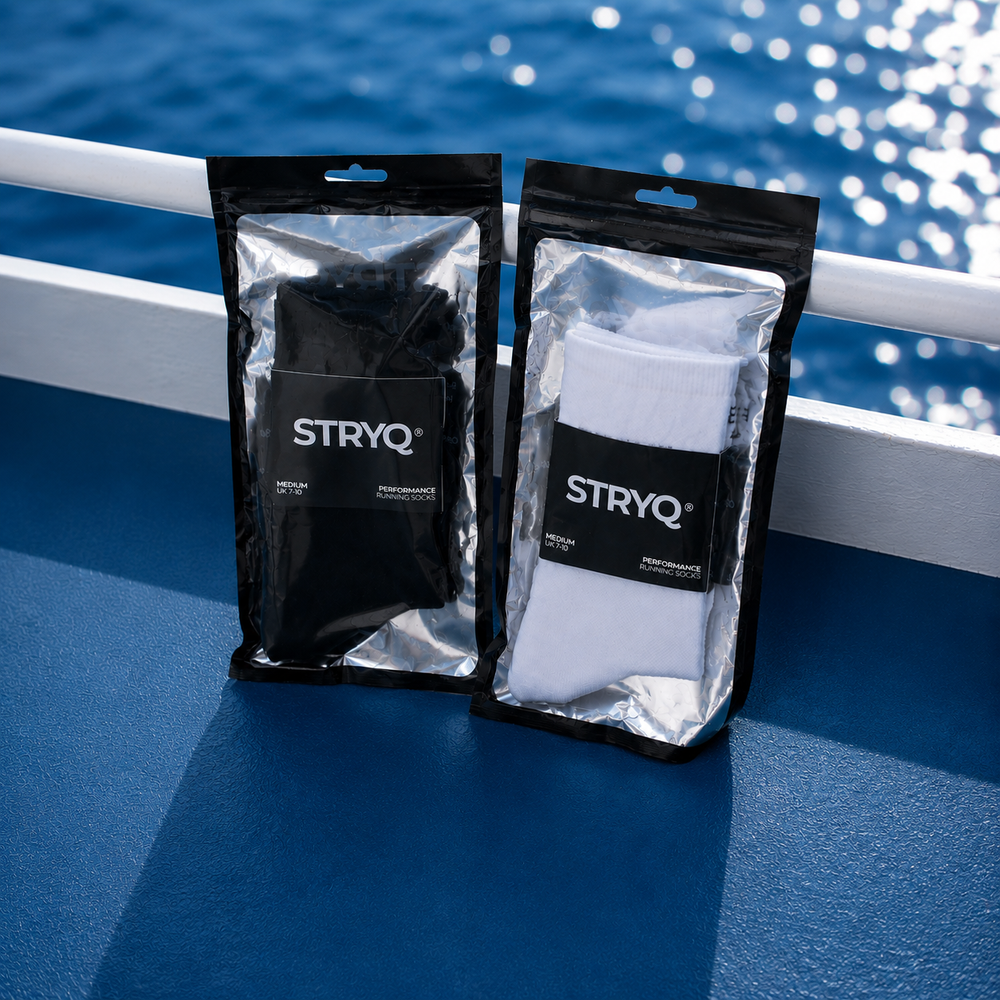
If you are building a set-up, our range covers each of the options above: a running belt and hydration vest for carrying fluid and essentials, and a 500ml soft flask for lightweight hydration. Our running socks are there for the miles in between, because spilled water at aid stations can leave feet wet.

Common mistakes at cupless races
- Turning up with nothing. Some races will not serve you without your own vessel.
- Trying new kit on race day. Chafing and bounce show up after the first hour, not the first minute.
- Overfilling. You rarely need to fill a 500 ml flask to the top at every station. Fill for the next gap.
- Ignoring weather. Follow your own sweat rate, not a plan written for a cool day. For a longer discussion of personalising your plan, see this hydration checklist.
- Forgetting electrolytes. If the race serves an electrolyte drink, check whether a water-only flask is enough. Some events want a separate cup for anything other than water.
FAQ
What is a cupless race?
It is a race where aid stations do not supply disposable cups. You bring your own bottle, flask, hydration vest or collapsible cup and fill it from jugs or refill points. Details vary, so check the race briefing.
Are bottles faster than cups in a race?
Often, yes, if you can drink without stopping. A bottle in hand or a flask in a vest lets you sip on the move and skip the queue. Carrying a load has a small effect on mechanics, so train with it first.
How much should I drink during a half marathon?
General guidance from the National Athletic Trainers’ Association is 400 to 800 ml per hour, adjusted for your sweat rate and the weather. Test it in training. If you have a medical condition, ask your doctor first.
Do I need a hydration vest for a 10K?
Usually not. In cool weather, water at the aid stations or a mouth rinse is enough for most runners. A small flask or handheld is a sensible step up if it is hot.
Sources
- RunSedona: Sustainable Racing
- Race Brimstone: Tuscazoar 100
- Bighorn Trail Run: race announcements
- ORRC: eco-friendly races
- Runners greatly underestimate sweat losses before and after a 1-hr summer run (PubMed)
- NATA Position Statement: Fluid Replacement for Athletes
- Mouth rinsing and fluid intake study (PubMed Central)
- Running Mechanics and Metabolic Responses With Water Bottles and Bottle Belt Holders