Running Gear
STRYQ Running Gear is designed to help runners train smarter, move freely and perform at their best. Our range of lightweight running accessories and equipment is built for comfort, stability and everyday reliability, whether you are training for your first 5K or preparing for a marathon.
More about running gear
The best setup is not the one with the most pieces. It is the one that solves the jobs your session actually creates: carrying a phone, keeping fuel accessible, managing fluid, staying visible when light drops and protecting your feet when distance increases.
That is why the STRYQ range is deliberately focused. A secure belt covers small everyday essentials. A vest steps in when hydration and storage become more important. A collapsible flask makes carried fluid easier to manage, while a technical pair deals with friction, cushioning and moisture inside the shoe. The reflective kit adds another practical layer for darker roads and paths.
Use the guide below to decide what you genuinely need now, what can wait until your distance grows, and how each product should work alongside the clothes and shoes you already trust.
More about the Running Gear collection
From secure running belts and hydration vests to essential running accessories, every piece of STRYQ running gear is tested by real UK runners to ensure comfort, durability and zero distraction.
Whether you call it a running kit, running equipment, running essentials or running accessories, the goal is the same: simple, high-performance running accessories in the UK that support every run.
Explore our full range of running belts, lightweight running vests, running soft flasks and running socks carefully designed running accessories to build your complete setup.
Choose running kit by the job it needs to do
The useful question is not how much kit you can carry. It is whether each piece solves a real problem without adding distraction.

Phone, keys, cards and compact fuel stay close to the body without relying on loose pockets.

For longer sessions, a vest gives fluid, nutrition and extra layers a more stable place to sit.

Visibility, hydration and foot comfort become more important as distance, weather and light change.
Carry, hydrate, protect or be seen. Once you know the job your kit needs to do, choosing the right STRYQ product becomes much simpler.
Open the sections that match the run you are planning. The full guide stays on the page without getting in the way of shopping.
CHOOSE BY THE RUNHow to choose kit for the running you're doing
How to choose kit for the running you're doing
Start with the session in front of you rather than buying for the most extreme situation you can imagine. A short local loop close to home creates a very different kit list from a two-hour Sunday run or a remote trail route. Most runners need less than they think for everyday training, but the few things they do carry should be comfortable, stable and easy to use without breaking stride.
For a 5K or easy recovery run, the practical questions are simple. Do you need your phone? Are you carrying keys? Will you be out after dark? If the answer is mostly phone and keys, a close-fitting STRYQ belt keeps those items off your hands and out of loose pockets. If you are heading out with nothing but a watch and your door key, even that may be more than you need.
As duration increases, fuel and fluid begin to matter. A 10K or half-marathon training session might add one or two gels and a card. A longer effort in warm weather might call for carried water. When fluid becomes a major part of the load, the STRYQ vest gives you more stable storage across the torso and easy access to the front while you move.
The same logic applies to race day. Nothing should be there just because it looks technical. Each item needs a job. Your running shoes protect and support the foot. A technical pair helps manage moisture and friction. Storage keeps valuables and nutrition secure. Hydration needs to match the event, the weather and the location of water stations. Visibility equipment matters when the route or start time makes you harder to see.
If you are building a setup for a specific event, our 5K race checklist explains what is genuinely useful for shorter events, while the marathon race-day accessories guide covers the extra considerations that arrive with longer distance.
SHOES & CLOTHINGMatch your shoes, clothing and accessories to the session
Match your shoes, clothing and accessories to the session
Storage and hydration do not work in isolation. They sit on top of the clothing and layers you already use, so the full setup needs to feel coherent once you start moving. A belt that is comfortable over a thin top may sit differently over winter layers. A vest that feels stable in a base layer can need a small adjustment when you add a jacket. Even sock thickness can alter the feel of close-fitting running shoes.
Start with the items that directly touch the body. Your shoes should already be broken in and suitable for the surface. Road models generally prioritise smooth transitions and lower weight; trail models use more aggressive grip and protective construction. If you switch between surfaces, use the running shoes that suit the route rather than asking one pair to do everything. A stable shoe also gives the rest of the setup a better foundation because you are not compensating for discomfort lower down.
Next, think about running clothing. Technical fabrics are designed to move sweat away from the skin and dry faster than everyday cotton. That matters because damp fabric can become heavy and abrasive over time. A lightweight top and running shorts may be enough on a mild day, while cooler conditions could require a base layer, tights or a jacket. Whatever you choose, make sure pockets, waistbands and seams do not fight with the belt or vest you plan to wear.
Running watches can be useful for pace, distance and route tracking, but they do not replace practical planning. A watch can tell you how far you have gone; it cannot carry the key you need to get home or the drink you need on a warm, exposed route. Treat technology as one part of the setup rather than the centre of it.
The final check is movement. Put everything on together and jog, bend, twist and raise your arms. If straps catch on a shirt, if a waistband pushes a belt upwards, or if a vest rubs at the neck, fix it in training. Small conflicts become much more noticeable after an hour of repeated motion.
UK CONDITIONSRunning apparel and footwear for changing UK conditions
Running apparel and footwear for changing UK conditions
UK weather makes flexible layering more useful than chasing one perfect outfit. A cool start can become warm sunshine; a dry route can turn wet within half an hour. Running apparel should let you adapt without creating bulk, and any storage you add should still work once those layers change.
In warmer conditions, breathable fabrics and lighter coverage help heat escape. A technical top with shorts is often enough for a steady road session, and a low-profile belt can be easier than covering the torso with a pack when you only need to carry valuables. If the temperature rises further, access to water becomes more important than adding more clothing.
In colder weather, build from the skin out. A close base layer manages moisture, then an outer layer deals with wind or rain. Avoid automatically overdressing; running generates heat quickly. If you expect to remove gloves, a hat or a light layer during the session, make sure there is somewhere sensible to put it rather than trying to force bulky clothing into storage designed for a phone and gels.
Your running footwear needs the same practical approach. Road, trail and mixed-surface routes place different demands on grip, cushioning and protection. Your choice should suit where you are actually going, while sock thickness needs to leave enough room for natural foot swelling. If a familiar shoe suddenly feels tight after changing socks, the combined volume is the issue, not necessarily the shoe itself.
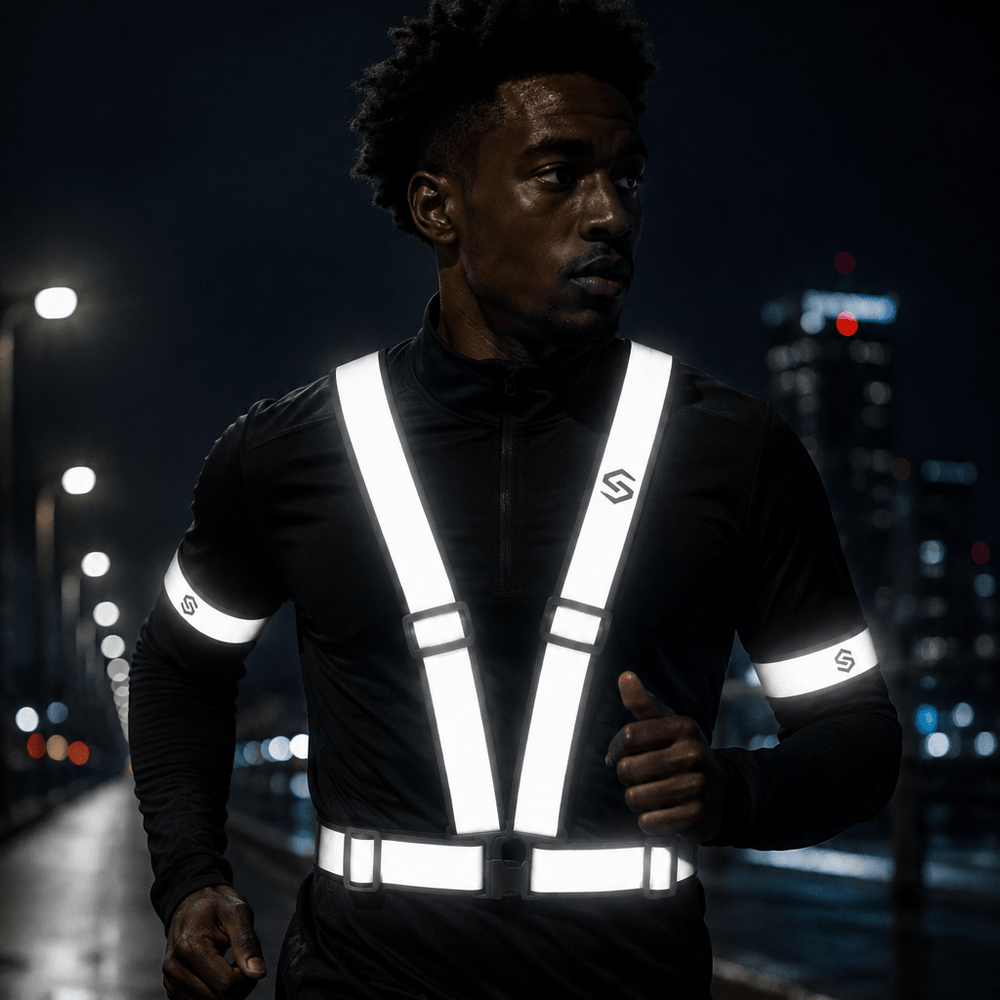
For wet or dark sessions, visibility becomes another layer of planning. The STRYQ high-vis vest and reflective bands kit adds reflective coverage without asking you to replace the clothing you already like. Reflective details help when headlights reach them; on unlit routes, use active lighting as well so you can see the surface ahead.
BEGINNER KITWhat beginners actually need first
What beginners actually need first
New runners are often sold the idea that starting properly requires a long shopping list. It does not. The first priority is comfort: a pair of suitable running shoes, clothing you can move in and a plan simple enough to follow consistently. Everything else should solve a problem that appears as you build the habit.
If carrying a phone and keys is irritating you, add a belt. If longer sessions make you thirsty between reliable water points, add a bottle or vest. If your feet are getting hot, damp or rubbed, look at the technical pair you wear and how it interacts with your shoes. That order keeps spending connected to a real need rather than buying equipment simply because experienced runners use it.
For Couch to 5K and early parkruns, you normally do not need to carry much. A phone can be useful for the training app, music or safety. House keys need somewhere secure. In poor light, visibility deserves attention. Beyond that, keep the setup minimal and concentrate on building consistency.
As you progress towards 10K and longer distances, begin testing the things you may later rely on in events. Practise carrying a gel before you need several. Learn whether you prefer a handheld drink or hands-free hydration. Test that pair on longer efforts before race day. Small experiments in ordinary training give you answers without risking an important session.
- First: comfortable running shoes and clothing that lets you move without rubbing or overheating.
- Then: secure storage if carrying a phone, keys or cards in your hands becomes annoying.
- Next: hydration and fuel once distance, heat or route isolation creates the need.
- Finally: extras such as reflective kit, additional layers and event-specific items when the conditions justify them.
Our beginner-friendly 5K accessories checklist goes deeper into the basics without turning the first few weeks of running into a shopping exercise.
LONG RUNS & TRAILSTrail, long-run and race-day setup
Trail, long-run and race-day setup
Longer distance changes the calculation because you spend more time away from home and have more opportunity for weather, hunger or small comfort issues to matter. The goal on trails is not to carry the most technical kit possible. It is to take enough to complete the route safely and comfortably without loading yourself with things you will never use.
On a supported road event, water stations reduce what you need to carry. A belt can hold a phone, keys and nutrition while you take drinks from the course. On a self-supported long run, a vest can make more sense because fluid, food and an extra layer need stable space. On trail routes, the distance between easy exit points matters as much as the mileage itself.
Hiking-style thinking can be useful on remote routes: check the weather, know where you are going and consider what happens if you have to stop. That does not mean turning every run into an expedition. It means recognising that a rocky two-hour route away from roads has different requirements from two hours of loops around a city park.
Race preparation should become more specific as the event approaches. Use the same shoes, foot-comfort setup, storage and nutrition strategy in long training sessions. If you plan to wear a vest, practise filling it to race-day weight. If you plan to rely on aid stations, know where they are. If your event starts before sunrise or finishes late, test visibility equipment in similar light.
The STRYQ race-day essentials guide brings those choices together by distance, while our marathon accessories guide focuses on the practical items that earn their place over 26.2 miles.
STRYQ PRODUCTSWhen belts, vests and flasks make sense
When belts, vests and flasks make sense
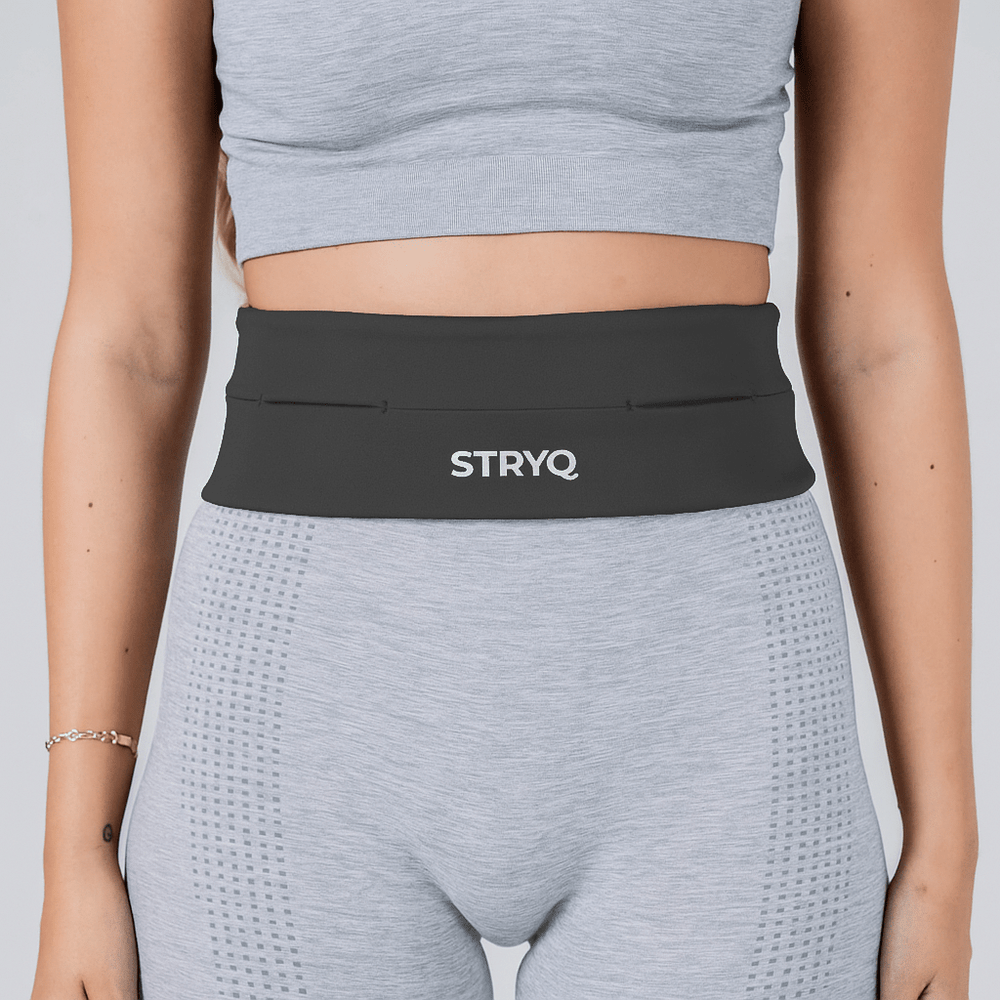
The STRYQ range is designed so you can choose by load rather than buying the biggest carrier first. The belt is the simplest option for compact essentials. Its pull-on construction and distributed storage suit everyday road sessions, events and travel when the load is mainly a phone, keys, cards and gels.
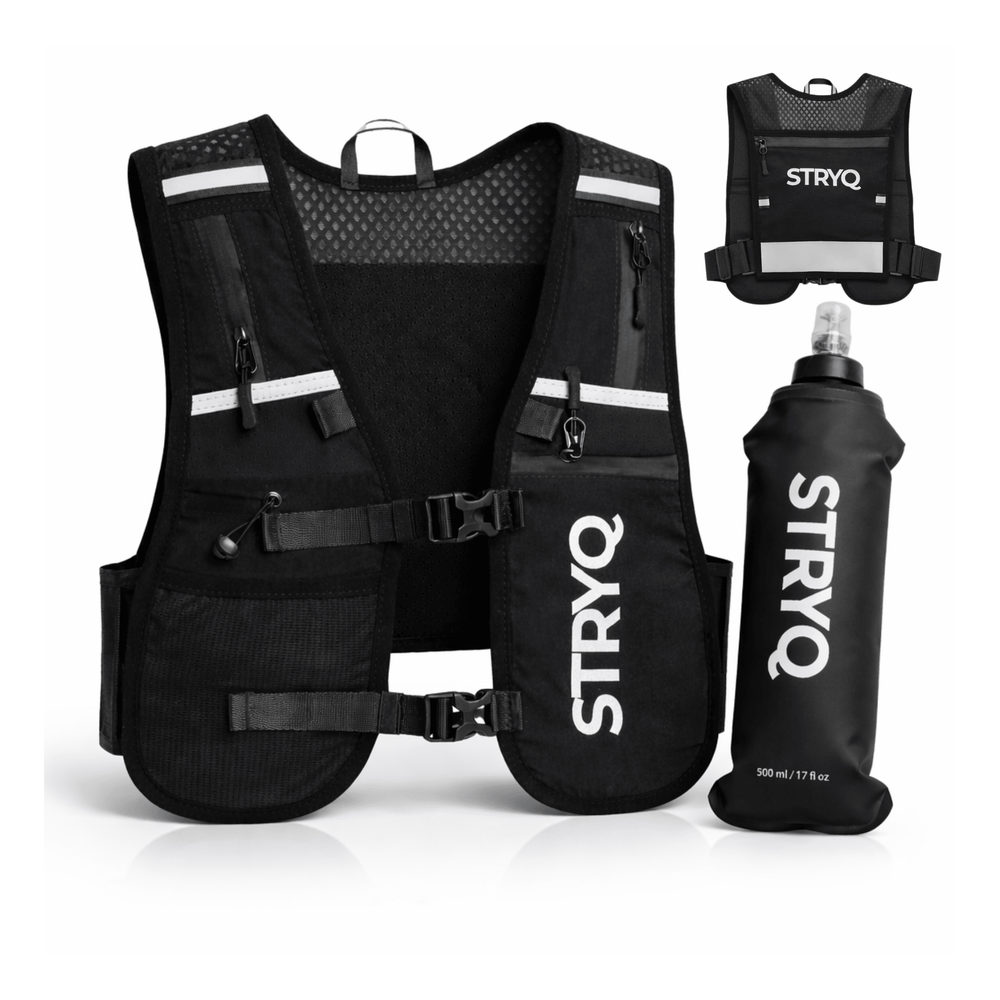
The hydration vest is for the point where fluid and additional storage become more important. It keeps bottles and nutrition accessible from the front and gives you more space at the back for longer training, trail routes or events where you need to be more self-sufficient.
A 500ml soft flask works with the vest and collapses as you drink, reducing empty bulk compared with a rigid bottle. It is also useful when you want to carry measured fluid without taking a larger reservoir. Rinse it promptly after sports drink or electrolytes and allow it to dry fully between uses.
The technical sock range solves a different problem entirely. Cushioning, ventilation, arch support and moisture management all affect what happens inside your shoes. Good technical pairs will not rescue badly fitting shoes, but the wrong choice can make good shoes feel much worse over distance.
Finally, the reflective vest and bands add visibility without becoming storage. That distinction matters: not every product needs to do every job. A well-built setup combines a few focused pieces rather than relying on one oversized item to carry, hydrate, protect and illuminate at the same time.
MORE RUNNING GUIDESUseful guides before your next run
Useful guides before your next run
Buying better kit only helps when you know how to use it. These STRYQ guides cover the common decisions that sit behind the products, from carrying fuel without bounce to choosing the right setup for the distance.
Running Gear FAQs
What should a complete running setup include?
What do I need as a beginner?
What works best for long runs and marathon training?
What is the difference between wearable kit and equipment?
Is STRYQ suitable for trail running?
What should I buy first?
Start with storage and foot comfort, then add hydration and visibility as your distance, route and conditions demand more.
SHOP THE COLLECTION