

Race day essentials: kit and routine for UK runners
Bring a short, rehearsed kit and run your practiced plan. That is the whole job on race day.
Emergency shortlist:
- Timing chip and race bib (pinned the night before)
- Tested shoes and Stryq running socks
- Nutrition and soft flask
TL;DR:
- Arrive well in advance before the start for large UK events; allow extra time for parking and toilet queues
- Pin your bib the night before; confirm your wave time and chip details in advance
- Switch to execution mode: you cannot get fitter today, only execute what training built
Table of Contents
- What to pack for race day: night before vs morning of
- Race-morning routine: switch from training to execution mode
- How do you choose the right race-day accessories?
- Stryq race-day essentials: which product fits your race?
- Hydration and fuelling on race day
- Warm-up, pacing, and micro-goals for race day
- Post-race recovery and caring for your kit
- Key takeaways
- The kit matters less than you think — until it doesn’t
- Stryq race-day kit: tested by UK runners
- Useful sources
What to pack for race day: night before vs morning of
Good packing prevents race-morning chaos. The goal is a staged bag you can drop without rummaging.
Night-before packing
| Item | Category | Note |
|---|---|---|
| Race bib (pinned to top) | Race documents | Confirm wave time and chip type |
| Timing chip (if separate) | Race documents | Attach to shoe lace |
| Running shoes | Clothing | Broken in, not new |
| Stryq running socks | Clothing | Tested on long runs |
| Shorts, tights, race top | Clothing | All pre-tested |
| GPS watch (charged) | Tech | Set to correct mode |
| Gels / chews | Nutrition | Pre-counted for distance |
| Soft flask (filled) | Hydration | Tested in training |
| Safety pins (spare set) | Admin | Four minimum |
| Anti-chafe balm | Comfort | Apply before dressing |
| Post-race bag | Recovery | Dry clothes, snack, flip-flops |
Race-morning additions
| Item | Note |
|---|---|
| Pre-race breakfast | Familiar meal, eaten 2–3 hours before start |
| Throwaway warm-up layers | Old hoodie or joggers donated at start line |
| Small tissue pack | Portaloos at UK races often run out |
| Phone (charged) | Navigation, meeting point, emergency contact |
Pro Tip: Lay everything out flat, take a photo on your phone, and zip the bag. The photo doubles as a last-minute check and settles pre-race nerves.
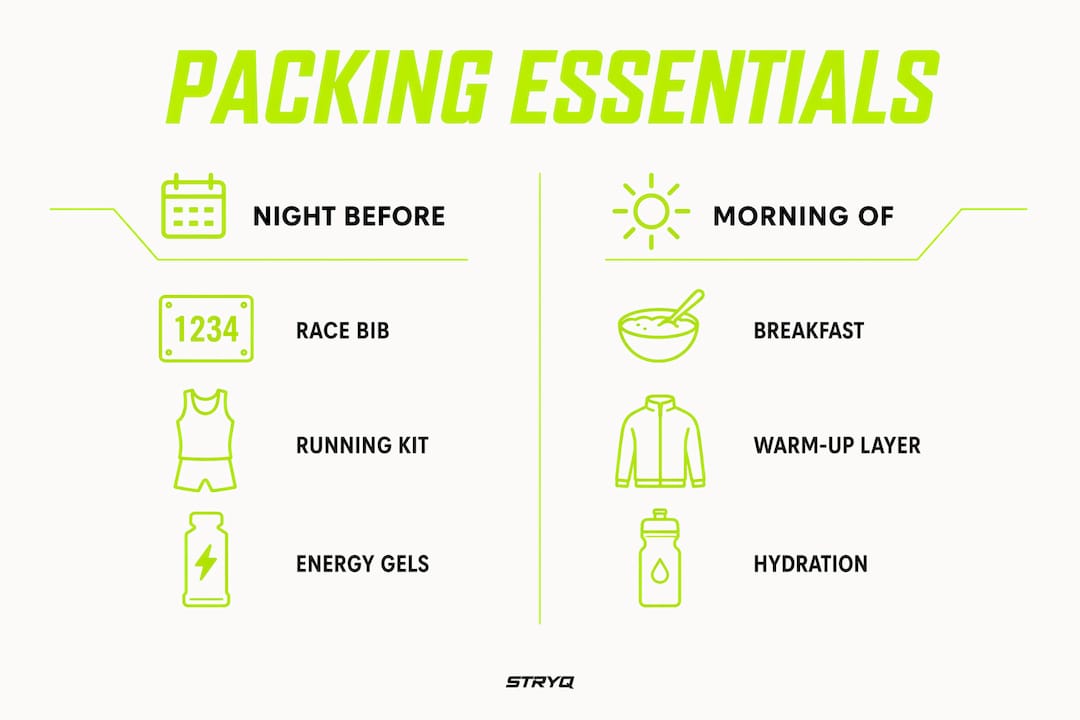
A pre-practised routine removes morning decisions and reduces the psychological weight of race morning. Pack duplicates of anything small and critical: spare safety pins, an extra gel, a second pair of Stryq socks in the post-race bag.
Race-morning routine: switch from training to execution mode
Race day is execution mode. Your fitness is already set. The morning is about removing decisions, not making new ones.
A workable timeline for a 9:00 AM UK start:
- 5:30 AM Wake up, use the bathroom
- 5:45 AM Eat a familiar breakfast (porridge, toast with banana, bagel)
- 6:30 AM Dress, apply anti-chafe balm, double-check bag against your photo
- 7:00 AM Leave for venue
- 7:30 AM Arrive (60–90 minutes before start), collect bib if needed, join toilet queue early
- 8:15 AM Warm-up (see Section 7)
- 8:45 AM Enter corral, remove throwaway layers
One note on sleep: the night two nights before the race matters more than the night before. Adrenaline and tapering compensate for a restless final night. Accept it and move on.
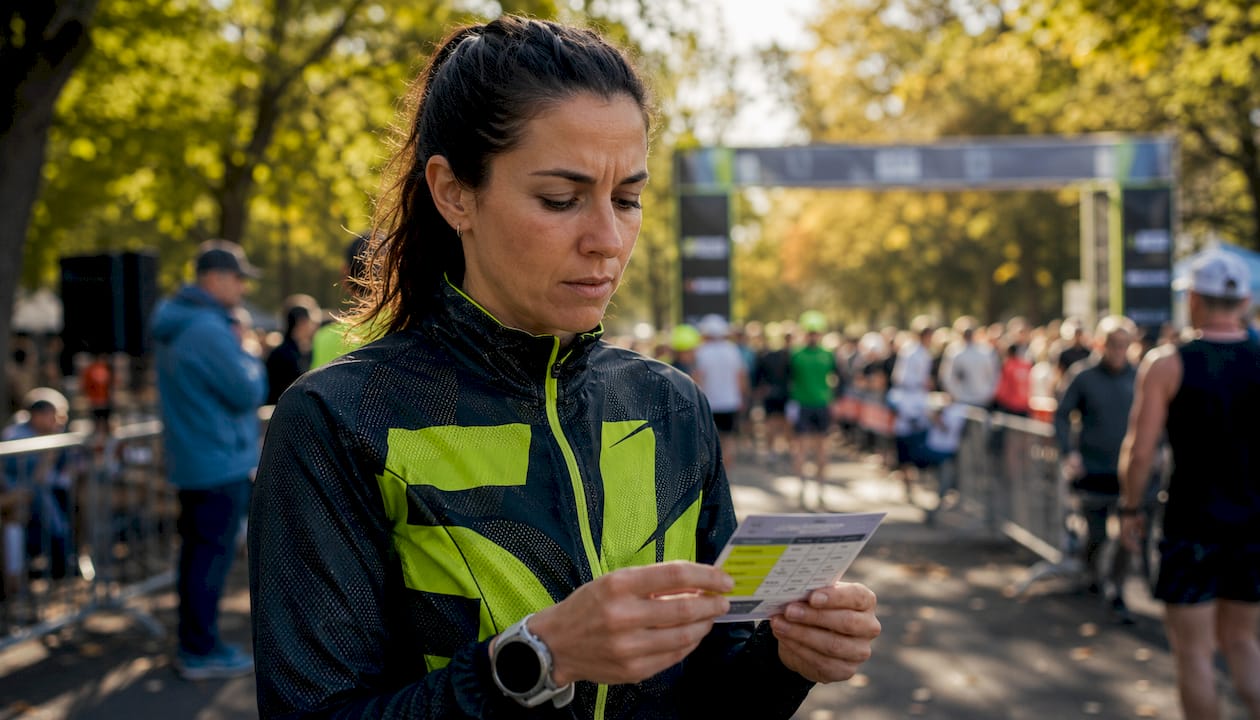
Pro Tip: Write your pacing plan and fuelling schedule on a small card or screenshot it. When crowd energy spikes at the start, having a physical reference pulls you back to your own plan.
How do you choose the right race-day accessories?
Choose by event distance first, then by how you carry fuel. A running belt suits 5K to 10K races where you need minimal storage. A hydration vest becomes the better call for half marathons, marathons, or hilly trail events where you carry multiple flasks and gels.
After distance, apply these five criteria in order:
- Fit and adjustability — nothing should shift during a race. Test at race pace in training.
- Weight — lighter is better; every gram compounds over distance.
- Storage capacity — count your gels and flask volume before buying.
- Anti-chafe features — flat seams, soft fabrics, and snug fit prevent mid-race problems.
- Washability — machine-washable kit lasts longer and stays hygienic.
Red flags when buying online: no size guide, vague capacity listed as “large” with no litre figure, missing wash instructions, and no returns policy. Quick QA prompts: Does the product page state exact dimensions? Is there a fit video or runner review? Can you return it if it chafes on the first run?
Pro Tip: If a belt or vest has no size guide, contact the seller before buying. A product that fits perfectly in a photo but shifts at 8-minute-mile pace is useless on race day.
Stryq race-day essentials: which product fits your race?
| Product | Best for | Fit & adjustability | Comfort / anti-chafe | Care | Price |
|---|---|---|---|---|---|
| Stryq Running Socks – Black | All distances | Arch support band, snug toe box | Cushioned sole, moisture-wicking | Machine wash cold | Check site |
| Stryq Running Socks – White | All distances | Arch support band, snug toe box | Cushioned sole, moisture-wicking | Machine wash cold | Check site |
| Stryq Running Belt | 5K–10K, half marathon | Adjustable waist band | Bounce-free, soft inner lining | Machine wash cold | Check site |
| Stryq Hydration Vest | Half marathon, marathon, trail | Adjustable chest and shoulder straps | Breathable mesh back panel | Hand wash recommended | Check site |
| Stryq Soft Flask 500ml | Any distance needing carried hydration | Fits vest front pocket | Collapsible, no slosh | Rinse after use, air dry | Check site |
Quick picks by distance
- 5K: Stryq socks (black or white), lightweight shorts, no belt needed unless carrying a phone
- 10K: Add a Stryq running belt for gels and phone; see the 10K gear checklist for a full list
- Half marathon: Stryq belt or vest depending on aid-station spacing; Stryq socks throughout
- Marathon: Stryq hydration vest, soft flask, Stryq socks; full marathon accessories guide available on the blog
Stryq Running Socks specs (both colourways):
- Arch support compression band
- Cushioned heel and forefoot
- Moisture-wicking, breathable fabric
- Reinforced toe and heel zones
- Available in UK sizes; machine washable
- UK availability: in stock at stryq.co.uk
Hydration and fuelling on race day
Start hydrated, sip frequently, and use only tested gels at practiced intervals. That rule covers 90% of race-day nutrition errors.
| Timing | Action |
|---|---|
| Night before | Carb-rich dinner (pasta, rice, potatoes); finish eating by 8 PM; hydrate steadily through the day |
| Morning (2–3 hrs before) | Familiar breakfast; 500ml water with meal; coffee only if it is your normal routine |
| 30 min before start | Small sip of water; no large volumes |
| During (under 60 min) | Water at aid stations; no gels needed |
| During (60–90 min) | One gel at 30 min; water at each station |
| During (over 90 min) | First gel at 20–30 minutes, then every 30–45 min; use a Stryq soft flask for between-station hydration |
| Immediately post-race | 500ml water or electrolyte drink; carb and protein snack within 30 minutes |
Three quick nutrition rules:
- Nothing new: every gel, bar, and drink must have been tested in training
- Start gels early in events over 60 minutes; waiting until you feel tired is too late
- Carry electrolyte tabs for warm UK race days; drop one into a water-station cup if cramping threatens
The final 24 hours should include finishing carb loading by early evening, not the morning of the race. Overeating the night before disrupts sleep and digestion.
Warm-up, pacing, and micro-goals for race day
A short, practiced warm-up primes the nervous system without depleting glycogen. Do 10–15 minutes easy jog plus 2–3 short openers (20-second pickups at race pace), not a full training session.
Warm-up script (start 20–25 minutes before your wave):
- 5 minutes easy walk from bag drop to warm-up area
- 8–10 minutes easy jog
- Dynamic drills: leg swings, high knees, hip circles (2 minutes)
- 2–3 strides at race pace, 20 seconds each, full recovery between
- Walk to corral, remove throwaway layers
Pacing dos and don’ts:
- Do start 10–15 seconds per mile slower than target pace for the first mile
- Do trust your training; the fitness is there
- Do use your GPS watch as the authority, not the crowd
- Don’t copy other runners’ early surges; crowd energy causes more DNFs than poor fitness
- Don’t check your overall pace obsessively; check at planned split points only
Micro-goals to use during the race:
- Break a 10K into two 5K blocks; treat the second as a separate race
- For a half marathon, aim to reach 10K feeling controlled, then build
- Use landmarks (a bridge, a turn, a mile marker) rather than time blocks when the course is unfamiliar
Pro Tip: Set a watch alert at your first gel time. When the crowd energy spikes at the start, it is easy to forget fuelling until it is too late.
Post-race recovery and caring for your kit
Finish line, then cool-down walk for 5–10 minutes. Sitting down immediately stiffens muscles faster. Drink 500ml of water or an electrolyte drink, eat a carb and protein snack within 30 minutes (banana and a protein bar works), and plan light movement the same evening.
Return to training gradually: easy walking the day after, a short easy run at 48–72 hours if legs allow, and no hard sessions for at least a week after a marathon.
Caring for Stryq kit
- Socks: machine wash cold, inside out, no fabric softener (softener degrades moisture-wicking fibres)
- Running belt: machine wash cold in a mesh laundry bag; air dry flat
- Hydration vest: hand wash with mild detergent; rinse thoroughly; hang to dry away from direct heat
- Soft flask: rinse immediately after use with warm water; air dry fully before storing; avoid hot tumble drying
Signs kit needs replacing:
- Socks: loss of arch compression, fabric pilling, persistent odour after washing
- Belt: zip failure, elastic stretch that no longer holds the belt in place
- Vest: frayed seams, broken buckles, bladder or flask pocket that no longer seals
- Soft flask: cracked valve, persistent taste after cleaning
Pro Tip: Wash your race kit within 24 hours of finishing. Sweat left in technical fabric breaks down fibres faster and sets odour permanently.
Key takeaways
A well-executed race day comes down to three things: rehearsed kit, a practiced routine, and a conservative start.
| Point | Details |
|---|---|
| Pack the night before | Lay out all kit, pin your bib, and photograph the bag to confirm nothing is missing. |
| Arrive 60–90 minutes early | Large UK events need extra buffer for parking, bag drop, and toilet queues. |
| Start gels early | For events over 60 minutes, take the first gel at 20–30 minutes in, not when you feel tired. |
| Nothing new on race day | Every item of kit, food, and drink must have been tested in training beforehand. |
| Stryq socks for every distance | Arch support and cushioning reduce blister risk across 5K to marathon distances. |
The kit matters less than you think — until it doesn’t
Most runners obsess over pace strategy and ignore kit until something goes wrong. A blister at mile 8, a gel that causes stomach cramps, a belt that bounces for 13 miles: these are not bad luck. They are the result of untested kit.
The “nothing new on race day” rule is not a cliché. It is the single most practical piece of advice in distance running, and it applies to socks as much as it does to gels. Stryq’s approach to product development reflects exactly this: multiple sample revisions, runner feedback built into each iteration, and strict quality control before anything reaches a customer. That process exists because the difference between a sock that works and one that causes a blister mid-race is not obvious in a product photo.
The runners who have the smoothest race days are not the ones with the most expensive kit. They are the ones who have tested everything, packed the night before, and committed to their plan before the gun goes off.
Stryq race-day kit: tested by UK runners
Stryq builds race-day kit around one principle: it has to work when it matters. The running socks in black and white are developed from real runner feedback, with arch support and cushioning tested across multiple sample revisions before launch. Both colourways are in stock and available for UK delivery.
The full range covers every distance: running belts for 5K and 10K, hydration vests for half marathon and beyond, soft flasks, gloves, and safety lights. Every product ships to UK addresses. Choose by fit and distance, test in training, and race with confidence.
Browse the full range at stryq.co.uk and pick the kit that matches your next race.
Useful sources
- Training Plan Blog: Race Day Tips — execution mindset, sleep advice, and hour-by-hour pre-race guidance
- RaceRaves: Tested & Trusted Race Day Tips — pacing discipline, crowd energy countermeasures, and the nothing-new rule
- Ahotu Magazine: Race Day Checklist — arrival timing, fuelling schedule, and logistics checklist
- RaceThere: Complete Race Day Preparation Guide — packet pickup, bib checks, and wave logistics
- CoreRise: What to Do in the Final 24 Hours Before a Race — hour-by-hour final-day checklist including carb loading and kit staging
- Stryq Blog — product-specific guides, gear checklists, and race-day advice for UK runners