A secure phone belt is one that holds your phone against your body without bouncing, sliding or rubbing, whatever the pace. Four things decide that: the belt sits on your hips rather than your waist, it fits your phone in its case, the pocket closes properly, and the weight is balanced. Get those right and you stop noticing the phone is there.
This guide covers what separates a secure belt from a pouch that flaps about, how to check fit before you buy, how to adjust the belt once you have it, and how to match the design to your distance. We make running belts, so we say where ours fits and where a different kind of carrier suits you better.
TL;DR
- Wear the belt snug on your hips, not at the natural waist. It should stop movement without limiting your breathing.
- Measure your phone with its case on. Rugged and battery cases are the most common reason a belt fails.
- Put the phone at the centre of your back or centre front. Side-loading creates a pendulum swing.
- Choose pocket layout by distance: a minimal band is fine for a 5K, but long runs need room and zips for gels and keys.
- Test with a short jog and a few jumps before you commit to a long run.
Table of Contents
- What makes a phone belt secure
- Does a belt actually beat an armband or a vest?
- Why you should carry a phone at all
- Check the fit before you buy
- How to wear and adjust it so it doesn’t bounce
- Choosing by distance
- Our view: what we look for in a phone belt
- The STRYQ running belt
- Common mistakes to avoid
- A quick pre-run checklist
- FAQ
- Sources
What makes a phone belt secure
People use “secure” to mean two different things, and a good belt has to deliver both.
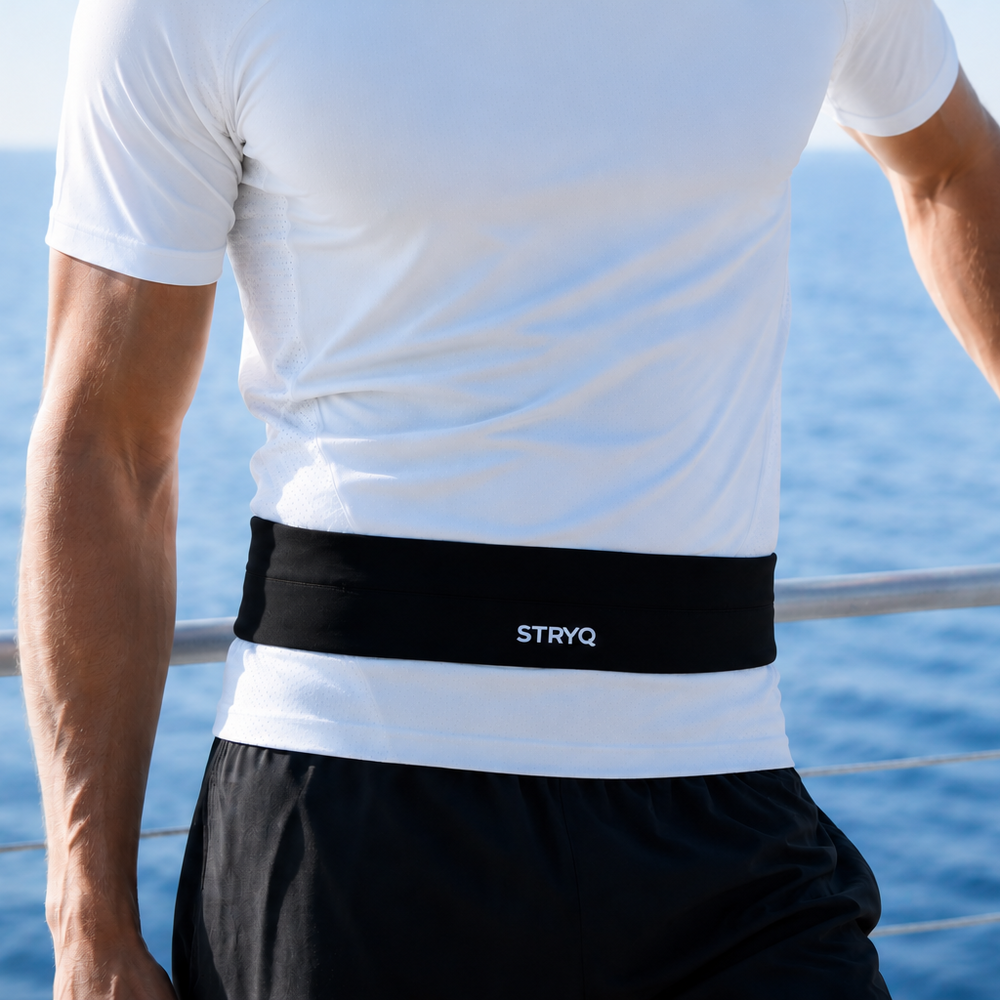
Secure against movement. The phone should not bounce, rotate round your body or ride up. Bounce is what makes a run irritating, and it is also what chafes. Running coach Brooke Torres makes the point in a running belt round-up for Women’s Health: the key is a design that sits snug around the hips, not the waist, and a tighter belt is not automatically a better one. It needs to be snug enough to remove movement without restricting breathing.
Secure against loss or damage. The phone should not fall out when you bend, trip or speed up, and it should survive sweat and rain. That comes down to the closure (zip, overlapping flap or an elastic opening with real tension), the fabric and how well the seams hold up after months of washing.
A third factor gets less attention: confidence. If you keep reaching down to check the phone is still there, the belt is not doing its job, however good it looks on paper.

Does a belt actually beat an armband or a vest?
Not always, and it is worth being straight about it. A 2020 study in Frontiers in Physiology compared handheld bottles, waist belts and backpacks carrying a 1.0 kg load over 60-minute runs. It found no significant differences in energy cost, oxygen cost, heart rate or perceived exertion between them. In practice, that means you should choose by fit stability and personal preference, not because one method is physiologically “faster”.
Here is how the main options compare on the things that matter day to day:
| Carrier | Best for | Main drawback |
|---|---|---|
| Hip-fit running belt | Phone plus keys and a card on runs of any length | Wrong size or position leads to bounce |
| Armband | Short runs when you only need the phone | Limited space and a poor fit with larger phones |
| Handheld holder | Quick access on short runs | Occupies a hand and changes your arm swing |
| Hydration vest | Long runs, trails, carrying water and layers | More kit than a 5K needs |
One more reason to think twice about carrying a phone in your hand: a 2021 study on running with objects in the hand points out that amateur runners often run holding keys, a phone or a bottle, yet there is little research on how that affects impact accelerations. A belt frees your hands and keeps your stride natural.
If you are torn between a belt and a vest, our own comparison, hydration vest vs belt, walks through the decision by distance.
Why you should carry a phone at all
For most runners the phone is for music, tracking and photos. It is also a safety tool. Local police guidance, such as these safety tips for runners and walkers from Kodiak, Alaska, tells runners to tell someone their route and return time, and to carry a mobile phone or know where telephones are along the course. Race organisers say similar things: the New York City Marathon’s runner health and safety page asks runners to keep emergency contact details up to date and save the race’s emergency number.
That is a practical argument for a belt you trust. A phone you can reach and are sure will not fall out is one you will actually carry on every run, including the early-morning and after-dark ones.
Check the fit before you buy
Most bad belt experiences are sizing mistakes, not product faults. Run through this list before you order anything.
1. Measure the phone in its case
Measure length, width and thickness with the case on. Rugged cases and battery cases add significant thickness and friction, and an elastic belt can become close to impossible to use with one. If you only run with the phone bare, say so when you compare sizes. If you use a thick case, look for a belt that has an adjustable or structured pocket, not a narrow stretch sleeve.
2. Measure your hips, not your waist
Wrap a tape measure round the part of your hips where the belt will sit, just above the hip bones for most people. Compare it with the belt’s stated range and aim for the middle, not the extreme end, so you have room to adjust for thicker winter layers.
3. Look at the closure
A zip is the most positive closure. A well-designed overlapping opening can work with a phone that is a snug fit. A loose, wide-mouthed pocket is the one to avoid, since a phone can work its way out once you bend or sprint.
4. Consider weather
Even moisture-wicking fabric can become saturated and start to slide. In wet or humid conditions, a common and inexpensive trick is to put the phone in a zip-lock bag before it goes into the belt. It protects the screen and ports from heavy sweat and sudden rain. It costs next to nothing and works with any belt.
5. Think about what else you carry
Phone only, or phone plus keys, card, a gel and a tissue? Be honest about it, because the answer decides the pocket layout. Experts quoted by Verywell Fit note that minimalist tube-style bands are good for bounce-free phone storage but can make it harder to get at gels or other fuel mid-run than a multi-pocket belt with zipped compartments.
How to wear and adjust it so it doesn’t bounce
A good belt worn badly still bounces. These adjustments take two minutes and make the biggest difference.
- Load it before you tighten it. Put the phone and anything else you will carry inside, then adjust. An empty belt feels different to a loaded one.
- Position it on your hips. Slide it below the natural waist. Torres’ advice is to sit it on the hips so it cannot ride up and down.
- Centre the weight. Asymmetry is a primary cause of bounce. Keep the phone at the centre of your back over the sacrum, or at the centre front against your abdomen. Side-loading sets up a pendulum swing with every stride.
- Tighten until it stops moving, not until it hurts. You should be able to take a full breath into your belly.
- Do the jump test. Jog on the spot, jump a few times and swing your hips. If anything shifts, adjust before you head out.
- Reassess after the first mile. Fabric settles and warms up. A small tweak at that point is normal.
Front or back? The back is usually the quieter place for a phone on faster runs. Front placement makes it easier to see and reach, which many beginners prefer for walk-run sessions. Try both on a short loop, since your body shape and the belt’s design affect which one wins.
For a longer walkthrough, see our guides on how to secure your running phone without bounce and finding a running belt that doesn’t bounce.
Choosing by distance
Parkrun, Couch to 5K and 5K runs
You need the phone, a key and maybe a card. A slim belt with one roomy, secure pocket is enough. Prioritise comfort and zero bounce, since you will probably wear it for 30 to 40 minutes and want to forget it is there.
10K and half marathon
At this point fuelling starts to matter. Look for a second small pocket or a flat compartment for a gel, plus an adjustable strap so you can fine tune the fit as you warm up. Our guide to running belts for phones covers what to look for at these distances.
Marathon and long training runs
Access becomes the main issue. You will be reaching for energy gels, tissues and maybe a soft flask several times, and a belt that makes you stop and fumble gets annoying fast. Long runs are easier when your form holds up late in the session, and a steady midsection helps keep a belt in place. If you are building towards a first marathon, a strength workout for runners is a sensible addition alongside your mileage. For belt-specific advice at the distance, read our running belt marathon review, and think about whether you need a vest instead once you want to carry water as well.
Our own advice, if you are unsure about carrying a phone on runs beyond 5K, is in Try a belt first.
Our view: what we look for in a phone belt
We started STRYQ because everyday runners kept running into the same problems: belts that bounced, pockets that did not fit a modern phone, and gear that fell apart after a season. Ordinary runners do not need a belt with a dozen features. They need one that works the same way on the fortieth run as on the first.
That is why our products go through multiple sample revisions, extensive testing and strict quality control, and are developed from real runner feedback. We would rather fix a strap angle, adjust a pocket or change a fabric than add a feature for the sake of the product page. Fit comes first, then durability, then everything else.
Our advice to anyone shopping for a phone belt, from us or anyone else: check the size against your phone with its case, test it in motion, and do not accept a belt that makes you think about it. If you are still choosing, our guide to choosing a running belt that stays put lays out the decision step by step.
— martin
The STRYQ running belt
Our STRYQ running belt is built for runners who want a belt that stays put. It has 360° storage, so you can place the phone where it is most stable for you and still have room for keys and small essentials. It is designed for comfort, a secure fit and breathability, and was developed and tested by UK runners.
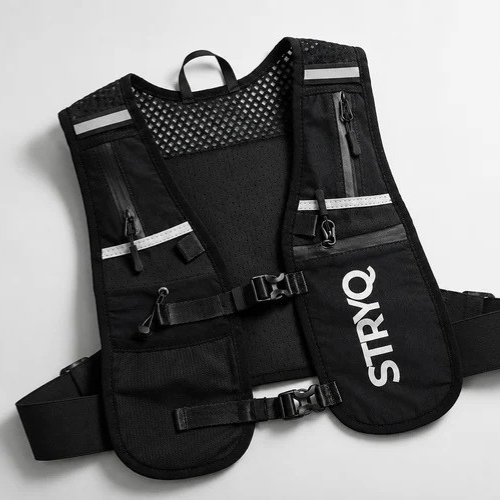
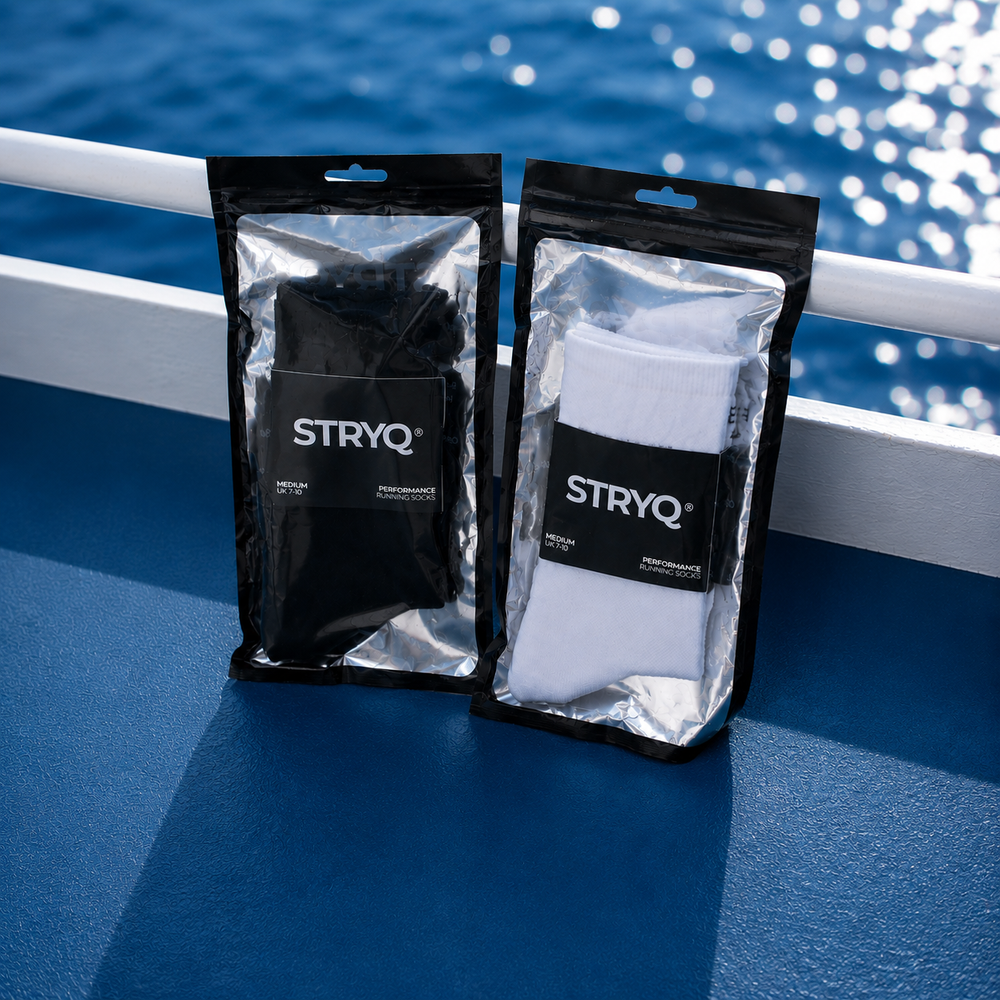
If you also want to carry water or be seen on dark mornings, the running gear collection includes our hydration running vest and a high-vis vest with reflective bands. The 500ml soft flask is a lightweight option for longer runs, and our running socks have arch support and cushioning. You can see current prices on each product page. You can read more about our design approach in our no-bounce guide or on the running belt page.

Common mistakes to avoid
- Buying for the phone’s size without the case. The most common error, and the one that leads to belts that are too tight or too loose.
- Wearing it at the waist. A belt at the narrowest part of your torso slides. The hips give it something to hold on to.
- Over-tightening. Cinching it down to stop bounce restricts breathing and still may not fix a poorly balanced load.
- Loading one side. Keys on one hip and the phone on the other will still swing. Keep the weight centred.
- Never testing it. A belt that feels fine in the hallway can behave differently at pace. Do a short loop before a long run.
- Ignoring rain and sweat. A cheap zip-lock bag protects a phone far better than hoping for the best.
For a wider look at the different ways runners carry a phone, including armbands and pockets, see how do runners carry their phone.
A quick pre-run checklist
Before a long run, give it ninety seconds:
- Phone in its case, in a zip-lock bag if the forecast is wet.
- Keys, card and fuel in the other compartments, weight spread evenly.
- Belt on your hips, tightened with everything loaded.
- Jump test and a few hip swings.
- Emergency contact details up to date on the phone and on your bib or ID, as race organisers recommend.
FAQ
What is the most secure way to carry a phone when running?
A belt worn snug on the hips, with the phone centred at the back or front, is among the most secure options. It keeps your hands free and avoids the slipping that armbands can suffer with large phones. Choose one that fits your phone in its case and test it with a short jog before relying on it.
How tight should a running belt be?
Tight enough that it does not move when you jog or jump, but loose enough that you can breathe fully. If you feel pressure on your stomach or ribs, or it leaves deep marks, it is too tight. Adjust it with the phone and other items already loaded.
Will a belt fit my phone if it has a thick case?
It depends on the pocket design. Rugged and battery cases add thickness and friction that can make a snug elastic sleeve very hard to use. Measure the phone with the case on and compare it with the pocket dimensions, or choose a belt with an adjustable, roomier compartment.
Do I need a belt for a 5K?
Not necessarily. If you only need to carry a phone for a short run, a slim belt is a comfortable option, but a pocket or armband can also work. A belt becomes more useful as distances grow and you need to carry keys, a card or fuel.
Sources
- The Optimal Weight Carriage System for Runners (Frontiers in Physiology, 2020)
- Acute Effects on Impact Accelerations Running with Objects in the Hand (MDPI)
- 18 Best Running Belts For Phone And More, From A Running Coach (Women’s Health)
- The 9 Best Phone Holders for Running, Tested (Verywell Fit)
- Safety Tips for Runners and Walkers (Kodiak, AK)
- Runner Health and Safety at the TCS New York City Marathon (NYRR)