Carry your EpiPen in a snug belt or hydration vest pocket that sits against your body, keep two injectors together, and make sure the people you run with know where they are. Hand-held carrying fails, a loose pocket bounces, and leaving it at home for a “quick” run is the choice allergy specialists specifically warn against. This guide covers where to put it, how to protect it from heat and sweat, how to check it before you leave, and what to do if a reaction starts mid-run.
We make running belts and vests, so we know the carrying problem well. We are not doctors. Your allergist decides your plan, your dose and your device. What follows is carrying logistics, built on official labelling and professional guidance.
TL;DR
- Take epinephrine on every run. The AAAAI says exercise and extreme heat can increase the likelihood or severity of an allergic reaction, so a short run is not an exception.
- Carry two auto-injectors together, and tell your running partners where they are and how to use them.
- Use a close-fitting belt or vest pocket, with each injector kept in its carrier tube. The tube is not waterproof, so add a sweat barrier.
- Keep it between 68 and 77°F (20 to 25°C) where you can, never refrigerate it, and check the liquid is clear before each long run.
- If you use it, call emergency services straight away, even if you feel better.
Table of Contents
- Why you should not leave it at home for a short run
- Carry two, and keep them together
- Where to carry it: belt, vest, pouch or hand
- Protect it from heat, sweat and impact
- Check it before you leave
- Tell your running partners
- If a reaction starts while you are running
- Flying to a race with an EpiPen
- Our perspective: carry less, but carry it right
- Choosing kit that suits an EpiPen
- FAQ
- Sources
Why you should not leave it at home for a short run
It is tempting to treat a 5K around the block as low risk. The guidance says otherwise. The AAAAI states that people with confirmed IgE-mediated food allergy are typically advised to always carry epinephrine. It also notes that exercise and heat can make reactions more likely or more severe.
The FDA label for EpiPen lists exercise among the causes of allergic emergencies, alongside foods, medicines, insect stings and unknown causes. For some people the trigger is the exercise itself, or a food eaten hours earlier combined with exercise. A peer-reviewed review of food-dependent exercise-induced anaphylaxis recommends carrying an auto-injector during exercise and avoiding extreme hot, humid or cold conditions where relevant.
Stings are the other reason runners carry one. Trail and park runs put you near wasps and bees, and a reaction can start far from help. If you have been prescribed an auto-injector for any reason, the carrying rule is the same.
Carry two, and keep them together
The manufacturer advises carrying two EpiPen or EpiPen Jr auto-injectors because one dose may not be enough before medical care arrives. The Allergy & Asthma Network cites an estimated 15 to 30% of anaphylaxis episodes needing more than one dose and recommends keeping the doses together.
For a runner, “together” is the practical constraint. Two injectors in two different pockets means one may be out of reach, or a helper grabs the wrong one. Choose a single pocket or a single carrier that holds both, so whoever reaches for it finds the full set.
The second dose is not a spare for a lost device. The FDA label says a second device may be needed if symptoms continue or recur, and that you must seek immediate medical care after using it.

Where to carry it: belt, vest, pouch or hand
The best place is the one you can reach quickly, even when you are dizzy, shaky or short of breath, and one that does not move. Here is how the common options compare.
| Option | Reach in an emergency | Bounce and comfort | Sweat and heat exposure | Best for |
|---|---|---|---|---|
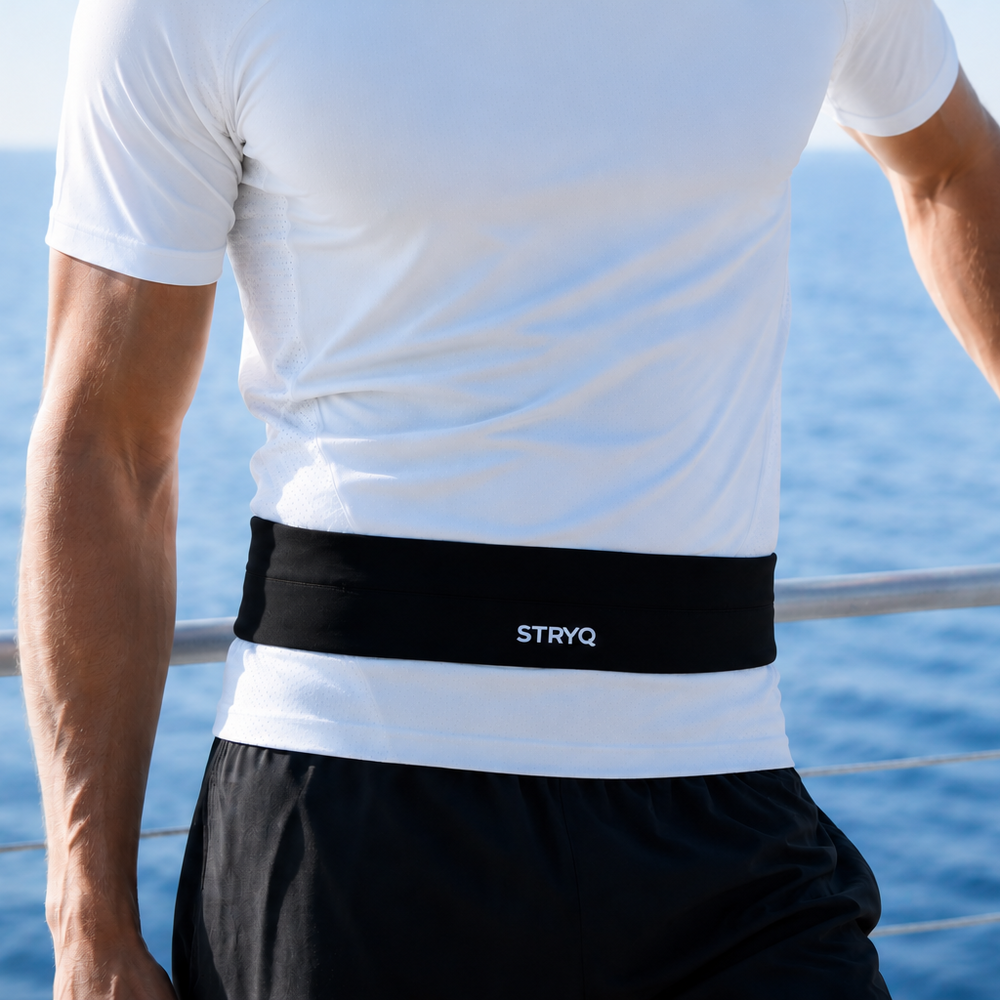
| Close-fitting running belt | Easy: pocket sits at the waist, a helper can find it | Low when snug and worn low on the hips | Moderate: sits against your skin | 5K to half marathon, road running |
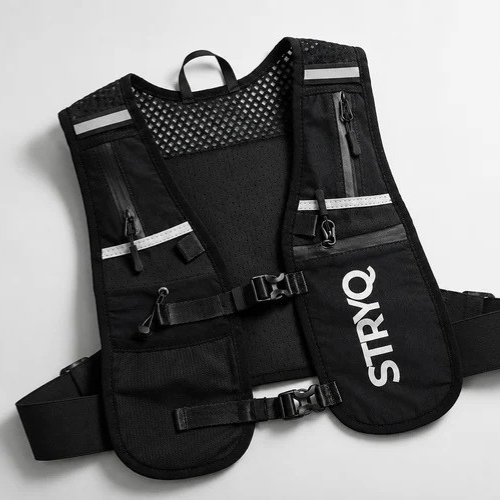
| Hydration vest | Easy: front pockets open without removing it | Low: weight spreads across the torso | Higher on your back, lower in front pockets | Long runs, trails, marathon training |
| Small clip-on pouch or case | Moderate: depends on where it clips | Can swing or rub on shorts | Depends on position | Short runs with pocketless kit |
| Shorts or jacket pocket | Variable | Often bounces | Exposed to sweat | Only if the pocket is deep and zipped |
| Held in your hand | Fast | Tiring, easy to drop | Warm from your palm | Not recommended |
An insulated carrier case is worth considering on top of any of these. The Allergy & Asthma Network says an insulated medical carrying case may help keep epinephrine safe and effective while travelling and that it should stay readily accessible. On a run, that means the case must slot into a pocket without making it bulge.
Running belts
A belt is the simplest answer for most road runners. A good one sits low around the waist, does not ride up, and keeps the load tight against you. Our running belt has 360° storage, so the weight is spread around the waist rather than hanging in one spot. Before relying on any belt, put your injectors in their carrier tube or case and test the fit at home: check the pocket closes fully, the tube does not press into your hip, and you can pull it out in a couple of seconds with one hand.
Our guide to carrying essentials on long runs without bounce covers how to load a belt so that the heaviest item is lowest and nearest the centre.
Hydration vests
On a long run, a vest keeps more in reach: injectors, phone, a flask, gels and ID. Put the injectors in a front pocket, not the rear compartment. A back pocket is fine for a spare jacket, but if you collapse, a helper will not look there first, and you cannot reach it quickly yourself. Our hydration running vest has adjustable straps and multiple pockets, so you can dedicate one pocket to medication and keep it the same every run. That consistency matters: a helper told “the left front pocket” will find it under stress.

Marking the pocket
One hiking community thread on this topic suggests external marking so that others know what you carry. We agree. A small label, a coloured tag on the zip, or a medical ID card in the same pocket makes it easy for a stranger to find. Our post on wearing ID while running explains what to include.
Protect it from heat, sweat and impact
An auto-injector is a precision device and a medicine. Running is hard on both.
Temperature
The FDA label says to store EpiPen at 68 to 77°F (20 to 25°C), with excursions allowed between 59 and 86°F (15 to 30°C). It also says not to refrigerate it. That has direct consequences:
- Do not pack it with an ice pack. Cold storage is not the answer to a hot day.
- Do not leave it in a parked car, before or after your run. A closed car in summer sun easily passes 86°F.
- Do not carry it on your bare back in strong sun. A front pocket in the shade of your body is better than the rear of a vest.
- Shorten the run, or move it indoors, on extreme days. The peer-reviewed review cited above recommends avoiding extreme hot, humid or cold conditions where relevant to the patient, and the AAAAI notes heat can worsen reactions.
Your body heat counts too. A belt against your skin on a warm day will run warmer than ambient air. After a hot session, take the device out of your kit, let it cool at room temperature, and check it.
Light and moisture
The label says to keep each auto-injector in its carrier tube to protect it from light, and warns that the tube is not waterproof. Sweat and rain are part of running, so add your own barrier: a small zip-seal bag inside the pocket works, or a dedicated case with a gasket. Keep the injectors in the tube inside that bag, not loose.
Impact
Small bumps will not matter much, but a falling runner lands on their hip or front. Avoid putting a hard case where you would land on it. A snug belt that sits slightly toward the back hip, or a vest front pocket, keeps it off the bony points.
Check it before you leave
Build a thirty-second check into your pre-run routine, the same way you check shoelaces.
- Look through the window. The label says the solution should be clear and colourless, with no particles. If it looks pinkish, brown, cloudy or has particles, replace it.
- Check the expiry date. Set a phone reminder for a month before it, and ask your pharmacist about replacement.
- Confirm there are two, and that both sit in the same pocket.
- Check the tube and case closures.
- Confirm someone knows. If you run alone, make sure someone at home knows your route and that you carry epinephrine.
If the liquid is discoloured or you suspect heat damage, do not just carry it anyway. Speak to your pharmacist or prescriber about a replacement. If you are having a reaction and it is the only device you have, follow the advice of the emergency dispatcher.
Tell your running partners
The device does little if nobody else knows it exists. UpToDate’s patient guidance says to keep epinephrine where others can easily find it during exercise, and to tell family and friends where it is stored and how to use it. For a runner this means:
- Tell your running group, parkrun friends or club leader where you carry it (for example, “front right pocket of my vest”).
- Show one person how to use it. EpiPen trainers exist for practice, and your pharmacist or allergist can demonstrate.
- Keep your medical details and emergency contact in the same pocket or on a wearable ID.
- Tell them to call emergency services immediately, and not to wait to see whether symptoms settle.
If you run alone, the self-use steps matter more, and the choice of location matters most. Practise drawing the trainer from your running kit while standing, so that the motion is familiar.
If a reaction starts while you are running
This is general information from official sources, not a replacement for your own emergency plan from your allergist.
- Stop running and tell someone nearby if you can.
- Use the auto-injector straight away if you have symptoms your plan treats as anaphylaxis. The AAAAI says epinephrine should be given without delay for severe symptoms, and that antihistamines do not replace it.
- Inject into the middle of the outer thigh. The FDA label says you can do this through clothing if necessary, and the AAAAI says most auto-injectors are designed to work through fabric, including jeans. Running tights and shorts are not a barrier, but thick bulky items in the pocket area of the thigh can be, so pull them aside if you can do it quickly.
- Call emergency services (911 in the US) even if you improve.
- Use the second injector if symptoms continue or return, as directed by your plan and the dispatcher.
Flying to a race with an EpiPen
Many runners travel for marathons and half marathons, so the carry-on question comes up. The TSA says you may bring medically necessary medications in your carry-on and that it helps to have them clearly labelled. Larger quantities of medically necessary liquids are allowed beyond the usual 3.4 ounce limit, but you should declare them to officers at the checkpoint. Keep your injectors in your carry-on, not checked luggage, which can be delayed and sits in an unheated hold. Keep the pharmacy label on the box, and carry the same temperature limits in mind when you reach a hot destination.
Pack your race-day belt or vest in the cabin bag too, loaded the night before, so the injectors are already in their pocket on the morning of the event.
Our perspective: carry less, but carry it right
We build our gear around one belief: the best carrying system is one you stop noticing. Runners who struggle with bounce tend to stop carrying things, and that is the worst outcome when the item is a medicine. Every product we make goes through multiple sample revisions and testing with real runners before launch, because a pocket that irritates you on kilometre six is a pocket you will leave at home.
For medication, we would put it this way. Pick one place, use it every time, and test it with the exact carrier you will use. Do not load a belt until it bulges; carry the injectors, a phone and ID, and leave the rest. If you need to carry water, gels and layers too, move to a vest and give the injectors their own front pocket. We also have guides for runners carrying other medical essentials, such as insulin on runs and inhalers with low bounce, which share the same principles of stable fit and heat awareness.
We are a small independent business, and we cannot tell you what your medical plan should be. What we can say is that gear should not be the reason you leave your epinephrine behind.
— martin
Choosing kit that suits an EpiPen
When you shop for a belt or vest to carry an auto-injector, judge it on these points:
- Pocket closure. It must stay shut when you run, and open with one hand.
- Pocket size. Test with your own carrier tube or case in the shop or at home, and check the return policy.
- Position. Low on the hips for a belt, front chest for a vest.
- Stability. Jump on the spot, then sprint ten metres. Nothing should shift.
- Fabric. Breathable, quick drying, and not so thin that a hard case digs in.
- Space for the rest. Phone, ID, keys and fuel, so you are not tempted to leave things out.
If you want a ready-made option, our running belt suits short and medium runs, and our hydration running vest suits longer ones. You can browse both on our running gear page. Compare the pocket against your own carrier before you commit to a run with it.
FAQ
Can I use an EpiPen through my running clothes?
Yes. The FDA label says to inject into the middle of the outer thigh, through clothing if necessary. The AAAAI adds that most auto-injectors are designed to work through fabric, including jeans. Move anything bulky out of the way if you can do so quickly, but do not delay the dose.
How do I keep my EpiPen cool on a hot run?
You do not chill it: the label says not to refrigerate it, and to store it at 68 to 77°F (20 to 25°C), with brief excursions between 59 and 86°F (15 to 30°C). Keep it in its carrier tube, away from direct sun, in a front pocket rather than on your bare back, and never leave it in a parked car. On extreme days, run earlier, shorter or indoors.
Do I really need two EpiPens for a short run?
The manufacturer advises carrying two, because one dose may not be enough before medical help arrives. The Allergy & Asthma Network recommends keeping the two together. Your allergist can confirm what suits your own plan.
Can I take an EpiPen in my carry-on to a race?
Yes. The TSA permits medically necessary medication in carry-on bags, and larger quantities of medically necessary liquids should be declared at the checkpoint. Keep the pharmacy label on the box and keep it out of checked luggage, where temperatures and delays are beyond your control.
Sources
- AAAAI: Epinephrine Myths vs Facts
- EpiPen official FAQ
- Allergy & Asthma Network: Epi storage tips at home and on the go
- FDA label for EpiPen and EpiPen Jr (2020)
- FDA label for EpiPen and EpiPen Jr (2023)
- Food-dependent exercise-induced anaphylaxis (PMC)
- UpToDate: Using an epinephrine autoinjector, beyond the basics
- TSA: Traveling with medication
- TSA: Medications (liquid)