Yes: carry readily readable identification when you run. The simplest reliable approach pairs a visible wearable ID with your phone, or your race bib on event day. This matters most on long runs, solo runs, and for anyone managing a medical condition. Organisations such as NYRR build race safety guidance around exactly this layered principle.
TL;DR:
- Wearing a visible, readable ID is crucial for quick medical response, especially for long, solo, or medical condition-affected runs on unfamiliar routes.
- A layered approach combining a wearable ID with a fully charged, accessible phone provides the best safety coverage during training and races.
- Keep ID information concise, with name, emergency contacts, and critical medical details, and update it regularly to ensure accuracy in emergencies.
- Test your ID setup before race day, ensuring it stays legible and secure during long runs, with placement in a natural, easily checked location like the wrist.
- Carrying ID is a personal safety measure; no laws require it, but practical benefits make it strongly recommended for all running situations.
Table of Contents
- Why carry identification when you run
- Types of IDs for runners: pros, cons and best uses
- What to put on an ID and how to keep it concise and useful
- How to wear and test your ID: fit, materials and rehearsal
- Race day versus ordinary training runs: what changes
- Publisher expertise: how STRYQ’s kit supports carrying ID and essentials
- Quick practical checklist: preparing for a long run or race
- Legal requirements for carrying ID while running in different regions
- Guidelines for updating ID information regularly to maintain accuracy
- Safety tips for protecting privacy when carrying personal ID
- Alternatives to physical ID for runners who prefer minimal gear
- What wearing an ID actually feels like on a long run
- How STRYQ kit solves the problem: recommended products
- Sources
- FAQ
Why carry identification when you run
Identification changes what happens in the minutes after something goes wrong. A disoriented or unconscious runner cannot explain a medical condition or recite a family member’s number. A wearable ID does that instead.
WomensRunning documented a case where a runner, disoriented after a fall, was helped by responders who used her wearable ID to contact family before ambulance transport. That single detail shortened the gap between collapse and coordinated care.
Race medical teams work under time pressure. The CHAMP/MCM medical triage guide sets out standardised triage algorithms for managing collapsed runners at endurance events, and rapid identification feeds directly into those decisions. A legible ID lets a medic skip guesswork and act.
Certain situations raise the stakes further:
- Running alone, especially on trails or before sunrise or after sunset.
- Long runs where fatigue, dehydration or heat build gradually and can escalate fast.
- Any diagnosed medical condition (asthma, diabetes, cardiac history, allergies) that affects emergency treatment.
- Unfamiliar routes where bystanders cannot describe where you live or who to call.
- Events with large crowds, where a runner separated from friends or family cannot easily be traced.
None of these require dramatic new habits. They simply argue for identification you already have on you every time you run, not just for races.
Types of IDs for runners: pros, cons and best uses
Runners have several practical options, and the right one depends on distance, terrain and medical history rather than personal preference alone.
- Wearable faceplate or engraved bracelet: high readability at a glance, no charging or unlocking required, and the format most first responders recognise instantly. It suits the majority of runners and works whether you train solo or race.
- Shoe tags and zipper pulls: low-bounce and easy to forget you’re wearing, which makes them useful for minimalists and trail runners who dislike wrist clutter. The trade-off is that they’re less visible to a bystander glancing at your wrist.
- Medical bracelets or necklaces: the right call for anyone with a serious condition such as epilepsy, severe allergies or a cardiac diagnosis, because they’re the format medics are trained to look for first. Visibility matters here more than with a general ID, so choose a style that sits in plain sight rather than tucked under a sleeve.
- Phone-based IDs and digital medical cards: convenient because most runners already carry a phone, but they depend on the phone being unlocked, charged, undamaged and still on your body. Guidance from NYRR treats a phone as a helpful supplement rather than a dependable substitute, precisely because it can be locked, drained or separated from the runner in a fall.
The practical answer for most runners is layering: a wearable ID as the baseline, with a phone as backup rather than the only plan. Guides on carrying a phone without bounce cover how to keep a phone accessible on the run, which supports this approach without replacing a visible ID.
What to put on an ID and how to keep it concise and useful
Engraved space is limited, so prioritise information a stranger or medic can act on immediately rather than a full medical history.
- Your full name, with a middle initial if space allows, so responders can confirm identity quickly.
- One or two emergency contact numbers, ideally a partner or parent first, then a secondary contact.
- Any medically critical condition or allergy that affects treatment, such as “Type 1 diabetic” or “penicillin allergy”.
- A life-critical medication, only if omitting it would put you at risk (for example, “carries EpiPen”).
Product and gear coverage recommends keeping engraved information short and prioritised rather than exhaustive, since a long medical history slows a responder down instead of helping. A workable format is: “Jane A. Smith. ICE: 07XXX XXXXXX (Mum). Type 1 diabetic.” That fits most standard plates and gives a responder everything they need in one glance.
How to wear and test your ID: fit, materials and rehearsal
Material and placement decide whether your ID survives sweat, weather and repeated wear.
Silicone or nylon bands paired with a stainless steel faceplate are the combination most consistently recommended for durability and legibility, since they resist sweat corrosion and stay readable after repeated washing. Gear reviews point to this pairing specifically for runners who train in most conditions.

Placement affects how quickly a bystander finds it. A wrist-worn ID is the most obvious choice for most runners, since it sits where a responder naturally checks first. Shoe tags and zipper pulls work as a secondary or minimalist option, particularly for trail runners who prefer nothing on the wrist.
Pro Tip: Test your ID on a long run before race day, not the morning of.
Before trusting any ID setup, run through this checklist:
- Read it at a normal running pace to confirm the engraving isn’t too small.
- Wear it alongside your GPS watch to check for rubbing or overlap.
- Splash or sweat-test it to confirm the engraving stays legible when wet.
- Charge your phone fully and check it survives a full long run without dying.
- Rehearse the exact combination (ID, phone, watch) on at least one long run before relying on it in a race.
Race day versus ordinary training runs: what changes
Race day adds layers that ordinary training runs don’t have, and each one should work alongside your ID rather than replace it.
Before the event, update your race registration’s emergency contact details and save the race communications centre number in your phone. NYRR’s runner safety guidance notes that this number can be faster than emergency services for locating and assisting a runner on course, because race staff already have your bib and location data.
Race medics rely heavily on bib numbers and registration information, but a visible wearable ID still matters if you’re separated from the crowd, disoriented, or unconscious before anyone checks your bib.
A short race-day checklist:
- Confirm your emergency contact details are current in race registration.
- Save the race communications centre number under a clear label in your phone.
- Wear your usual ID in addition to your bib, not instead of it.
- Keep your phone accessible rather than buried at the bottom of a bag.
Publisher expertise: how STRYQ’s kit supports carrying ID and essentials
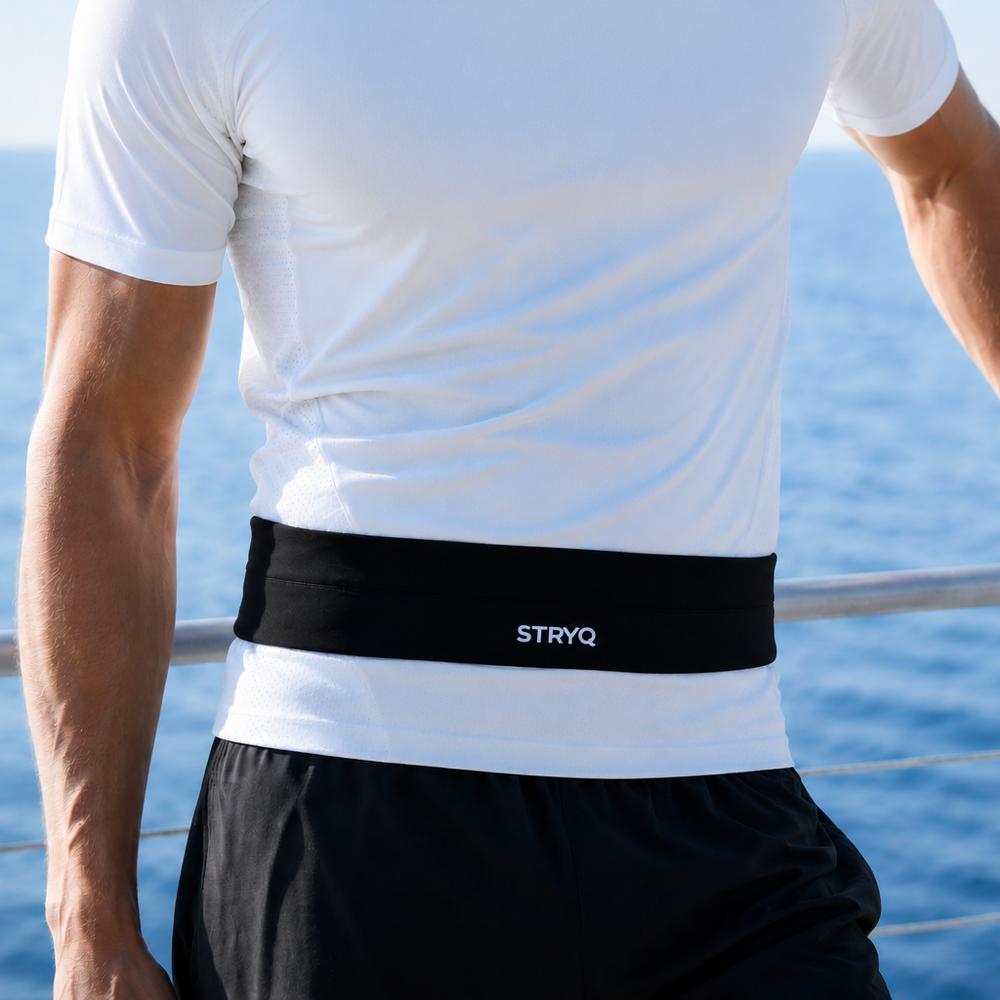
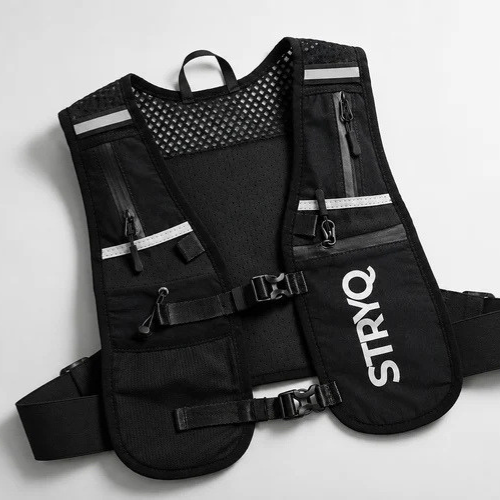
Carrying ID reliably comes down to storage that keeps it accessible and secure, not just owning one. A running belt or hydration vest with a dedicated, low-bounce compartment solves the practical problem of an ID sliding around, getting buried under keys, or being left at home because there was nowhere convenient to put it.
STRYQ builds its running belt and hydration running vest around that exact job: secure, organised storage for a phone, an engraved ID and small essentials, developed through testing and revisions with UK runners rather than a single prototype run.
- A belt with 360° storage keeps an ID and phone in a fixed, checkable spot rather than shifting mid-run.
- A hydration vest with multiple pockets separates ID and phone from bottles and gels, so nothing gets buried.
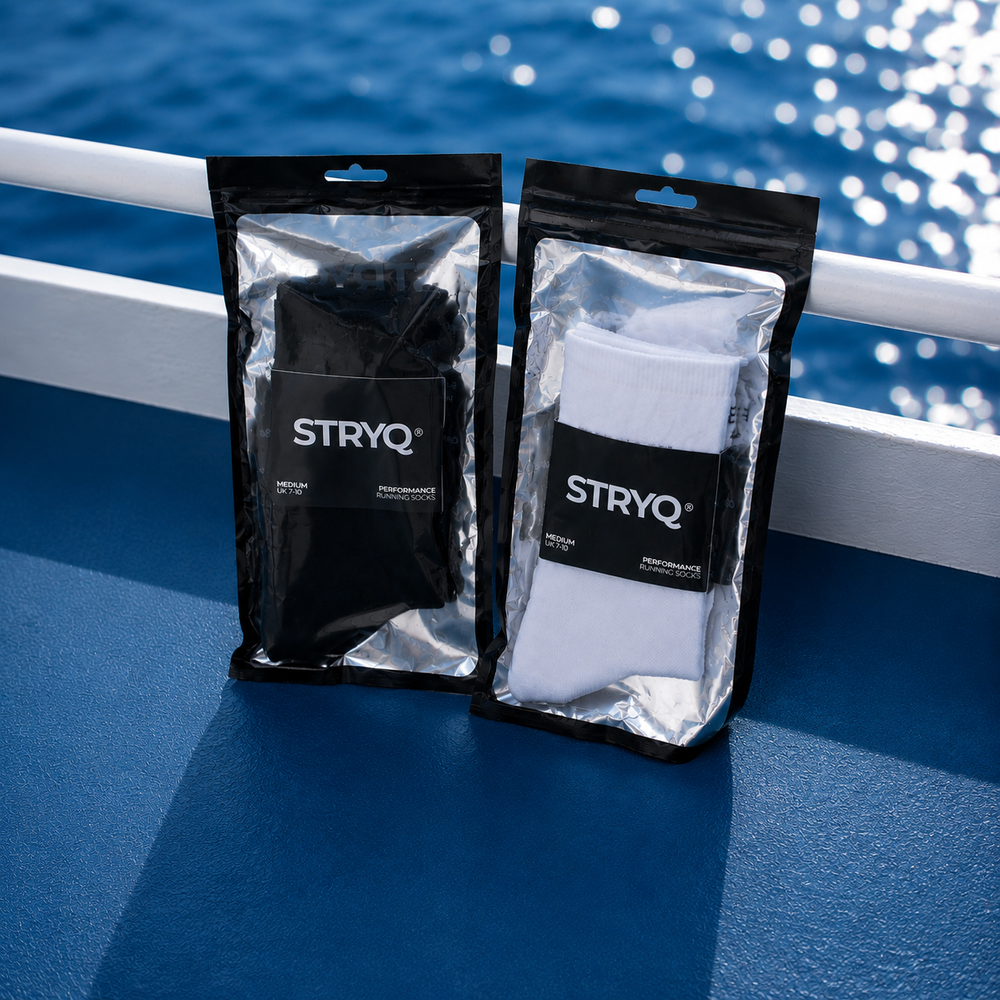
- STRYQ Running Socks add fit and comfort to the same kit you rehearse your ID setup in, since blisters change how you run and how accessible your gear stays.
Feedback from runners using this kit has shaped revisions to strap fit and pocket placement, which is the kind of practical detail that decides whether an ID stays put over a long run.
Quick practical checklist: preparing for a long run or race
Run through this before any long run or race:
- Wear a readable ID on your body, not packed away in a bag.
- Charge your phone fully and confirm emergency contacts are saved and accessible.
- Update bib or registration emergency information if it’s a race.
- Rehearse with the exact belt, vest or pouch you plan to use on the day, as the Gatorade Sports Science Institute race-day toolkit recommends for hydration and carrying kit generally.
- Tell someone your planned route and expected return time.
During warm-up, check your ID hasn’t twisted out of sight and your phone is unlocked-ready if you need it fast. Mid-run, a quick glance confirms nothing has shifted or come loose.
Legal requirements for carrying ID while running in different regions
There is no general law requiring runners to carry personal identification while training or racing. Running is not treated differently from walking or cycling in this respect, and no jurisdiction commonly cited in runner safety guidance mandates an ID for recreational exercise.
Race organisers set their own rules rather than governments doing so. Many events require a visible bib with registration details rather than a personal ID, and some ask participants to complete emergency contact fields during sign-up, as NYRR’s guidance describes. These are event policies, not legal statutes, and they vary by organiser.

The safest approach is to treat carrying ID as a personal safety decision rather than a legal one. Since no law compels it, the incentive is entirely practical: faster contact with family, faster triage, and less time lost if something goes wrong. Where local laws do require general identification to be carried (some countries have broader identity document rules unrelated to sport), those rules apply regardless of whether you’re running, and it’s worth checking your own country’s requirements separately from any running-specific guidance.
Guidelines for updating ID information regularly to maintain accuracy
An ID is only useful if the details on it are current. A phone number that changed two years ago, or a contact who’s moved abroad, can waste critical time in an emergency.
Review your ID information at fixed points rather than waiting for something to prompt it: at the start of a new training block, before any race you register for, and whenever a phone number, address or emergency contact changes. Race registration platforms typically let you edit emergency contact fields separately from your main profile, so update both when either changes.
For engraved IDs, factor updates into your buying decision. A reusable silicone band with a slide-on plate is easier to replace than a fully engraved metal tag if a phone number changes, since only the plate needs reordering rather than the whole item.
Treat your ID the same way you treat your race registration details: something to check every few months, not something set once and forgotten.
Safety tips for protecting privacy when carrying personal ID
Carrying ID means putting personal information within reach of anyone who looks. A few habits limit the risk without compromising usefulness in an emergency.
Avoid engraving your home address. It gives a stranger far more information than a responder needs, since emergency contacts and medical details are what actually speed up treatment. A name and phone number are enough for identification; your address adds risk without adding safety value.
Use a first name and surname rather than a full legal name if you prefer, provided it still matches how your emergency contact would recognise you. List a contact’s relationship (Mum, partner, spouse) rather than their full name if you want an extra layer of discretion, since responders only need to know who to call, not who that person is.
Digital medical ID apps that lock behind a passcode strike a reasonable balance, since they keep sensitive medical history private from casual viewers while still being accessible to responders trained to check a locked phone’s medical ID screen. Whichever format you choose, the goal is the same: enough information to help in an emergency, and no more than that.
Alternatives to physical ID for runners who prefer minimal gear
Some runners would rather skip a bracelet or engraved tag altogether. A few alternatives cover similar ground with different trade-offs.
Smartwatches with built-in emergency features let a responder access medical information directly from the watch face without unlocking a phone, which suits runners who already wear one for pace and heart rate. The limitation is battery life and the fact that not every model supports this feature by default, so it needs checking and setting up in advance.
Digital medical ID cards stored in a phone’s lock screen are the most common minimal-gear option, since most phones display basic medical information without needing a passcode. The trade-off, as with any phone-based method, is that it depends on the phone surviving the run undamaged, charged and on your body.
Shoe-based tags or laces with printed contact details offer a physical option that avoids wrist wear entirely, suiting runners who find bracelets uncomfortable. None of these fully replace a visible wearable ID, but they widen the choice for runners who want ID coverage without adding to what’s on their wrist.
What wearing an ID actually feels like on a long run
I started wearing a plain engraved band after reading about a runner who was helped purely because a responder could read her details. It took one long trail run alone, with no phone signal for stretches, to see the point clearly: it costs nothing to wear, and it removes one thing to worry about.
Copy this: put your ID on before your shoes, every single run, so it becomes automatic rather than optional.
— martin
How STRYQ kit solves the problem: recommended products
Wearing an ID only helps if it stays put and stays readable, and that depends on the kit around it. STRYQ’s running belt is built with 360° storage that keeps an engraved ID and phone secure and checkable rather than bouncing around mid-run. The hydration running vest offers the same principle across longer distances, with multiple pockets that separate ID and phone from bottles and gels so nothing gets buried when you need it fastest.
- The running belt suits shorter runs and races where minimal bulk matters most.
- The hydration vest suits long runs and marathons where water and fuel share space with ID and phone.
- STRYQ Running Socks add fit and comfort to the same setup, since discomfort changes how quickly you’d react in an emergency.
Browse the full running gear range to find the combination that fits your training and racing.

Sources
- Safety Tip: Don’t Hit The Road Without A Wearable ID — WomensRunning
- Managing the collapsed runner: Marine Corps Marathon medical triage and algorithms — CHAMP / MCM (2024)
- GSSI marathon race-day toolkit — Gatorade Sports Science Institute
FAQ
What is the 80% rule in running?
It’s a training-load principle rather than a safety rule, and it doesn’t change whether or how you should carry ID.
Is it illegal to not carry ID at all times?
No general law requires runners to carry personal identification during training or racing. Race organisers may set their own bib and registration requirements, but these are event policies rather than legal mandates.
What are the 5 things to avoid before a run?
Common advice points to avoiding a heavy meal, new or untested gear, excessive caffeine, skipping a warm-up, and heading out without telling anyone your route. None of these replace the separate step of carrying readable ID.
Is it okay to carry my phone during a marathon?
Yes, and most race guidance treats a phone as a useful supplement alongside a visible ID, not a replacement for one. NYRR’s guidance notes phones can be locked, damaged or separated from the runner, which is why a wearable ID still matters even when carrying a phone.