Measure your foot length in centimetres and match it to a sock-size bracket (S, M or L) rather than ordering by shoe size alone. As a rough rule, UK shoe sizes 3 to 5 sit in Small, 6 to 9 in Medium and 10 to 13 in Large, though brand charts vary. Compression socks use a separate measurement method based on calf circumference, not foot length.
TL;DR:
- Brand brackets vary: a UK size 13 may sit at the top of Large or the bottom of XL, so check the maker’s chart.
- Measure both feet while standing, preferably in the evening, and use the longer result because foot length can differ from side to side.
- If your measurement falls on a chart boundary, choose the larger bracket when wearing orthotics, thicker cushioning, or preferring extra toe room.
- Compression sizing combines widest calf circumference and shoe size; knee high styles also need leg length, while medical grade pairs must fit correctly.
- Try socks with your running shoes: thick cushioning can crowd the toe box, while a snug fit through the arch and heel helps prevent slipping.
Table of Contents
- What sock sizes mean and why brands use brackets, not exact shoe sizes
- How to measure your foot for running socks
- Conversion table: sock-size brackets against common shoe sizes
- Compression socks and specialty fits: what changes
- Common sizing mistakes and practical fit tips for runners
- How STRYQ tests fit and why our sock sizes are reliable
- Author perspective: what I recommend for everyday runners
- Try STRYQ running socks: fit notes and where to buy
- FAQ
- Sources
What sock sizes mean and why brands use brackets, not exact shoe sizes
Sock labels such as Small, Medium and Large are not fixed units. Each brand sets its own foot-length range for each bracket, which is why a size 13 can sit at the top of Large for one maker and the bottom of XL for another. A shoe size tells a retailer the length and width of a last. A sock bracket covers a wider span of feet because knit fabric stretches to accommodate different volumes within that range.
Construction details change how a bracket fits in practice:
- Fabric stretch and knit density determine how much a sock expands around the foot.
- Cushioning zones at the heel and forefoot add bulk that affects the snugness of the fit.
- Anatomical left and right shaping, common in performance socks, follows the natural contours of each foot rather than using a single symmetrical template.
- Gendered cuts narrow the heel and midfoot on women’s-specific lasts, which changes fit even at the same stated length.
Sock size is not identical to shoe size because a sock has to accommodate foot volume, not just length, and many opt for quality socks and apparel blanks to customize fit and comfort. Two runners with the same UK size 8 shoe can have noticeably different foot girths, and a bracket system is built to flex around that rather than pin down an exact measurement. Design features like arch compression bands and anatomical shaping also give a snugger hold without needing to size up, which is a point gear reviewers raise repeatedly when comparing brands. Because the labels vary this much from maker to maker, the safest approach is to treat S/M/L as a starting point and confirm against each brand’s own chart before you buy.
How to measure your foot for running socks
A tape measure and a flat wall give a more reliable result than guessing from memory or last year’s shoe size.
- Stand on a sheet of paper with your full weight on one foot, as you would mid-stride rather than seated.
- Mark the back of your heel and the tip of your longest toe on the paper.
- Measure the distance between the two marks in centimetres and in inches.
- Repeat on the other foot, since most people have one foot slightly longer than the other.
- Use the larger of the two measurements when you check a brand’s size chart.
- Note how your current running shoes fit at the toe box: if you have extra volume or wear orthotics, that points towards sizing up within the bracket.
Once you have a figure in centimetres, line it up against the specific brand’s chart rather than converting mentally from shoe size. If your measurement sits exactly on the boundary between two brackets, consider choosing the larger size when wearing thicker cushioning, orthotics or if you prefer a looser fit around the toes.
Pro Tip: Measure in the evening when feet have swollen slightly from a day on them, since that gives a closer match to how your feet behave on a long run.
Conversion table: sock-size brackets against common shoe sizes
Brand charts differ, but most follow a similar pattern once you map foot length in centimetres against generic size labels.
These bands are a generic guide, not a universal standard. The same foot length can fall into different brackets depending on the maker, and brand size charts frequently use inconsistent ranges, listing something like “men’s 5 to 13” on one chart and “3 to 15 unisex” on another for what is broadly the same sock. If your measured length sits right at a boundary, for example 24.5 centimetres between Small and Medium, check the exact brand chart before ordering rather than assuming the generic table above applies without adjustment. When in doubt, the bracket that gives a snug arch without crowding your toes is the right call, even if it means rounding up from the generic figure.
Compression socks and specialty fits: what changes
Compression socks are sized differently from standard running socks because the fit depends on pressure around the leg, not just foot length.
Athletic mild compression and medical-grade graduated compression are not the same product. Podiatrist guidance separates the two clearly, recommending targeted compression bands for arch support in everyday training while warning that medical-grade compression needs to be fitted correctly rather than chosen off a generic size chart.
Compression can genuinely help recovery: running experts report that compression socks may reduce delayed onset muscle soreness and improve venous return after races, though the benefit depends on the compression grade and how long the socks are worn afterwards.
Fitting a compression sock correctly usually involves more than one measurement:
- Calf circumference at its widest point, taken with a soft tape measure.
- Shoe size, used alongside calf measurement on most compression charts.
- Leg length from the floor to just below the knee, for knee-high styles.
A quick safety checklist helps avoid a bad fit: watch for pins-and-needles or numbness after putting compression socks on, check that the band sits flat without digging in, and speak to a medical professional before wearing medical-grade graduated compression for any diagnosed circulatory condition.
Common sizing mistakes and practical fit tips for runners
Buying by shoe size alone is the single most common mistake, since it ignores how sock thickness, foot volume and orthotics change the fit inside a shoe.
Thin dress-sock thinking does not transfer to running. A cushioned running sock takes up more room in the toe box than a thin liner sock, so the same shoe size can need a different sock bracket depending on how padded the sock is. Runners who use orthotics or have naturally high-volume feet often need to size up within a bracket to avoid pressure at the forefoot.
A few habits consistently improve fit:
- Try socks on with the actual running shoes you plan to wear them in, not barefoot in a shop mirror.
- Test fit later in the day, when feet have swollen slightly from standing and walking.
- Match sock cushioning level to how your shoes already fit, since a snug shoe paired with a thick sock can crowd the toes.
- Size up a bracket if you wear orthotics, prefer thicker cushioning, or know you have wider-than-average feet.
Getting this wrong is a common cause of blisters and hotspots, and simple fit adjustments go a long way towards fixing it, as covered in our guide to stopping sock blisters.
Pro Tip: If you are between two sizes on a brand chart, size up rather than down. A slightly loose sock is far easier to live with on a long run than one that pinches your toes at mile eight.
How STRYQ tests fit and why our sock sizes are reliable
We build our running socks around a development cycle that starts with runner feedback, not a factory template. Each design goes through multiple sample revisions before launch, with UK runners testing cushioning, arch support and heel fit across real training runs rather than a single lab session.
Through that process we record foot length, arch height and reported pressure points across a spread of runners, and that data feeds directly into the size charts we publish for STRYQ Running Socks. We treat sizing as something to keep checking rather than fix once, folding feedback from each testing round into the next sample before it ever reaches a production run. That approach sits behind our wider focus on practical features over marketing claims, something we cover in more depth in our complete guide to running sock fit and performance.

Author perspective: what I recommend for everyday runners
Measure both feet, pick the bracket that gives a snug hold through the arch without crowding your toes, and always test the socks inside the actual shoes you train in. That single habit solves more fit complaints than any amount of brand comparison.
Save compression socks for recovery days or long-race aftercare rather than everyday training, and only step up to taller cushioned styles if your current socks are leaving marks or slipping at the heel. Fit beats fabric hype every time.
— martin
Try STRYQ running socks: fit notes and where to buy
We built STRYQ Running Socks around arch support, moisture control and a snug heel hold, tested across repeated sample rounds with everyday UK runners rather than guessed from a generic template. 
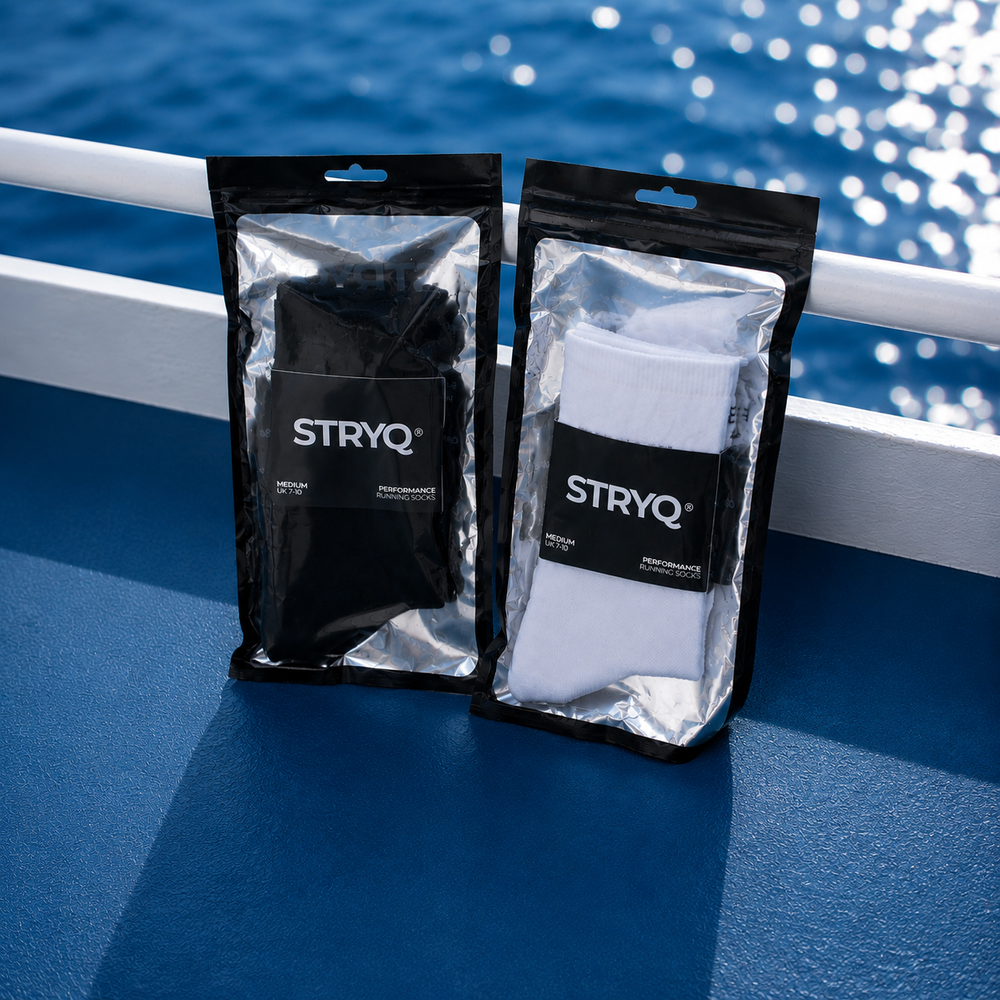
Measure your foot length before ordering and check it against our size chart rather than your shoe size alone. Pick up STRYQ Running Socks in Black or STRYQ Running Socks in White for £17 a pair, or browse the wider running gear collection, including the £32 STRYQ Running Belt, to kit out a full run.
FAQ
Should I size up for running socks?
Size up within the bracket if you wear orthotics, prefer thick cushioning, or your foot length sits right on the boundary between two sizes. A slightly looser fit at the toe is safer than a tight one that causes pressure on long runs.
What size socks should I get if I’m a size 10?
A UK shoe size 10 typically falls into the Large bracket on most brand charts, roughly 28 to 30 centimetres of foot length. Always check the specific brand’s chart, since ranges vary between makers.
Is your sock size the same as your shoe size?
No, sock size is sold in broader brackets like Small, Medium and Large that cover a range of shoe sizes and foot volumes, not a single exact size. Measuring foot length directly gives a more reliable match than converting from shoe size.
Should my running socks be tight?
Running socks should feel snug through the arch and heel without squeezing or crowding the toes. Podiatrist guidance notes that targeted compression bands can support the arch, but a sock that leaves marks or causes numbness is too tight.
Sources
- Podiatrist-recommended socks for foot health
- Are compression socks good for running? - RUN | Outside
- Best running socks of 2026 (runner-tested)