

Why marathon socks matter on long runs
Specialised marathon socks reduce blister risk, manage moisture and support recovery across 26.2 miles. That is not marketing copy. A 2025 Materials study found that specialised running socks deliver measurably superior shock absorption and significantly reduced peak plantar pressure at the great toe and first metatarsal head (p < 0.05). A marathon involves roughly 50,000 steps. Even a fraction of a millimetre of sock movement per stride accumulates into the kind of friction that ends races early.
Three reasons this matters for your next long run:
- Blister prevention. Moisture-wicking fibres and seamless construction reduce the friction and skin maceration that cause blisters, the most common reason runners slow down or stop.
- Moisture management. Technical socks pull sweat away from the skin, keeping the foot drier and reducing heat build-up inside the shoe.
- Recovery and performance. Graduated compression options reduce calf swelling and muscle oscillation during and after long efforts, helping you recover faster between training runs.
Stryq’s running socks are developed and tested in the UK specifically for long-run conditions. The rest of this guide explains the mechanics, the evidence and how to choose the right pair.
Table of Contents
- Why marathon socks matter more than most runners expect
- Which materials and construction details actually make a difference
- What sock styles and heights should you wear for long runs?
- How a running sock should fit, and the mistakes that cause blisters
- Sock care, lifespan and whether to change mid-race
- A practical buying checklist for marathon socks
- What the research actually shows about long-run socks
- Key takeaways
- The case for taking socks seriously
- Stryq running socks: a tested option for UK runners
- Useful sources for further reading
Why marathon socks matter more than most runners expect
Every step you take in a marathon creates a small amount of movement between your foot, your sock and your shoe. At 50,000 steps, even tiny amounts of friction or moisture accumulate into genuine damage. Skin softened by sweat tears more easily. That is maceration, and it is the direct precursor to blisters.
A marathon involves a very high number of foot strikes. Across that distance, even minor friction or moisture becomes a serious blister risk.
The shoe microclimate matters too, but perhaps not in the way you expect. Research published in the Journal of The Textile Institute found that sock fibre type does not dramatically alter absolute temperature or humidity inside the shoe. What socks do change, significantly, is the perception of wetness and stickiness. That perceptual shift drives discomfort on long runs. When your feet feel wet and sticky, you alter your gait, tense up, and start noticing every hotspot.
Muscle oscillation is a separate mechanism. During long runs, calf muscles vibrate with each foot strike. That internal vibration contributes to fatigue and delayed soreness. Compression knit and supportive sock construction reduce that oscillation, which is one reason many distance runners reach for taller socks for hard training blocks and race day.
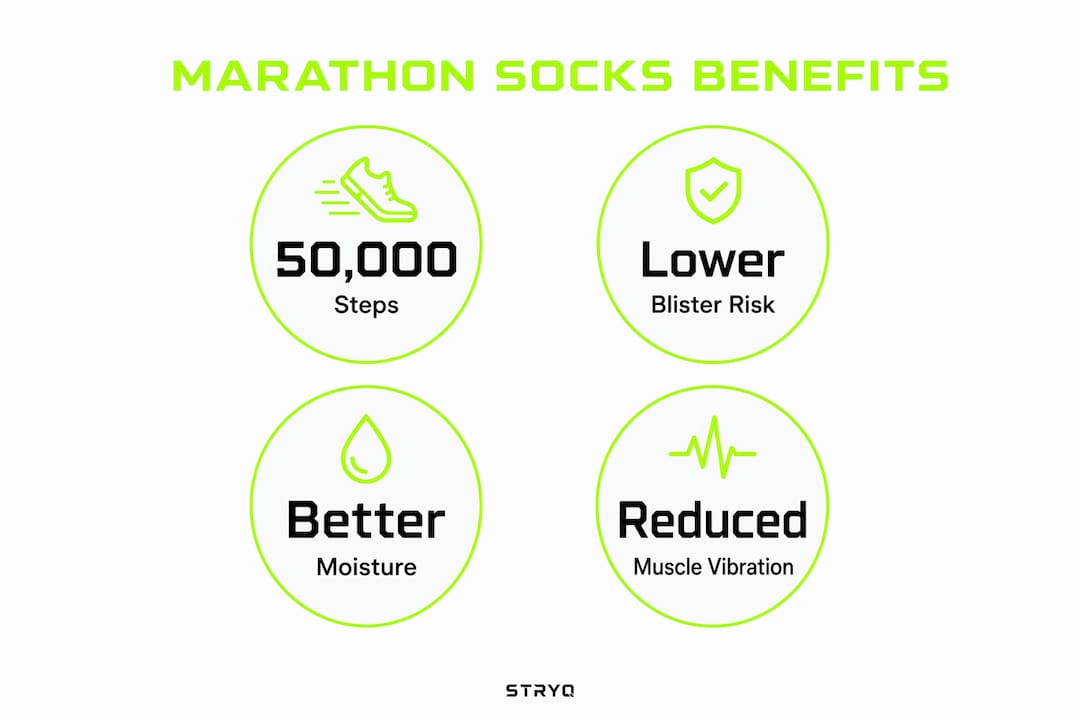
Cotton socks fail on all three counts. They absorb sweat and hold it against the skin, increasing friction rather than reducing it. Runners who switch from cotton to technical running socks consistently report fewer blisters, less foot pain and better comfort on longer runs.
Which materials and construction details actually make a difference
Fibre choices
Merino wool regulates temperature naturally, manages moisture well and stays comfortable across a wide range of conditions. It is a strong choice for cooler races or runners who run hot and cold on the same long run. Polyester and Coolmax® dry quickly, offer excellent durability and allow precise knit structures. Most high-performance socks blend polyester or nylon with elastane or LYCRA® to maintain shape and prevent the sock from migrating during a run. Tencel® (lyocell) appears in some blends for its softness and moisture absorption, though it is less common in pure performance socks.
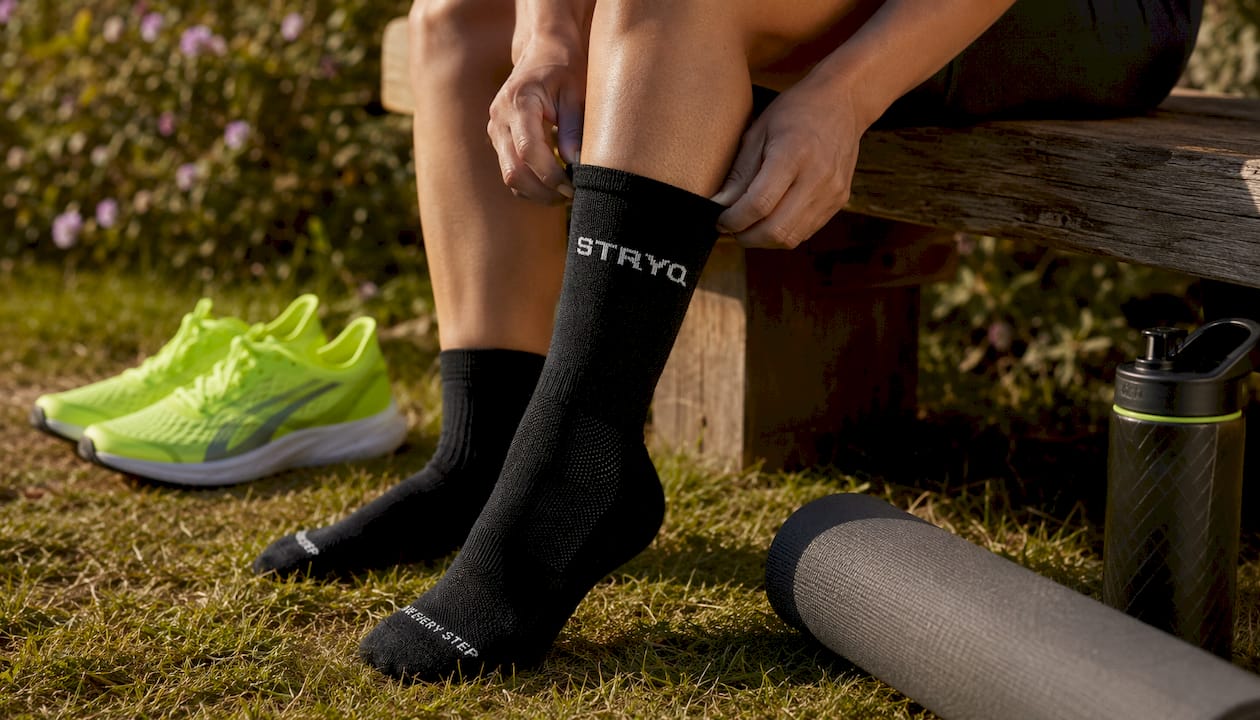
No single fibre does everything. The best marathon socks combine two or three to take advantage of each.
Construction features that reduce injury risk
Seamless toe closures remove the ridge that rubs against the top of the toes over long distances. Graduated arch knit supports the midfoot and reduces internal sock movement. Targeted cushioning zones at the heel and forefoot absorb impact where it is highest, without adding bulk across the whole foot. Double-layer systems shift friction between the two fabric layers rather than between fabric and skin, which measurably reduces blister incidence. Five-toe designs separate each toe individually, altering proprioception and potentially reducing some forefoot loads.
The Materials 2025 study links these construction choices directly to measurable outcomes: reduced forefoot ground contact time and lower average peak pressure in the toe and forefoot regions compared with regular socks.
Pro Tip: Cushioning adds bulk. If you add a thicker sock to a shoe that already fits well, you may create a tighter fit that causes blisters rather than preventing them. Test any new cushioning level on a long training run before committing to it on race day.
Material quick guide
| Condition | Recommended fibre | Why |
|---|---|---|
| Hot or humid | Polyester/nylon blend | Dries fast, resists heat build-up |
| Cool or cold | Merino wool blend | Temperature regulation, stays warm when damp |
| Blister-prone feet | Double-layer or seamless construction | Friction shifts between layers, not skin |
| High mileage training | Elastane/LYCRA® blend | Shape retention, prevents sock migration |
What sock styles and heights should you wear for long runs?
No-show and ankle socks
No-show socks sit below the ankle and are popular for road marathons in warm conditions. They are lightweight and minimise heat retention. The trade-off is limited protection against debris on trail sections and no coverage for runners prone to Achilles rubbing from the shoe collar.
Ankle socks add a small cuff above the shoe line. They suit most road marathon conditions and are the most common choice among club runners in the UK.
Crew and tall socks
Crew-length socks reach mid-calf and offer meaningful protection against trail debris, sock slippage and calf chafing from gaiters or race bibs. For ultra distances, the extra coverage is often worth the slight increase in warmth.
Graduated compression socks
Knee-high graduated compression socks are used by distance runners to reduce calf swelling and muscle oscillation. Industry guidance and lab work indicate that compression helps limit swelling and may speed recovery during intense training blocks. The in-race performance benefit is less certain, but many runners find the recovery advantage alone justifies wearing them on long training runs. For more detail on the evidence, Stryq’s guide on why runners wear compression socks covers the research clearly.
Decision table
| Race or training condition | Runner profile | Recommended style |
|---|---|---|
| Road marathon, warm weather | Most runners | Ankle or no-show, lightweight |
| Road marathon, cool weather | Most runners | Ankle or crew, merino blend |
| Trail or ultra distance | All runners | Crew or tall, debris protection |
| Hard training block, recovery focus | High-mileage runners | Graduated compression, knee-high |
| Calf swelling or fatigue history | Distance runners | Graduated compression |
Pro Tip: Calf swelling during long runs is real. A compression sock that fits perfectly at the start of a 30 km run may feel tight at kilometre 25. Trial your cuff height and compression level on a long training run, not on race morning.
How a running sock should fit, and the mistakes that cause blisters
Fit is where most runners go wrong. A sock that is too loose bunches under the arch and creates friction hotspots. One that is too tight restricts circulation and causes numbness or black toenails. Neither is obvious at the start of a run. Both become very obvious by kilometre 20.
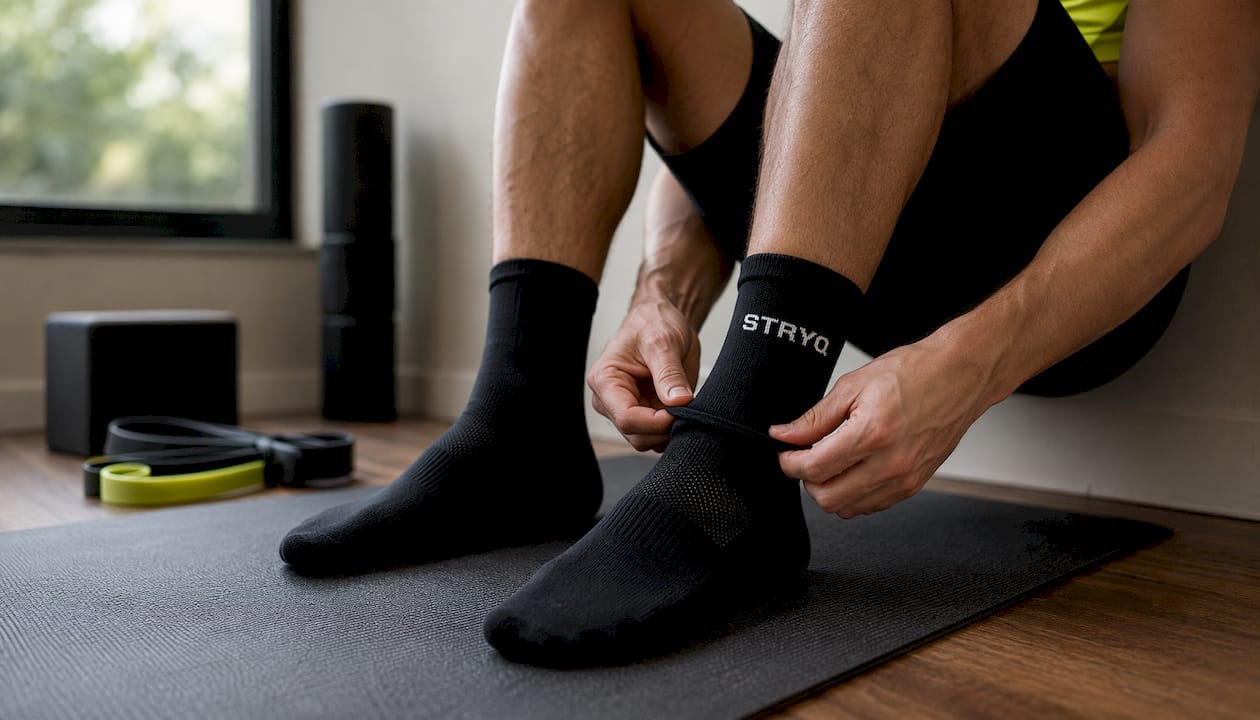
Socks change the effective volume inside your shoe. A thicker cushioning profile can convert a correctly fitting shoe into a restrictive one. This is why testing socks with your race shoes on long training runs is not optional guidance — it is the only way to know whether the combination works for your foot.
Fit checklist
- Heel cup alignment. The sock’s heel pocket should sit exactly over your heel, not riding up the ankle or pulling down.
- Toe-box space. No excess fabric bunching at the toes. The sock should lie flat against the skin.
- Arch tension. The midfoot knit should feel supportive without constricting. You should not feel the sock digging in.
- Anatomical left/right. If the sock offers left and right specific cuts, use them. The asymmetric shaping reduces internal movement.
- No slippage. Walk around for two minutes after putting the sock on. If the heel cup has already shifted, the sock will not stay in place at kilometre 30.
Common mistakes
Buying by sock size alone ignores foot width and arch height. Failing to test socks on runs of 20 km or more means you have no idea how they perform under fatigue. Wearing a thicker sock without checking shoe fit is probably the single most common cause of unexpected blisters on race day. Marathon preparation guides consistently stress that socks should be tested in training, not introduced on race morning.
Sock care, lifespan and whether to change mid-race
Washing and drying
Machine wash at 30–40°C, inside out, with a non-biological detergent. Avoid fabric softener — it coats the fibres and reduces wicking performance over time. Air-dry rather than tumble-dry. Heat degrades elastane and compresses cushioning faster than any amount of running.
When to replace
Elasticity loss is the clearest signal. If the sock no longer holds its shape around the arch and heel after washing, the supportive knit has broken down. Compressed cushioning that no longer springs back, persistent hotspots in the same location on every run, and visible thinning at the heel or ball of the foot are all replacement indicators. There is no universal mileage figure that applies to every sock construction, but checking for these signs every few months of regular training is a reliable approach.
Mid-race sock changes
This is more relevant to ultra distances than standard marathons. Community experience from ultra runners shows that many avoid mid-race changes because feet swell significantly during long events, making re-fitting shoes after a sock change genuinely difficult. For a standard marathon, most runners do not change socks mid-race. If you plan to, test the process in training: put on a fresh pair after a 25 km run and re-lace your shoes. If that feels comfortable, it is a viable strategy. If not, focus on choosing a sock that performs for the full distance without a change.
Practical note. If you carry a spare pair, pack them in a small zip-lock bag to keep them dry. Wet spare socks defeat the purpose entirely.
A practical buying checklist for marathon socks
Before you buy, work through these points:
- Fit with your shoe. Test the sock-and-shoe combination on a run of at least 15 km before committing to it for race day.
- Fibre mix and breathability. Polyester/nylon blends for warm conditions; merino blends for cool or variable weather.
- Cushioning profile. Light cushioning for racing; moderate for training. Confirm the thicker sock does not tighten your shoe fit.
- Seam construction. Seamless or flat-toe closure to eliminate friction at the toes over long distances.
- Left/right anatomy. Anatomically shaped socks reduce internal movement and fit more precisely.
- Compression specification. If choosing graduated compression, check the mmHg rating. Mild compression (around 15–20 mmHg) suits most long-run and recovery use.
- Durability indicators. Reinforced heel and toe sections, quality elastane content and a brand with a clear testing process.
On price: entry-level technical running socks in the UK typically start around £5–£8 per pair. Mid-range performance socks with targeted cushioning and seamless construction sit around £10–£15. Premium options with merino blends or graduated compression reach £20–£30. Stryq’s running socks sit in the mid-range, offering the construction features that matter for long runs without the premium brand markup.
Pro Tip: Test any new sock over at least three long runs at increasing distance — 15 km, 20 km, then 25–30 km — before trusting it for race day. One comfortable short run tells you almost nothing about how a sock performs under fatigue.
For a deeper breakdown of what to look for, Stryq’s running socks buyer’s guide covers the full range of options and real-world feedback.
What the research actually shows about long-run socks
The evidence base for specialised running socks is stronger than most runners realise, though it is not without nuance.
The 2025 Materials study is the most directly relevant piece of lab work for marathon runners. It found that specialised running socks provide superior shock absorption and significantly reduced peak plantar pressure at the great toe and first metatarsal head, with statistical significance at p < 0.05. The MDPI Materials paper adds that specialised socks reduce forefoot ground contact time and lower average peak pressure in the forefoot and toe regions compared with regular socks. These are the areas that take the most cumulative load over marathon distances.
The Journal of The Textile Institute research provides an important qualification: the primary benefit of technical sock fibres is perceptual rather than absolute. Socks do not dramatically change the temperature or humidity inside the shoe, but they significantly reduce the sensation of wetness and stickiness. Over a four-hour run, that perceptual difference is substantial.
Where evidence is mixed: direct race-time performance gains from sock choice alone are not well established. Socks improve comfort and reduce injury risk, but they are not a substitute for training. The recovery benefit of compression is supported by industry and lab commentary, though the in-race performance effect remains less certain.
| Evidence area | Strength of evidence | Practical implication |
|---|---|---|
| Peak plantar pressure reduction | Strong (p < 0.05, Materials 2025) | Choose targeted cushioning at heel and forefoot |
| Shock absorption improvement | Strong (Materials 2025, MDPI) | Prioritise structured knit over flat construction |
| Perceived wetness reduction | Strong (Journal of Textile Institute) | Technical fibres over cotton for all long runs |
| Blister prevention via double-layer | Moderate (PMC review) | Consider double-layer for blister-prone feet |
| Compression for recovery | Moderate (industry + lab) | Use graduated compression for hard training blocks |
| Direct race-time performance gain | Weak / mixed | Focus on comfort and injury prevention, not speed claims |
For runners interested in broader injury-prevention strategies alongside kit choices, the Run Complete guide to supplements for running injury prevention is a useful companion resource.
Key takeaways
Specialised marathon socks reduce peak plantar pressure, manage perceived moisture and lower blister risk across the many steps of a marathon — fit and fibre choice are the two variables that matter most.
| Point | Details |
|---|---|
| Step count drives risk | A marathon involves roughly 50,000 steps; even minor friction accumulates into blisters without the right sock. |
| Lab evidence is clear | Materials 2025 found peak pressure reductions at p < 0.05 — measurable protection at the most loaded areas. |
| Train in your race socks | Test any new sock over 15–30 km training runs before race day; never introduce new kit on race morning. |
| Prioritise fit and moisture management | Seamless construction, technical fibres and correct sizing matter more than brand name or price alone. |
| Stryq for UK runners | Stryq running socks are developed from runner feedback and tested for long-run conditions, available in black and white. |
The case for taking socks seriously
Most runners spend weeks agonising over shoe choice and almost no time on socks. The research suggests that is the wrong priority order, at least at the margin. Once your shoes are right, the sock is the next variable that directly affects the foot-shoe interface on every single stride.
The perception argument from the Journal of The Textile Institute is the one I find most compelling. Socks do not transform the physics of your shoe. What they do is change how your foot feels inside it. At kilometre 30 of a marathon, when your focus is narrowing and your form is degrading, the difference between feet that feel dry and controlled and feet that feel wet and slipping is not trivial. It affects how you run, how tense you are, and how much mental energy you spend managing discomfort rather than pacing.
The other point that gets overlooked is the replacement cycle. Runners who wear the same socks for years, long past the point where the elastane has broken down and the cushioning has compressed, are essentially running in cotton-equivalent socks. The wicking and structure that justified the original purchase are gone. Checking your socks every few months of regular training and replacing them when the fit degrades is one of the cheapest performance interventions available.
The “nothing new on race day” rule applies here as strongly as it does to shoes. Three long training runs in a new sock, at increasing distance, is the minimum before trusting it for a marathon. Anything less is guesswork.
Stryq running socks: a tested option for UK runners
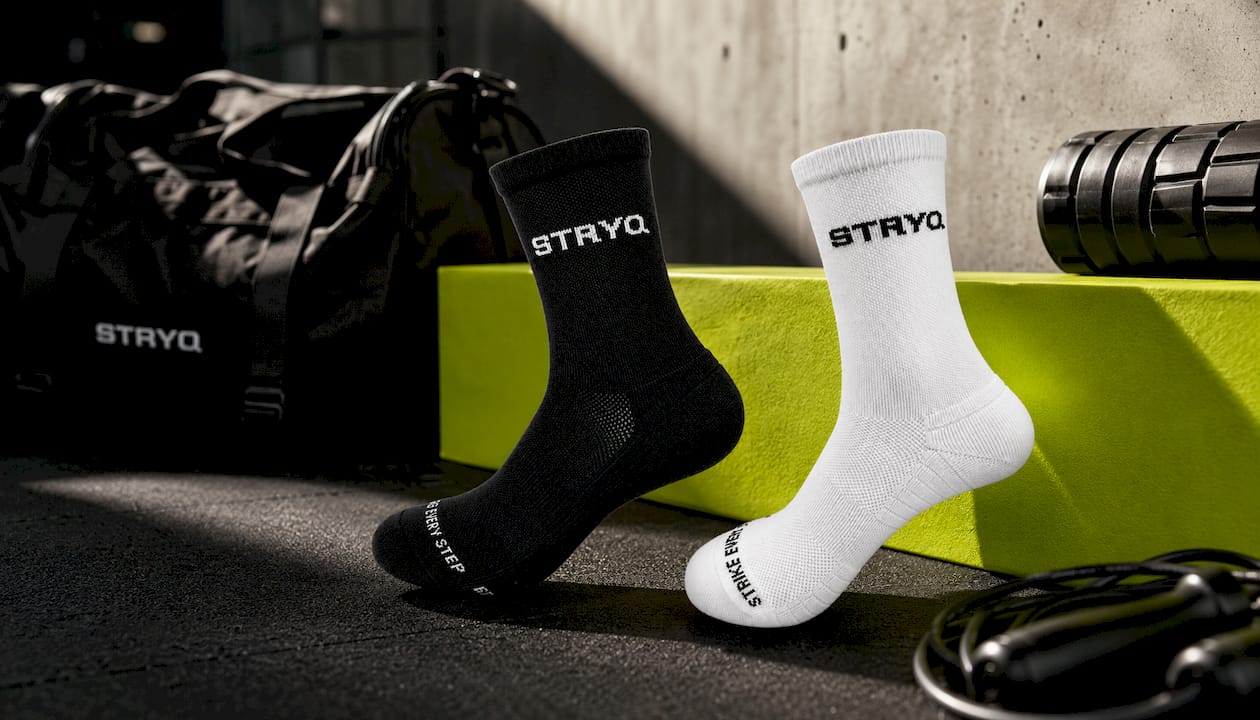
Stryq running socks are built around the same principles this article covers: technical fibre blends for moisture management, targeted cushioning at the heel and forefoot, seamless toe construction and a fit designed to stay in place across long distances. They sit in the mid-range price bracket, offering the construction features that matter for marathon training without the cost of premium heritage brands.
Both the black running socks and white running socks are available now and shipped within the UK. Each pair has gone through multiple sample revisions and long-run wear trials before reaching the product page. The development process is grounded in runner feedback, which means the fit decisions reflect real-world use rather than lab assumptions.
The advice from this guide applies directly: test them over 15–30 km training runs before race day, confirm the fit works with your specific shoes, and replace them when the elastane starts to go. Browse the full Stryq running socks range to find the right option for your next training block or race.
Useful sources for further reading
The following studies and guides informed this article. Each is worth reading in full if you want to go deeper on a specific area.
- Materials 2025 — Cushioning performance of specialised running socks: The primary lab study on shock absorption and peak plantar pressure reduction (p < 0.05). Most directly relevant to the evidence section.
- MDPI Materials — Cushioning performance and plantar pressure: Companion paper reporting reductions in forefoot ground contact time and peak pressure. Use alongside the Materials 2025 study.
- Journal of The Textile Institute — Sock fibre type and shoe microclimate: Key source for the perception argument — socks affect how feet feel more than absolute temperature or humidity.
- PMC — Sock designs and blister prevention: Clinical review of double-layer socks and five-toe designs; useful for the construction and blister-prevention sections.
- Marathon Handbook — How many steps are in a marathon?: Source for the 50,000-step figure used throughout.
- Runners Need — Why you need technical running socks: Practical retail guidance on switching from cotton to technical socks.
- Running Bear — What socks should you wear for your marathon?: UK-facing practical guide on race-day sock selection and training protocol.
- CEP Running — Tall compression socks for distance runners: Industry and lab commentary on compression benefits for swelling and recovery.
- Stryq — How to stop sock blisters on runs: Practical blister-prevention guide from Stryq, covering materials and fit in detail.
- Stryq — Running socks: built the right way: Background on Stryq’s product development and testing process.