

Why runners wear compression socks: the evidence explained
Compression socks benefit runners primarily through improved circulation and faster recovery, not by making you run faster. The research is consistent on this: race times and endurance are not meaningfully improved by wearing them during a run. What they do well is reduce muscle soreness, support venous return, and help you recover well enough to train again sooner. For runners building weekly mileage or tackling back-to-back long runs, that recovery edge is worth understanding properly.
Here is why runners choose to wear them:
- Graduated compression improves blood flow back to the heart, reducing swelling in the lower legs
- Reduced muscle vibration during running may lower neuromuscular fatigue, particularly on downhill sections
- Post-run soreness (DOMS) is measurably reduced when worn for a day or two after intense effort
- Perceived exertion and comfort during long runs often improve, even when objective performance does not
- Psychological confidence from reduced soreness can support motivation and consistency
How compression socks actually work for runners
Compression socks apply graduated pressure along the lower leg, tightest at the ankle and decreasing progressively up towards the calf. This design is not cosmetic. The pressure gradient physically assists the valves in your leg veins, pushing blood upward against gravity and back towards the heart. Without that assistance, blood can pool in the lower legs during prolonged standing or running, causing swelling and that heavy, aching feeling familiar to anyone who has finished a long race.
Graduated compression enhances venous return by squeezing the superficial blood vessels, which increases flow velocity and reduces the volume of blood sitting stagnant in the lower limbs. The effect is most pronounced during activities where the calf muscle pump is working hard, such as running, but also during periods of inactivity afterwards, like sitting in a car after a race.
Key design features that determine whether a compression sock actually delivers this effect:
- Graduated pressure gradient: tightest at the ankle, reducing upwards. Uniform-pressure socks do not achieve the same circulatory benefit.
- Compression level: medical-grade socks typically fall in the 20–30 mmHg range. Below this, the physiological effect on circulation is minimal.
- Fit and length: a sock that bunches, slides, or cuts off at the wrong point on the calf will not maintain the intended pressure gradient.
- Material: breathable, moisture-wicking fibres matter for comfort during runs, particularly in warmer conditions.
The distinction between medical-grade and fashion-grade compression is worth stating plainly. Many socks marketed as “compression” to runners provide inconsistent or insufficient pressure. Without a verified 20–30 mmHg gradient, you are largely paying for a snug sock, not a physiological tool.
Do compression socks actually improve running performance?
The honest answer is: not in any way you will notice on the clock. A systematic review published on PubMed covering studies across half marathons, 15 km trail races, 5 km and 10 km runs found no statistically significant effect on race times, VO2 max, blood lactate concentrations, heart rate, or cardiac output. If you are hoping compression socks will shave minutes off your parkrun, the evidence does not support that expectation.
Where the picture gets more interesting is in secondary measures. Muscle oscillation during downhill running is measurably reduced when wearing compression socks. Muscle fibres vibrate on impact, and that vibration contributes to neuromuscular fatigue over time. Reducing it does not make you faster in the short term, but it may delay the point at which your legs start to feel heavy. Studies also show small positive effects on running economy and biomechanical variables, though these are modest.
-
Perceived exertion is another area where compression socks show a consistent, if subjective, benefit. Runners report feeling less fatigued and more comfortable, even when their actual output is unchanged. Whether that is a genuine physiological effect or a placebo-driven improvement in subjective recovery experience is debated. Either way, if you feel better during a long training run, you are more likely to complete it well.
-
No significant improvement in race times or VO2 max
-
Reduced muscle oscillation, particularly on downhill terrain
-
Small positive effects on running economy and biomechanical efficiency
-
Improved perceived exertion and comfort during long efforts
-
Psychological benefit from reduced soreness perception
Pro Tip: Trial compression socks on a long training run before wearing them on race day. Some runners find the added warmth uncomfortable in summer conditions, and race day is not the moment to discover that.
Why compression socks genuinely help with post-run recovery
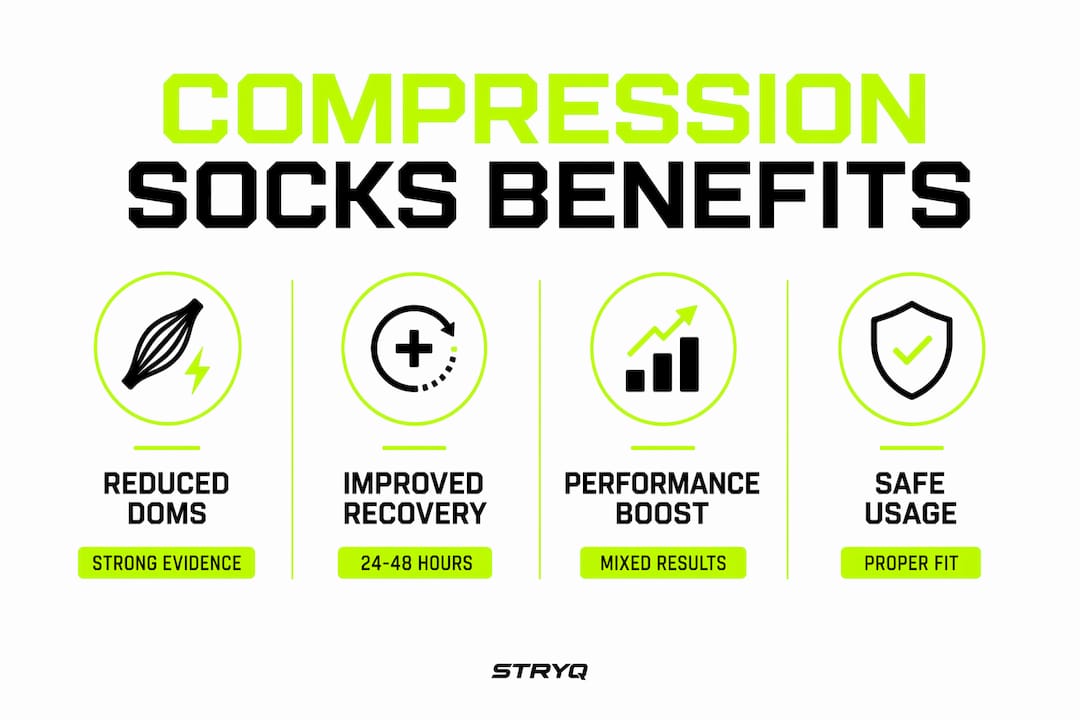
Recovery is where the evidence for compression socks is strongest. Wearing them at 20–30 mmHg for 24–48 hours after intense running reduces delayed-onset muscle soreness and supports recovery of muscle strength. A post-marathon study found a 2.6% improvement in time to exhaustion among runners who wore compression socks during the recovery period, compared to those who did not.

The mechanism is straightforward. After a hard run, inflammation builds in the muscle tissue, and metabolic waste products accumulate in the lower legs. Compression socks accelerate the clearance of these by maintaining elevated venous return even while you are sitting or resting. The result is less swelling, less soreness at 24 and 48 hours, and better preservation of muscle function for subsequent training sessions.
| Recovery benefit | Evidence level | Timeframe |
|---|---|---|
| Reduced DOMS | Strong (multiple RCTs) | 24–48 hours post-run |
| Improved time to exhaustion | Moderate (2.6% gain in post-marathon study) | Recovery period |
| Reduced muscle swelling | Strong | During and after exercise |
| Better muscle strength retention | Moderate | 24–48 hours post-run |
| Lower perceived soreness | Strong | 24–48 hours post-run |
For runners doing back-to-back training days, or preparing for a multi-day event, this matters more than any in-race benefit. Arriving at Sunday’s long run with less residual soreness from Saturday’s session is a practical, repeatable advantage. Compression socks worn during the journey home from a race, and for several hours afterwards, are doing useful work even when you are not.
How to use compression socks safely and correctly
Compression socks are safe for the vast majority of runners, but correct use matters. Harvard Health advises putting them on first thing in the morning, when legs are least swollen, and removing them before sleep. When you lie down, your legs are horizontal and venous drainage occurs naturally. Wearing compression socks at night adds no benefit and may cause discomfort.

Medical experts caution that runners with existing vascular conditions, peripheral arterial disease, or diabetes-related circulation issues should consult a doctor before using compression socks. The pressure that helps a healthy runner can restrict blood flow in someone with arterial insufficiency.
Do’s and don’ts for runners:
- Do put them on immediately after a run for maximum recovery benefit
- Do choose socks with a verified 20–30 mmHg compression rating
- Do check the fit: no bunching, no cutting in at the top, no slipping during movement
- Do remove them before sleeping
- Don’t wear them if you have peripheral arterial disease without medical clearance
- Don’t assume a tighter sock is better. Too much compression restricts circulation rather than aiding it.
- Don’t use fashion-grade “compression” socks and expect physiological results
Pro Tip: If your compression socks leave deep marks on your skin or feel painful after 30 minutes, they are either the wrong size or too high a compression level. Proper fit should feel firm but never restrictive.
How to choose the right compression socks for running in the UK
The market for running compression socks ranges from cheap, unverified products to well-engineered socks built around real runner feedback. Knowing what to look for saves you money and ensures you actually get the benefits the research supports.
Key selection criteria:
- Verified compression rating: look for 20–30 mmHg, clearly stated. If a product does not specify mmHg, it is not medical-grade compression.
- Graduated design: pressure must decrease from ankle upwards. Check the product description explicitly states this.
- Material and breathability: merino wool blends or technical synthetics manage moisture and temperature better than cotton. For UK running conditions, this matters year-round.
- Durability: compression socks lose their pressure gradient over time. Quality construction and reinforced heels and toes extend the useful life significantly.
- Fit by calf circumference: sizing by shoe size alone is insufficient. Measure your calf at its widest point and match to the manufacturer’s sizing chart.
- Purpose: decide whether you need socks primarily for during-run use, post-run recovery, or both. Some designs prioritise cushioning and breathability for active wear; others are built for recovery compression.
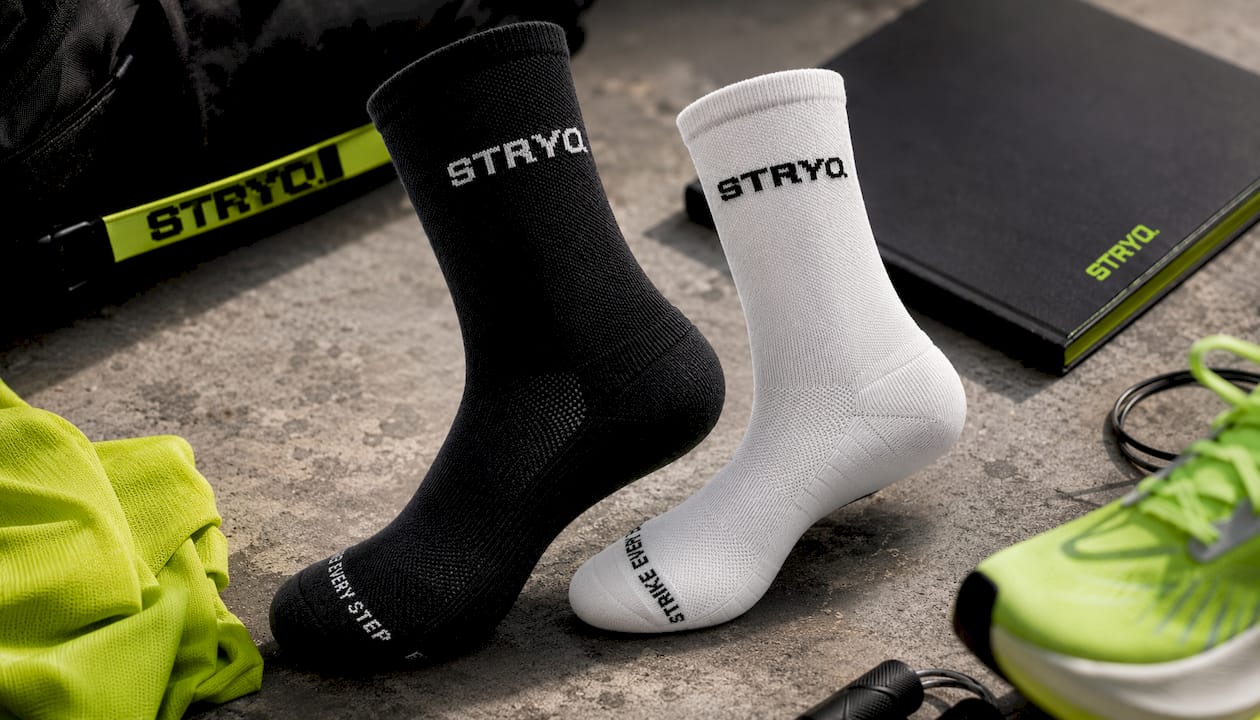
Stryq builds its running socks around exactly this kind of practical brief. Every product goes through multiple sample revisions and real-world runner testing before launch, with fit, durability, and functional compression as the non-negotiable criteria. The focus is on socks that perform consistently over hundreds of runs, not just in the first few wears. For UK runners looking for a product that sits between budget marketplace options and expensive specialist brands, the Stryq running sock range is worth a look.
A few additional points worth considering when buying:
- Avoid socks that claim compression benefits without specifying mmHg
- Check return policies. Fit is personal, and a sock that works for one runner’s calf shape may not work for another’s.
- Read the complete guide to running socks if you want a deeper breakdown of how sock construction affects performance and recovery
Key takeaways
Compression socks deliver their clearest benefit in post-run recovery, not during the race itself, with the strongest evidence pointing to reduced muscle soreness and faster strength recovery when worn at 20–30 mmHg for 24–48 hours after intense effort.
| Point | Details |
|---|---|
| Recovery over performance | Compression socks reduce soreness and aid recovery; they do not meaningfully improve race times. |
| Graduated compression matters | Only socks with a verified 20–30 mmHg gradient deliver measurable circulatory benefit. |
| Timing is key | Wear immediately after running and remove before sleep for optimal recovery effect. |
| Post-run strength recovery | A post-marathon study found a 2.6% improvement in time to exhaustion with post-run compression wear. |
| Fit determines effectiveness | Correct sizing by calf circumference, not shoe size, is necessary for the pressure gradient to work. |