Use both: reflective gear for recognition, plus a simple flashing rear LED for attention. Together they give drivers the best chance of spotting you early, since biomotion research shows reflectors on moving joints sharply extend recognition distance, while the IIHS notes some vehicle sensors respond unevenly to reflective materials. This guide breaks down when each method works best and how to combine them.
TL;DR:
- Reflective strips placed on moving joints like ankles and wrists double recognition distances compared to torso-only gear.
- Flashing rear LED lights are more attention-grabbing and energy-efficient than steady lights, especially when attached to the most active body part.
- Reflection relies on external light sources and is ineffective in unlit areas without illumination, while LEDs depend on battery life and weather resistance.
- Automatic vehicle safety systems may fail to detect articulated reflective strips, making lights essential for reliable detection and early driver response.
- A minimal visibility kit with biomotion reflectors and a rear flashing LED offers the best balance of effectiveness, comfort, and practicality for most runners.
Table of Contents
- Reflective materials versus LED lights: strengths and weaknesses
- Building a compact visibility kit and fitting it properly
- What the research actually shows about visibility and detection
- Environmental impact: LED batteries versus reflective fabric
- Are there official standards for reflective and LED running gear?
- Our view on building a visibility kit that actually gets used
- Get a minimal visibility kit without the guesswork
- FAQ
- Sources
Reflective materials versus LED lights: strengths and weaknesses
Retroreflective material bounces a vehicle’s headlight beam straight back to the driver’s eyes, which is why it only works when it is lit by an external light source. Placement matters more than most runners assume. Strips positioned on moving joints, ankles, knees, wrists, create a biomotion pattern that the human eye is tuned to notice because it mimics the shape of a walking or running figure. Closed-road and open-road studies found that biomotion configurations produced recognition distances roughly twice as long as typical sports clothing and substantially longer than black clothing. A plain reflective logo on the chest does not do this. A strip around each ankle does.
LED lights work differently: they generate their own light rather than relying on a headlamp to illuminate them, so they are visible even without direct headlight contact. A flashing LED is built to grab attention from a distance, which makes it well suited to a rear position where oncoming traffic first catches sight of you. A steady LED gives consistent light for seeing the ground ahead and is generally preferred on the front, since a flashing beam facing forward can be disorientating to oncoming cyclists or pedestrians.
Both methods have real limits:
- Reflective strips are invisible in the dark unless a light source hits them directly. They are useless on unlit paths without a torch or headlamp nearby.
- LEDs depend on battery charge and can dim or fail without warning, leaving you with no backup if you are relying on lights alone.
- Weather and street lighting change effectiveness: rain and fog scatter both reflected and emitted light, while bright street lighting can wash out a flashing LED’s contrast.
- The IIHS has found that some automatic emergency braking systems respond inconsistently to highly reflective, limb-articulated strips, a quirk that does not apply to human drivers.
On a well-lit urban loop with street lamps and passing headlights, reflective gear alone can be enough. On a dark towpath or unlit lane, an LED becomes necessary rather than optional. Most runs sit somewhere between the two, which is the case for carrying both.
Building a compact visibility kit and fitting it properly
A minimal kit does not need to be bulky. Four items cover most situations:
- A vest or set of bands arranged in a biomotion layout, with strips on the torso and at least one limb.
- A rear-facing flashing LED, clipped to a belt, vest or waistband.
- A forward-facing steady light or low headlamp for footing on unlit ground.
- Ankle or shoe reflectors, since joint movement is what catches a driver’s eye fastest.
Fit is where a lot of kit underperforms. Reflective strips sitting flat against a loose vest move less than ones fixed close to the joint, so ankle bands and wrist bands tend to outperform a torso-only vest even though the vest looks more comprehensive. A reflective bands kit built around this layout is a straightforward way to get the joint placement right without assembling separate pieces. For the head torch, a slightly downward angle stops the beam dazzling oncoming traffic while still lighting the ground two or three strides ahead.
Pro Tip: Clip the rear LED to whichever part of your body moves most, your waistband or a vest hem, rather than your lower back, since motion is what makes a flashing light register with a driver’s peripheral vision.

Battery management is the part runners forget until a light dies mid-route. Most compact rear LEDs run for several hours on flashing mode, longer than on steady mode, so flashing is also the more battery-efficient choice for a long run. Charge before every run rather than after, keep a spare clip-on light in a drop bag or car for long training blocks, and check the water rating before running in persistent rain, since not every budget light is sealed against it.
Adjust the mix to the route. A well-lit urban pavement with regular street lamps can manage with reflective bands and a flashing rear light alone. Poorly lit suburban roads call for the full kit, reflective layout plus front steady light plus rear flashing light. Single-track trails need a brighter forward beam above anything else, since footing risk outweighs traffic risk there, with reflective elements kept as a secondary layer for any road crossings.

What the research actually shows about visibility and detection
Eye-tracking research gives a concrete sense of how much biomotion placement matters. In a closed-road study, drivers recognised pedestrians wearing biomotion reflectors at a much greater distance compared with without them, and time to first fixation dropped significantly.
Biomotion configurations attracted driver fixation earlier and reduced the time needed to recognise a pedestrian by roughly two thirds compared with a vest alone.
That gap matters at typical road speeds, where every extra second of recognition time is extra stopping distance. A wider Cochrane-style review of 39 trials found that lamps, flashing lights and retroreflective materials increase detection and recognition at night, while fluorescent materials help mainly in daylight. The same review is candid about its limits: detection improves reliably in trials, but no trial in the review robustly measured whether that translated into fewer collisions or injuries.
The IIHS adds a caveat that cuts against the instinct to maximise reflective coverage: in tests on two 2023 model vehicles, automatic emergency braking systems failed to slow for a dummy wearing reflective strips that articulated at the limbs, even though the same systems performed better against a plain-clothed dummy. A Subaru model in the same tests handled the reflective strips without the same failure, so the effect varied by vehicle rather than applying universally. The practical takeaway is not to abandon reflective gear, since human drivers remain the primary audience for it, but to treat it as a complement to LED attention-getting rather than a substitute, and not to assume every vehicle’s sensors will behave the way a human eye does.
Environmental impact: LED batteries versus reflective fabric
LED lights carry an environmental cost that reflective fabric does not: batteries, whether disposable or rechargeable, require mining, manufacturing and eventual disposal, and a light that stops charging properly is usually replaced rather than repaired. Rechargeable USB lights reduce this somewhat compared with disposable-battery units, since one unit can be recharged hundreds of times rather than discarded after a single battery runs out.
Reflective fabric has a simpler footprint once it is made: no battery, no charging cycle, and a reflective strip sewn into a sock or band typically outlasts the garment it is attached to. The trade-off sits at manufacturing rather than use. Reflective coatings often rely on glass microbeads or metallised film bonded to fabric, which complicates recycling at end of life compared with a plain textile.
For a runner weighing the two, the practical difference is modest rather than decisive. Buying one durable rechargeable light instead of a string of disposable-battery units, and choosing reflective garments built to last several seasons rather than replacing cheap ones yearly, does more for your footprint than picking one technology over the other outright. Durability, in both categories, is the lever that actually moves the needle.
Are there official standards for reflective and LED running gear?
Running apparel sits in a different regulatory position to occupational workwear. Roadworker and cyclist high-visibility clothing in many markets follows formal standards specifying strip width, placement and reflectivity levels, but everyday running gear is not generally required to meet those same certifications. A product can be marketed as “high-vis” or “reflective” without passing a formal test, which means the label alone does not guarantee a specific level of performance.
That gap puts more weight on checking what a product actually does rather than trusting the marketing term. Looking at where reflective strips sit (torso only versus joints), how bright and water-resistant a light is rated, and whether a brand describes real testing behind the design tells you more than a “hi-vis” tag on its own.
Local road rules around lights and reflective wear for pedestrians and runners vary by area, and some regions set specific requirements for cyclists that do not automatically apply to runners on foot. Checking local guidance for your own roads is worth doing once, rather than assuming a rule from one place applies everywhere.
Our view on building a visibility kit that actually gets used
Most runners own more reflective and LED gear than they actually wear, because comprehensive kit is uncomfortable, fiddly, or both. The evidence on biomotion placement is strong, but it is wasted on a vest that stays in a drawer because it is annoying to put on in the dark. Our focus in developing visibility products has been on what a tired runner will reliably use on a 6am or 9pm run, not what looks most complete on a shelf.
That shaped a straightforward recommendation: simple biomotion-style reflective bands at the ankles or wrists, paired with a low-profile flashing rear LED, cover most road running situations without the bulk of a full vest. It is less kit, used more consistently, which beats more kit left at home.
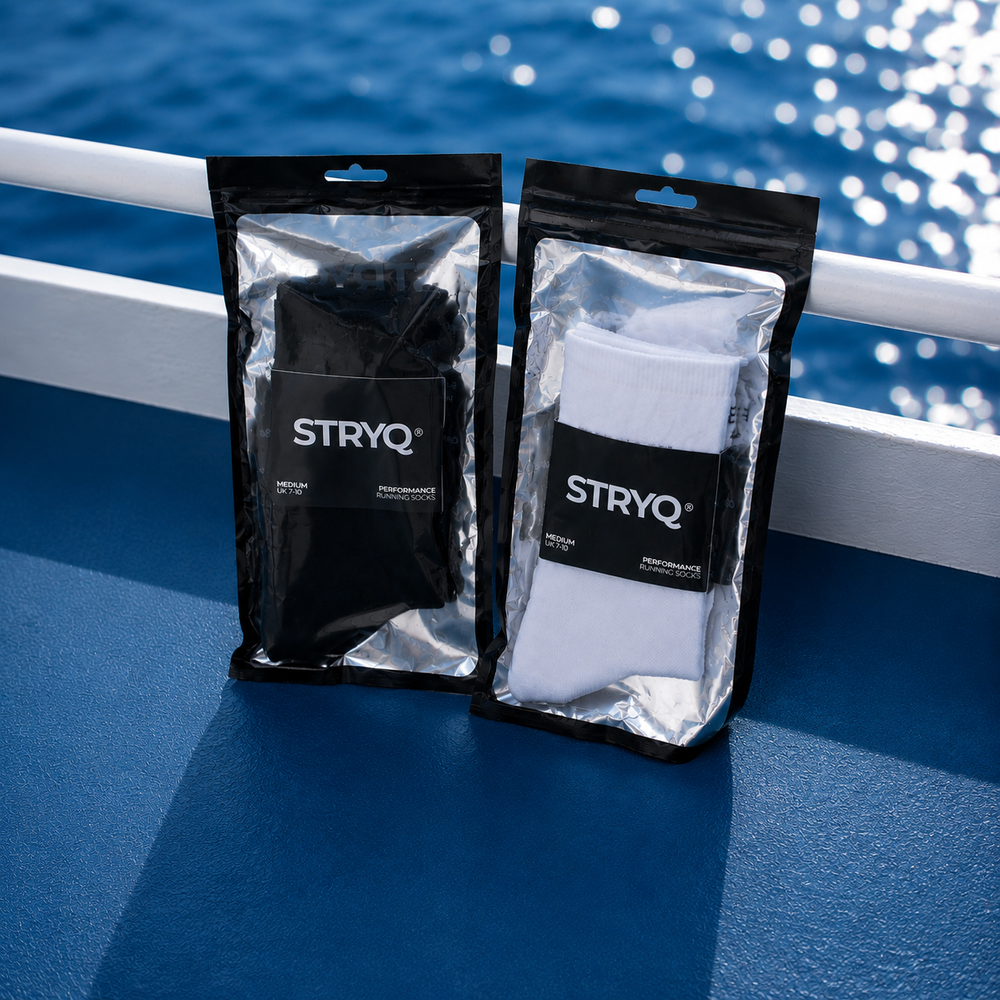
Visibility is one part of a comfortable, well-fitted kit, and STRYQ Running Socks - Black and STRYQ Running Socks - White sit alongside dedicated reflectors and lights as part of that, through cushioning and fit rather than any visibility feature of their own.
— martin
Get a minimal visibility kit without the guesswork
We built our running gear collection around the kit described above: a reflective layout at the joints, a compact flashing rear light, and nothing extra to lose on the way out the door. It is a direct way to put the biomotion research into practice without piecing components together from several different sellers.

A few starting points from the range:
- The Hi-Vis Running Vest & Reflective Bands Kit covers the reflective layer in one purchase, priced at £28.
- STRYQ Running Socks, including the Black and White options, add cushioned comfort for the extra miles a proper visibility setup tends to encourage, at £17.
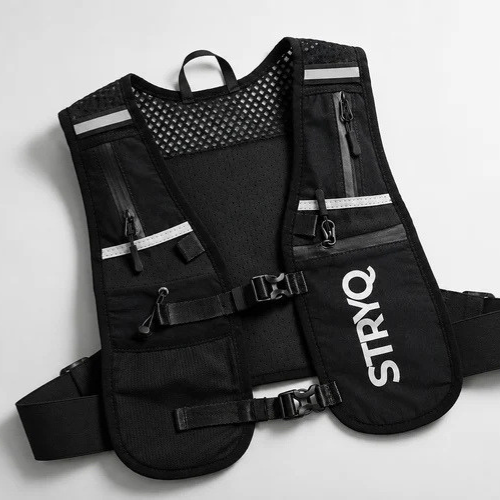
- A hydration vest at £42 or a 500ml soft flask at £14 round out a kit for longer low-light sessions.
Every item is developed from feedback from UK runners rather than built to a marketing brief, which is the same approach behind the visibility layout recommended earlier in this guide. Check availability on the running gear collection page and build a kit that matches your usual routes.
FAQ
Is reflective clothing or an LED light better for night running?
Neither works best alone: reflective material only becomes visible when lit by a car’s headlights, while an LED generates its own light and works even without a direct light source. Pairing a biomotion-style reflective layout with a flashing rear LED gives drivers both earlier recognition and quicker attention, which eye-tracking research supports.
Where should reflective strips go for the best effect?
Reflective strips work best on moving joints such as ankles, knees and wrists rather than on the torso alone, since this creates a biomotion pattern the eye recognises as a moving figure. Closed-road studies found this placement produced recognition distances roughly twice as long as standard sports clothing.
Should a running light flash or stay steady?
A flashing light is generally better positioned at the rear to catch a driver’s attention from a distance, while a steady light works better at the front for lighting the ground ahead without dazzling anyone coming towards you. Flashing mode also tends to draw more battery life out of a charge than steady mode.
Can reflective clothing confuse a car’s automatic braking system?
In IIHS testing, two 2023 model vehicles’ automatic emergency braking systems failed to slow for a dummy wearing reflective strips that moved at the limbs, though a third model performed better. This does not mean reflective gear should be dropped, since human drivers remain the main audience for it, but it is worth knowing that not every vehicle sensor behaves like a human eye.
Does reflective gear actually reduce the risk of being hit?
Reflective materials and lights clearly improve how quickly and how far away drivers notice a pedestrian or runner, according to a review of 39 trials. The same review notes that no trial in it directly measured whether this detection advantage reduced actual collisions or injuries, so the benefit is established at the detection stage rather than as a proven collision reduction.
Sources
- Making nighttime pedestrians safer: using innovative clothing designs — A M Fylan (Leeds Beckett)
- Night-time pedestrian conspicuity: effects of clothing on drivers’ eye movements (QUT ePrints)
- Interventions for increasing pedestrian and cyclist visibility for the prevention of death and injuries (Cochrane review, PMC)
- High-visibility clothing may thwart pedestrian crash prevention sensors (IIHS)