Yes. Wearable running lights improve how easily drivers and other road users spot you in daylight, but only against specific problems: backlighting, deep shadows, glare and cluttered backgrounds. They are not a substitute for fluorescent or reflective kit. Buy on the buying checklist below, then run the five-minute field test before you trust any light on a real route.
TL;DR:
- Proper mounting positions like chest or vest straps ensure a stable silhouette that remains visible to drivers, unlike limb-mounted clip-ons which can rotate or face the wrong way.
- Flashing or strobing modes outperform steady beams in daylight by capturing attention through motion, especially when combined with wide, diffused beams and contrasting colors.
- Testing lights from typical driving distances at multiple angles using photos or videos provides a more reliable safety check than relying solely on product specifications.
- Combining fluorescent clothing with active lights on flash mode offers the best visibility in mixed light conditions, especially during dawn, dusk, or overcast days.
- Battery life for flashing modes and the durability rating are crucial factors, with rechargeable lithium batteries generally outperforming disposables for consistent, cost-effective use.
Table of Contents
- What are daylight running lights, and how do they work?
- What should you look for in a daylight-capable light?
- Where should you mount a light, and how do you test it?
- How do you layer lights with fluorescent and reflective kit?
- Can a running light give you false confidence?
- What do the rules say about running lights?
- Which setup suits your usual running environment?
- Rechargeable or disposable: which battery type actually works better?
- Stryq’s perspective: why testing from the driver’s seat matters more than the spec sheet
- How Stryq’s kit supports a stable, daylight-ready lighting setup
- Sources
What are daylight running lights, and how do they work?
Daylight running lights are wearable, battery-powered lights, clip-ons, chest units, vest-integrated fibre-optic strips that runners wear to stay visible during the day, not the automatic daytime lights built into cars. This article deals exclusively with the wearable kind.
The logic behind them is simple: human eyes are drawn to movement and contrast, and a static reflective panel gives neither when there’s no headlamp beam to bounce off. A pulsing or steady light source does both, which is why the effect shows up clearly in testing. A 2026 MDPI study on active lighting systems found that vests fitted with active lighting extended visibility past 430 metres in tunnel trials, around 67% further than retroreflective tape managed alone. That gap widens exactly where daylight visibility usually fails.
Daylight throws up problems that pure reflectives can’t solve because there’s no artificial beam to reflect:
- Backlighting, where the sun sits behind you and drivers see only a silhouette
- Deep shadows under bridges, tree cover or between buildings
- Glare off wet tarmac or windscreens that washes out contrast
- Busy visual backgrounds, like a high street with shopfronts and traffic, where a static runner blends in
None of this means a light replaces the basics. Route choice, road positioning and eye contact with drivers still matter more than any accessory. A light adds a margin of safety in the situations reflectives were never designed for.
What should you look for in a daylight-capable light?
Not every light marketed for runners performs the same job in daylight. Raw lumens grab attention on a packaging label, but they’re a poor proxy for what actually gets you noticed on a bright, cluttered street.
- Flash pattern over brightness. A pulsing or strobe mode cuts through daylight glare far better than a steady beam of similar output, because the human eye tracks change faster than it tracks intensity.
- Beam spread and colour. A wide, diffused beam is easier to spot at an angle than a narrow spotlight. Red and amber tend to stand out better against daylight backgrounds than white or blue.
- Mount type. Core-centred mounts (chest strap, vest, belt) hold steady with your stride. Limb-mounted clip-ons swing with your arm or ankle and can end up facing the wrong way half the time.
- Battery life and charging. Check the rated hours on flash mode specifically, not steady mode, since flashing is what most runners actually use outdoors.
- IP rating and durability. Look for at least IPX4 for splash resistance, and check whether the unit is rated to survive sweat and rain over repeated runs, not just a single shower.
- Ergonomics. Weight and profile matter more on a marathon than a 5K. A light that bounces or digs in will get left in a drawer after two runs.
- Replaceable batteries and warranty. A light with a sealed, non-replaceable battery is disposable gear. Check whether the manufacturer backs it with any warranty or repair support.
Pro Tip: Charge your light the night before a long race, not the morning of. Cold mornings drain lithium batteries faster than you’d expect, and a light that shows 80% the night before can read closer to 60% by the start line.
Where should you mount a light, and how do you test it?
Mounting matters as much as the light itself. Core-centred positions, chest, vest or belt, give a stable, predictable silhouette that stays in a driver’s line of sight regardless of your arm swing or stride length. Limb-mounted clip-ons look convenient but rotate, bounce and can end up facing your leg rather than the road, especially over longer distances.
Check for occlusion before you trust any placement. Hydration vest straps, jacket zips, running belt pouches and even your own arm swing can block a light at exactly the angle a driver needs to see it.
A five-minute test from the observer’s viewpoint settles this faster than reading another spec sheet:
- Set up at typical road distances, roughly 50, 100 and 150 metres, the ranges drivers actually need to react.
- Check from multiple angles: head-on, three-quarter and side-on, since a light that’s brilliant from behind can be invisible from the side.
- Take a photo or short video from each distance and angle rather than relying on memory.
- Test both flash and steady modes at each distance to see which mode actually holds attention.
- Note any glare or distracting flicker that might make a driver misjudge distance rather than help them.
This method mirrors the observer-viewpoint field test recommended by lighting researchers, and it’s the single most reliable pre-purchase check available. A light that passes at 50 metres but disappears at 150 isn’t doing its job on faster roads. Retest in different weather and at different times of day, since a light that performed well on a clear morning can behave very differently in rain or low winter sun.
How do you layer lights with fluorescent and reflective kit?
Active lights, fluorescent fabric and retroreflective materials each solve a different lighting problem, and the strongest setups use all three depending on conditions.
Fluorescent fabric works by absorbing UV light and re-emitting it as visible colour, which is why a fluorescent yellow top looks almost luminous on an overcast day. It’s the most effective daytime visibility tool precisely because it needs no external light source to work, unlike retroreflective strips, which only bounce light back when a headlamp or headlight hits them directly. Active lights fill the gap between the two, useful whenever ambient light is mixed, fading or inconsistent, dawn, dusk, tunnels, overcast afternoons.
Practical combinations for common runs:
- Short daylight runs: fluorescent top, no light needed unless the route crosses shadowed underpasses
- Dawn or dusk commutes: fluorescent layer plus one active light, chest or vest mounted, on flash mode
- Night-heavy long runs: retroreflective vest, active light on steady or flash, and a headlamp for terrain
Redundancy matters on longer efforts. Carry a spare battery or a backup reflective strip, since a light that dies at mile eighteen leaves you with nothing if that was your only visibility measure. Our guide to reflective gear for runners breaks down how these materials perform across different conditions in more detail.
Can a running light give you false confidence?
A light that’s visible to you isn’t automatically visible to the driver approaching from behind or the side, and that gap is where most of the risk sits. Runners who clip on a light and assume the job is done often relax habits that matter more, checking over their shoulder, holding a predictable line, making eye contact at junctions.
Glare is the other trap. An overly bright strobe pointed too high can dazzle rather than inform, making it harder for a driver to judge your speed or distance rather than easier. This is particularly true after dusk, where a light calibrated for daylight contrast can be genuinely blinding. Angle any chest or vest light slightly downward, and favour a flash pattern over a constant blaze wherever the packaging offers the choice.
The safest approach treats a light as one layer among several, not the layer. Road positioning, predictable pacing and choosing routes with good sightlines still do more for your safety than any single accessory. A light earns its place by covering the specific failure points reflectives and fluorescents don’t, not by replacing the judgement calls you make on every run.
What do the rules say about running lights?
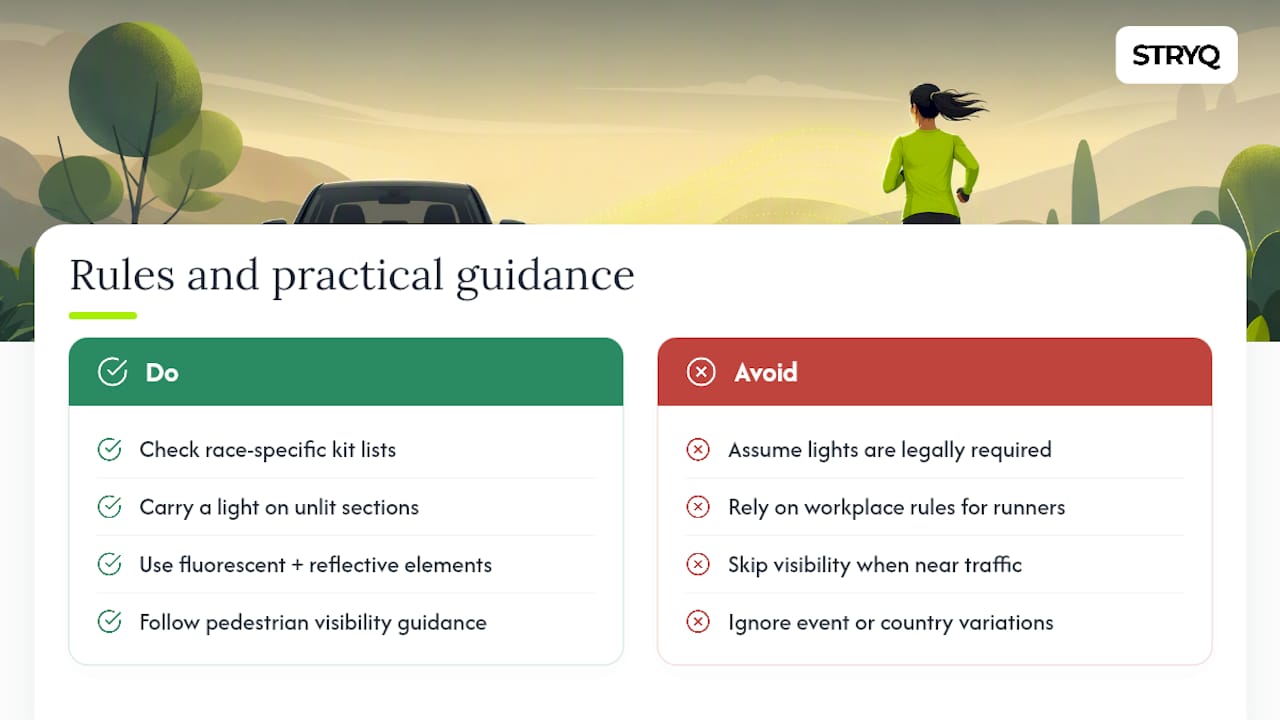
There’s no single global standard governing wearable running lights the way there is for bicycle lights on public roads in some countries, where fitted lights are a legal requirement after dark. For runners, wearing a light is almost universally a personal safety choice rather than a legal one.
That said, some local authorities and race organisers set their own expectations. Certain marathon and ultra events, particularly those with sections on unlit trails or roads, require runners to carry a light or wear reflective kit as a condition of entry. Always check race-specific kit lists before assuming your usual setup is compliant, since requirements vary by event and by country.
Workplace-facing guidance is more developed than anything aimed at recreational runners, since high-visibility standards for outdoor workers are often written into occupational safety regulations. Runners can borrow useful principles from that guidance, such as the value of combining fluorescent and reflective elements, even though the legal requirement itself doesn’t apply to a solo training run. If you’re running alongside traffic regularly, it’s worth looking at general pedestrian visibility advice too, since much of it translates directly, as covered in this practical breakdown of pedestrian visibility tips.
Which setup suits your usual running environment?
The right lighting setup depends heavily on where you actually run, and treating every route the same way wastes both money and battery life.
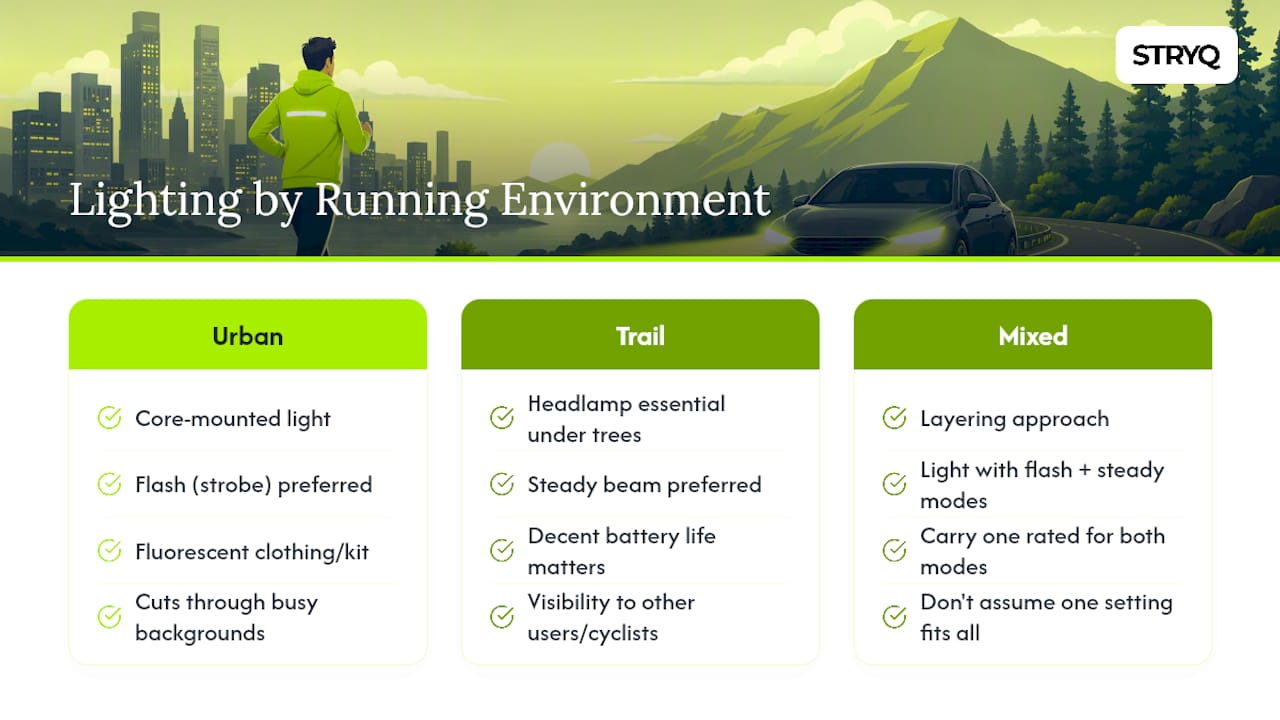
Urban runs put you closest to traffic, so prioritise a core-mounted light on flash mode paired with fluorescent kit for daylight hours. Streetlights and shopfronts create the busy backgrounds where a strobing light cuts through clutter better than a steady one.
Trail runs demand a different priority. Ambient light is unpredictable under tree cover, and you’re less concerned with cars than with visibility to other trail users and, on multi-use paths, cyclists. A steady beam with decent battery life matters more here than an aggressive strobe, and a headlamp becomes essential rather than optional once tree cover thickens.
Mixed routes, pavement to towpath to trail within a single run, are where the layering approach pays off. Carry a light rated for both flash and steady modes, and don’t assume a setting that worked on the road will suit the last unlit mile through a park.
Whatever the environment, weather changes the picture. Rain reduces contrast and daylight itself, so a light that felt like overkill on a dry morning can become genuinely necessary once the sky darkens mid run.
Rechargeable or disposable: which battery type actually works better?
Most modern running lights use rechargeable lithium batteries, usually charged over USB, and for most runners this is the more practical choice. You get consistent output across the battery’s life, no drawer full of dead disposables, and a lower cost per run over a training year.
Disposable batteries, typically coin cells or AAAs, still show up in ultra-budget clip lights and some backup units. Their advantage is genuine: no charging cable to remember, and a spare in your running belt pocket works as true redundancy if your main light dies mid-run.
The practical answer for most runners is both. Use a rechargeable light as your primary source, and carry a small disposable-battery backup for long runs or races where a dead battery isn’t just inconvenient, it’s a safety gap. Check the manufacturer’s rated hours on flash mode before you buy either type, since steady-mode figures on packaging routinely overstate how long a light lasts in the mode you’ll actually use.
Stryq’s perspective: why testing from the driver’s seat matters more than the spec sheet
Most lighting specs are written from the runner’s perspective: how bright it looks in your hand, how long the charge lasts on your desk. That’s the wrong vantage point. What matters is how the light reads from 100 metres away, through a windscreen, in whatever light happens to be available that morning.
Stryq’s product development leans on runner feedback loops precisely because lab numbers and real-road recognisability don’t always align. A light that tests brilliantly in a dark tunnel can wash out completely against a low winter sun. If you’re unsure whether a mount or fit works for your build, our customer service team can talk through fitting and placement rather than leaving you to guess from a product photo.
— martin
How Stryq’s kit supports a stable, daylight-ready lighting setup
Getting a light to actually work in daylight comes down to where you put it, not just which one you buy, and that’s where the right base layer of gear earns its keep. A core-centred mount beats a swinging clip-on every time, which makes your choice of vest or belt as important as the light itself.
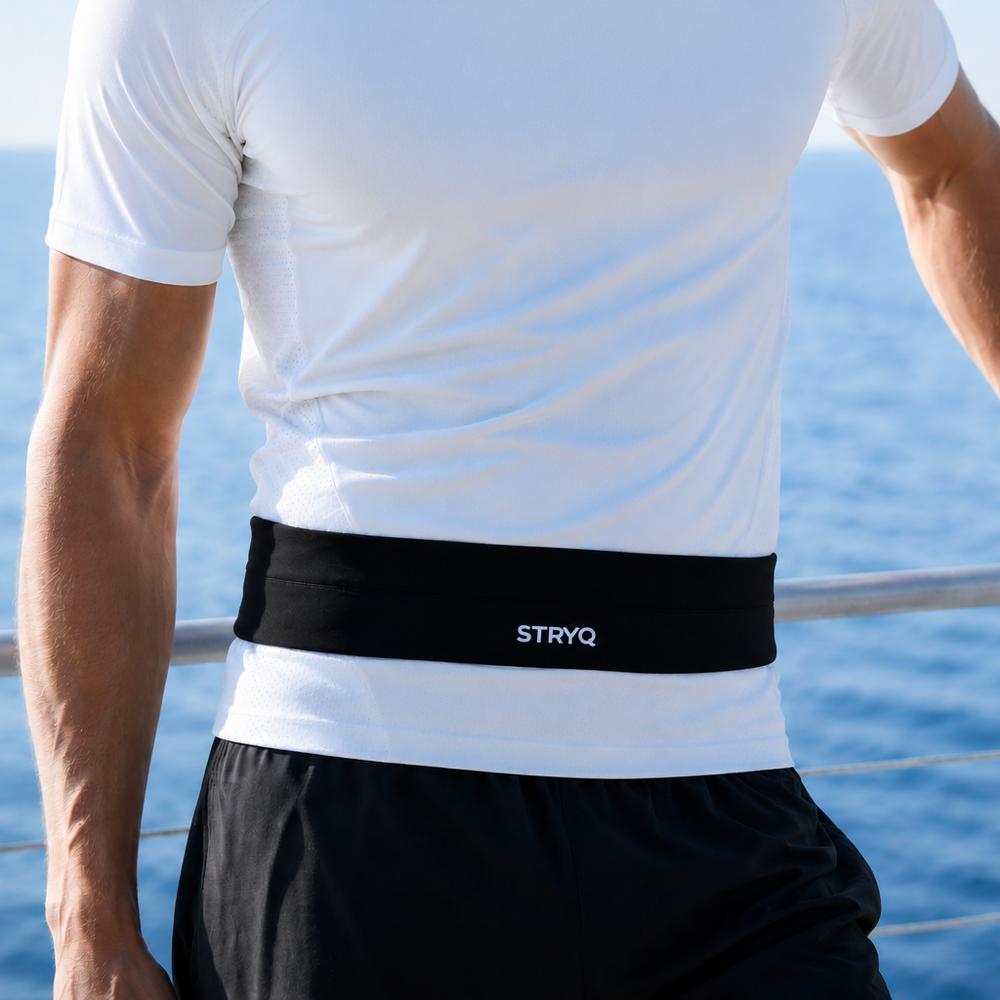
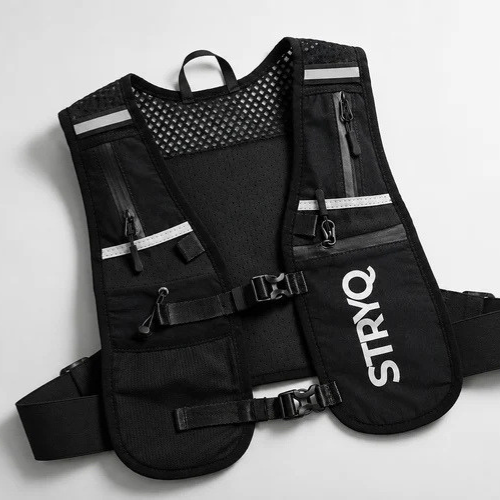
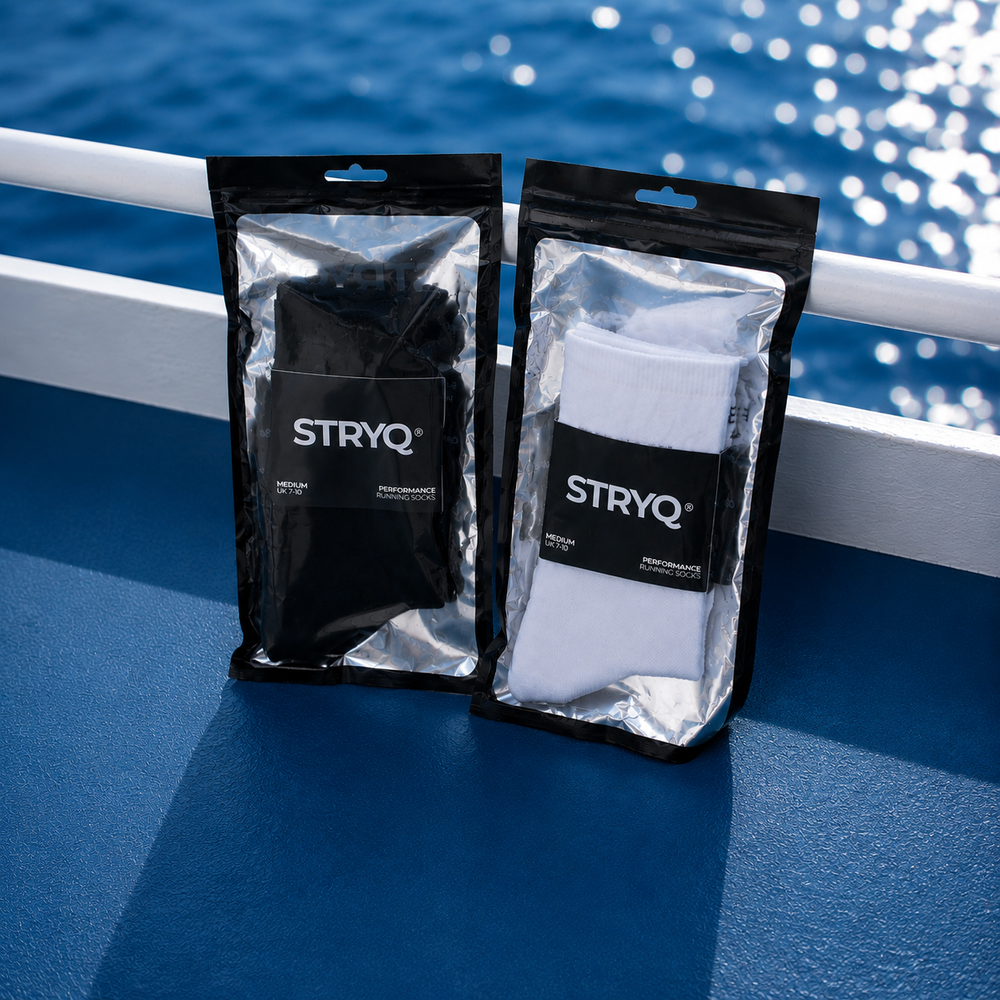
The Stryq Hydration Running Vest gives you a stable chest-level mounting point that holds a light steady with your stride rather than your arm swing, with pockets sized for a small power bank on longer efforts. For shorter runs where a full vest feels like overkill, the Stryq Running Belt offers the same low-bounce stability at the waist, useful for anyone clipping a light or backup battery on without wanting straps across the chest. Our running socks, in black or white, add a motion cue at ankle level that moves predictably with your gait, useful alongside any light you’re carrying higher up. For hydration on long runs where a light’s battery life becomes a real concern, our soft flasks slot straight into vest pockets, sold in black, pink and purple.
Every piece is developed from real runner feedback rather than a spec sheet. If you’re building a full daylight-visibility kit, start with the running belt collection and work out from there.
Sources
- Enhancing visibility and aesthetics of warning clothing for non-professional use via active and passive lighting (MDPI, 2026)
- Do wearable safety lights work in daylight or only at night? (Obotop)
- Stand out: the power of fluorescent running clothes for safe running (ChalkTalk SPORTS)