For most runners, the best answer is neither one alone. A headlamp frees your hands but bobs and throws a flat beam. A handheld light gives you aim but costs you arm swing. What works best on dark roads and trails is a light you can steer plus a second source low on the body, with reflective gear so drivers can see you too. That is how we think about night running at STRYQ, and the sections below show you why, with a simple way to choose for your route.
TL;DR
- A handheld light gives the most control over where the beam goes, but it occupies a hand, changes your arm swing and can tire your arm on long runs.
- A headlamp is hands-free and follows your eyes, but it can bob, press on your forehead and dazzle other people if it sits at eye level.
- Light mounted lower on the body casts shadows that show bumps and holes, which a head-height beam tends to flatten.
- Being seen matters as much as seeing: add reflective gear and a rear-facing light, especially near traffic.
- Our High-Vis Running Vest & Reflective Bands Kit covers the being-seen half of the plan.
Table of Contents
- Handheld vs headlamp: the real differences
- Why a headlamp can make the ground harder to read
- Comfort, bounce and the weight problem
- How bright does it need to be?
- Which one suits which run?
- Can you use both?
- Seeing is half the job: being seen
- Perspective: our view on handheld vs headlamp
- Build your night kit
- FAQ
- Sources
Handheld vs headlamp: the real differences
A handheld light (a torch, or a flashlight in US English) is held in your fist and pointed where you choose. A headlamp is strapped round your head and points wherever you look. Everything else follows from that.
| Handheld light | Headlamp | |
|---|---|---|
| Hands | One hand occupied | Both hands free |
| Aiming | Point it anywhere, including at a driver’s line of sight or a distant junction | Follows your head, so it also moves when you glance sideways |
| Beam steadiness | Depends on your arm swing | Can bounce with your stride, especially if heavy or loose |
| Comfort | Arm and grip fatigue on longer runs | Strap pressure, forehead warmth, weight on the head |
| Risk to others | You choose when to angle it away | Easy to dazzle people by looking at them |
| Depth cues | Can be held low to create shadows | Head height tends to flatten the ground |
Run coach Chris Knighton says a flashlight has become his go-to for running because it offers the most aiming control, while noting headlamps are hands-free but can feel uncomfortably tight, bob up and down and accidentally blind others. He also notes a handheld light affects your arm swing and can tire the arm over distance.
Men’s Health reports that one run-club leader also prefers a handheld light, because it gives total control over where to shine it.
Why a headlamp can make the ground harder to read
When the light sits next to your eyes, the beam travels along your line of sight. Shadows fall directly behind each bump, so you cannot see them. The surface looks flat even when it is not.
Team RunRun’s gear review explains that head-mounted lights do not cast shadows or give definition in darkness, which pushes runners to slow down to decipher the terrain. The same review says a light mounted lower on the body casts shadows that give a near three-dimensional picture of the ground. It also points to more waist lights appearing at races as a sign runners are noticing this.
This is the main reason we like lower-body lighting. A kerb, a pothole or a tree root becomes a shape rather than a patch of uniform glare.
If you want to see how it plays out in practice, our guide to chest running light vs headlamp bounce covers beam movement, shadowing and weight in detail.
Comfort, bounce and the weight problem
Headlamp bounce is not just annoying. A heavy lamp acts like a lever on your forehead, so the beam lags behind your head and shakes with every footfall. Olight’s stability guidance, summarised in our research, suggests keeping the lamp under 100 grams, snug to about two fingers of slack, and positioned slightly above the brow line, angled down to light the ground three to five metres ahead.
The practical rules for a headlamp are therefore simple:
- Keep it light, because weight is what makes it bounce.
- Tighten the strap until it is snug but not a headache, and add the top strap if you have one.
- Angle it downward. Men’s Health advises choosing a model with a pivoting head so you can tilt the beam down and avoid blinding oncoming traffic or other runners.
- Check for beam bounce at the end of your driveway before you head out.
A handheld light has its own comfort rules. Choose something small enough that your fingers do not clamp, swap hands every few minutes, and keep the beam aimed a few metres ahead rather than far down the road. Holding a light for a 10K or half marathon is a very different job from holding it for a lap of the park.
If you are weighing up fit, our 7-point fit checklist for headlamps and chest lights walks through strap pressure, weight and controls.
How bright does it need to be?
Brightness is measured in lumens, the total light a lamp puts out. More is not always better: a very bright beam at head height reflects off wet roads and dazzles others.

Two guides give different ranges, which is a hint that surface and speed matter. Men’s Health suggests choosing at least 400 lumens for a headlamp. RoutePrinter’s night-running guide matches output to the ground: 100 to 200 lumens for roads and smooth paths, 200 to 400 for technical trails, and more only for overnight ultras.
A sensible reading for most readers:
- Lit streets and pavements: a modest beam is enough because you are mostly being seen rather than seeing.
- Unlit paths and parks: step up to the middle of those ranges.
- Roots, rocks and mud: go to the top of the range and add a second, lower light for shadows.
Check battery life against your longest run, with spare time built in, because cold weather shortens it. Check weather resistance too, as you will end up out in rain at some point in winter.
Which one suits which run?
Road running and Parkrun-style routes
On pavements and cycle paths the job is mostly visibility. Drivers need to notice you, and you need to spot kerbs and puddles. A handheld light is good for the first because you can flash it across a junction, and a low-mounted light helps with the second. Men’s Health reports the same run-club leader keeps his group on well-lit routes with more traffic lights than stop signs, because drivers at night tend to be more careless. Plan the route as carefully as you choose the kit.
Trails and unlit paths
Here you need real seeing power. A headlamp as the main light makes sense because you can look at a turn before you take it, but it works best with a second light lower down to add texture to the ground, as the layered-setup advice in the RoutePrinter guide describes. Handheld lights suit trails less when you need both hands for balance, scrambling or poles.

Beginners and Couch to 5K
If you are new to running, you are probably running at dusk or in the dark mainly because of work and winter evenings. Keep it simple: stay on lit routes, wear something reflective and carry a light you find comfortable. Do not add complexity until you know which style annoys you most. Our guide to when and how to wear running lights is written for exactly this stage.
Longer runs: 10K, half and marathon training
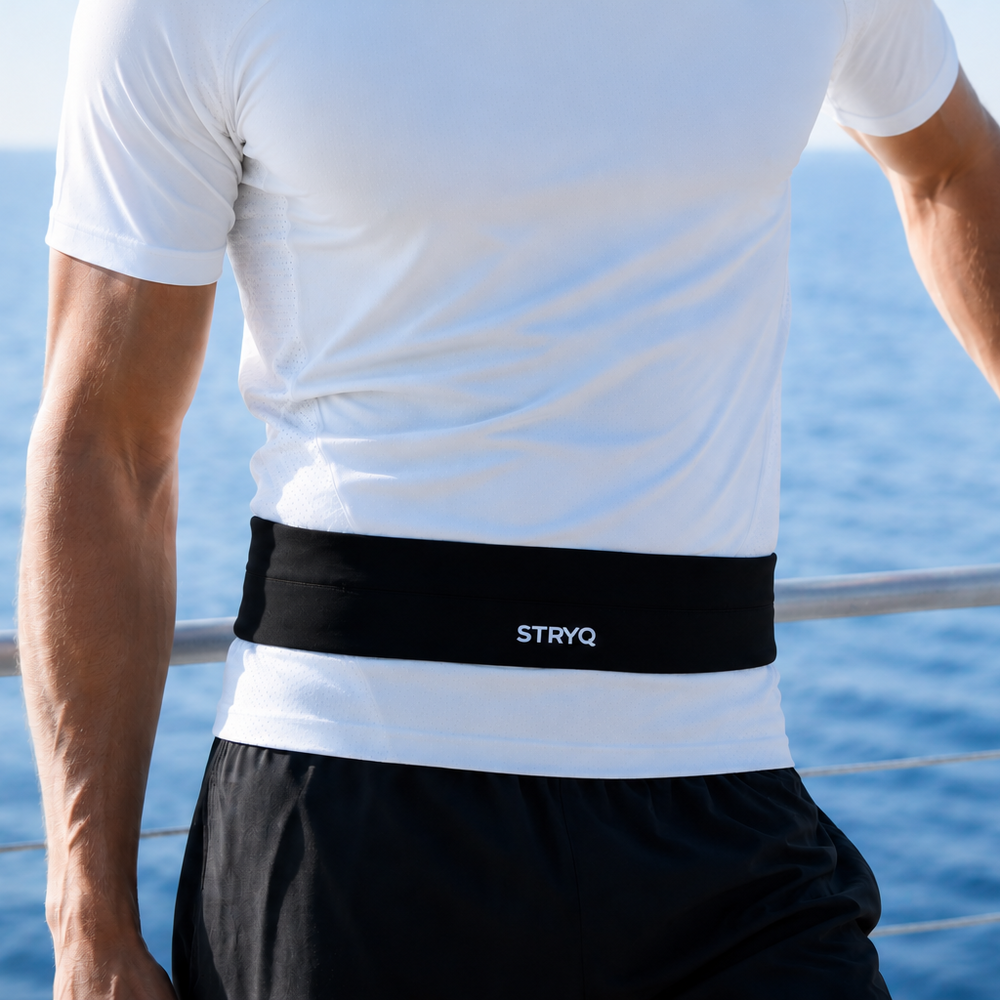
On long winter runs, hand fatigue and head pressure both grow with time. This is where hands-free, lower-body carrying pays off. A running belt with 360° storage lets you keep a small light, phone and keys against your body instead of in your fist.
Can you use both?
Yes, and many experienced night runners do. The combination works because each light fixes a weakness in the other:
- The headlamp (or a chest light) gives steady, general illumination wherever you look.
- A handheld light, or a light worn low, adds shadows and lets you aim at a specific hazard or signal to a driver.
RoutePrinter’s layered-setup advice for trails is a headlamp as primary plus a chest or waist light to add ground texture. For roads, it recommends a front light, a rear red light and reflective details, and it warns that one tiny clip light as your entire plan, or a headlamp aimed straight at eye level, does not work well. Our write-up on when a chest light plus headlamp layered setup makes sense shows how to combine the two without glare.
Seeing is half the job: being seen
Whichever light you pick, it lights your path, but it does not make a driver notice you. Reflective material on moving parts such as ankles and wrists draws the eye because the motion looks like a person. A rear light covers the side that traffic approaches from.
A simple routine for dusk:
- Put on a front light you can aim downward.
- Add something reflective at torso and limbs.
- Add a light facing backwards, so your back is never dark near traffic.
- Choose a lit route and run facing oncoming traffic where there is no pavement, if that is the local norm.
Our four-part night running visibility kit and our guide to where to wear lights at night go through each part.
Perspective: our view on handheld vs headlamp
We build running gear around problems real runners tell us about, and night running comes up again and again: bouncing beams, sore foreheads, a hand that goes numb by mile four.
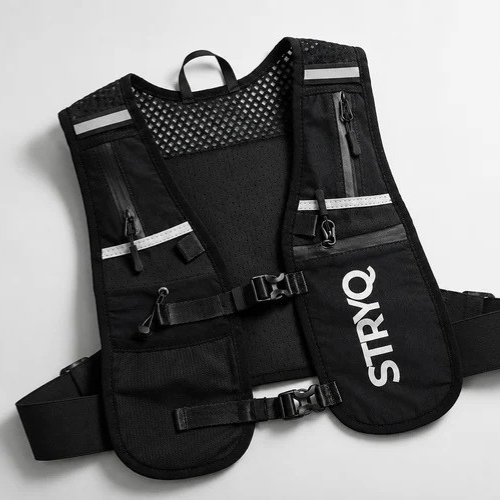
Our view is that the question is rarely which single light to carry. It is where the light sits on your body, and whether other people can see you. Lower light shows the ground, hands stay free, and reflective gear tells drivers you are a runner. That is why our range is built around fit and security: a running belt with 360° storage so essentials do not bounce, a hydration vest with adjustable straps and multiple pockets for longer runs, and a high-vis kit for the being-seen side.
Every product goes through several sample revisions and testing before launch, because gear that moves around or chafes gets left at home. Start with what keeps you comfortable and visible, and add to it as your runs get longer and darker.
martin
Build your night kit
For the visibility layer, our High-Vis Running Vest & Reflective Bands Kit is made for dusk and dark runs. For carrying a light, phone and keys without bounce, take a look at the STRYQ running belt, and for runs where you need fluids as well, the hydration running vest has adjustable straps and multiple pockets. You can see everything together on our running gear collection.
If you are on longer winter runs, a 500ml soft flask rides in a vest pocket and keeps your hands free for whatever light you choose.
FAQ
Is a handheld light or a headlamp better for running?
Neither wins everywhere. A handheld light gives you more control over aim, and a headlamp keeps your hands free. For roads, many runners prefer to carry or wear a light below head height and add reflective gear. For trails, a headlamp plus a second low light is a stronger setup.
How many lumens do I need for night running?
It depends on the surface. One guide suggests 100 to 200 lumens for roads and smooth paths and 200 to 400 for technical trails. Another recommends at least 400 lumens for a headlamp. Whatever the output, angle the beam down so you do not dazzle others.
Why does my headlamp bounce when I run?
Usually it is too heavy or too loose. Keep the lamp light, snug the strap to about two fingers of slack and angle it slightly down from above the brow line. A lower-mounted light moves less because it sits closer to your centre of mass.
Can I run with a handheld light and a headlamp together?
Yes. Use the headlamp for general illumination and the handheld or lower light to add shadows and aim at hazards. Add a rear light and reflective gear for traffic.
Sources
- How to Run Safely at Night, Knighton Runs
- How to Run Safely at Night, Men’s Health
- UltrAspire Waist Lights Gear Review, Team RunRun
- Lights for Running at Night, RoutePrinter