A well-made running hydration vest can stay in your rotation for years, and the habits that decide whether it does are simple: rinse it, dry it fully, keep the fit snug and replace the small parts before they fail. One vest in a Trail Runner Magazine durability feature was still going after more than three years, which gives a realistic picture of what good build and sensible care can deliver. No one number fits every vest, because sweat, salt, sugary drinks, storage and how often you run all move the date. This guide shows what wears out first, how to spot it, and how to make the vest outlast the parts attached to it.
TL;DR
- With sound construction and regular care, a vest body can last several years. One long-term test vest passed three years of hard use.
- The soft flasks, reservoir, tube and bite valve are the parts you replace first, not the vest itself.
- Salt, sweat, heat and storing the vest damp do most of the damage. A cold rinse after runs and full air drying prevent most of it.
- Replace a vest when straps lose their stretch, seams or zips fail, or fit no longer holds the load steady.
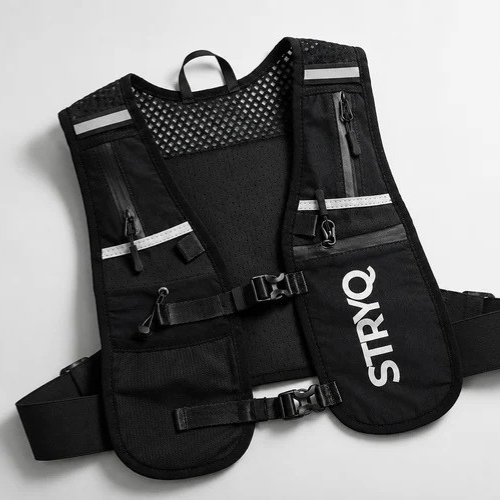
- Our STRYQ hydration running vest is built for durability, tested over multiple sample revisions with feedback from UK runners.
Table of Contents
- How long does a hydration vest last?
- What wears out first
- Signs it is time to replace a part or the whole vest
- What shortens a vest’s life
- Washing and drying: the habits that add years
- Storage and fit: the other half of lifespan
- Repair or replace?
- Is a longer-lasting vest worth it for beginners?
- Our view: build for years, then care for it
- A vest and flasks made to be used
- FAQ
- Sources
How long does a hydration vest last?
There is no official lifespan for a running vest, because it is a fabric, elastic and plastics product, not a regulated safety item. What you can rely on is real-world reporting and your own inspection.
The clearest published example is the Trail Runner Magazine feature on gear that lasts. Its author reports a vest that lasted more than three years, with stretchy material that kept its shape after many miles and survived rough rounds in the washing machine. The author puts that durability down to simplicity: simple hooks in place of two-part plastic clasps, so there were fewer moving parts to break.
That last point is useful when you shop. Every buckle, zip, elastic cord and bungee is one more thing that can fail. A vest with a clean layout, strong stitching and hardware that is easy to replace tends to outlast a complicated one.
As a rough guide for everyday runners:
| Part | What decides its life | What to expect |
|---|---|---|
| Vest body and fabric | Stitching, salt exposure, washing method | Years with care |
| Straps and elastic | Stretch cycles, heat, overtightening | Gradual loss of recovery; check at every wash |
| Zips and clips | Dirt, salt, snagging | Fail one at a time; often cheap to fix |
| Soft flasks | Folding, seam stress, mould | Often the first thing you replace |
| Reservoir, tube, bite valve | Moisture, sugary drinks, heat | Replaced on condition, not on a calendar |
The table is a planning aid based on how these parts typically wear, not a guarantee. Your own mileage and conditions matter more than any average.
What wears out first
In most vests it is not the vest. It is the things you put inside it.
One personal trail running review is a good illustration. The runner’s soft flasks split at the seams and leaked after roughly 120 and 150 miles, while the vest itself was still fine after more than 250 miles. Flasks get squeezed, folded, filled and refilled constantly, so the seams take more stress than anything on the vest.
That is normal, and it is why we think of flasks as consumables. If a flask goes, you swap the flask and carry on with the same vest. Our 500ml running soft flask is made to fit hydration vest front pockets, so a replacement drops straight into the vest you already know fits you.

If your vest uses a tube and bite valve, the valve is the next wear point. It is a small silicone part that is bitten, squeezed and washed hundreds of times. We cover the swap step by step in how to replace a bite valve on your hydration tube.
After that, the order is usually:
- Flasks or reservoir seams
- Bite valve and tube connection
- Elastic cords and stretchy side panels
- Reflective trim, which can peel with repeated washing
- Zips and buckles
- Main fabric and seams
Knowing this order helps you separate a vest that is finished from a vest that needs one small part.
Signs it is time to replace a part or the whole vest
Check the vest every few weeks and before any long run or race. You are looking for these signs.
Parts you replace, not the vest
- Leaking flask or reservoir seam. A split seam or puncture means the container is done. Stop using it for a long run.
- A bite valve that drips after cleaning, feels cracked or stiff, or no longer springs back to shape.
- A tube that is brittle, kinked or split.
- A smell that survives cleaning. Persistent odour or cloudiness inside a flask or reservoir means it is time for a fresh one. For milder cases, our guide to hydration vest smell covers a two-minute routine.
Before you buy a replacement, work through one part at a time over the sink with clean water. Start at the closure, then the seams, the outlet, the tube and the valve. Water runs to the lowest point, so a wet base does not prove the bottom connection is the leak. Often a closure that needed reseating or a hose caught under a strap is the whole problem.
Signs the vest itself is wearing out
- Stretched-out straps and elastic that no longer hold the vest snug. A loose vest bounces more than one cinched down properly, and bounce is what rubs skin and wears seams.
- Frayed webbing, torn mesh or seams pulling open. A small hole or loose stitch can be sewn up quickly. Men’s Health quotes a certified trainer advising that tears should be sewn up as soon as possible to stop them spreading. See their running vest guide.
- Zips that snag or no longer close across a pocket, which risks losing your phone or keys on the road.
- Peeling reflective material. Cosmetic at first, but if you run in low light you want that trim working.
- Fit that no longer holds the load. If you cannot get the vest to stay still with two full flasks, the elastic has lost its recovery.
A useful rule: one worn part is a repair or a swap. Several failing at once, particularly straps and seams, means the vest has done its job and a new one is the better buy.
What shortens a vest’s life
Four things do most of the damage.
Sweat and salt. Tree Line Review’s field-tested vest guide says sweat and salt build-up damages fabric and zips over time, which is why it recommends rinsing after runs and inspecting the fabric and zips periodically for snags, small tears and dirt. Salt crystals are abrasive when they dry in the fibres, and in summer or on long runs you will sweat plenty.
Heat. Hot water, tumble dryers, radiators and a car boot in summer all degrade elastic, coatings and plastics. Heat is the quiet cause of straps that go slack.
Moisture left inside. A damp flask or reservoir grows mould and biofilm. The smell is the first sign, and by then the material is often compromised. Storing anything wet is the habit to break first.
Sugary and electrolyte drinks. Sugars feed mould and leave residue in tubes and valves. Rinse the same day if you ran with anything other than plain water.
Two more factors are in your hands: overstretching elastic when you tighten the vest, and overloading the pockets. If you routinely carry more than the vest was designed for, the seams carry the strain. Our guide on packing a hydration vest shows a balanced load for two 500ml flasks.
Washing and drying: the habits that add years
You do not need a complicated routine. You need a consistent one.
After every run
- Empty the flasks or reservoir and open every pocket.
- Rinse the vest in cold water to flush off sweat and salt. Do it the same day while the salt is still easy to dissolve.
- Hang it in a ventilated spot, away from direct sun and heat, with the zips closed or open as the fabric needs to dry through. Make sure every pocket is dry.
- Rinse the flasks, prop them open and let them dry completely.
Every few weeks, or after a salty summer run
A full wash. Men’s Health quotes advice to machine wash a running vest in cold water on a gentle cycle and hang it to dry, avoiding hot water and the tumble dryer. Whichever method you use, the principles hold: cold or lukewarm water, mild detergent, no fabric softener, no tumble drying. Soft handling keeps the elastic and coatings working. We walk through the whole process in how to wash, dry and store a hydration vest, and cover the straps and foam in washing your hydration vest without wrecking it.

Tree Line Review’s roundup also flags that some manufacturers specify hand washing at no more than 30°C, because machine cycles and dryers can damage the polyurethane coating on certain vests. Check the care label of your vest and follow it.
Flasks, reservoirs, tubes and valves
- Wash inside out with warm water and a little mild soap.
- Clean the tube and valve with a long, thin brush.
- Dry fully, with the opening propped open so air circulates.
- Deep clean after any run with electrolyte or sugary drinks.
- Store dry in a cool place.
The point is to never let moisture sit. If you run three or four times a week, rinsing flasks every time is the single most protective thing you can do.
Storage and fit: the other half of lifespan
Where the vest lives between runs matters. Keep it dry and ventilated: not balled up in a gym bag, not hung over a radiator, not left in a hot car. A vest on a hanger or hook, with pockets open, will dry and keep its shape.
Fit also affects wear. A vest sized and adjusted properly moves less on your torso, which means less friction on the seams and less strain on the elastic. If you find yourself tightening straps to the last notch just to stop bounce, read how to fit a hydration vest without bounce. An organised layout also reduces the yanking and stuffing that wear zips and fabric, which is the focus of organising your hydration vest for race-ready runs.
Repair or replace?
A simple way to decide:
| Problem | Usual answer |
|---|---|
| Dripping bite valve | Replace the valve |
| Leaking flask seam | Replace the flask |
| Small hole or loose stitch in fabric | Sew it up now |
| Odour that cleaning removes | Keep, and clean more often |
| Odour that returns every time | Replace the flask or reservoir |
| Stretched straps and loose fit | Replace the vest if re-adjusting no longer holds it still |
| Several seams or zips failing | Replace the vest |
The rule of thumb is to take the smallest fix that restores safe, comfortable use. That keeps a good vest in service for as long as it deserves, and it also tells you honestly when the vest has had its time.
Is a longer-lasting vest worth it for beginners?
If you are new to running, it is tempting to buy the lightest, cheapest vest and see if you like it. That makes sense for a few weeks. But if you are heading into 10K, half marathon or marathon training, you will wear the vest several times a week for months. Cost per run falls fast when a vest holds up, and a vest that fits and does not fail mid-run is one less thing to worry about on race day. Our article are hydration vests worth it for runners goes through when a vest earns its place over a belt or handheld bottle.
Our view: build for years, then care for it
We design running gear around a simple idea: if a product is going to be part of your routine, it should hold up to it. That is why every STRYQ product goes through multiple sample revisions, extensive testing and strict quality control, using feedback from runners in the UK, before it is launched.
For a hydration vest, durability comes from the unglamorous details: adjustable straps that hold the fit without being cranked to the limit, multiple pockets that spread the load instead of stressing one seam, and a design that does not rely on unnecessary complexity. We would rather you get years of runs from one vest than replace it every season.
The other half is your routine. A cold rinse after a run and a proper dry will do more for your vest than any feature on the label. And when a flask or valve eventually wears out, replacing that one part is a normal part of owning a vest, not a sign something has gone wrong.
martin
A vest and flasks made to be used
If you are choosing a vest you want to keep, our STRYQ hydration running vest has adjustable straps and multiple pockets, and it was developed and tested by UK runners. It is designed to be comfortable and secure over long runs and to keep doing so as the miles add up. For the part that wears first, the STRYQ 500ml running soft flask is made for hydration vests, so a spare is easy to keep at home.

You can see the full range of belts, vests and safety kit on our running gear collection.
FAQ
How many years should a running hydration vest last?
There is no fixed figure, but with regular rinsing, gentle washing and proper drying a vest can last several years. One vest in a long-term durability feature passed three years of use. Judge by condition: fit, seams, zips and straps tell you more than the calendar.
Which part of a hydration vest fails first?
Usually a soft flask, reservoir or bite valve. These parts are squeezed, filled and cleaned constantly, so seams and silicone wear before the vest does. Replacing the part is normal and keeps the vest going.
Can I put my hydration vest in the washing machine?
Some makers allow a cold, gentle cycle and hang drying, and others specify hand washing in lukewarm water, so follow the care label on your vest. Avoid hot water, fabric softener and the tumble dryer in every case. Our vest care guide covers the full routine.
How do I stop my vest and flasks from smelling?
Rinse the vest and flasks the same day, dry them fully with the flask opening propped open, and store them dry. Smell comes from moisture and sugary drink residue left behind, so a quick rinse after each run prevents most of it.
When should I replace the whole vest?
Replace it when the straps and elastic no longer hold it snug, when seams or zips are failing in several places, or when it bounces even after you readjust it. One isolated fault, such as a dripping valve or a leaking flask, only needs that part replaced.
Sources
- Trail Running Gear That Lasts, Trail Runner Magazine
- Best Running Hydration Vests of 2026 (Field-Tested), Tree Line Review
- The Best Running Vests, Men’s Health
- Aonijie Triwonder hydration vest review, Beast Coast Trail Running