Yes, you can freeze a soft flask, and for hot long runs it is one of the simplest tricks going. The rules are short: clean it first, fill it only about two-thirds to three-quarters full, freeze it flat or upright with the spout up, and top it up with cold water before you leave. Water expands as it freezes, so a flask filled to the brim is the one that splits.
This guide covers the exact fill level, the cap and valve, how to thaw it on the move, what to do in the opposite problem (a flask freezing in winter) and how to store a flask in the freezer without growing mould.
TL;DR
- Fill a soft flask no more than about 70% to three-quarters full, so the ice has room to expand.
- Wash and fully dry it first: freezing only puts bacteria to sleep, it does not remove them.
- Freeze it flat or spout up, with nothing heavy on top, for at least four hours or overnight.
- On the run, top it up with cold water so it melts into an ice-cold drink over the first hour.
- Never store a wet flask in the freezer: if you store it there, make sure it is empty and completely dry.
Table of Contents
- Why a frozen soft flask works on hot runs
- Can you freeze a soft flask without damaging it?
- How to freeze a soft flask, step by step
- Frozen versus half frozen: which is better?
- How to thaw and use it on the run
- Winter: when the flask freezes by itself
- Storing a flask in the freezer between runs
- Common mistakes
- Our perspective
- A flask built for long runs
- FAQ
- Sources
Why a frozen soft flask works on hot runs
A frozen flask does two jobs. It keeps the drink cold for far longer than a flask filled from the tap, and as the ice melts it gives you a steady supply of cold water instead of a warm mouthful at kilometre ten. Runners who tackle summer half marathons and marathons use it for exactly that reason: a flask in a vest pocket or a belt sits against a warm body, and unchilled water warms up quickly.
Some runners go a step further and add electrolytes or a pinch of salt before freezing. One runner’s marathon-training tip describes a frozen flask with a crumbled electrolyte tablet and a little salt that melts gradually into something cold and refreshing. If you want to mix a drink properly rather than guess, our guide to mixing electrolytes in a soft flask without clumps covers the order of powder and water.
The flask itself is what makes this practical. A soft flask collapses as you drink, so it stops sloshing and shrinks as it empties. A frozen block of ice is bulky at the start, but it gets smaller and lighter with every sip. That is a good reason to choose a soft flask over a rigid bottle for this job, and our comparison of a soft flask versus a hydration bladder explains which one suits which runner.

Can you freeze a soft flask without damaging it?
Yes, if you leave room for expansion. Water takes up roughly 9% more volume as ice, according to Kit Authority’s hydration bladder guide, and that is enough to split seams if the flask is full. The splits do not come from the cold. They come from ice with nowhere to go.
The second risk is the weak points. The cap threads, the valve and, on a bladder, the tube all hold small amounts of water. Those freeze first and can crack or stop working. Sorting these out is most of the technique.
The third risk is the flask material. Flexible flasks are made of different plastics, and some are meant for cold use more than others. Check the care instructions that came with your flask and follow them if they give a fill limit or temperature range.

How to freeze a soft flask, step by step
1. Clean it first
Wash the flask with warm water and mild soap before it goes in the freezer. Crate Club’s guide to freezing hydration bladders points out that freezing only makes bacteria dormant, so any mould or film already inside will be waiting when the water thaws. Also look at the seals and the cap for cracks or debris. If you need a routine, our soft flask cleaning guide takes you through it.
2. Fill to the right level
The usual advice is between two-thirds and three-quarters full:
- A flask maker’s instructions say to fill a flask to no more than 70% of capacity when it is fully inflated, and to freeze it spout up.
- The Crate Club guide suggests two-thirds to three-quarters full, about 2 litres in a 3-litre system, and squeezing out excess air before sealing.
- A watermelon salt slush recipe for a 500 ml soft flask fills the flask about three-quarters full to leave room for expansion.
For a 500 ml flask, that means roughly 330 to 375 ml. That is not much drink, which is why you top it up before the run (see below). If you are unsure, go lower: a flask that is half full always survives, and you can add more cold water at the start.
3. Dry the cap and threads
Wipe the neck and the threads before closing the flask. Crate Club notes that wet screw-cap threads can ice up and freeze shut, which is annoying when you are trying to get the cap off at the start line. A quick wipe with a clean cloth does it.
4. Lay it flat or stand it spout up
The flask maker’s guidance is to freeze with the spout up. Crate Club suggests freezing flat or horizontal with no heavy items on top, because pressure on the plastic as it freezes can leave permanent creases or weak spots. A flask lying on a tray on its own is perfectly good. A recipe for a slush flask freezes it lying flat for at least four hours or overnight, and says it keeps for up to a month in the freezer.
The practical version: put it on a flat shelf, away from the frozen peas, and leave it overnight.
5. Check before you run
A flask that has frozen solid can be stiff. Pull it out a few minutes before you leave, and run it under water for a few seconds, as the flask-maker’s instructions suggest, to loosen the ice from the walls. Look at the seams and the valve. If you see a split, a crease that will not smooth out or a cap that does not seal, do not use it for the run, as it will leak in your vest.
Frozen versus half frozen: which is better?
There is no single right answer, so think about the run:
| Run | What to freeze | Why |
|---|---|---|
| Up to 10K in summer heat | One flask, about two-thirds full, topped up with cold water | Cold drink for the whole run, light enough not to bother you |
| Half marathon | Two flasks, one frozen, one fresh | The frozen one is cold later on, the fresh one is drinkable from the start |
| Marathon or long training run | A frozen flask with electrolytes, plus a normal flask | Slush melts into a cold drink; the second flask is your reliable supply |
| Very hot day | Frozen flask against your chest or back | The ice also cools you down through the vest |
One common problem with a solid flask is that you cannot drink from it in the first 20 minutes. Topping up with water solves it. The slush recipe mentioned earlier says its flask thaws into an ice-cold slush over the first hour of a hot run, which gives you a good guide for timing.
How to thaw and use it on the run
- Top up before you leave. Fill the remaining space with cold tap water. Now you can drink from minute one, and the ice keeps it cold.
- Carry it where you want it. In a vest front pocket it sits against your chest and cools you down. In a belt or a back pocket it melts more slowly. If you use a vest, our guide on how to organise hydration vest storage shows where bottles sit best.
- Squeeze and shake. Gentle pressure on the flask moves melted water to the spout. Bending the flask also breaks up the ice, a tip from the flask-maker’s instructions for freezing ice cubes.
- Do not force it. If the spout is blocked by ice, wait a minute or two rather than biting and squeezing hard, which can damage the valve.
- Refill smartly. At a water stop, refilling a half-ice flask with cold water keeps it chilled. Our guides to refilling soft flasks without a mess and to fast, clean, leak-free refills are worth reading before race day.
If the flask leaks as the ice melts, a loose cap is the usual cause rather than the ice. Our advice on how to avoid flask leaks on every long run covers the cap and valve checks.
Winter: when the flask freezes by itself
The opposite problem happens in a cold snap. On a below-freezing run, the water in the spout or tube can freeze before the rest of the flask does. Crate Club explains that the tube and valve freeze faster than the main reservoir because they hold little water for their surface area, and that ice in the valve can damage it.
For winter runs:
- Blow air back after sips if you use a tube, so the water drains out of it.
- Keep the flask close to your body, under a jacket or the vest’s inner pocket, where body heat holds off the ice. If a tube freezes solid, tuck it inside your shirt.
- Start with warm, not hot, water. Warm water takes longer to freeze, but never use boiling water in a soft flask.
- Carry less water in a cold spell. Smaller loads empty before they freeze, and you drink less when it is cold anyway.
If you also run in the dark, a safety light or a high-vis kit makes the early-morning winter run safer. We stock a High-Vis Running Vest and Reflective Bands Kit for exactly that.
Storing a flask in the freezer between runs
Some runners keep a flask in the freezer so it is ready to go. Others store a clean flask there to stop mould. Both can work, but a wet flask is the problem.
Kit Authority’s guide says that for freezer storage, the flask must be completely empty and completely dry. It also suggests sealing it in a zip-lock bag to keep out freezer odours. The seams dry last and are where mould most often appears, so give them an extra 24 hours of drying. If the sealed edge still feels cool or film-like, it needs longer.
So the rule is:
- A flask you will use soon: fill to two-thirds, freeze, and use it within days. Label the date if it has electrolytes in it.
- A flask you want to store: wash, dry for at least a day (longer at the seams), bag it and freeze it empty.
After a long storage, wash it again before first use. For more on picking containers that suit cold and warm storage, this travel-friendly bottle guide is useful for the wider question of which bottle goes where.
A flavoured drink needs special care. Sugary mixes leave residue and flavour behind, which speeds up smells. If your flask tastes off after a few uses, our page on fixing soft flask taste goes through what to do.
Common mistakes
- Filling to the top. The most common cause of splits.
- Freezing a dirty flask. Bacteria and mould come back when it thaws.
- Stacking things on top. Weight leaves creases that become weak spots.
- Leaving the cap wet. Ice glues threads shut.
- Using the flask for ice cubes alone. If you want ice cubes, fill it to a quarter only, soften it under water and bend it to break the ice, as the maker’s guidance says.
- Biting or hammering a frozen spout. You will tear the valve.
Our perspective
We design our flasks and vests around problems runners tell us about, and the freezer question comes up every summer. The answer is almost always about how you use the flask, not about how clever the trick is: leave room for the ice, keep it clean and dry, and top it up with cold water so the first kilometre is not a block of ice.
That is why we build running gear with a lot of testing and several sample revisions before anything goes on sale. A flask that fits a vest pocket properly, seals properly and collapses as you drink is the one you will actually reach for at kilometre 15 on a hot day. We think runners deserve premium quality that does not cost premium-brand money, and we want products that last for many seasons.
If you take one thing from this guide, make it the fill level: two-thirds, not full.
martin
A flask built for long runs
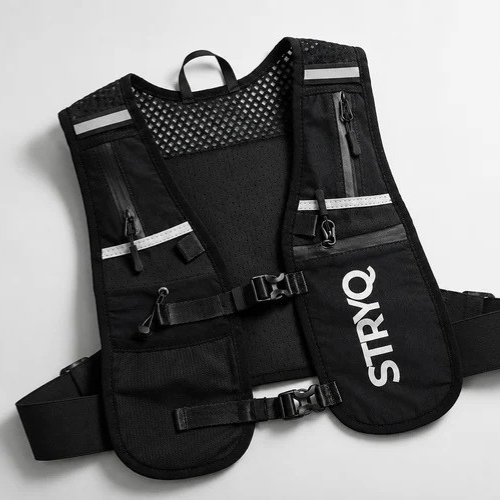
If you are looking for a flask to carry cold water in a vest, our STRYQ 500ml Running Soft Flask is made to fit hydration vest pockets and is developed and tested by UK runners. It sits well alongside our hydration running vest, which has adjustable straps and multiple pockets so you can carry two flasks and your fuel.

If you carry several flasks on long runs, our guide to what to carry in a hydration vest helps you plan the load.
FAQ
How full should I fill a soft flask before freezing it?
About two-thirds to three-quarters full. A flask maker’s guidance says no more than 70% of a fully inflated flask, and other guides say up to three-quarters. For a 500 ml flask, that is roughly 330 to 375 ml, which leaves space for the ice to expand.
Can I freeze a soft flask with electrolytes in it?
Yes, runners do it for hot runs, but keep the same fill level and clean the flask well afterwards, because sugary mixes leave residue. Use a frozen flask within a few days rather than leaving it for weeks.
How long does a soft flask take to freeze?
Plan for at least four hours, and overnight is easier. A flat flask freezes more evenly. If you want slush rather than a solid block, take it out earlier and shake it.
Can I store an empty soft flask in the freezer?
Yes, as long as it is completely dry first. Moisture trapped in the seams can grow mould, so give them an extra day to dry, then seal the flask in a bag to keep out freezer smells.
My flask froze solid on a winter run. What now?
Keep it against your body under a jacket and let it thaw before you squeeze. Do not force a blocked spout or bite on it, as this can damage the valve.
Sources
- Flask Instructions, Easy Traveler Inc
- Can You Freeze Your Hydration Bladder? Crate Club
- How to clean a hydration bladder, Kit Authority
- Watermelon Salt Slush Flask, RunCoach Recipes
- Marathon Training Tip for HOT long runs, Get Up Earlier