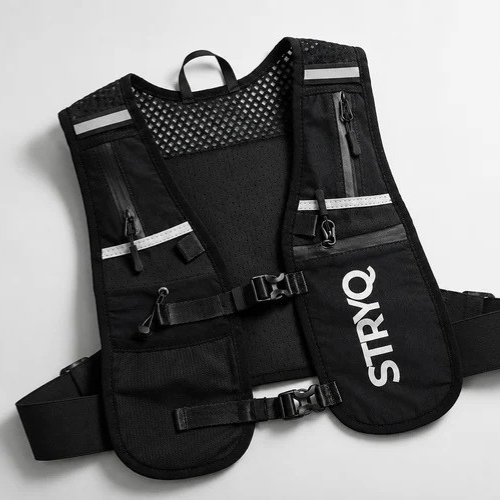
A running vest bounces when it is the wrong size, loosely adjusted or loaded unevenly, and all three can be fixed in a few minutes before a run. Loosen every strap, put the vest on, tighten the chest straps first, then the sides, and pack the heaviest items low and close to your back. Test it with a short jog before you leave. Our own hydration vest has adjustable straps and multiple pockets, so you can tune the fit to your body and to what you carry.
TL;DR
- Bounce comes from three things: a vest that is too big or too loose, straps adjusted in the wrong order, and a load that shifts around in the pockets.
- Start from fully loosened straps, then snug the chest straps and tighten the side straps if your vest has them. Fitting guidance from Trail Sisters follows this order.
- Secure soft flasks and small items so they cannot swing. Pack the heaviest things low and central.
- Chafing usually follows bounce, so fix the movement first, then look at fabric and contact points.
- Finish every adjustment with a short jog and check for bounce, shift, swing, breathing and arm movement.
Table of Contents
- Why a running vest bounces
- How a running vest should fit
- The step-by-step fix
- Packing the vest so nothing swings
- When the vest rubs: preventing chafing
- Quick check before and during a run
- Does a vest suit your running?
- What we have learned about vest bounce
- Our vest and flasks
- FAQ
- Sources
Why a running vest bounces
A vest is a small rucksack that wraps your torso. Every stride sends your body up and down, and anything loose on you moves slightly out of step with your body. A snug vest moves with you. A loose one lags, then slaps back down on the next stride. That repeated slap is what you feel as bounce.
For most runners, the cause is one of five things.
The vest is too big. If you can fit a hand flat between the vest and your chest, or the shoulder straps sit off your collarbones, there is slack that no strap can remove. Size by your chest measurement against the maker’s size chart, not by what you usually wear in a t-shirt.
The straps were adjusted in the wrong order. Tightening one strap hard while the others stay loose pulls the vest sideways or up. It will feel tight in one place and still bounce in another.
The load is uneven. A full flask on one side and nothing on the other swings the vest toward the heavy side with each step. Heavy items high up act like a pendulum.
Flasks and items can move inside their pockets. A bottle that is free to slide around in a pocket adds its own movement on top of the vest’s. Runners regularly complain of bottles jumping around in the pockets, particularly as they empty.
Your clothing is working against you. A baggy jacket or a thick, slippery layer under the vest lets the vest slide over it. Each layer changes how the vest sits.
None of these is a flaw in you or your running form. They are fit problems, and fit problems have a routine fix.

How a running vest should fit
A good fit is snug all the way round, not tight in one spot. Trail Sisters’ fitting guide describes a vest that sits securely around the shoulders, chest, lower back and below the armpits, without being too tight or too loose.
You are looking for these signs:
- The shoulder straps lie flat on your shoulders without digging into your neck.
- The vest’s bottom edge sits around the lower back or waist, not riding up between your shoulder blades.
- You can take a full breath into your belly without the chest straps restricting you.
- You can swing your arms freely without the armholes rubbing.
- When you shake your torso, the vest moves with you instead of lagging behind.
If you are choosing a vest rather than adjusting one you own, our guides on how to choose hydration vests that don’t bounce and how to choose a running vest that stays put go through sizing and features in more depth.
The step-by-step fix
Work through this at home first, then check it on the road. It takes about five minutes the first time and under a minute once you know your settings.
1. Load the vest the way you will run
Fit the vest with the weight you will actually carry. An empty vest fits differently from a loaded one, and adjusting it empty is the most common reason it loosens up mid-run. Fill the flasks, add your phone, keys and any food, and zip the pockets.
2. Loosen every strap
Start with all adjusters open. Trail Sisters advises loosening the straps before you put the vest on. Trying to fine-tune from a half-tight position leads to uneven tension and a vest that sits crooked.
3. Put it on and settle it
Put your arms through, then let the vest sit naturally on your shoulders. Give it a little shrug so it drops into place. If it will not sit near your lower back, it may be too large or too long for your torso.
4. Snug the chest straps
The chest or sternum straps do the most to stop the front of the vest swinging away from you. Fasten them across the chest, firm but not so tight that your breathing feels held in. If the strap position can be moved up or down, set it where it sits comfortably across the chest and does not ride up toward your throat. GearJunkie’s review of one running vest notes that adjustable sternum-strap height and side-torso straps help tailor the fit.
5. Tighten the side straps
If your vest has side straps, pull them in evenly, a little on each side, until the vest hugs your ribcage. This takes out the sideways slop and is where most bounce is cured. The same review found side straps easy to adjust while moving, which matters because you may need a small tweak after a mile or two as the bottles empty.
6. Make small corrections, not big ones
Adjust in small increments and re-check. Hauling one strap tight to fix a symptom usually creates a new one somewhere else. Our guide on fixing hydration vest bounce with micro adjustments covers this fit-first approach, and the five-step no bounce fit is a quick version you can follow with the vest in your hands.
7. Jog before you commit
Take a short jog around the block. Trail Sisters recommends a short test run after fitting and checking that the vest does not bounce, shift or swing, and that your breathing and arm movement stay comfortable. If anything fails that check, go back to step 4 or 5 and adjust again.
Packing the vest so nothing swings
Even a perfectly fitted vest bounces if the contents move. Think about where the weight sits.
Heavy and dense items go low and close to your back. Water is the heaviest thing you will carry. The closer the weight sits to your centre of gravity, the less it affects each stride.
Balance left and right. If you carry one flask, put it on one side and balance it with something of similar weight on the other, such as a phone or food. If you carry two, fill them to the same level.
Keep soft items together in one pocket. Loose keys and a card in a big pocket will rattle and shift. Group them and zip the pocket, or tuck them into a small inner pocket.
Do not overload the back. A vest crammed with spare layers you may not need has more mass to move. Carry what the run requires.
Keeping soft flasks from jumping
Soft flasks are a big help here because they collapse as you drink. A rigid bottle stays the same size and can slosh as it empties, while a soft flask shrinks and keeps its shape against your chest. The problem comes when the flask is too small for its pocket or only half full and flops forward.
To stop flasks jumping around:
- Fill the flask close to full when you start so it does not slosh. Squeeze out the air before closing.
- Seat it fully down into the pocket with the nozzle pointing up.
- Use any elastic cord or retainer in the pocket to hold the neck of the flask. Many vests have a small elastic that goes around the spout for exactly this reason.
- As the flask empties, roll or flatten it rather than leaving it floppy, and re-tighten the side straps if the vest loosens.
Our 500ml running soft flask is made to sit in the front pockets of a hydration vest, and the green 500ml hydration vest bottle comes in a second colour if you want to tell two flasks apart.
When the vest rubs: preventing chafing
Bounce and chafing go together. A vest that moves drags its edges across the same patch of skin hundreds of times per mile. Fix the movement first, and the rubbing often goes away. If it does not, work through this list.
Check the contact points. The usual culprits are the neck where the shoulder straps meet, the armpits, the sides of the ribcage and the lower back. Note exactly where it rubs after a run, because that tells you which strap or edge to adjust.
Raise or lower the strap position. If the shoulder straps cut into the side of your neck, the vest may be sitting too high. If the chest strap sits on your collarbone, move it down if the design allows.
Wear a close-fitting, smooth top. A top that hugs your body gives the vest less fabric to drag across. Loose or creased tops bunch up under the straps and rub. Your fabric choice also affects how much sweat builds up and how long skin stays damp, which is why moisture-wicking versus cotton is worth reading before your next long run.
Cover bare skin on the worst spots. If you are running without a top under the vest or in a vest cut at the armholes, rubbing at these points tends to be worse. A thin layer between skin and strap helps.
Keep sweat in check. Wet skin chafes sooner than dry skin. A fresh, dry top at the start of a longer run helps, and a sweat-wicking fabric helps through the run.
If you get skin that is broken, bleeding or persistently sore after runs, rest it and speak to your GP or pharmacist.

Quick check before and during a run
Use this short checklist at the door, then once in the first mile.
| Check | What you want to feel | If it fails |
|---|---|---|
| Shake test | Vest moves with your torso | Tighten side straps a little |
| Chest strap | Snug, but you can breathe deeply | Move or loosen the strap |
| Shoulders | Straps flat, nothing digging in | Lower the vest or loosen the straps |
| Flasks | No sloshing, no jumping | Fill fully, seat in pocket, use elastic |
| Arm swing | Free, no rubbing at the armholes | Check size and sleeve layers |
| Jog | No bounce, shift or swing | Repeat the fit steps from loosened |
Do a second check after the first mile. As flasks empty and your body warms up, a strap may need a quick tweak. Choose a vest whose adjusters you can reach while moving.
Does a vest suit your running?
Not every run needs a vest. A parkrun or a 5K usually needs nothing more than a phone and a key, which a running belt can hold. A vest becomes useful when you run longer than about an hour, when you need water and food with you, or when the route has no places to refill. Our guide on whether hydration vests are worth it helps with that choice.
For beginners moving up from Couch to 5K to 10K, half marathon or marathon training, the vest becomes a normal part of your kit as your long runs get longer. That is the point to learn the fit routine above, because a vest set up correctly in training behaves the same way on race day.
What we have learned about vest bounce
Most of the bounce complaints we hear about come down to fit and packing, not to the runner. A vest should be adjustable enough that you can find a snug position on your own body, on your own run, with your own load.
That is why we design our hydration vest around adjustable straps and multiple pockets, and why every product goes through sample revisions and testing with real runners before we release it. We would rather build something practical that you can set up in a minute than add features you will never use.
Our advice is the same whether you buy from us or not: fit the vest loaded, adjust in small steps and jog before you leave. We built our range so that routine works well, from the vest to the flasks that go in it.
martin
Our vest and flasks
If your current vest keeps bouncing despite careful fitting, the vest itself may be the limit. The STRYQ hydration running vest has adjustable straps and multiple pockets, so you can set the fit to your frame and carry your flasks, phone and food in separate places. Pair it with the 500ml soft flask and you have the setup this guide describes.

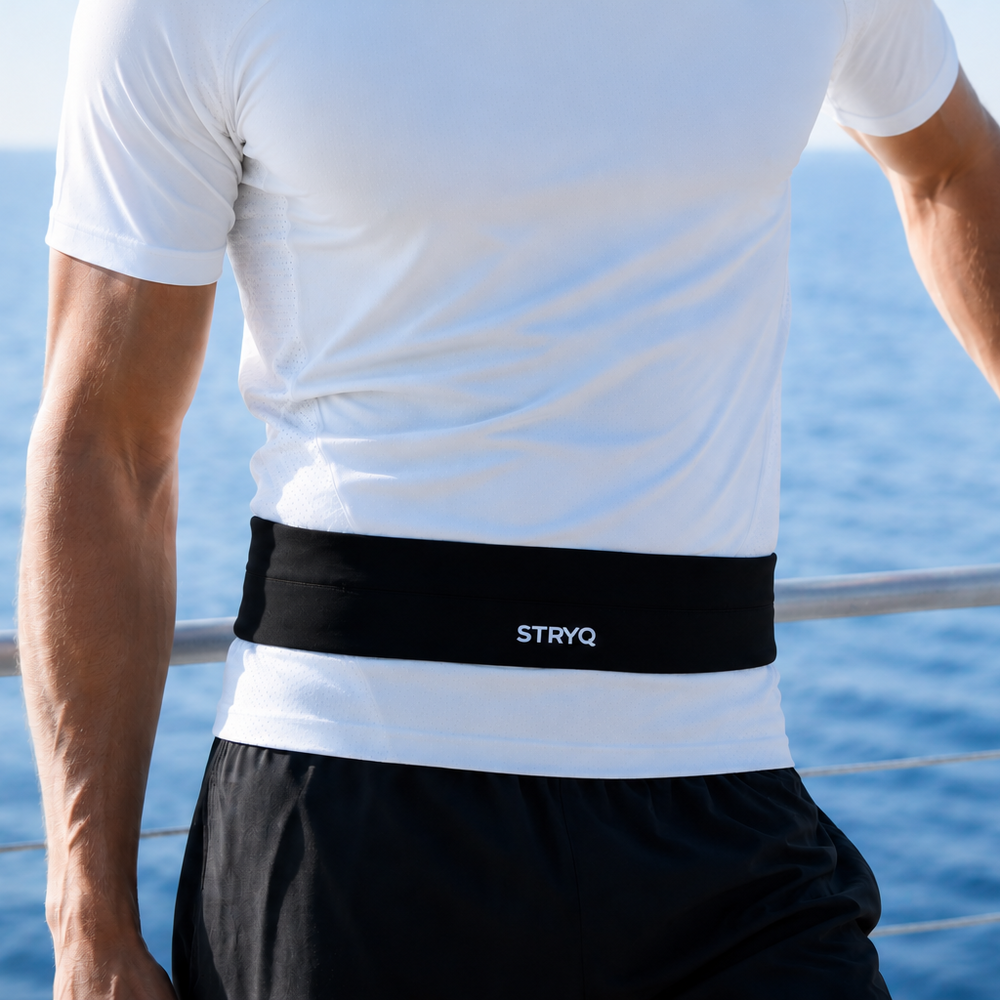
For shorter runs, a belt may be all you need. See the full range in our running gear collection, which also includes the high-vis vest and reflective bands kit for dark mornings and evenings. Running socks with arch support and cushioning are in the running socks collection.
FAQ
Why does my running vest bounce even when it feels tight?
Tight in one place does not mean snug all round. Straps pulled hard on one side or the chest alone can leave slack elsewhere. Loosen everything, fit the vest loaded, then tighten chest straps and side straps in small, even steps.
Should I fill my flasks to the top?
Filling close to full usually stops liquid sloshing and keeps the flask firm in its pocket. Squeeze out the extra air before you close the cap. As you drink, flatten or roll the flask and re-check the side straps.
How do I stop a vest chafing my neck?
First remove the bounce, because movement is what rubs. Then check that the vest is not sitting too high and that the shoulder straps lie flat. A smooth, close-fitting top underneath also reduces friction.
Is a vest better than a belt for bounce?
It depends on the distance and what you carry. A belt suits a phone and keys on shorter runs, and a vest suits longer runs with water and food. Either one needs a snug, balanced fit to stay still.
How long should I test a vest before a long run?
A short jog is enough to spot obvious bounce, shift or swing. Do it with your normal load, then check again in the first mile of the run, since flasks empty and straps settle.