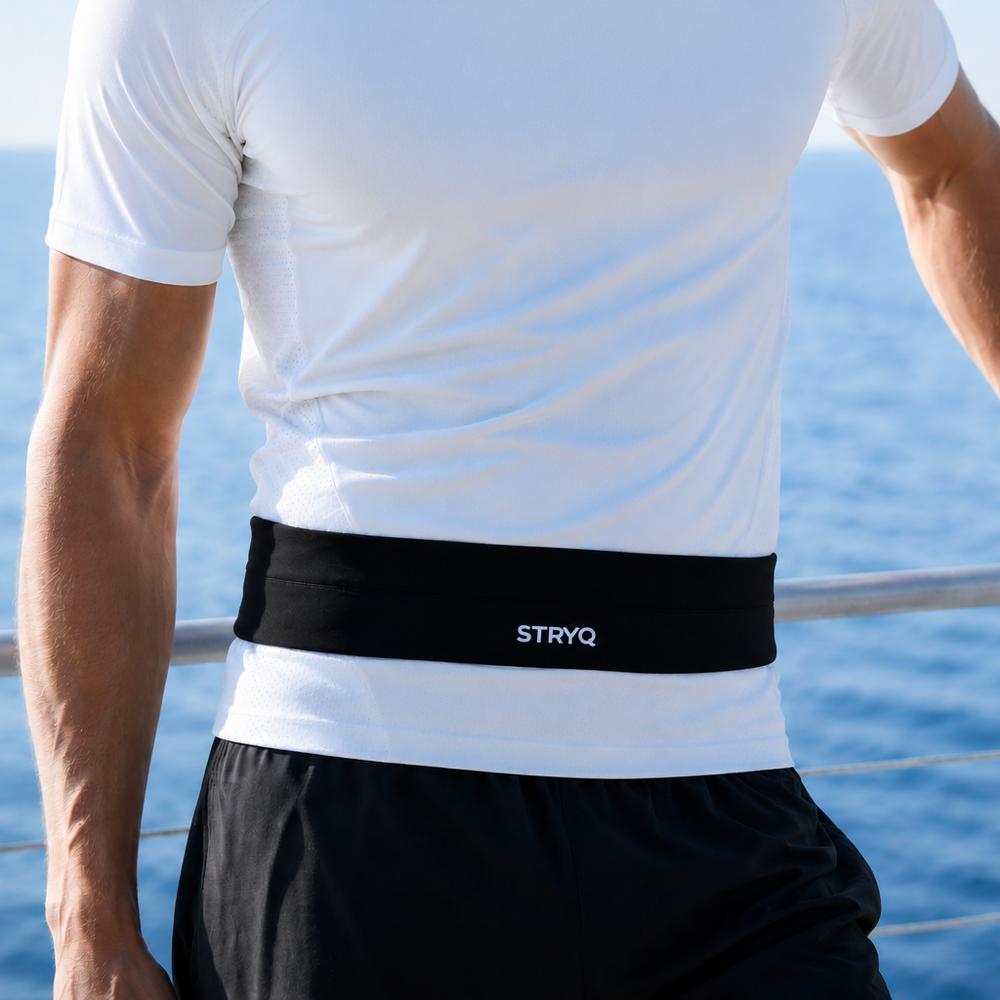
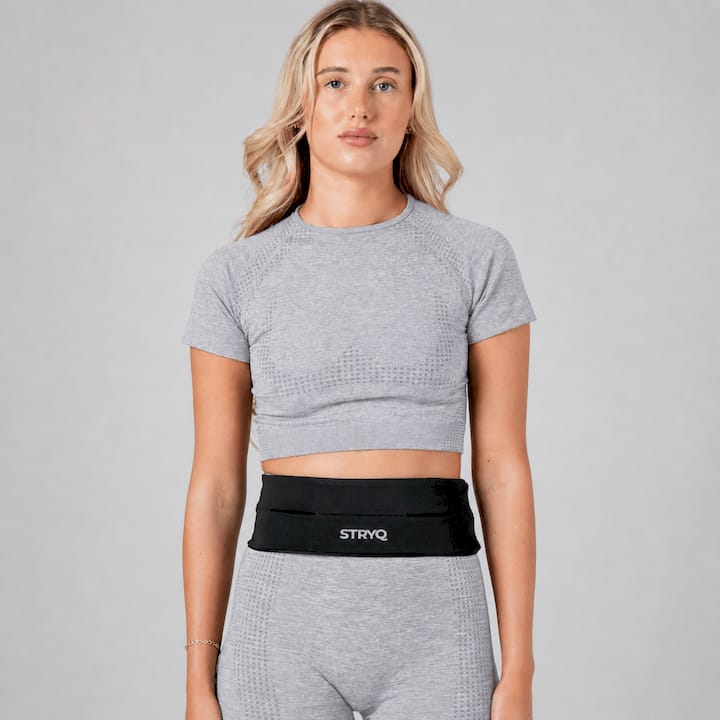
If your running belt bounces, wear it lower on the pelvic bone and tighten it slightly. That single change removes most bounce instantly, because it moves the load onto bone rather than soft tissue that shifts with every stride.
Before your next run, work through this quick checklist:
- Measure your hips at the widest point, roughly level with the top of your hip bones.
- Set placement low, sitting over the pelvic rim rather than up at your natural waist.
- Pack heavy items (phone, keys, flasks) centrally at the back, balanced left to right.
- Test jog for two minutes at pace before committing to a long run.
Independent testing across running gear reviewers consistently points to the same conclusion: incorrect placement is the most common cause of a bouncing belt, not the belt itself. A wide, tubular, buckle-free design, such as the STRYQ RUNNING BELT, solves most of this at the design level, leaving fit and packing as the only variables you need to manage.
Key Takeaways
Running belt bounce is almost always fixable through pelvic placement, correct tension, and balanced packing, before you need to change the belt itself.
| Point | Details |
|---|---|
| Wear it low, on the pelvis | Position the belt over the bony pelvic rim, not the natural waist, for a stable anchor point. |
| Tighten more than feels needed | Fit snug while standing still since fabric and load loosen once you start moving. |
| Pack heavy items centrally | Place the heaviest item near your lower back and balance flasks left to right. |
| Test with real load, not empty | Jog for two minutes with the exact items you’ll carry before trusting the setup on race day. |
| Choose design details that resist bounce | The STRYQ RUNNING BELT uses a wide tubular band, buckle-free closure, and 360° storage built around these fixes. |
Table of Contents
- Why running belt bounce happens in the first place
- How to fit, pack and test your belt for zero bounce
- What features actually stop a belt from bouncing
- Getting the size right the first time
- When a belt isn’t the right tool for the job
- How STRYQ’s belt design solves the causes of bounce
- Keeping your belt bounce-free over months of running
- Where to get a belt built to solve this
- Frequently asked questions
- Sources
Why running belt bounce happens in the first place
Belt bounce isn’t bad luck. It’s physics acting on a badly fitted or badly designed strap.
Your pelvis is the only stable anchor point on your lower body during a run. A belt worn at the natural waist, above the hip bones, has nothing solid to grip and will creep upward and rotate with every stride. Worn lower, over the bony ridge of the pelvis, belts sit on structure rather than soft tissue, which is why placement fixes more bounce than any single product feature.
Running also generates vertical oscillation. Even efficient runners bounce several centimetres with each footstrike, and that motion transfers directly into anything strapped loosely around the torso. Arm swing adds a rotational force on top of it. A belt that’s a centimetre too loose amplifies both, turning a gentle bob into a visible, irritating bounce by kilometre three.
Design faults make this worse:
- Narrow straps concentrate pressure into a thin band, which flexes and slips rather than holding firm.
- Buckle closures can work loose from vibration over a run, needing constant readjustment.
- Low-quality elastic stretches permanently after a few washes and loses its recoil.
- Slippery synthetic fabrics slide against technical tops instead of gripping.
Then there’s packing. An unbalanced load acts like a pendulum. A single full soft flask on one side, or a phone shoved into a side pocket, creates a swinging weight that the belt has to fight with every stride. Removing air from soft flasks and balancing weight left to right cuts a surprising amount of movement, because sloshing liquid and lopsided loads are often the actual source of what feels like “the belt bouncing”, when it’s really the contents doing the swinging.
Continuous tubular elastic bands behave differently under load than buckled webbing. As liquid weight drops during a run, an elastic tubular design will typically contract and re-tension itself, while a buckled belt usually needs manual retightening as your flask empties. That’s one reason belts without buckles tend to stay stable for longer without you touching them.
How to fit, pack and test your belt for zero bounce
Fixing bounce is a sequence, not a single tweak. Runners who skip steps usually end up blaming the belt for a packing or placement mistake.
1. Measure properly, at the right point. Wrap a tape measure around your body at the widest part of your hips, roughly where your hip bones sit, not your natural waist. This is almost always a few centimetres lower than where most runners instinctively measure. Match that figure against the belt’s size chart. If you’re between sizes and plan to carry more weight, size down slightly for a firmer hold.
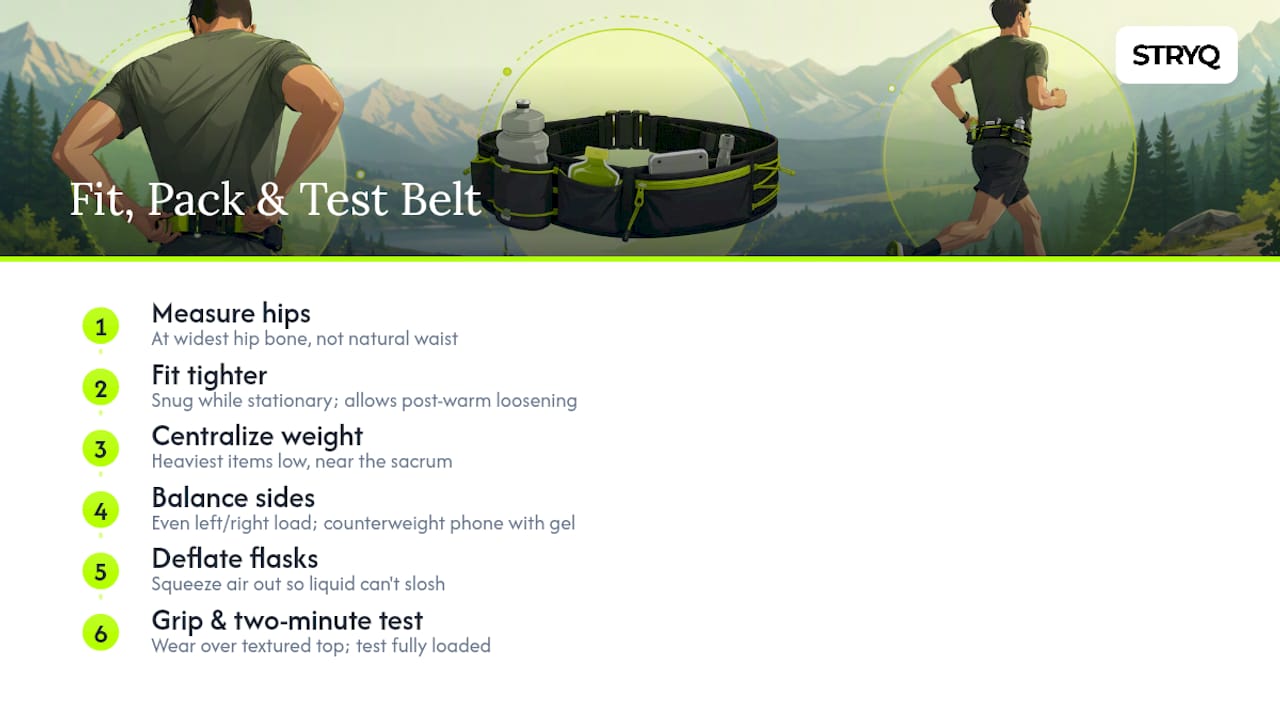
2. Fit it tighter than feels necessary, while stationary. This is the step most runners get wrong. A belt that feels snug but comfortable standing still will loosen once your body heats up and the fabric flexes with movement. Starting slightly tighter than seems natural preserves stability once you’re moving, because both your body and the elastic itself relax a little in the first kilometre.
3. Pack heavy items centrally and low, near your sacrum. Your lower back, just above the tailbone, is the most stable point on your torso. Positioning the heaviest item there, rather than at the front or to one side, keeps your centre of gravity even and reduces the swinging motion that causes visible bounce.
4. Balance left and right before you set off. Two half-full flasks beat one full one. If you’re carrying a phone on one side, counterweight it with keys or a gel on the other. Uneven loading is one of the most overlooked causes of belt movement, and it costs nothing to fix.
5. Squeeze the air out of soft flasks. Trapped air in a soft flask creates slosh, and slosh creates rhythmic movement that the belt transmits straight to your hips. Compress the flask before sealing it so the liquid sits still against your back rather than shifting with each stride.
6. Wear it over textured technical fabric, not slippery layers. A grippy running top underneath your belt adds friction that a smooth cotton tee simply can’t. If your belt has silicone or textured grip zones on the inner band, they work far better against ribbed technical fabric than against bare skin or slick synthetic layers.
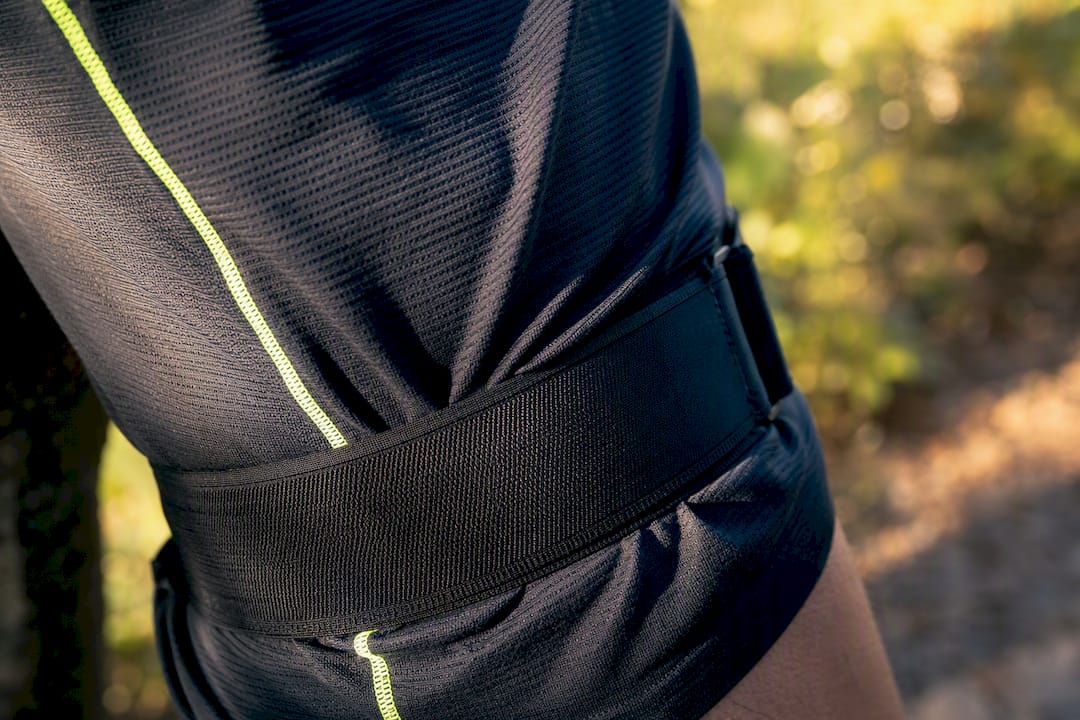
7. Run the two-minute test before you trust it. Jog for two minutes at an easy pace, then pick up to your normal running speed for another minute. Watch for rotation around your waist, bouncing at the back, or straps flapping loose. If anything shifts, stop, retighten by a notch, redistribute the load, and test again.
Pro Tip: Test your belt fully loaded with the exact items you’ll carry on race day, not empty. A belt that sits still with nothing in it can bounce noticeably once you add two full flasks, because testing at your real carrying weight is the only way to know how it actually behaves.
Do this once on a training run and you’ll rarely need to think about it again. The running belt setup that stays put tends to come down to these five minutes of preparation more than any single product decision.
What features actually stop a belt from bouncing
Not every belt marketed as “anti-bounce” earns the label. Some of the difference is genuinely down to construction, and it’s worth knowing what to check before you buy.
- Wide, tubular elastic bands beat narrow buckled webbing almost every time. Increasing the contact area against your lower back spreads pressure evenly instead of concentrating it into a thin strip that digs in and slips.
- Silicone or textured grip strips on the inner band add friction exactly where you need it. Reviewers repeatedly note that grip zones are the practical difference between a belt that looks stable and one that stays stable once you’re moving.
- Low-profile rear sleeves for flasks or phones keep weight tucked close to your body rather than sticking out and catching air resistance or swinging loosely.
- A flat-pressing phone pocket stops your phone from flapping against your hip with every stride, which is one of the more common complaints from runners who “size up” for extra room.
- Continuous, buckle-free closures remove the one component most likely to vibrate loose mid run.
- Sensible strap management, elastic loops or tucks for excess length, stops loose strap ends flapping and adding their own small bounce.
There’s a real trade-off buried in all of this. More storage generally means more surface area to move, and belts built to carry two large flasks plus a phone and gels are working against physics from the design stage. A high-capacity belt without a wide band, grip zones, and sensible weight placement will almost always bounce more than a minimalist one carrying half the load. If you genuinely need higher capacity, the stabilising design details above stop being optional; they’re what makes the extra volume wearable rather than just extra weight swinging around your waist.
Getting the size right the first time
Most bounce complaints trace back to one of two sizing mistakes: measuring in the wrong place, or picking a size based on comfort standing still rather than performance moving.
Measure around the widest point of your hips, at the iliac crest, the bony ridge you can feel just below where most people assume their waist sits. This is the anchor point a belt needs to grip, and it’s usually a few centimetres lower than where a first-time buyer instinctively wraps the tape measure. Check that figure against the size guide for a secure fit rather than guessing from your usual clothing size, since belt sizing rarely matches trouser sizing.
If you’re planning to carry heavier loads, two full flasks, a phone, gels, and keys, size down for a firmer hold rather than up for extra room. A tighter fit with less spare fabric has less material to bounce. If your load is minimal, a single flask or nothing at all, you can size up slightly for comfort without sacrificing stability.
The tension should feel snug, close to firm, while standing still. Once you’re moving, it should feel secure but no longer tight; if it still feels tight after a kilometre of running, you’ve likely sized down too far. Slippery outer layers, waterproof jackets in particular, reduce grip significantly. Wear the belt underneath a jacket rather than over it whenever the forecast allows, so the grip zones stay in contact with fabric that actually offers friction.
When a belt isn’t the right tool for the job
Belts are brilliant for short to mid-distance running, but there’s a point where physics stops being on your side, no matter how good the design.
For runs under 90 minutes or roughly 10 to 15 kilometres, a well-fitted belt carrying a phone and a single flask is usually all you need. Beyond that, water needs rise faster than a belt’s capacity can comfortably hold without adding bulk that starts working against stability.
Longer endurance efforts introduce a problem no fit adjustment solves: shifting liquid weight. As you drink from a flask, the balance of the belt changes kilometre by kilometre, and a belt loaded to its maximum capacity has more surface area and more moving mass to control than a lightly loaded one. Minimalist belts can eliminate bounce almost entirely on shorter runs, while higher-capacity belts trade some of that stability for extra volume, and that trade-off becomes more noticeable the longer you’re out.
A few triggers suggest it’s time to choose a vest over a belt:
- You’re carrying more than two flasks or over a litre of fluid.
- Your run regularly exceeds two hours.
- You need to carry nutrition, a jacket, or mandatory kit alongside hydration.
- You’ve already optimised fit and packing on a belt and it still bounces under full load.
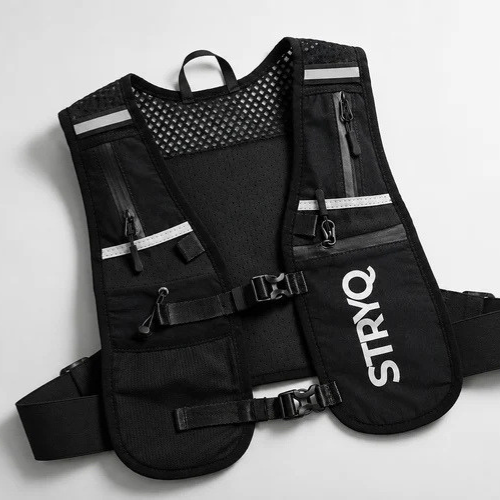
A vest distributes weight across your shoulders and chest rather than relying entirely on hip tension, which is why it becomes the more sensible option once load exceeds what a belt can carry stably. The comparison between hydration vests and belts is worth reading properly before a marathon buying decision, since the wrong choice here is expensive to get wrong twice.
How STRYQ’s belt design solves the causes of bounce
Every design decision on the STRYQ RUNNING BELT traces back to one of the causes covered above, because it was built by testing against exactly this problem.
The band itself is wide and tubular rather than narrow webbing with a buckle, spreading pressure across a larger area of your lower back and removing the vibrating closure that loosens mid run. Grip zones on the inner surface add the friction that keeps it anchored against technical fabric rather than sliding as you move. The 360° pocket layout is built so weight sits close to the body and can be distributed evenly, rather than forcing everything into one bulging front pouch that swings with each stride.
- Bounce from loose placement → solved by the wide tubular band gripping the pelvic rim rather than riding up.
- Bounce from buckle vibration → solved by a continuous, buckle-free closure.
- Bounce from unbalanced packing → solved by 360° storage that lets you split weight around the belt instead of piling it into one pocket.
- Bounce from slosh → addressed by pairing the belt with a low-profile soft flask designed to sit flat and compress fully.
For hydration, pairing the belt with the STRYQ 500ml Running Soft Flask keeps liquid weight low and close to the back rather than in a rigid bottle that sits proud and catches with your arm swing. Runners who prefer a firmer container over a squeezable flask can pair the belt with the STRYQ Green 500ml Hydration Vest Bottle instead, though soft flasks generally compress flatter against the body once partially empty.
Pro Tip: If you’re moving from a buckled belt to a tubular design for the first time, size down slightly from what you’d expect. Tubular elastic relies on even tension around the whole band, not a fixed clip point, so a size that feels “just right” standing still is often a touch loose once you’re moving.
Keeping your belt bounce-free over months of running
A belt that fits perfectly on day one can start bouncing again after a few months, not because the design failed but because the materials wore down.
Elastic loses recoil gradually with repeated stretching, heat, and sweat exposure. Washing your belt after sweaty runs, rather than letting salt and body oils sit in the fabric, slows that breakdown considerably. Hand washing in cool water, or a gentle machine cycle inside a wash bag, protects the elastic fibres far better than a hot wash, which accelerates the same fatigue that causes bounce to creep back in.
Grip zones need attention too. Silicone printing can pick up lint, dried sweat residue, and sunscreen, all of which reduce the friction that keeps a belt anchored. Wiping the inner grip strip with a damp cloth after runs, rather than leaving it to dry with residue baked in, keeps that friction intact for longer.
Avoid tumble drying entirely. Heat is the fastest way to degrade elastic fibres, and a belt that’s been through a hot dryer a dozen times will stretch and sit looser than one that’s air dried. Store the belt loosely coiled rather than folded tightly at the same crease every time, since repeated folding at one point creates a weak spot that stretches unevenly.
Check tension every few weeks, particularly after your belt has clocked up serious mileage. If it feels noticeably looser standing still than it did when new, that’s the elastic telling you it’s approaching the end of its reliable life, not a sign you’re doing something wrong.
The one change that mattered most in testing
If there’s a single lesson worth taking from all of this, it’s that placement beats product almost every time. The most reliable fix during development testing wasn’t a stiffer band or a bigger pocket. It was simply moving the belt down onto the pelvic bone and tightening it one notch further than felt comfortable while standing still.
Test any new setup on a training run, never on race day. A belt that feels secure in the kitchen can behave completely differently after five kilometres and a genuine sweat. Give yourself one short run to find the right notch before you trust it anywhere that matters.
Where to get a belt built to solve this
The fixes above work with almost any belt, but they work best when the belt is designed around them from the start. The STRYQ RUNNING BELT was developed specifically around the wide tubular band, buckle-free closure, and balanced 360° storage covered throughout this guide, so you’re not fighting the design to get a stable fit.
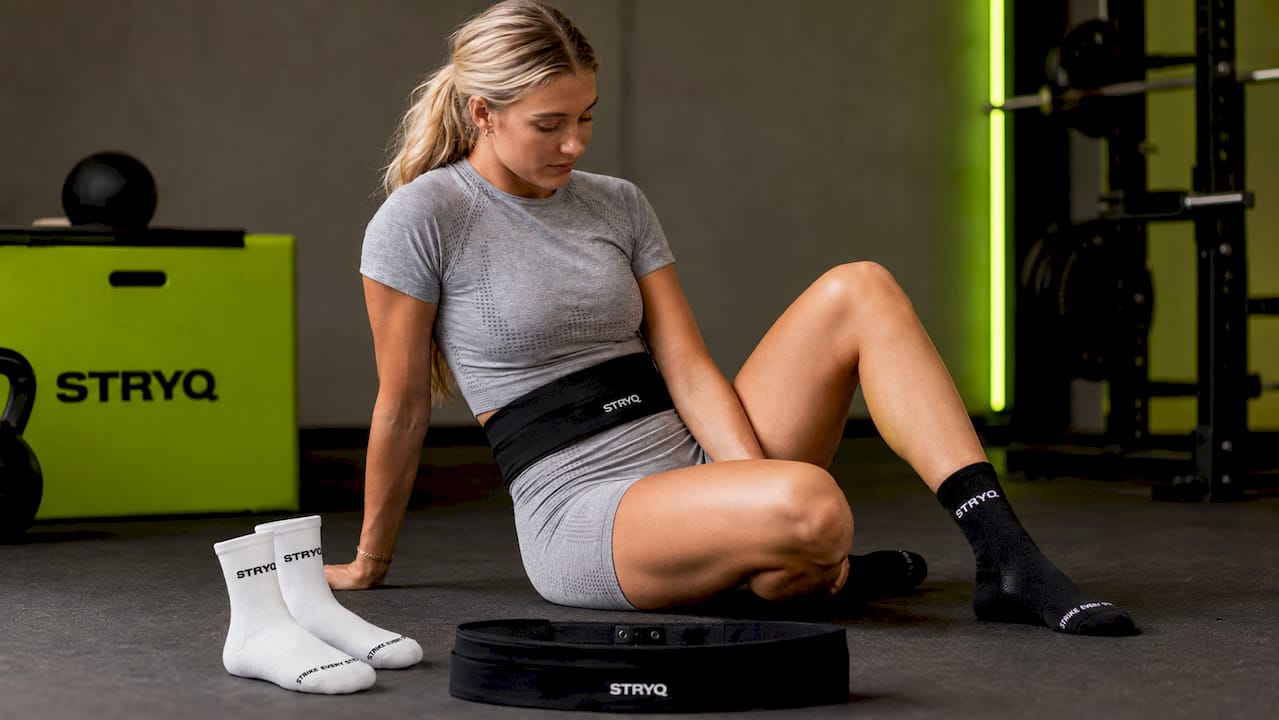
Every STRYQ product goes through multiple sample revisions and real-world testing by UK runners before release, backed by ordinary customer service and support if the fit isn’t right first time. You can browse the full running belt collection to compare capacity options, or go straight to the STRYQ RUNNING BELT product page for sizing details and pricing in pounds sterling. Pair it with a STRYQ Purple 500ml Soft Flask for lightweight hydration that compresses flat against your back, or add the STRYQ Blue Collapsible Running Bottle if you prefer a semi-rigid option. Runners tackling longer distances who are weighing up a vest instead can check the STRYQ HYDRATION RUNNING VEST for comparison before deciding.
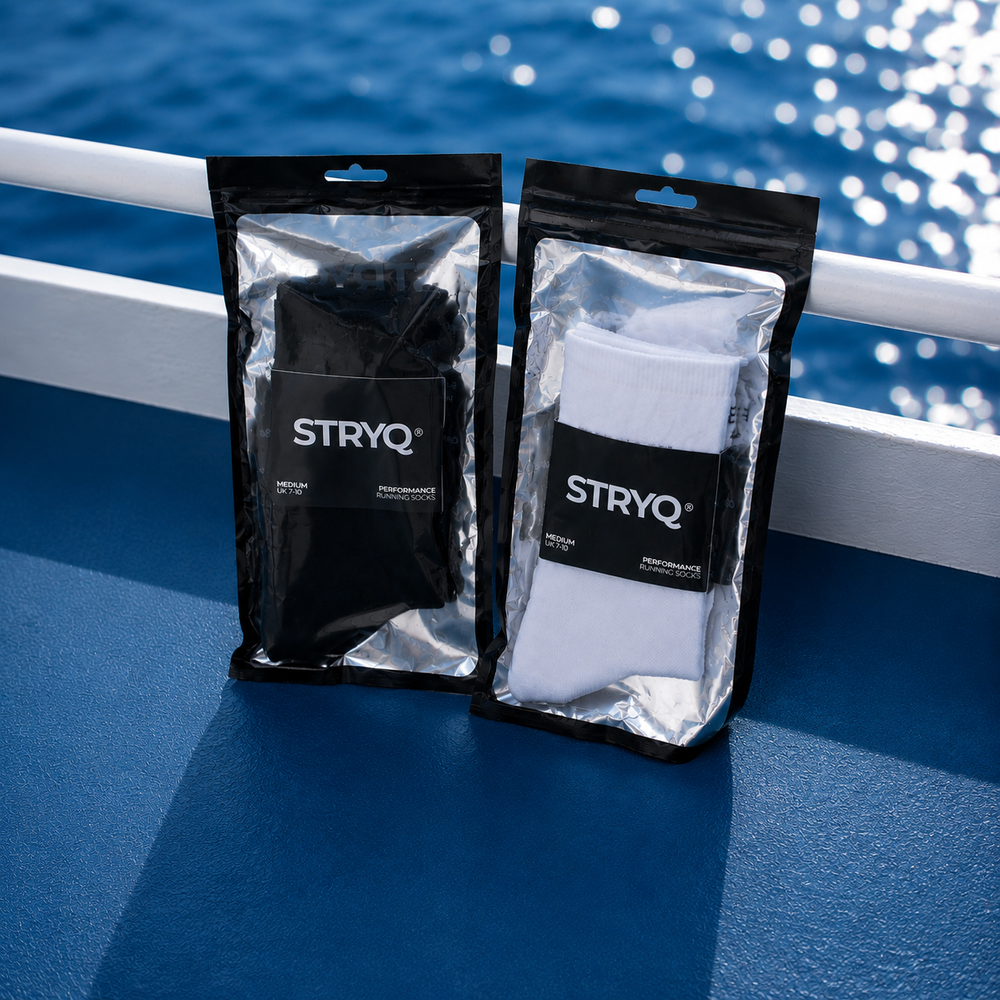
If your feet take as much of a beating as your hips do on long runs, the STRYQ Running Socks in Black add arch support and cushioning worth pairing with a stable belt setup. Pick your size, check the fit guide first, and test it on a training run before you rely on it anywhere that counts.
Frequently asked questions
Why does my running belt bounce even when it feels tight enough? Tension that feels right standing still often loosens once you’re moving, because both the elastic and your body relax slightly during a run. Start noticeably tighter than feels comfortable at rest.
Does a bigger belt automatically mean more bounce? Not automatically, but higher-capacity belts have more surface area and mass to control, so they need wider bands and better grip zones to stay stable under full load.
Should I wear my running belt over or under a jacket? Underneath, wherever possible. Slippery waterproof outer layers reduce the friction grip zones rely on, so keeping the belt against a technical base layer works far better.
How do I know if I need a vest instead of a belt? If you’re carrying more than two flasks, running over two hours, or a well-fitted belt still bounces under full load, a hydration vest distributes weight more evenly across your torso.
Can I fix an old, stretched-out belt, or should I replace it? Elastic that’s lost recoil after months of wear can’t be restretched back to original tension. If washing in cool water and avoiding tumble drying hasn’t helped, replacement is the more reliable fix.
Sources
Independent reviewers, including Wirecutter, test running belts across multiple runs to judge real-world stability rather than a single fitting session, which is the standard this guide follows. iRunFar’s buyer guide and BBC Good Food’s review both break down feature trade-offs between minimalist and high-capacity designs. For biomechanics and fit specifics, Rise Endurance’s fitting guide and Trail.nl’s practical advice on preventing shift and bounce informed the packing and tension guidance throughout.
- How to Wear a Running Belt for Comfort and Performance — Rise Endurance LLC ®
- Best Running Belts of 2026
- The 4 Best Running Belts of 2026 | BBC Good Food review
- Trail
- The 4 Best Running Belts of 2026 | Reviews by Wirecutter