Bounce from a hydration vest is usually preventable. Start by snugging the sternum and side straps, then balance the weight between front and rear pockets before you run a single step. Most bounce comes down to fit and load distribution, not the vest itself. Adjust both, then confirm the fix with a short jog test before you commit to a longer run.
TL;DR:
- Proper fit and load balancing, especially tightening the sternum and side straps, are essential to prevent hydration vest bounce during runs.
- Using a vest with micro-adjustable straps and well-designed pocket retention can significantly reduce movement, even with fully loaded gear.
- Adjustments should be tested with the vest loaded as for an actual run and confirmed through a jog test, focusing on discomfort points and sway.
- An uneven front-to-rear load distribution or loose flasks cause most bounce issues, which are best fixed by proper weight placement and system tightening.
- Some persistent bounce problems require product-specific fixes or different equipment, especially when adjustments don’t eliminate sway.
Table of Contents
- What actually causes hydration vest bounce?
- How do you fix a bouncing hydration vest, step by step?
- The fit checklist and jog test that confirms a no-bounce set-up
- Troubleshooting the bounce problems that won’t go away
- Why Stryq designed around adjustability, not just capacity
- Try Stryq’s vest and flasks loaded, not just on the rack
- Sources
- FAQ
What actually causes hydration vest bounce?
A vest that bounces is almost always translating your vertical running motion into pack movement it shouldn’t have. Every stride sends a small shock through your torso, and a loose harness lets that shock ripple outward instead of staying locked against your back. Tighten the fit and that energy has nowhere to go. Leave it loose and you get the familiar flap on every footfall.
Weight distribution matters just as much as tightness. A vest loaded heavily at the front with nothing at the rear, or vice versa, shifts your centre of gravity slightly with each stride, and that small shift is what you feel as sway rather than a clean bounce. Trail Runner’s testing guidance points to exactly this: uneven front to rear balance destabilises the whole pack, even when the shoulder straps feel fine on their own.
Soft flasks are a common culprit too. A full flask sits rigid in its pocket, but as you drink, it collapses and starts to flop unless the pocket has proper retention. Bladders carry a similar risk. Unless the reservoir is compressed and strapped down, the sloshing water inside adds its own momentum on top of your stride.
A few design factors make all of this worse:
- Stretchy, unstructured mesh pockets that let bottles or flasks migrate as you move
- Oversized vest volumes chosen “for safety” rather than fitted to your actual torso
- Missing or underused compression straps at the base of front and rear pockets
- No sternum micro-adjust system, forcing one fixed tension for the whole run
Get the harness tight and the load balanced, and most of this disappears before you’ve even changed a single component.
How do you fix a bouncing hydration vest, step by step?
Fixing bounce is a sequence, not a single tweak. Work through it in order and you’ll usually solve the problem without buying anything new.
- Measure your chest, not just your height. Sizing charts built around “one size fits most” ignore the fact that chest circumference, not torso length, drives how a vest sits. Nathan’s sizing data shows that gender-specific cuts with a properly measured chest fit reduce pressure points and bounce far more reliably than picking a size off a height chart alone.
- Set the sternum strap first. Clip it at a height that sits comfortably across your chest, then tighten until the vest feels locked to your body but you can still take a full breath. REI’s fitting advice is blunt on this point: if breathing feels restricted, the vest is too small, not too loose.
- Bring in the side tension cords. Most vests have a secondary cinch at the ribs. Pull these after the sternum strap, not before, so you’re fine-tuning rather than fighting the main harness.
- Balance front and rear load. Heavy items (extra flasks, a phone, gels) should sit low and central. If your rear pocket is empty while both front flasks are full, that imbalance alone can cause noticeable sway, so add a small soft item to the back if needed just to hold it flat.
- Choose your hydration system deliberately. A conical soft flask with a retention sleeve stays put far better than a straight-sided flask dropped into an open mesh pocket. HydraPak’s WingStay development work found that designing the flask and pocket together, rather than treating them as separate purchases, cut bounce noticeably across prototype testing.
- Retension on the move. As front flasks empty, the vest loosens slightly. Micro-adjust tabs let you take up that slack without stopping, which testers consistently rate as one of the highest impact features on a long list of tested vests.
- Manage the hose. If you’re running a bladder, tuck the hose or bite valve under the sternum strap rather than letting it dangle. A loose hose flopping against your chest is one of the most common, and most easily fixed, sources of irritation on longer runs.
Pro Tip: Do your first adjustment pass with the vest fully loaded, water and all. An empty vest always feels tighter than it will once you’ve added a litre or two, so tightening on an empty pack almost guarantees you’ll be loosening straps again halfway through your first real run.
The fit checklist and jog test that confirms a no-bounce set-up
A proper check takes two minutes and saves you from discovering problems five kilometres into a trail run.
Run through this before you leave the house, or before you leave the shop if you’re trying a vest in-store:
- Chest measurement matches the vest’s stated size range, not just your usual t-shirt size
- Shoulder straps sit flat with no twisting and no gap between strap and shoulder
- Sternum clip sits at a height that lets you inhale fully without the vest constricting
- Side tension cords are snug enough that a firm tug on the vest doesn’t shift it on your torso
- Every pocket, front and rear, has something in it, even if that means adding a small weight to balance an otherwise empty pocket
Load the vest exactly as you would for a real run, not just with a token water bottle, then jog for one to two minutes at your normal cadence on whatever surface is available. Watch specifically for movement at the shoulders and rear pockets, not just the front.
If you feel bounce at the shoulders, tighten the sternum strap first. If the rear pocket is the problem, check whether it’s underloaded relative to the front. If tightening everything still leaves noticeable movement, the issue is probably the size itself rather than the adjustment, and it’s worth trying a size down before assuming the vest design is at fault.
Troubleshooting the bounce problems that won’t go away
Some bounce issues persist even after a proper fitting, and each one usually has a specific, narrow fix rather than a general “tighten everything” answer.
- Rear pocket bounces when it’s empty. Add a soft flask or a small low weight to the back. An unbalanced front heavy load is one of the most common causes of persistent rear sway, and it’s rarely solved by tightening straps alone.
- Flasks work loose as they empty. Switch to a flask with a retention sleeve or a shaped, conical design rather than a straight cylinder; reviewers testing pocket retention systems found this made the single biggest difference for flop once a flask dropped below half full.
- Hose or bite valve flops around. Secure it under the sternum strap or clip it to a chest loop if your vest has one.
- Chafing or pressure points appear after a few kilometres. Reposition the offending strap slightly, or pad the contact point with sports tape as a short-term fix. If the same spot chafes on every run regardless of adjustment, that’s usually a sign you need a different size rather than a different strap position.
- Sway continues no matter what you adjust. This is the point where the fix is a different product, not a different setting. Testing that simulates a progressively emptying front load over 10 to 30 minutes often reveals problems that never show up in a static shop fitting, so if bounce only appears well into a run, the vest’s pocket design, not your adjustment technique, is the likely limit.
Why Stryq designed around adjustability, not just capacity
Stryq’s hydration vest went through repeated revisions with real UK runners testing fit under load, not just on a rack. The sternum and side tension systems were prioritised early because the feedback was consistent: runners cared far more about a harness that could be fine-tuned mid-run than about extra pocket count or capacity. That matches what independent testers keep finding, that adjustable systems and micro-adjust tabs matter more for comfort than brand reputation ever does.
None of that removes the responsibility from you as the wearer. Fit is individual. A harness that eliminates bounce for one runner’s torso can still move on someone built differently, which is exactly why the fitting steps above come before any product recommendation, not after.
— martin
Try Stryq’s vest and flasks loaded, not just on the rack
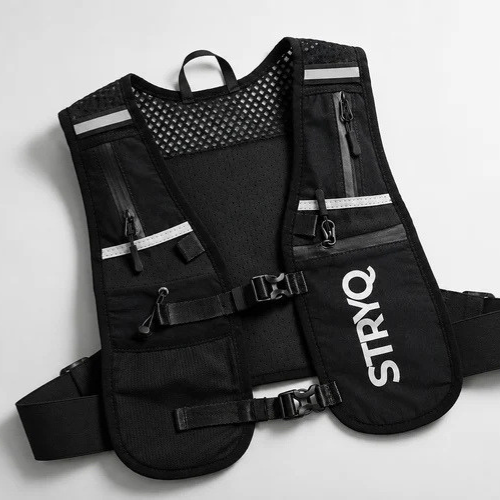
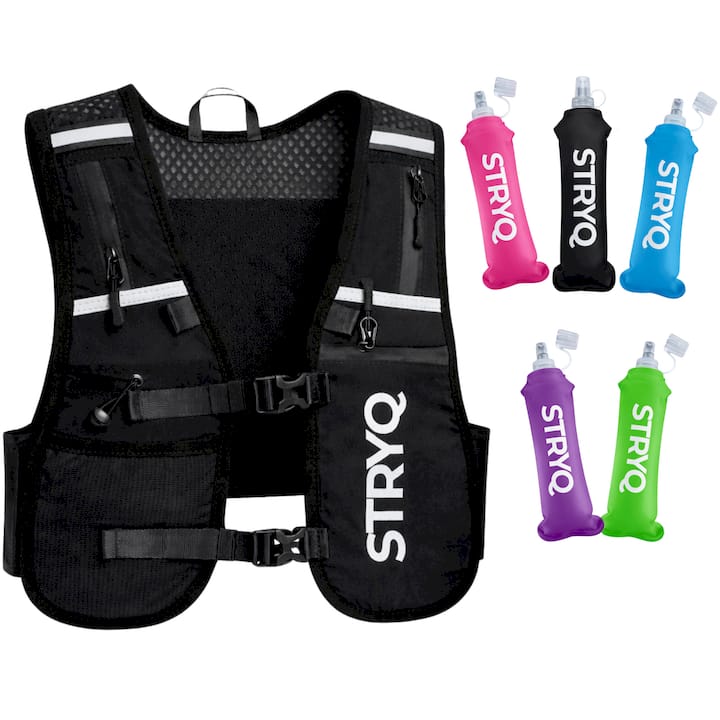
Some hydration vests are not designed with adjustability in mind, making bounce fixes guesswork. The STRYQ Hydration Running Vest uses a sternum micro-adjust system alongside side tension cords, built specifically so you can retension on the move as front pockets empty, rather than starting your run at one fixed tightness and fighting it for the next hour.
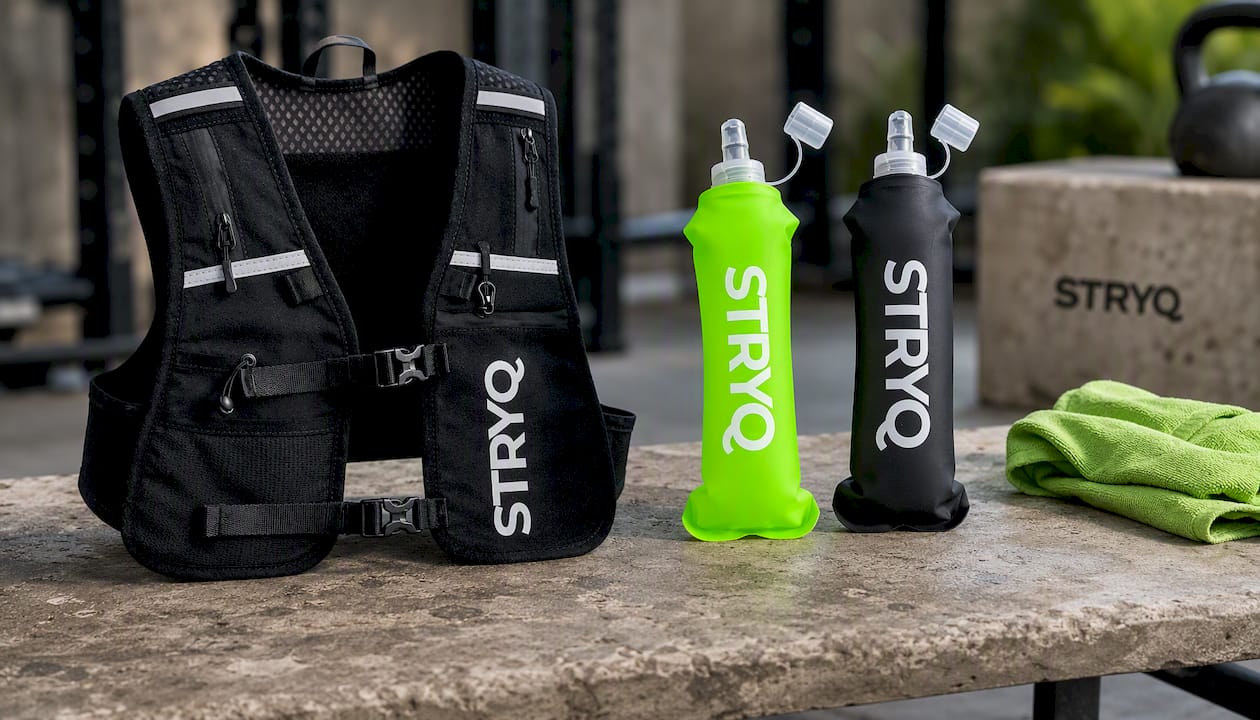
Pair it with the STRYQ 500ml Running Soft Flask, which is shaped to sit flatter in the front pocket as it empties, cutting the flop that straight-sided flasks are prone to. If you prefer a rigid bottle for front storage, the STRYQ Green 500ml Hydration Vest Bottle holds its shape throughout the run rather than collapsing unpredictably. Whichever you choose, load it fully before you judge the fit. An empty vest on a shop rack tells you almost nothing about how it will behave forty minutes into a long run. Browse the full running gear collection to see how the vest pairs with Stryq’s belts and reflective kit, then try the vest loaded before your next long run to see whether the bounce you’ve been living with actually disappears.
Sources
- The best hydration vests for trail running
- 11 best running hydration vests, tested by experts
- How to choose a running hydration vest | REI
FAQ
How do you stop a hydration vest from bouncing?
Tighten the sternum and side straps first, then balance weight between front and rear pockets so no single area is carrying an uneven load, and confirm the fix with a short loaded jog.
What’s a good running vest that doesn’t bounce?
Look for a vest with a sternum micro-adjust system, side tension cords, and pocket retention features, then try it fully loaded before judging the fit. The STRYQ Hydration Running Vest was built around exactly this adjustability.
Why do some marathons not allow hydration vests?
Race organisers sometimes restrict hydration vests when aid stations are frequent enough to make personal carrying unnecessary, or when course rules limit what runners can wear to keep race logistics simple; check each race’s specific kit list rather than assuming a blanket rule.
Which hydration vest is the best?
There’s no single best vest, since fit is individual and depends on your torso shape and load. What matters most, based on repeated testing across reviewers, is an adjustable harness with proper pocket retention, tried fully loaded before you buy.