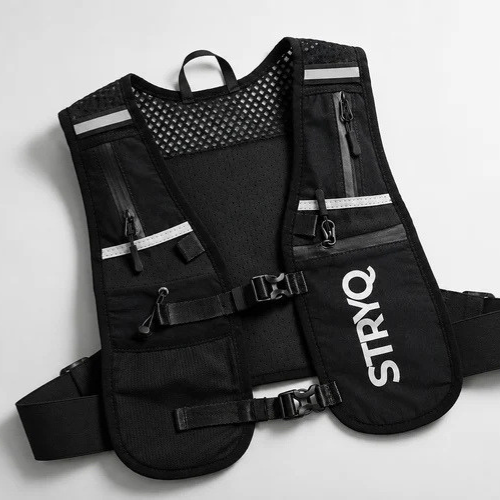
A hydration vest should feel like part of your running kit, not something you spend every mile pulling, tightening or wishing you had left at home. This hydration vest fit guide explains how to set one up properly, whether you are building towards a first 5K, training for a marathon or heading out for a long trail run.
The goal is simple: no bounce, no rubbing and no restriction when you breathe. A good vest carries water, fuel and essentials close to your body so you can focus on the run.
What a well-fitted hydration vest feels like
A correctly fitted hydration vest sits high and close around your upper torso. It should not swing from side to side, slide down your back or move independently from your body when you run downhill.
There is a useful distinction between snug and tight. Snug means the vest stays put when you jog, turn and take deep breaths. Tight means it presses into your ribs, limits your breathing or leaves painful marks. You need the first, not the second.
Most runners notice a good fit within the first few minutes. You stop thinking about the vest. The soft flasks remain stable, your mobile phone does not bounce in a pocket, and the shoulder straps do not creep towards your neck.
A little movement is normal, particularly when flasks are full or your vest is carrying a jacket and extra food. Repeated bouncing is not. If the load is moving enough to distract you, it will usually cause rubbing later in the run.
Start with the right size
Sizing comes before strap adjustment. A vest cannot be made comfortable simply by pulling every strap tighter if the body size is wrong.
Use your chest measurement as the starting point and check the size guide for the specific vest. Measure around the fullest part of your chest while wearing a light running top. If you sit between sizes, think about how you will use the vest most often.
Choose the smaller size if you mainly run in a T-shirt, carry minimal kit and prefer a close race-style fit. The larger size may be better if you regularly run in winter layers, carry mandatory race equipment or have a broader chest. Do not size up just because you expect to fill every pocket. A vest should hold its shape around you, even when it is not fully loaded.
Women should also consider how the vest sits over a running bra and where its chest straps fall. The most comfortable placement varies from runner to runner. Adjustable chest straps give you more scope to position them away from areas that feel sensitive or restrictive.
How to adjust a hydration vest
Set up your vest at home before its first proper run. Wear the clothing you would normally choose for that distance and put some weight in the vest. A vest that feels fine when empty can behave very differently with two full flasks, gels, keys and a mobile phone inside.
Loosen everything first
Put the vest on with the side and chest adjustments loosened. Settle the back panel high on your back, rather than allowing it to hang low around your waist. The shoulder sections should lie flat, without twisting or folding your top underneath.
Fasten the chest straps so the vest is held against your torso. They should sit comfortably across your chest, not pull the front panels too far together. If the elastic cords are adjusted unevenly, the vest can twist as you run.
Tighten the side adjustments evenly
Next, use the side cords or straps to bring the vest close to your ribs. Make small adjustments on both sides rather than tightening one side heavily. The aim is even contact around the torso.
Take a few deep breaths. You should be able to fill your lungs without feeling the vest resist you. If it feels restrictive while standing still, it will feel worse on a hill or during a faster effort.
Test the fit while moving
Jog on the spot, lean forwards, rotate your shoulders and do a few gentle hops. Listen for flask slosh and feel for any movement at the back. Then run for ten minutes if you can.
Make one adjustment at a time. Tightening every strap at once makes it hard to work out what solved the problem. Often, a small change to the side adjustment is enough to stop a vest lifting or bouncing.
Fit changes when your vest is loaded
A hydration vest does not carry the same on every run. The weight and position of what you pack affect fit as much as the straps do.
Keep heavier items close to your body and spread the load evenly. Full soft flasks usually work best in the front pockets, where their weight is supported by the chest and shoulders. Place your mobile phone, gels and keys in secure pockets that stop them moving about. A loose set of keys can be surprisingly irritating after an hour.
For longer runs, use the rear compartment for lighter bulk such as a waterproof, gloves or a buff. If you carry a heavier item at the back, balance it where possible with water or fuel at the front. A lopsided load is more likely to pull the vest sideways and rub one shoulder.
As you drink, your flasks become lighter and may shift slightly. This is normal. Soft flasks designed for running reduce sloshing as they empty, but it is worth checking your fit on a long training run rather than assuming it will stay perfect for several hours.
Common hydration vest fit problems
The vest bounces on your chest
This usually means the chest straps are too loose, the side adjustments need a little more tension, or both. Start by checking that the vest is sitting high enough. Then tighten in small increments until the front pockets stay close to your body.
Do not over-tighten the chest straps to solve all bounce. This can make breathing uncomfortable. A more even fit around the sides generally works better.
The back panel rides up
A back panel that creeps upwards often means the front is carrying too much weight or the side fit is too loose. Check that full flasks are seated properly in their pockets and that heavy items are not hanging low at the back.
Tighten the side adjustments slightly and redistribute the load. If it still rides up with a sensible amount of kit, the vest may be too large or too long for your torso.
You get rubbing around the neck, ribs or armholes
Rubbing is usually a movement problem, not simply a fabric problem. Look for a loose edge, a twisted strap or an overloaded pocket that is pulling the vest out of position.
Pay close attention to the first signs of a hot spot. A small irritation at 5 km can become a sore patch by 15 km. On longer runs, use an anti-chafing balm where you know you are prone to rubbing, especially in warm or wet conditions.
Your clothing matters too. A seam, loose collar or damp cotton top can create friction even with a well-fitted vest. Test the full combination you plan to use on race day.
Breathing feels restricted
Loosen the chest and side adjustments a little, then make sure the vest is still stable when you move. It is common to set a vest too tight when standing in front of a mirror. Your ribcage expands more when you are working uphill or running hard.
A vest should feel secure at an easy pace and still allow a full breath during a faster section. If you must choose, prioritise breathing over an ultra-compressed fit. You can usually solve slight movement by improving load distribution rather than squeezing the vest tighter.
Test it before race day
Do not save a new hydration vest for a half marathon, marathon or trail event. Use it first on a short easy run, then on a longer session with the same water, nutrition and layers you expect to carry on the day.
This is when you learn practical details: whether you can reach your flasks without breaking stride, which pocket keeps gels easiest to grab, and whether your mobile phone stays put. It also gives you time to adjust the fit as the vest and your routine become familiar.
Weather changes the setup. In colder months, a thicker base layer may mean loosening the vest slightly. In summer, sweat can make rubbing more likely, so a secure fit and considered pocket placement matter even more. Make these adjustments before leaving home rather than halfway through a run.
A quick pre-run fit check
Before you head out, check that the vest sits high, the chest straps are even and the side adjustments have equal tension. Make sure flasks are pushed fully into their pockets, zips are closed and heavier items are packed close to your body.
Then take a few strides. If anything clicks, swings or rubs before you reach the end of the road, fix it then. Small adjustments are easier at home than when you are ten miles into a long run.
The best hydration vest fit is not the tightest one. It is the one you barely notice, mile after mile, while everything you need stays exactly where it should be.