For most road and mixed-use runners, a chest light gives a steadier ground view and better side and rear visibility to traffic; for foot care after your runs, you might consider professional pedicure care for runners to keep your feet in top condition. Technical trail runners still need a headlamp for scanning uneven ground. Lumen needs range from 100 to 400 for roads and up to 800 for trails, and comfort depends on weight and strap fit. We offer running kit for use alongside either setup.
TL;DR:
- Use 100 to 200 lumens on lit pavements, 200 to 400 on dark roads, and 500 to 800 on technical trails; excess output adds weight and drains batteries.
- Visibility aids improve driver detection, but collision prevention remains uncertain; angle beams down and add a rear flasher or reflective ankle and wrist details.
- Check runtime at your chosen brightness, not the maximum burst rating, and carry spare batteries or a power bank on long runs.
- For technical night ultras, navigation sections, or steep unlit descents, pair a chest light at higher output with a low headlamp for markers and maps.
- Test the light with your usual vest, belt, or hat on a short run; adjust straps to stop bounce without causing pressure or numbness.
Table of Contents
- Technical differences: beam, movement, shadowing and weight
- How visibility to traffic changes with each light
- Which to choose by environment and running speed
- Practical lumen ranges and battery or runtime trade-offs for runners
- How to fit lights and harnesses to minimise bounce, pressure and cable nuisance
- When a layered setup of chest light plus headlamp makes sense
- Stability, bounce and what it does to depth perception
- Comfort, strap fit and the risk of neck or head strain
- Ease of use and reaching the controls mid-run
- Fitting lights alongside a hydration vest or hat
- Our perspective on integrating lights with running kit
- How STRYQ kit helps you run safely at night
- FAQ
- Sources
Technical differences: beam, movement, shadowing and weight
A headlamp sits on the forehead and points wherever the head turns, so the beam follows the eyes. That’s useful for reading the ground directly ahead, but it also means every head movement shifts the light, and shadows from rocks or kerbs move with it. A chest light sits lower and stays fixed relative to the torso, so the beam tracks the body rather than the gaze. Headlamps generally weigh 39 to 213 grams, with 39 to 108 grams often preferred by runners, while chest lights typically weigh more at 150 to 250 grams, a difference that can matter on a long run.
Because the chest beam doesn’t move with every stride, it tends to produce a steadier, more uniform pool of light on the ground. That stability helps depth perception: constantly shifting shadows from a bouncing headlamp can make kerbs, roots or potholes harder to judge at speed. Headlamps are often described as acting like a personal lighthouse, with spot and flood modes that make them well suited to rapid scanning, which is precisely why trail runners favour them on technical ground.
The practical differences come down to a few mechanical facts:
- Headlamps follow your gaze, so wherever you look is lit, which suits scanning but shifts shadows with every head turn.
- Chest lights stay fixed to the torso, producing steadier, more even ground illumination with less bounce.
- Headlamps in the lighter range (39 to 108 grams) reduce neck strain over long runs, while chest lights in the 150 to 250 gram range add stability at the cost of some bulk.
- Mounting height changes the effective throw of a beam: a higher headlamp beam reaches further but casts longer shadows, while a lower chest beam lights the immediate path more evenly.
Beam shape plays into this too. A tight spot beam from a headlamp throws light a long way, useful for spotting a trail marker ahead, while a flood beam from a chest light spreads wider and lower, better for seeing the ground directly underfoot. Neither beam shape is wrong, they simply solve different problems, which is why the choice depends on what you’re running on rather than which light is “better” in the abstract.
How visibility to traffic changes with each light
Being seen matters as much as seeing. Chest lights sit at a height drivers and cyclists naturally scan, and many models include a rear LED, giving a continuous front-and-back reference point as you move through traffic. A headlamp, by contrast, throws its beam forward and can create a bright, narrow point that’s harder for an oncoming driver to judge distance from.
A Cochrane-style review of trials found that lamps, flashing lights and retroreflective materials increased drivers’ detection and recognition of pedestrians and cyclists at night, though evidence on whether this reduces actual collisions remains limited and mixed. That distinction matters: visibility aids make you easier to spot, but they’re one part of a wider safety picture that also depends on road choice and driver attention.
Headlamps can cause a secondary problem: glare. A bright, forward-facing beam pointed at approaching traffic or other runners can momentarily blind them, which is counterproductive if the goal is to be seen safely. Dropping to a lower-power warm-toned beam, angling the headlamp slightly towards the ground, and pairing it with a rear flasher reduces this risk considerably.
A short checklist covers most scenarios:
- Keep a front beam angled down and towards the path, not level with oncoming eyes.
- Add a rear flashing light so drivers approaching from behind have warning too.
- Use reflective elements at ankle or wrist height, since biomotion markers are easier for drivers to interpret as a moving person.
- Avoid pointing a high-lumen beam directly into another runner’s or cyclist’s face when passing.
Fog and mist change the picture further: a high-lumen beam can scatter in moisture and reduce your own visibility rather than improve it, so a lower, warmer beam paired with reflective trim often works better in those conditions.
Which to choose by environment and running speed
Matching light type to terrain avoids both under-lighting and unnecessary bulk.
- On well-lit urban pavements, a lower-lumen chest or waist light is usually enough, since the goal is being seen rather than lighting your own path; reflective clothing adds a further margin.
- On dark or unlit roads, mid-range lumens and a chest light are generally favoured, since the fixed beam and any rear LED help drivers judge your position; adding a rear flasher is a sensible extra.
- On technical trails, a higher-lumen headlamp earns its place, since scanning for roots, rocks and sudden drops depends on the beam following your eyes.
- For group runs or commuting alongside others, a chest light reduces the risk of glare towards companions while still giving you strong frontal visibility from multiple angles.
Running speed matters too. Faster paces shrink your reaction window, so trail runners moving quickly over technical ground benefit from the wider, further-reaching spot beam a headlamp provides. Slower, steady road running rarely needs that reach, which is one reason chest lights suit the bulk of everyday night runners.
Practical lumen ranges and battery or runtime trade-offs for runners
Lumen numbers are only useful once matched to terrain. The working ranges most runners find sufficient are 100 to 200 lumens for streetlit pavements, 200 to 400 for dark unlit roads, and 500 to 800 for technical trail running. Buying far beyond what your usual route needs adds weight and battery drain without a real safety benefit.

Flat, consistent output over the length of a run often matters more than the headline lumen figure on the box. Lights that hold a steady beam for the advertised runtime, rather than fading gradually as the battery drains, give a more predictable experience on a dark route than a higher-rated light that tails off early.
A few practical points help when buying or planning a run:
- Check the manufacturer’s runtime at the lumen setting you’ll actually use, not just the maximum burst figure.
- USB-C charging has become the common standard, which simplifies topping up before a run with the same cable used for a phone or watch.
- For long runs or races, carry a small spare power bank or spare batteries rather than relying on a single charge lasting the full distance.
- Chest lights generally accommodate larger batteries than headlamps, which is part of why they often run for extended periods on a single charge.
Planning runtime against your usual loop length avoids the common mistake of a light dimming unexpectedly halfway through a run.
How to fit lights and harnesses to minimise bounce, pressure and cable nuisance
A light that fits poorly undoes most of its benefit, since constant adjustment is itself a distraction. A short fit check before committing to a long run saves discomfort later.
- Tighten the chest harness enough that the light sits still when you jog on the spot, but not so tight it restricts breathing.
- Test the fit on a short run before a longer session to check for slipping, bouncing or pressure points that only show up once you’re moving.
- Watch for red marks or numbness at strap contact points, both signs the harness needs loosening or repositioning.
- Route battery packs and cables along the body, tucked under a vest strap or belt, so nothing swings loose or rubs with each stride.
Chest harnesses generally sit well alongside a hydration vest, with battery packs tucked into a front pocket and the cable run along a strap rather than left hanging. Headlamp straps bring their own fit questions: hair caught under the band, a hat worn underneath, or goggles on cold mornings can all shift the strap and create pressure across the forehead or temples. Adjusting the rear strap position, rather than just the front tension, usually solves this.
Pro Tip: Test any new light with your full usual kit, whether that’s a vest, belt or hat, on a short run before trusting it for race day or a long session.
When a layered setup of chest light plus headlamp makes sense
Combining both lights earns its weight in specific situations rather than as a default. Technical night ultras, sections with real navigation demands, or steep unlit descents are where the extra bulk pays off, since you get steady ground illumination from the chest light and gaze-directed scanning from the headlamp at the same time.
- Set the chest light as the primary beam at a higher output, since it does most of the work of lighting your path and signalling your position to others.
- Keep the headlamp on a low setting, used mainly for reading markers, checking a map or route sign, or close-up tasks like fixing a shoelace.
- Avoid running both lights at full brightness together, since overlapping beams can wash out depth cues rather than add detail.
- Store spare batteries in a vest pocket or running belt rather than stacking them all in the chest harness, which keeps the weight distributed.
This layered approach is really just the mechanical strengths of each light working together rather than competing.
Stability, bounce and what it does to depth perception
Bounce is more than an annoyance. A light that moves unpredictably with each stride changes the shadows on the ground in front of you, and shifting shadows make it harder to judge the depth of a kerb, pothole or root. This is one of the clearest practical differences between the two formats: a chest light, fixed against the torso, holds a steadier beam angle through the gait cycle, while a headlamp inevitably moves with the head, which moves more than most runners realise mid-stride.
On flat, predictable pavement this barely matters, since there’s little depth information to misjudge. On uneven trail or broken pavement, though, a bouncing beam can make a shallow dip look deeper than it is, or hide a raised edge entirely for a fraction of a second. Testers of high-lumen chest lamps have noted that even with strong output, the fixed low angle still gives a more stable, even spread of light across the path than a head-mounted beam achieves at the same brightness.

Reducing bounce is largely a fit problem rather than a product problem: a well-tightened chest harness barely moves, while a loose headlamp strap amplifies every head bob into a wobbling beam.
Comfort, strap fit and the risk of neck or head strain
Weight sits in a different place with each format, and that changes where strain shows up. A headlamp’s weight rests on the forehead and the back of the skull, so a heavier unit, especially one near the 213 gram upper end of the typical range, can create a dull ache across the brow over a long run. A chest light’s weight rests on the shoulders and upper back via the harness straps, which most runners find easier to carry for longer distances even though the units themselves tend to weigh more.
Strap tension is the main lever for comfort in both cases. Too loose, and the light bounces or slips; too tight, and it presses uncomfortably into skin or hair. A headlamp strap that’s been adjusted only at the front, rather than also at the rear crown strap where available, is a common cause of forehead pressure that’s easy to fix with a different adjustment point.
Neck strain rarely comes from the light itself at typical lumen weights, but from compensating posture, tilting the head to avoid strap discomfort over a long run. Checking fit before a long session, rather than after discomfort sets in, avoids this altogether.
Ease of use and reaching the controls mid-run
A light you can’t operate without stopping is a light you’ll use badly. Headlamp buttons sit on the unit itself, at the temple or crown, which usually means reaching up and finding a single raised button by feel, something that gets harder with gloves on in cold weather. Chest lights, mounted lower on the chest, are generally easier to glance at and adjust without breaking stride, since the control sits within natural sightline and hand reach.
Mode-switching matters too. Lights with a simple single-button cycle through brightness levels are easier to manage mid-run than those needing a long press plus a secondary gesture to change settings, which is worth checking before buying rather than after a fumbled adjustment on a dark road.
Cold weather adds a layer of difficulty either way: numb fingers struggle with small buttons regardless of mounting position, so a light with a distinct, raised control is worth prioritising for anyone running through a UK winter.
Fitting lights alongside a hydration vest or hat
Most night runners aren’t just carrying a light. Water, a phone and sometimes nutrition come along too, so how the light integrates with existing gear matters as much as the light itself. A chest light generally sits well above or alongside the front pockets of a hydration vest, provided the harness straps don’t compete for the same space as the vest’s own chest straps.
A headlamp interacts with headwear more than with hydration gear: running in a cap or beanie means the strap sits over or under the hat depending on preference, and testing that combination in advance avoids a slipping strap mid-run. Hair, particularly longer hair tied back, can also shift a headlamp strap over the course of a run, so a rear adjustment point is worth checking for specifically.
Layering a chest light with a belt, rather than a full vest, works for runners who don’t need much hydration capacity but still want somewhere secure to route a battery pack and cable away from the light itself.
Our perspective on integrating lights with running kit
Our approach to gear starts from the same question every time: does this solve a real problem a runner actually has. With lighting, that means focusing on how the rest of the kit around it should work, including how vests and belts fit alongside a chest harness.
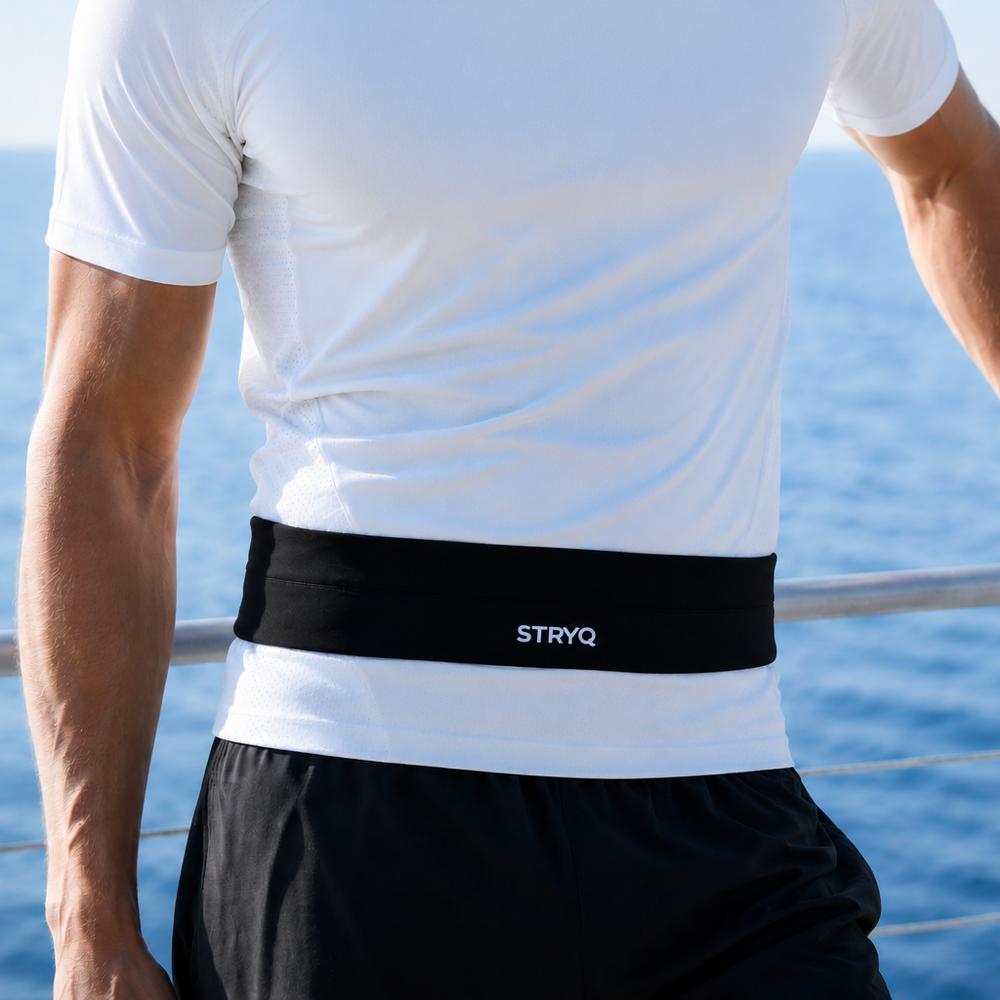
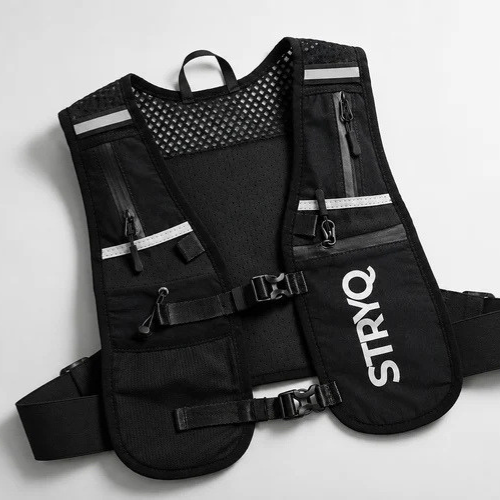
A hydration vest can carry essentials while you run. A running belt does the same job for runners who prefer less coverage. Both are worth testing on a short run first, checking fit, brightness in real traffic, and whether reflective elements are actually catching headlights at the angles that matter, before relying on the setup for a longer or more technical route.
— martin
How STRYQ kit helps you run safely at night
Chest lights and headlamps both work better when the rest of your kit isn’t fighting them. Our STRYQ HYDRATION RUNNING VEST has multiple pockets, and our STRYQ RUNNING BELT offers 360° storage for runners who prefer less coverage on shorter routes.
A few additions make a night setup more complete:
- Our soft flasks, including the 500ml Running Soft Flask, are lightweight hydration options for your running kit.
- Our High-Vis Running Vest & Reflective Bands Kit adds reflective coverage that works alongside either a chest light or headlamp rather than replacing it.
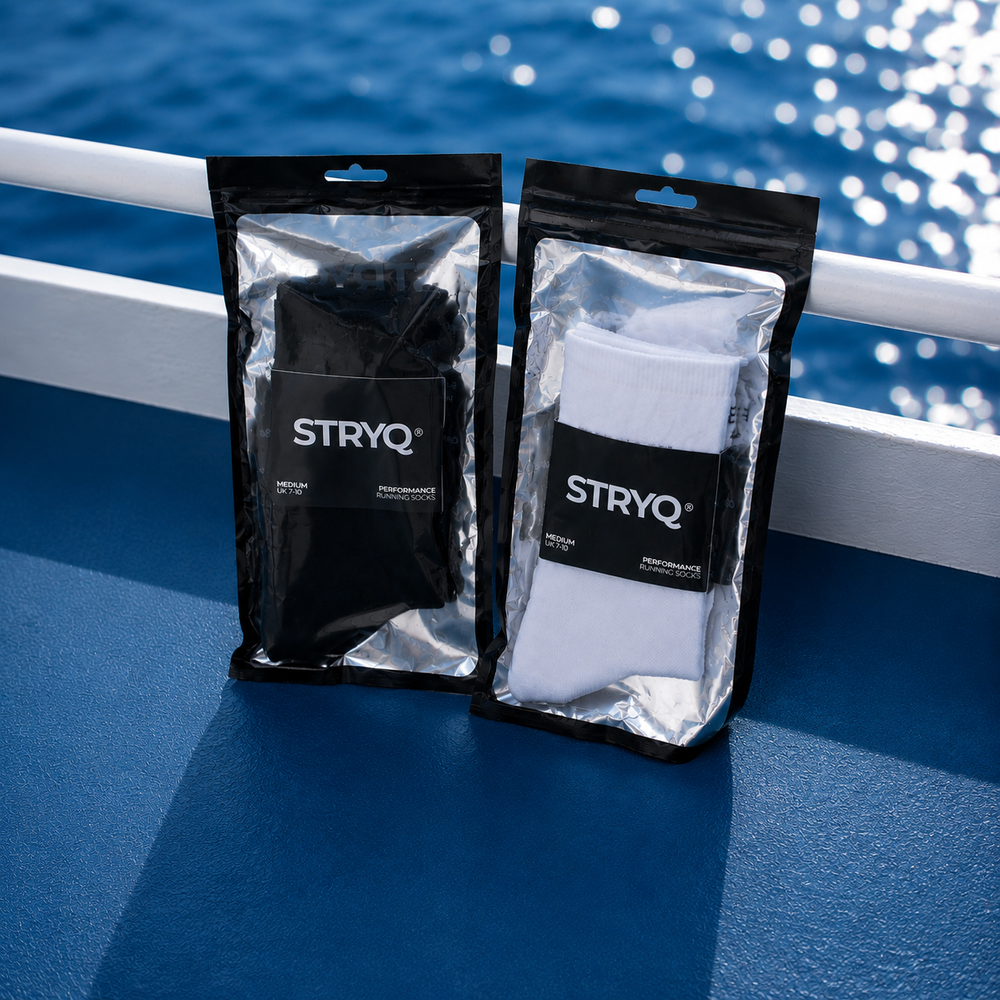
- Our running socks round out a night kit built for comfort over distance, not just visibility.
Try the vest or belt on a short test run first, checking fit and battery placement before committing to a longer dark route. Our full running gear collection is the place to start.
FAQ
What does a running light do?
A running light makes you visible to drivers, cyclists and other runners in low light, and in the case of a headlamp also lights your own path ahead. Trials show that lamps, flashing lights and retroreflective materials increase how well drivers detect and recognise pedestrians and cyclists at night, though their effect on reducing actual collisions is less clear.
Do daytime running lights count as headlights?
This question usually refers to vehicle daytime running lights, which are a car safety feature and not the same as a personal running light worn by a runner. For running gear, the relevant distinction is between a headlamp, which lights your path, and a chest or vest light, which primarily makes you visible to others.
Can I use a torch instead of a running headlamp?
A handheld torch can work in a pinch, but it ties up one hand and lacks the hands-free, head-tracking beam that makes a dedicated headlamp useful for scanning technical ground. A proper running headlamp or chest light is designed to stay secure and stable through a full running gait, which a general-purpose torch usually isn’t built for.
What is the best headlamp for running at night?
The best headlamp depends on terrain rather than a single model: technical trail running generally calls for 500 to 800 lumens with a strong spot beam for scanning, while well-lit roads need far less. Headlamps in the lighter weight range, roughly 39 to 108 grams, tend to cause less forehead and neck fatigue over longer runs.
Sources
- What Is the Difference Between Chest Lights and Headlamps for Running?
- Interventions for increasing pedestrian and cyclist visibility for the prevention of death and injuries
- Best Running Safety Lights for Runners: Stay Visible - ProWearTrends
- ISEYOU 800LM Running Chest Lamp Test & Review | Rox Journey