Regular night training sessions of one to two and a half hours need a light that genuinely lasts three to four hours. Anything overnight or off-road demands eight or more hours, or a swappable battery. The safest working rule: aim for two to three times your expected time in darkness, and choose a rechargeable USB-C light with a proper battery indicator rather than a vague fuel gauge.
TL;DR:
- For regular night training lasting one to two and a half hours, choose a headlamp that provides at least three to four hours of actual runtime at your typical brightness setting.
- Use a rechargeable USB-C headlamp with a clear battery indicator rather than a vague fuel gauge, especially for longer or unsupported runs.
- Carry a spare battery or power bank, especially for runs over 90 minutes or when in remote areas, and store spares close to your body to prevent cold-related capacity loss.
- Planning for two to three times your expected darkness exposure, and scaling safety margins based on remoteness, minimizes the risk of running out of light in unsupported conditions.
Table of Contents
- Running light battery life targets by run type
- What lumens and FL-1 ratings actually tell you about runtime
- Battery types, charging speed, and how cold affects them
- Pre-run checks, in-run habits, and backup plans that actually work
- How Stryq tests kit for real night-running conditions
- An author’s checklist for every night run
- Carrying spares without breaking your stride
- Sources
- FAQ
Running light battery life targets by run type
Manufacturer runtime figures rarely survive contact with a real, cold, muddy run. That’s why matching your light’s battery capacity to the actual run you’re doing, rather than the headline lumen number on the box, matters more than most runners realise.
For short urban runs around 20 to 45 minutes, a light rated for about an hour or more at your usual setting is plenty, provided it holds a safe margin above your expected time out. Most roadrunners sit in the 100 to 300 lumen range here, where battery drain is modest and even smaller rechargeable units comfortably outlast the run.
Regular night training, typically one to two and a half hours, is where a lot of runners get caught out. A light that claims two hours on the box might deliver less once you factor in a higher brightness setting or a cold night. Aim for a light that gives three to four hours of actual runtime at the setting you’ll use, and prioritise a model with a clear, multi-stage battery indicator rather than a single blinking light that only warns you when it’s nearly too late.

Long training runs, overnight sessions, and ultras are a different problem entirely. Here you need eight or more hours of runtime, a swappable battery system, or the ability to charge on the move. Carrying a spare cell or a compact power bank stops being a nice-to-have and becomes standard kit. iRunFar’s testing recorded 8 to 11-hour nights on medium settings during 100-mile races using reactive lighting, and consistently recommends a backup light or spare batteries for anything in that territory.
The safety margin you apply should scale with how remote or unsupported the run is:
- Familiar loop, close to home: 25% extra runtime is enough. You can bail out quickly if the light dims.
- Point-to-point or unfamiliar trail: 50% extra gives you room for a slower pace or a wrong turn.
- Remote, unsupported, or overnight: double your expected exposure to darkness, or carry a genuine backup. This is where the 2 to 3× rule from experienced night runners earns its keep, according to running community guidance.
What lumens and FL-1 ratings actually tell you about runtime
Lumens measure output, not usable visibility, and the two aren’t the same thing. A light blasting 1,000 lumens on its highest setting looks impressive in a shop, but that figure usually only holds for two to four hours before the unit steps down to protect the battery. Road runners generally do fine on 100 to 300 lumens, since street lighting and pavement conditions need less raw brightness. Trail runners, dealing with uneven ground and unpredictable obstacles, typically want 200 to 500 lumens or more, particularly on technical single-track.
The gap between “high mode” runtime and real-world need is where most buying mistakes happen. High mode exists for short bursts, spotting a stile in the distance, checking a junction, not for running an entire session. Once the battery drops below a certain threshold, most lights switch to a reserve mode, a much dimmer, low-lumen setting designed purely to get you home rather than light your way properly.
This is exactly what the ANSI/PLATO FL-1 standard was built to clarify. It’s an industry testing protocol that gives manufacturers a consistent way to report:
- Burn time: how long the light lasts before dropping to 10% of its initial output.
- Regulated output: whether the light maintains a stable brightness for most of its runtime, or fades gradually from the moment you switch it on.
- Reserve/low-battery signalling: how the light behaves once it’s nearly out of charge.
Checking whether a manufacturer publishes FL-1 figures is a quick way to separate lights tested to a real standard from ones with optimistic marketing numbers.
Real-world runtime examples at common lumen settings At 200 to 300 lumens, medium settings on trail-tested lamps commonly deliver several hours of reliable light, a sweet spot for most training runs. At 500 lumens, expect runtime to drop noticeably, with high-output lamps like the Black Diamond Distance LT 1100 managing around 4.25 hours on its 600-lumen setting. Push past 1,000 lumens and you’re often looking at just two to four hours before the unit steps down, which is why Treeline’s testing treats high mode as a situational tool, not an all-night setting.
A light rated for 200 to 300 lumens on a medium setting tends to offer the best balance of visibility and endurance for most trail runners, a pattern that holds across most tested headlamps rather than being specific to one brand.
Battery types, charging speed, and how cold affects them
The battery inside your light shapes its weight, its runtime, and whether you can swap it mid-run. Three types dominate the running light market, and each comes with a genuine trade-off.
- Built-in rechargeable packs (usually lithium-ion) are the standard on most modern lights. They’re compact, charge via USB-C, and need no faff, but you can’t swap them out if they die mid-run.
- 18650 and 21700 cells are larger, higher-capacity lithium cells used in bigger headlamps like the Fenix HM61R, which runs on a 3,400 mAh 18650 battery. Its retail specifications show medium settings lasting around 12 hours and low settings stretching to 35, exactly the kind of capacity ultra runners need. The trade-off is bulk and weight.
- AAA and disposable cells still appear in hybrid designs, such as Petzl’s ACTIK CORE, which runs on either a rechargeable CORE battery or three AAAs. That flexibility is genuinely useful when you’re travelling or can’t guarantee access to a charger.
Charging technology has moved fast. USB-C charging is now close to universal on decent running lights, and quick-charge features can rescue a bad pre-run situation. Treeline’s testing found that an 8-minute charge on a BioLite Range 40 delivered roughly an hour of high-mode use, a genuinely useful emergency top-up if you’ve forgotten to charge overnight. Some lights also support pass-through charging, letting you run a power bank into the unit while it’s switched on, which matters far more for overnight events than for a weekday 5K.
Cold weather quietly eats into all of this. Lithium batteries lose effective capacity as temperatures drop, and a light that comfortably manages three hours in summer might fall short on a frosty January night. Storing spare batteries close to your body, in a vest pocket rather than an outer pouch, helps preserve capacity, a tactic backed by iRunFar’s cold-weather testing notes. Starting a winter run with a full charge rather than a partial one gives you more headroom for the same reason.

Pre-run checks, in-run habits, and backup plans that actually work
Most battery failures on a night run come down to poor habits, not poor equipment. A five-minute pre-run routine solves the vast majority of them.
- Check the battery indicator before you leave, not while you’re lacing up in a rush. Most decent lights show at least three charge stages; treat anything below the middle stage as a reason to top up.
- Run a 10 to 15 minute quick-charge if you’re below half capacity and short on time. As noted above, even a short USB-C burst can add a genuinely useful hour of runtime.
- Pack a spare, always, whether that’s a second small light, a spare 18650 or 21700 cell, or a compact power bank. For anything over 90 minutes, this stops being optional.
- Choose your setting before you start moving. Use the lowest lumen level that gives adequate visibility for the terrain, and switch to a reactive or auto-dimming mode if your light has one, since these adjust output on the fly and meaningfully extend runtime according to iRunFar’s field testing.
- Reserve high mode for moments, not miles. Use it to check a junction or spot a hazard, then drop back to medium or low.
Pro Tip: Keep a spare light or battery in a vest pocket close to your chest rather than a bag on your back. Body heat slows the capacity loss that comes with cold, and it’s easier to reach without stopping.
The weight versus runtime calculation comes down to how long you’ll be out. For anything under two hours, a single lightweight rechargeable unit is almost always the better call, carrying spares just adds unnecessary bulk. Past that point, particularly for overnight or ultra distances, the extra 100 to 150 grams of a spare cell or small power bank is a fair trade for not being left in the dark three hours from the finish.
How Stryq tests kit for real night-running conditions
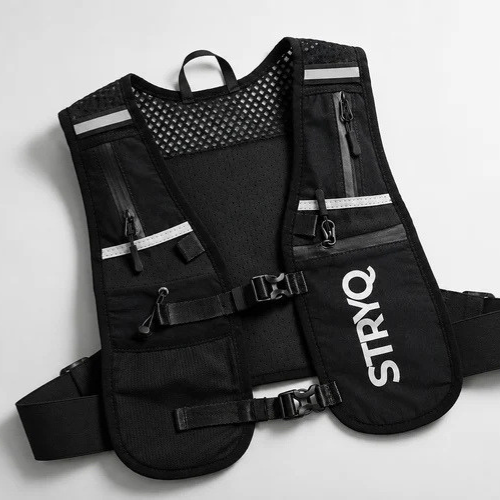
Battery-life advice only holds up if it survives an actual dark, wet trail, which is why product decisions at Stryq get shaped by feedback from runners training through UK winters, not just spec sheets. Where you carry a spare battery affects whether you’ll actually use it. In a hydration vest, front pockets sit close to the body, keeping cells warmer and within easy reach without breaking stride. On a running belt, the same spare sits lower and further from body heat, fine for shorter sessions but worth factoring in colder months.
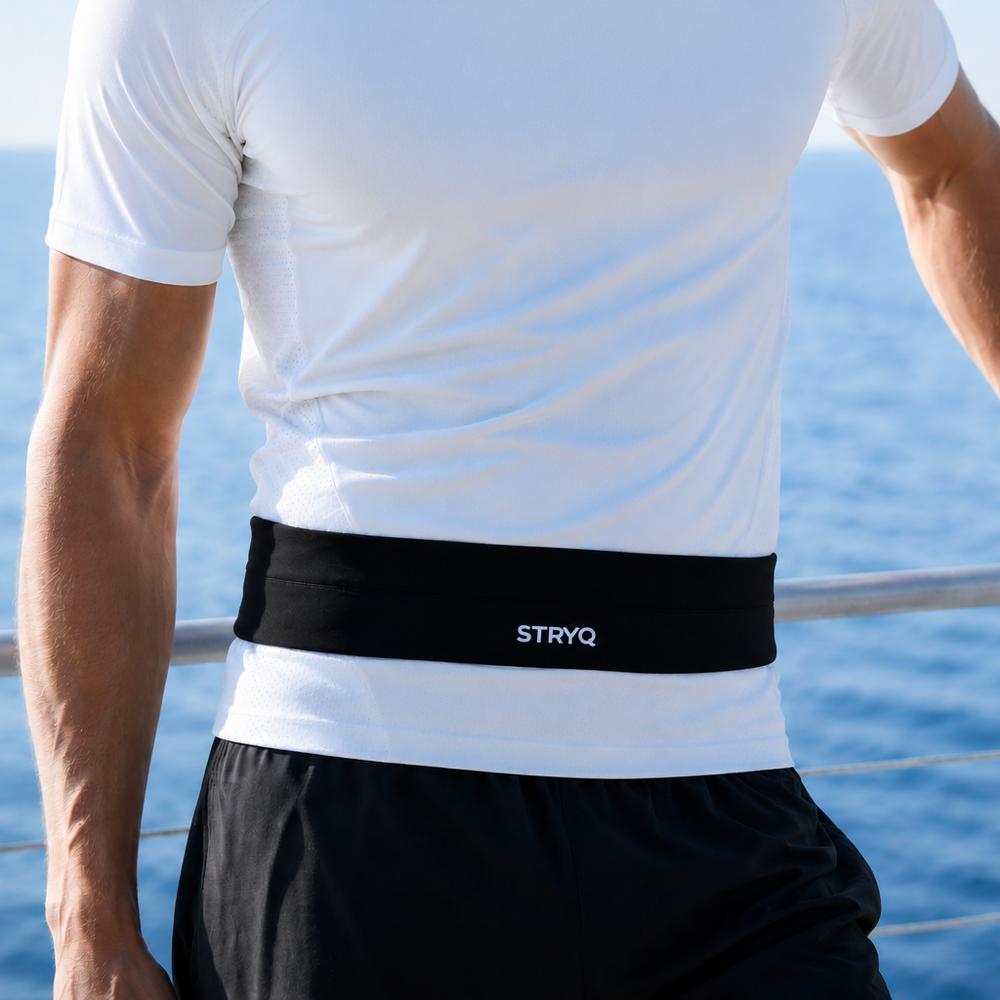
For runners doing longer sessions with a higher-capacity lamp and a spare cell or power bank, the STRYQ HYDRATION RUNNING VEST gives more dedicated storage and better weight distribution than a belt. For shorter, lighter night runs where you’re carrying little beyond the light itself, a STRYQ running belt does the job without the extra bulk.
An author’s checklist for every night run
My own kit stays simple: a USB-C rechargeable light with a visible battery gauge, charged the night before, plus a spare cell if I’m running longer than usual. Three checks happen every single time, battery percentage, a quick squeeze of the mount to make sure it’s secure, and a mental note of where my spare sits if I need it fast.
None of this works as a one-off. The habit that actually prevents dark, dead-battery finishes is charging kit as soon as you’re home, not the morning of your next run.
— martin
Carrying spares without breaking your stride
There are other ways to solve the battery problem, a bigger lamp, a bulkier battery pack strapped wherever it fits, but most of them fight against how you actually run. Stryq’s approach is to build the storage into gear you’re already wearing, so a spare cell or a slim power bank rides comfortably rather than bouncing around in a pocket.

For everyday road running, pair a lightweight rechargeable headlamp with the STRYQ running belt, enough room for a phone, a spare battery, and nothing you don’t need. For longer trail sessions or anything pushing past two hours in the dark, the STRYQ HYDRATION RUNNING VEST gives you dedicated pockets for a higher-capacity lamp, a spare battery cell, and water, without the vest shifting as you move. If you’re genuinely tackling ultra distances, a swappable-battery lamp or a larger-capacity unit is still the better technical choice over anything a vest alone can fix, but the vest is what makes carrying that extra weight comfortable enough to actually do it.
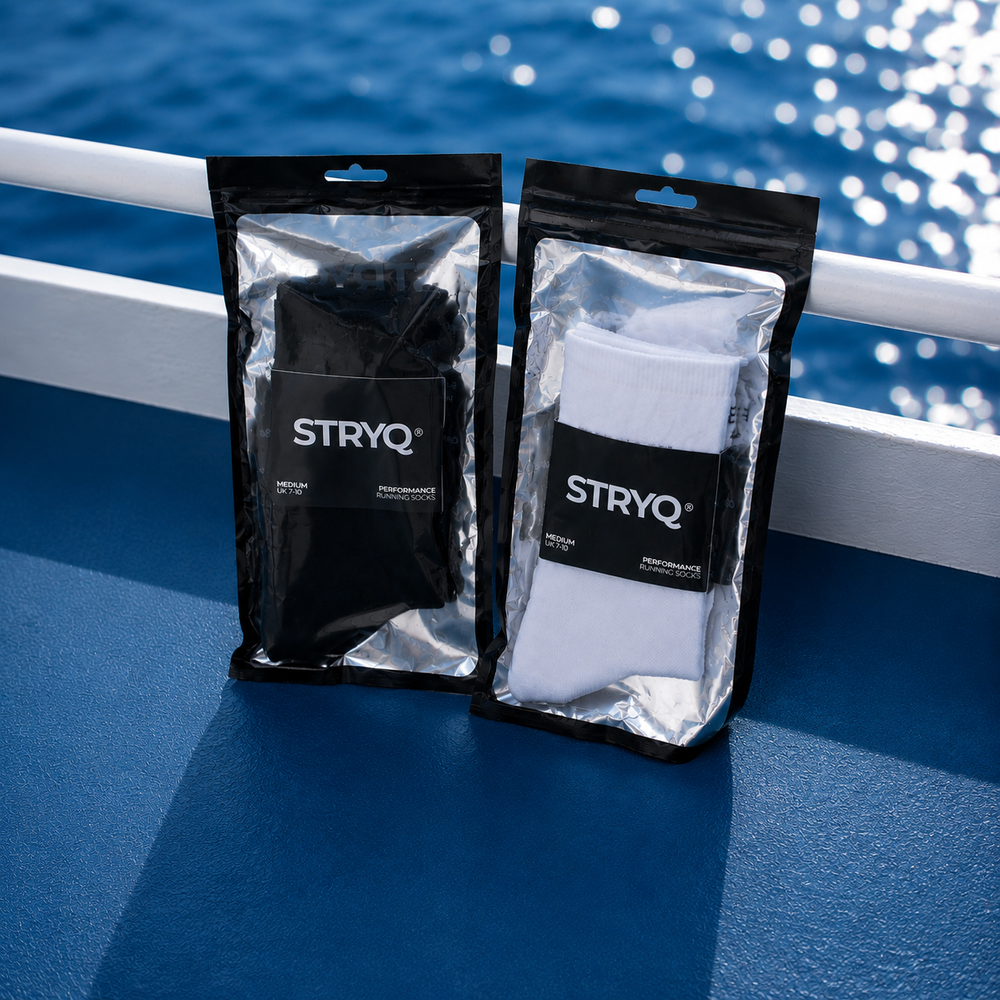
Comfort on the feet matters just as much over a long night out, and a pair of STRYQ running socks with arch support is a small addition that pays off over three or four hours on your feet. For hydration on longer sessions, the STRYQ 500ml Running Soft Flask tucks into the same vest pockets you’re using for your battery backup. Browse the full running gear collection to build a kit around whichever run you’re training for next.
Sources
- Best running headlamps of 2026 – iRunFar
- 9 Best running lights of 2026 (Tested & Reviewed)
- Fenix HM61R rechargeable headlamp — REI product page
FAQ
How long do battery running lights typically last?
It depends entirely on the setting and battery type, but most rechargeable lights give three to four hours on a medium setting suitable for regular night training. Higher-capacity units with 18650 cells, like the Fenix HM61R, can stretch to 12 hours on medium and 35 hours on low.
What’s the best running light for battery life?
There’s no single best option, it depends on your run length. For most training runs, a USB-C rechargeable light with a clear battery indicator and a medium setting around 200 to 300 lumens gives the best balance of weight and endurance, a pattern consistent across tested trail lamps. For overnight or ultra distances, a swappable 18650 or 21700 cell system is the more reliable choice.
How long does a high-lumen light’s battery actually last?
High-output lights in the 1,000 lumen range typically only hold that brightness for two to four hours before stepping down to protect the battery. Testing on units like the Black Diamond Distance LT 1100 shows around 4.25 hours even on a reduced 600-lumen setting, so treat high mode as a short-burst tool rather than a full-run setting.
Which running light has the longest battery life?
Lights built around larger 18650 or 21700 cells generally outlast smaller built-in rechargeable units on low and medium settings, with some managing 35 hours on low according to retailer specifications. Reactive lighting models that automatically adjust brightness, as tested by iRunFar, also extend usable runtime significantly compared with a fixed setting.
How much extra runtime should I plan for on a night run?
A reliable rule is two to three times your expected time in darkness, more for remote or unsupported routes. This gives you a genuine safety margin if you slow down, take a wrong turn, or the temperature drops and reduces battery performance.