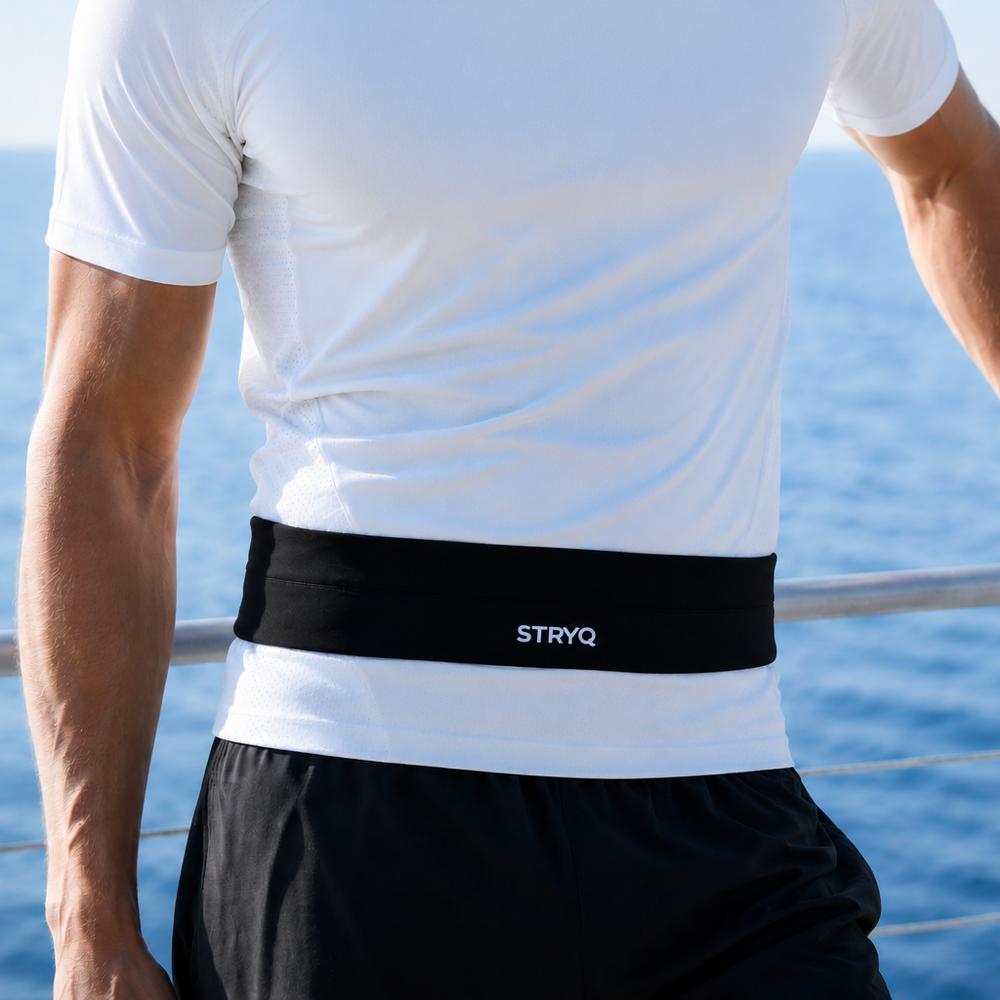
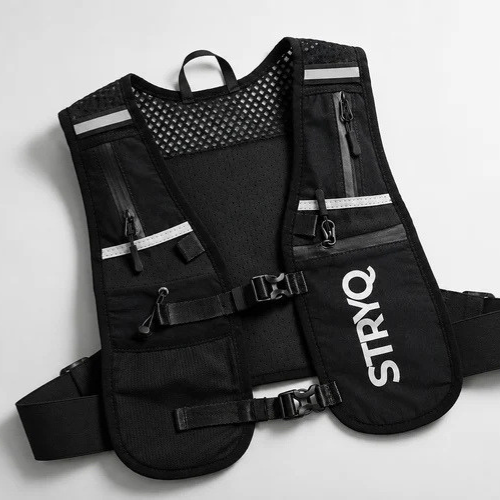
The minimal effective kit is a front light, a rear red flashing light, moving reflectors on your ankles and wrists, and a high-coverage reflective torso piece such as the Stryq Hydration Running Vest. Put it all on the moment dusk arrives, not once it’s properly dark. This isn’t optional extra kit for serious runners. It’s the baseline that stops drivers guessing where you are.
TL;DR:
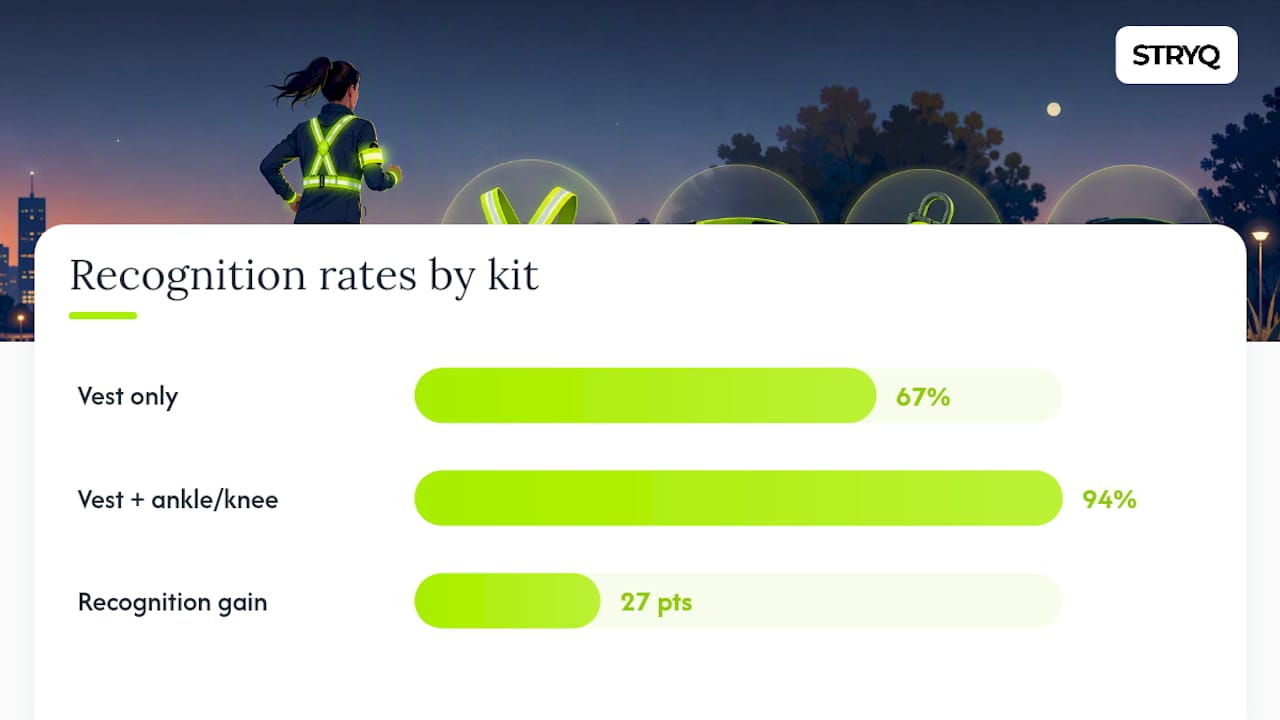
- Moving reflectors on ankles and wrists significantly increase visibility, with recognition rates jumping from 67% to over 94% when combined with torso coverage.
- Brightness levels should be at least 200 lumens for headlamps on roads and more for trail running, with battery life and fit being critical for safety.
- The dusk-rule prioritizes gearing up at the first sign of fading light, as recognition and reaction times sharply decline after dark.
- The Stryq Hydration Running Vest provides essential torso reflectivity and stable rear-light attachment, combining visibility with hydration for longer runs.
- Leg and wrist reflectors work better than static patches because of biomotion, making them vital even when wearing high-visibility clothing.
Table of Contents
- Building night running visibility: what to buy first and why
- How bright should your running lights be?
- Reflective gear and placement: why ankles matter more than you think
- Choosing visibility gear you’ll actually wear
- Building the dusk-rule habit into every run
- Why Stryq’s kit fits the visibility routine
- Are there legal requirements for night running visibility?
- What the research gets right, and where most advice still falls short
- Get your night running visibility kit sorted tonight
- Sources
Building night running visibility: what to buy first and why
Visibility at night isn’t about one brilliant product. It’s about four things working together: a light pointing forward, a light glowing behind you, reflectors that move with your limbs, and enough reflective surface across your torso to register at a glance. Drop any one of these and you create a blind spot a driver can miss entirely.
Here’s why each piece earns its place:
- A front light lets you see the pavement, potholes and kerbs. It does very little for drivers approaching from behind you.
- A rear red flashing light is the one piece most beginners skip, and it’s the one that matters most in traffic. A flashing red light behind you is often the only signal a driver coming up from behind ever gets.
- Moving reflectors on ankles and wrists exploit something static reflective patches can’t. A driver’s eye locks onto rhythmic, swinging motion far faster than a fixed bright patch, because human vision is tuned to spot biological movement.
- Torso reflective coverage gives you bulk and shape recognition once a driver has clocked the moving points. It’s the difference between “something’s out there” and “that’s a person running”.
If you’re starting from nothing, a sensible budget kit looks like this:
- A basic clip-on or vest-style reflective layer with decent surface area.
- A cheap rear blinker that clips to a belt, vest strap, or waistband.
- An entry-level headlamp for routes without streetlighting.
Once you’re running regularly at night, it’s worth upgrading:
- A brighter, longer-runtime headlamp with a stable, anti-bounce fit.
- A rear light with a longer battery life and a genuinely bright flash mode, not just a dim steady glow.
- Higher-quality ankle bands that stay secure over trainers and sleeves without sliding.
The Stryq Hydration Running Vest sits well in either kit because it does two jobs at once. It gives you broad reflective torso coverage, which is the piece beginners most often underestimate, and it has attachment points where a rear light can clip on at a consistent height, rather than bouncing around on a waistband. For anyone building their first proper night kit, that combination of coverage and a stable place to mount your rear light removes two decisions in one purchase. Stryq’s own guide to reflective gear for running covers placement in more depth if you want to fine-tune beyond the basics.
How bright should your running lights be?
Headlamps, rear blinkers and clip-on waist lights each solve a different problem, and mixing them up is the most common beginner mistake. A headlamp is there so you can see the ground. A rear light is there so drivers can see you. Treat them as separate purchases, not one device doing both jobs.
For most road running, REI’s guidance suggests aiming for at least roughly 200 lumens on a headlamp, which is enough to pick out kerbs, potholes and loose surfaces on a lit or semi-lit route. Trail running in full darkness needs considerably more, since you’re relying on the beam alone to spot roots, rocks and drop-offs with no ambient light to help. A narrow, focused beam suits road running because it throws light further down the pavement ahead of you. A wider, more diffuse beam suits technical trail terrain because it fills in your peripheral vision, where most trip hazards actually appear.
Battery life matters more than most runners expect until they’re caught out. A cheap headlamp on its brightest setting can drain in under two hours, which is a problem on a longer winter run. Look for:
- A stated runtime on the brightest usable setting, not just the “eco” mode, since manufacturers often quote the flattering number.
- At least basic water resistance, since rain and sweat both find their way into cheap light housings.
- A rear light with a genuine flash mode rather than only steady, since flashing patterns catch peripheral attention far better in traffic.
Fit is where good intentions fall apart. A headlamp that bounces on a downhill stride becomes an annoyance you stop wearing within a fortnight, so an anti-bounce strap or a slight forward tilt in the band matters more than an extra 50 lumens. Chest-mounted lights solve the bounce problem for some runners but throw a lower, flatter beam, which suits road running better than technical trail. Rear lights work best clipped high, around shoulder blade height on a vest or pack, rather than low on a waistband where a jacket or bag can block the beam entirely from a driver’s sightline. Stryq’s headlamp versus chest light fit checklist is worth a look if you’re torn between the two mounting styles.
Recognition distance is the number that should worry you. Trail Runner Magazine’s research found drivers spot a runner in a plain reflective vest only 67% of the time. Add ankle and knee reflectors to that same vest and recognition jumps to 94%. That 27-point gap is the entire argument for wearing moving reflectors, not just a torso light or a bright top.
Reflective gear and placement: why ankles matter more than you think
Ankle and wrist placement outperforms torso-only reflectivity because of how human vision processes movement. Researchers call this biomotion: your visual system is wired to spot the rhythmic swing of limbs long before it registers a static shape, which is why a driver’s eye catches swinging ankle reflectors well before it catches a still, bright jacket. That’s the mechanism behind the 94% recognition figure above, and it’s the reason a £5 pair of ankle bands can matter more than an expensive jacket.
A few rules make this work in practice rather than just in theory:
- Wear ankle and wristbands over your outer layer, never underneath a jacket sleeve or tucked inside a sock, since a covered reflector is a wasted reflector.
- Pair moving reflectors with a torso vest rather than relying on one or the other. Motion catches the eye first; torso coverage confirms shape and size once that eye is already looking your way.
- Check the material, not just the amount of reflective surface. Genuine retroreflective material, similar to certified 3M Scotchlite-style fabric, bounces light directly back at a driver’s headlights. A small decorative logo or a thin printed reflective strip does very little in comparison, even if it looks silver in daylight.
- Rotate reflective gear into your kit before you think you need it. Dusk light tricks your own perception into feeling more visible than you are, so gearing up early costs nothing and buys margin.
Pro Tip: Ask a partner to shine a car headlight or a strong torch at you from around 50 metres while you stand in your usual running posture, then move as if mid-stride. Watch which reflector catches their eye first. If your ankle bands don’t register instantly, they’re either too dim, badly positioned, or hidden under a layer, and that’s worth fixing before your next run rather than after a close call.
For anyone building a kit from scratch, Stryq’s rundown of reflective running gear walks through which materials genuinely perform versus which ones are mostly decorative.
Choosing visibility gear you’ll actually wear
The best visibility kit is the one that survives more than three runs. Plenty of reflective gear ends up in a drawer because it chafes, bounces, or feels like overkill on a warm evening, so fit and comfort deserve as much attention as brightness.
Run through this before you commit to a purchase:
- Vests should sit flat against your back and chest with no bounce at a jogging pace. Adjustable side straps matter more than the marketing photos suggest, because a vest that shifts as you run will eventually get abandoned.
- Ankle and wrist bands need to sit securely over sleeves and socks without sliding down mid-run. If a band needs constant readjusting, it will end up staying home.
- Headlamps should hold a stable beam through a full stride cycle, with a strap that doesn’t dig in after 30 minutes. A quick two-minute test around the house, walking and jogging in place, tells you more than reading a spec sheet ever will.
Weather changes the equation. Rain and cold push most runners toward jackets, but a jacket has a habit of swallowing ankle bands or covering a chest-mounted light entirely. Wear reflective bands over the cuffs of a rain jacket, not underneath, and check that a vest still sits over any extra insulating layer rather than being buried by it. Snow and fog cut visibility further in both directions, since drivers see less of you and you see less of the road, which makes a brighter headlamp and a flashing rear light non-negotiable rather than a nice-to-have.
There’s a genuine trade-off between breathability and coverage. A lightweight vest with mesh panels breathes better on a warm evening but often has less reflective surface than a bulkier option. For short tempo runs, weight matters more, so a slim reflective layer plus bands may beat a full vest. For long, slow winter runs in poor conditions, coverage and warmth win out, and a vest or jacket with genuine retroreflective panelling is worth the extra grams. If you’re also rethinking footwear for grip in wet or dark conditions, YDA UK’s shoe selection guide is a useful companion read.
Building the dusk-rule habit into every run
The dusk rule is simple: gear up at the first hint of fading light, not once it’s fully dark. Transitional light is the most dangerous window of the day, because drivers are often still running on daytime habits and haven’t adjusted their scanning behaviour for reduced visibility, even as the light drops fast beneath tree cover or between streetlights.
A short pre-run checklist removes the guesswork:
- Charge lights the night before, not the morning of, since a flat rear light is worse than no light at all if you assume it’s working.
- Put reflective bands over sleeves and jacket cuffs, never underneath.
- Carry ID and your phone, and tell someone your planned route and rough return time.
- Face oncoming traffic where local rules allow it, so you can react to a driver rather than trust them to react to you.
- Skip headphones, or keep volume low enough to hear an approaching vehicle.
- Choose a lit, busier route over a quiet shortcut whenever the timing allows it.
Pedestrian and runner crash risk climbs sharply in the hour either side of dusk, largely because visibility drops faster than driving behaviour adjusts. That single fact is the entire argument for treating the dusk rule as non-negotiable rather than a nice habit for darker months.
Why Stryq’s kit fits the visibility routine
Stryq builds gear from real runner feedback rather than chasing the lowest price point, which matters here because most visibility failures aren’t about missing knowledge. They’re about gear that gets left in a drawer. Every product goes through multiple sample revisions and testing before release, with the aim of solving practical problems: comfort, secure fit, and genuine functionality rather than gear that looks good on a shelf.
That approach shows up directly in the Stryq Hydration Running Vest:
- Broad reflective panelling gives the torso coverage this guide recommends as one of the four essential elements.
- Attachment points hold a rear light at a consistent, visible height, rather than letting it slide or bounce on a waistband.
- Adjustable straps are built to sit flat against the body, addressing the bounce problem that causes most runners to abandon reflective vests within weeks.
- The vest doubles as hydration kit, so runners aren’t choosing between visibility gear and carrying water on longer sessions.
The wider Stryq range, including reflective bands and safety lights, is built to the same brief: solve a real problem a runner actually has, tested until it works, rather than a product designed to look impressive in a listing photo.
Are there legal requirements for night running visibility?
There’s no single US law that mandates specific lights or reflective gear for runners, unlike cyclists, who face clearer state-level lighting requirements in many jurisdictions. Rules that do apply to runners tend to come through pedestrian and traffic laws rather than running-specific legislation, and they vary by state and even by municipality.
Most jurisdictions require pedestrians using a roadway without a footpath to walk or run facing oncoming traffic, and many require yielding right of way to vehicles except at marked crossings. Some areas have specific rules about walking or running on the road at night when a footpath is available, treating the roadway as a last resort rather than a default choice.
None of this amounts to a requirement to wear reflective gear or carry a light, but it shapes the practical advice in this guide. If you’re legally expected to be visible and responsible for spotting traffic yourself, then wearing gear that actually gets you noticed isn’t a courtesy. It’s the only real leverage you have over a driver’s reaction time. Check your local jurisdiction’s pedestrian statutes if you’re running somewhere unfamiliar, since footpath and crossing rules genuinely differ between states and towns.
What the research gets right, and where most advice still falls short
Most night-running advice fixates on brightness, as if the answer to visibility is simply a bigger lumen number on a headlamp. The Trail Runner Magazine research tells a different story: a static reflective vest gets spotted two-thirds of the time, but adding moving ankle reflectors pushes that past 94%. Motion, not brightness, is doing most of the work.
That’s the piece conventional advice underweights. Runners buy an expensive headlamp and skip the £5 ankle bands, when the bands are arguably doing more for their safety in traffic. Bright kit that sits in a drawer because it chafes or bounces protects nobody, which is why fit deserves equal billing with lumens in any real buying decision.
If there’s one thing to prioritise first, it’s building the dusk-rule habit before optimising equipment. A basic kit worn consistently from the first hint of fading light beats a premium kit that only comes out once it’s already properly dark.
— martin
Get your night running visibility kit sorted tonight
Stryq’s Hydration Running Vest gives you the torso coverage and rear-light attachment points this guide keeps coming back to, and it carries your water at the same time, so you’re not choosing between visibility and hydration on longer evening runs. It works whether you’re doing an easy 5K loop after work or a longer weekend session once the clocks change.
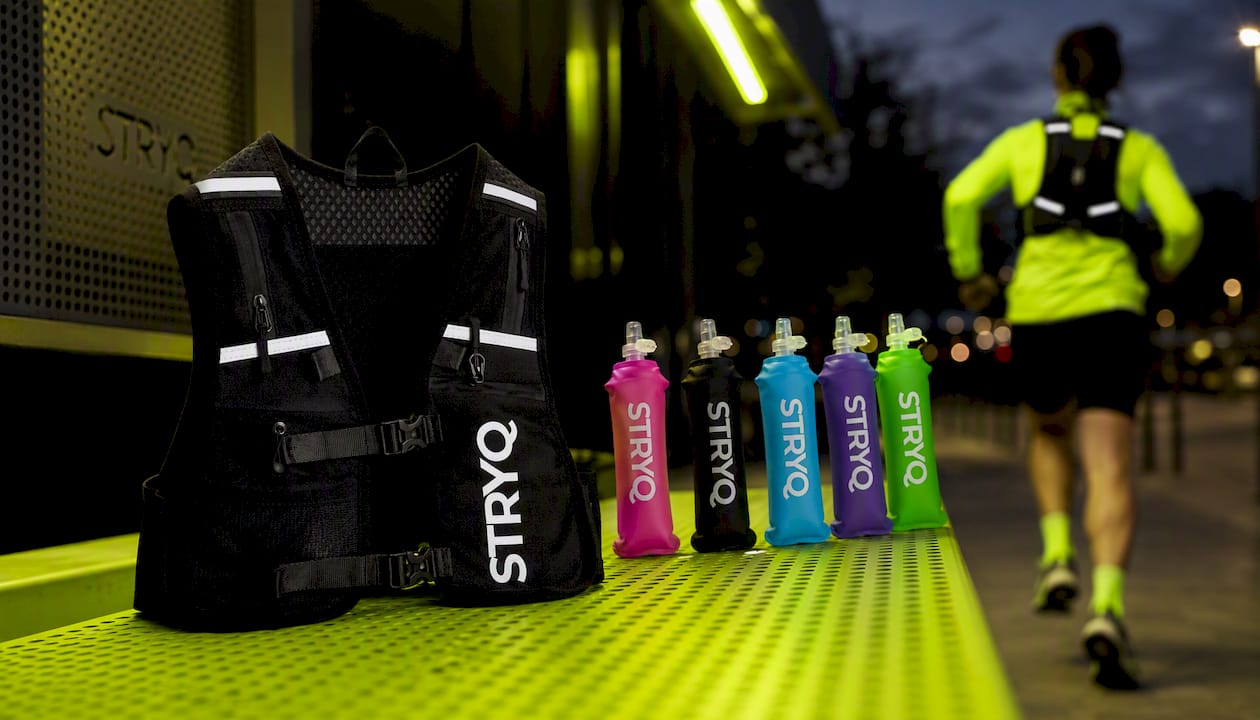
Pair it with a set of reflective ankle and wrist bands and a rear flashing light to complete the four-part kit outlined above, and check Stryq’s hi-vis vest and reflective bands set if you’d rather buy the core pieces together. Every product is built from real runner feedback and tested through multiple revisions before it reaches the shop, and prices sit in £ with no surprises at checkout. Head to the Stryq Hydration Running Vest page to check sizing and get your kit ordered before your next evening run.
Sources
- The science of being seen at night — Trail Runner Magazine
- Running at night tips | REI Expert Advice