For most UK runners, a running belt covers the majority of training runs and supported road races. A hydration vest becomes the right call once you go beyond two hours, head off-road, or race without reliable aid stations. Soft flasks or a handheld bottle suit short efforts where keeping cool and traveling light matters most.
Two trade-offs drive the decision:
- Capacity vs heat: A vest carries more fluid and more pockets, but adds back warmth and weight. A belt keeps your shoulders free and stays cooler, but limits how much you can carry.
- Simplicity vs storage: A handheld or small soft flask is the lightest option, but offers no room for keys, phone, or gels beyond what fits in your hand.
Your first buy: If your next goal is a supported half marathon or city marathon, start with a running belt. If you are training for a trail race, a long fell run, or any effort over two hours without guaranteed aid stations, go straight to a vest.
Table of Contents
- Which carrying system suits your distance and race type?
- How do you choose the right belt, vest, or soft flask?
- On-run handling: gels, refilling, and race transitions
- Cleaning, drying, and maintaining your kit so it lasts
- Stryq’s recommended on-run kit
- Key takeaways
- What Stryq’s testing actually showed
- Stryq’s carry range: where to buy
- Sources and where to learn more
Which carrying system suits your distance and race type?
The right system depends on how far you are running, what terrain you are on, and how often you will pass an aid station.
| Distance / use | Best system | Capacity | Gel/phone/key storage | Weight impact | Fit / anti-bounce | Cleaning | Price range |
|---|---|---|---|---|---|---|---|
| Short road run (up to 10K) | Belt or handheld | 500ml | Belt: phone + keys + 1–2 gels | Minimal | Belt: adjustable waist strap | Easy rinse | — |
| Half marathon (road, aided) | Running belt | 500ml | Front pockets: gels, phone, keys | Low | Adjustable waist, anti-bounce clip | Easy | — |
| Marathon (road, aided) | Belt or vest | 500ml–1L | Multiple front pockets | Low–moderate | Sternum straps + waist | Moderate | — |
| Trail long run (2h+) | Hydration vest | 1L (soft flasks) | Multiple pockets, mandatory kit | Moderate | Multi-point tensioning | Moderate | — |
| Ultra / fastpacking | Vest + rear bladder | 1.5–3L (rear bladder) | Full storage, poles loops | Higher | Full torso wrap | More involved | — |
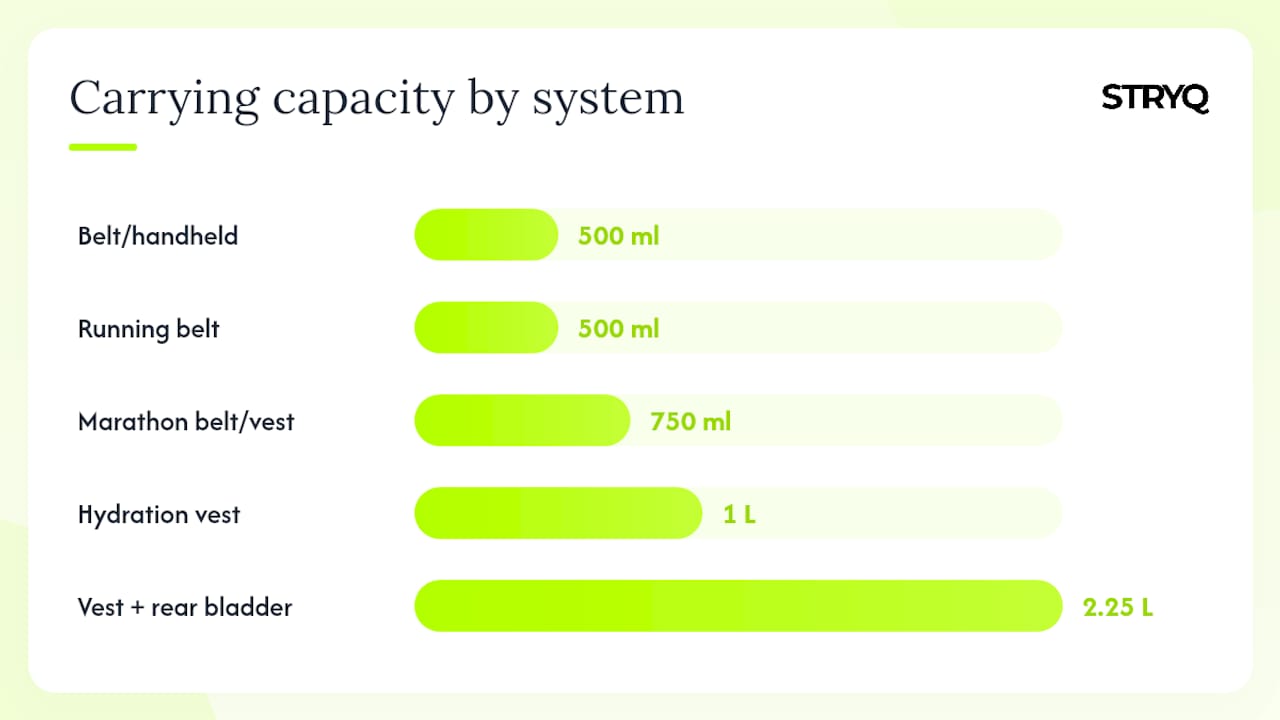
Belt vs vest choice comes down to how you want weight to sit: a belt keeps it low and simple for shorter road runs, while a vest spreads load across the torso when you need more capacity and pockets.
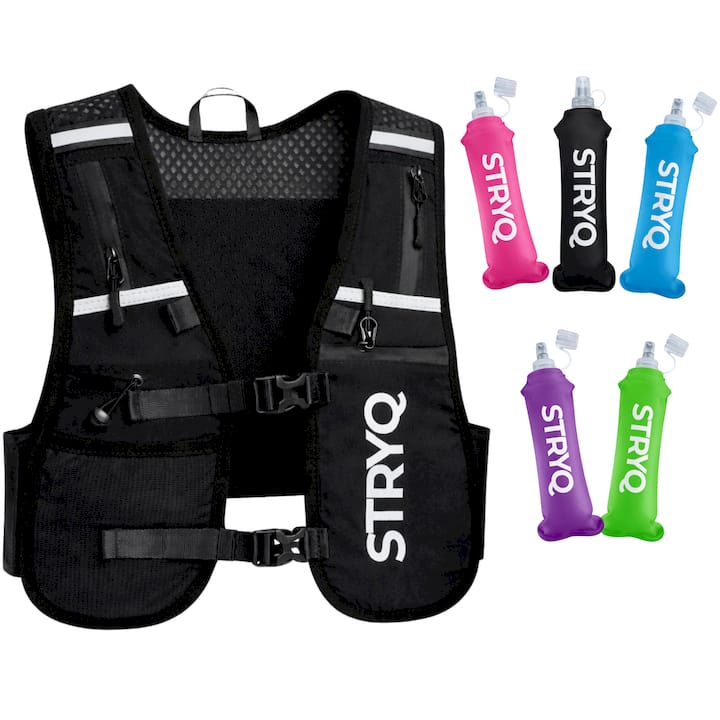
The aid-station rule is straightforward. Belts suit 5K–10K city runs, vests suit half to full marathons with less frequent support, and rear-bladder packs are for ultras needing much larger capacity. London Marathon, for example, has aid stations roughly every mile, so many runners carry nothing at all or use a small belt for gels and a phone. A Scottish fell race with no support for three hours is a different calculation entirely.
For trail runs over two hours and fell races with mandatory kit, a vest is usually required. Road marathons with regular aid stations often do not require carrying water at all.
How do you choose the right belt, vest, or soft flask?
Work through this checklist before you buy.
- Capacity for your run type. For runs under 75 minutes with aid stations, 500ml is usually enough. For two-plus hours off-road, plan for at least 1L of immediate-access fluid. Soft flasks range from 150ml to 500ml; two 500ml front flasks give roughly 1L total.
Red flags to avoid: loose front pockets that flap at speed; sternum straps with no adjustment; soft flasks with thin, unsealed welds; and any belt that only fits one waist size.
Questions to ask before buying: What is the size adjustment range in centimetres? Does the brand offer replacement flasks? What is the returns window if the fit is wrong?
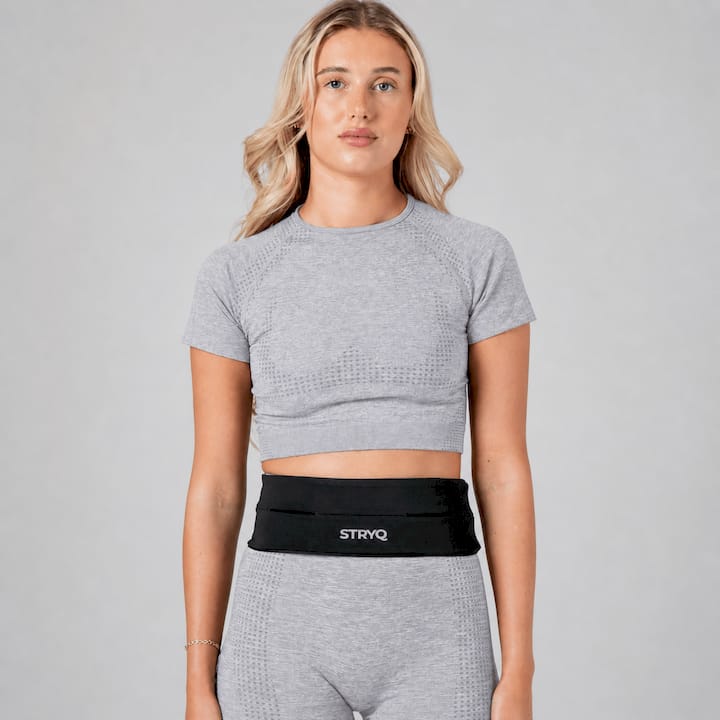
Pro Tip: Stryq’s testing found that runners consistently size down on vests. If you are between sizes, take the smaller one. A vest that feels slightly firm when stationary will settle into the right position once you start moving, and it will not bounce.
See also: running gear mistakes new runners make for a broader look at fit errors that cost runners comfort and time.
On-run handling: gels, refilling, and race transitions
Keep race-day gels in front pockets ordered by hour. Gel one goes in the easiest-access pocket on your dominant side; subsequent gels sit behind it in sequence. You should be able to extract a gel with one hand at pace without looking down.
Front soft flasks are easier to access and refill than rear bladders mid-run. Most vests include two 500ml soft flasks as standard, giving roughly 1L of immediate front-access hydration. To prevent slosh, squeeze the air out of a soft flask completely before you seal it. A half-full flask with trapped air will move around noticeably, especially on descents.
At aid stations, pull the flask from the front pocket, fill it from the volunteer’s jug or tap, squeeze out the air, and replace it before you move on. Practise this at home with a jug of water until the motion is automatic. Fumbling with a flask at mile 18 costs more time than the refill itself.
Used gel wrappers go into a dedicated pocket, not back into the gel pocket. Designate one small zip pocket as your rubbish pocket before the race starts, and use it consistently.
Pro Tip: Rehearse every clip, zip, and reach action in training. Run two or three long sessions wearing your race kit and practise extracting gels, refilling flasks, and stowing wrappers at pace. Race day is not the time to discover that your zip sticks.
For race-specific hydration planning, the London Marathon hydration strategy guide covers aid-station timing in detail.
Cleaning, drying, and maintaining your kit so it lasts
Clean soft flasks after every run. Rinse with warm water, add a small drop of mild washing-up liquid, shake, then rinse thoroughly. Leave the cap off and stand upside down on a drying rack. A bottle brush helps if you use electrolyte tablets, which leave residue.
Bladders need more effort. Use a long-handled bladder brush for the reservoir and a thin tube brush for the drinking hose. Dry both completely before storage, as trapped moisture causes mould quickly.
| Item | Clean after every run? | Typical lifespan issue | Ease of cleaning |
|---|---|---|---|
| Soft flask (150–500ml) | Yes | Weld failure, valve wear | Easy |
| Rear bladder (1.5–3L) | Yes | Mould in hose, seal wear | More involved |
| Belt fabric | Weekly or as needed | Odour, elastic stretch | Easy (hand wash) |
| Hard bottle | Yes | Lid seal wear | Easy |
Inspect seams and welds every four to six weeks. Run a finger along the weld line of each soft flask. Any delamination or bubbling means the flask should be replaced before it fails mid-run. Check zip pulls on vests and belts at the same time. A small drop of zip lubricant on sticky zips extends their life considerably.
Stryq’s recommended on-run kit
Stryq builds its carry range around the problems that come up repeatedly in runner feedback: bounce, poor pocket access, and flasks that leak.
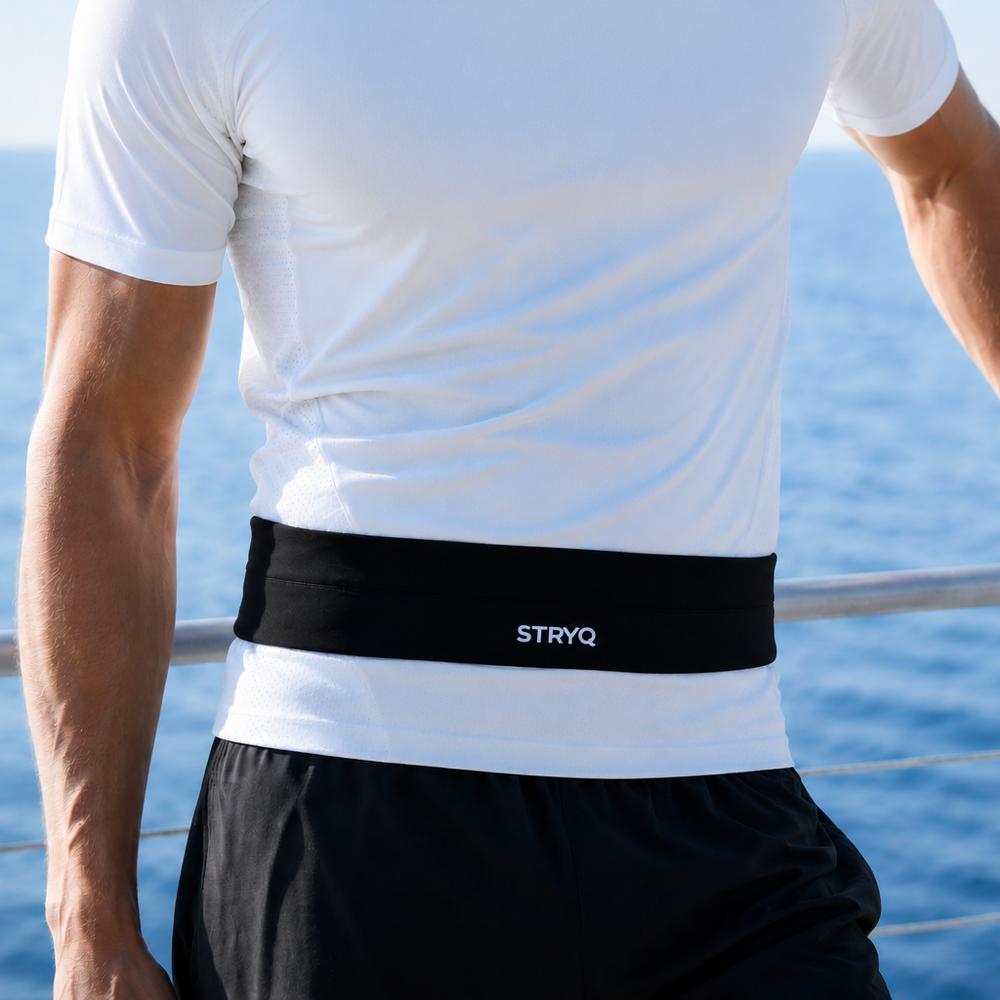
Stryq running belt
- Best for: supported road runs, 5K to marathon
- Storage: 360° pocket layout, phone, keys, multiple gels
- Weight impact: low profile, sits at the waist
- Fit: wide adjustment range, anti-bounce design
- Cleaning: hand wash, quick dry
- Price: check current price at Stryq running belts
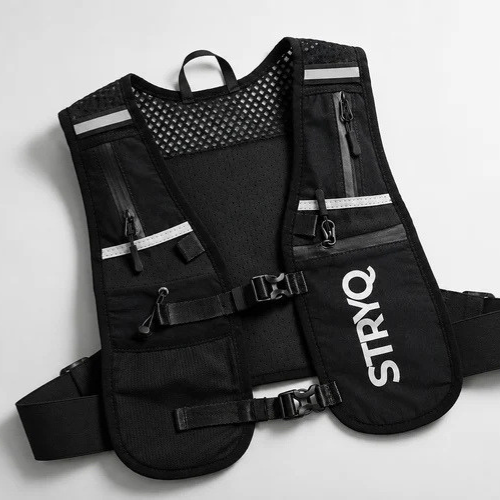
Stryq hydration vest
- Best for: long runs, trail, fell, and unsupported efforts
- Capacity: two front soft flask pockets (500ml each)
- Storage: multiple front and rear pockets for gels, phone, mandatory kit
- Fit: adjustable sternum straps, multi-point tensioning
- Cleaning: hand wash vest; rinse flasks after every run
- Price: check current price on the Stryq website
Stryq soft flasks
- Best for: replacement or upgrade flasks for any vest
- Capacity: available in multiple sizes
- Key feature: RF-welded seams, tested valves, collapsible to reduce slosh
- Cleaning: easy rinse, wide mouth for brush access
- Price: check current price at Stryq soft flasks
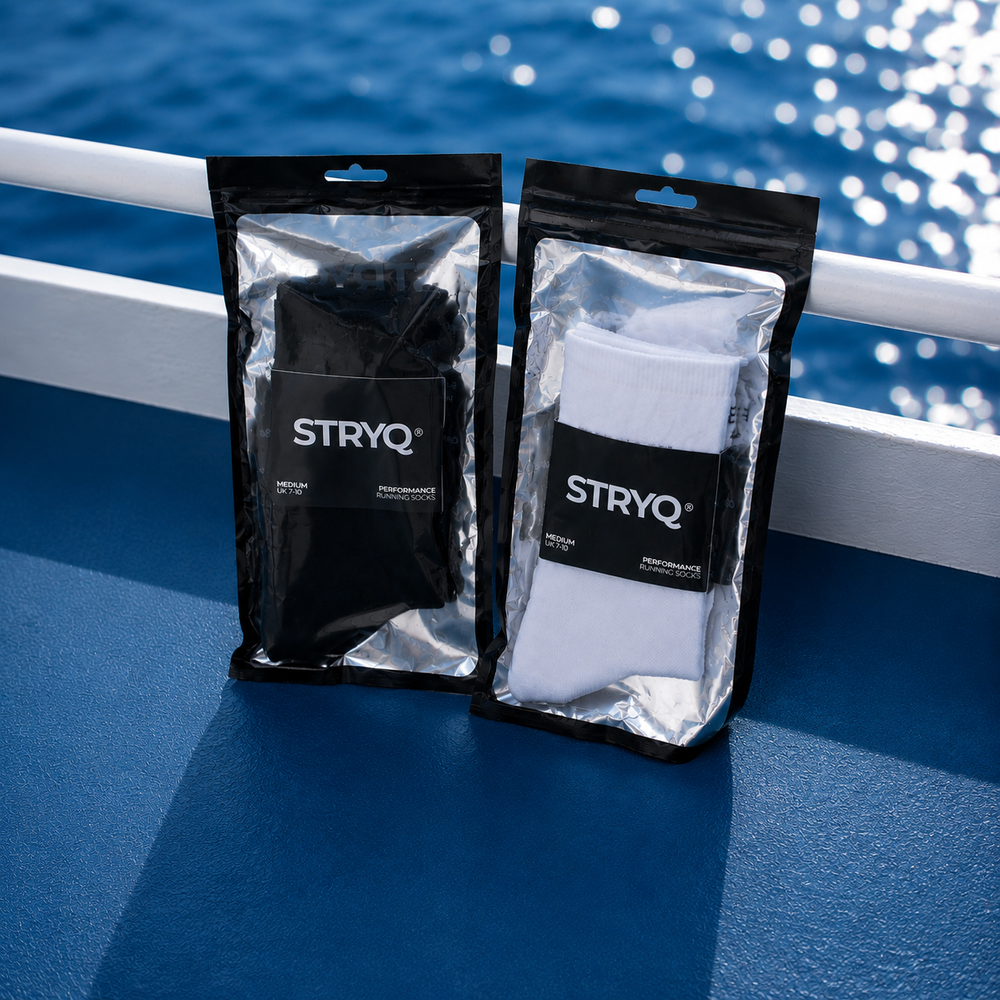
Every Stryq product goes through multiple sample revisions and real-world test mileage before it reaches the shop. The socks range, including Stryq Running Socks in Black and Stryq Running Socks in White, follows the same development process: arch support, cushioning, and moisture control tested across training runs before launch.
For runners planning longer efforts and thinking about what to carry alongside fluids, fuelling long runs is covered in detail by Granavitalis.
Key takeaways
Choosing the right carrying system comes down to distance, terrain, and aid-station availability: a belt covers most supported road runs, a vest covers everything longer or off-road.
| Point | Details |
|---|---|
| Belt for supported road runs | A running belt suits 5K to marathon distances where aid stations are frequent. |
| Vest for 2h+ or off-road | Any run over two hours or on trail requires a vest with at least 1L capacity. |
| Soft flask capacity | Two 500ml front flasks give roughly 1L of immediate-access hydration. |
| Clean after every run | Rinse soft flasks after each run; bladders need a brush and full dry to prevent mould. |
| Stryq carry range | Stryq’s belt, vest, and soft flasks are tested across UK running conditions with multiple sample revisions. |
What Stryq’s testing actually showed
Every Stryq carry product has gone through real-world test mileage across road and trail conditions in the UK, with multiple sample revisions driven by runner feedback. Pocket placement, strap width, and flask valve design were all adjusted between iterations based on what runners reported after long runs and races.
The fit guidance in this article, particularly the advice to size down on vests and to designate a rubbish pocket before race day, comes directly from that testing process. If you have a sizing question or want advice on which product suits your next race, the Stryq customer support team is available through the website.
For a broader look at how Stryq approaches product development, the running lifestyle guide covers the brand’s philosophy in more detail.
Stryq’s carry range: where to buy
Stryq’s carry range covers the three systems this guide recommends: a low-profile running belt for road and supported races, a hydration vest for longer and off-road efforts, and soft flasks for replacement or upgrade.
Visit the Stryq running belts page if your next goal is a supported half or city marathon. Head to the soft flasks collection if you need replacement flasks for an existing vest. For a complete kit check before race day, the best marathon race day accessories guide lists everything worth packing.
If you are unsure between a belt and a vest, order the belt first. Test it on two or three long runs. If you find yourself wanting more capacity or more pockets, that is the signal to add a vest. Check the returns and warranty details on each product page before you order.
Sources and where to learn more
- Hydration Vest vs Belt for Running: Which Should You Buy? – StripeFit
- Hydration Pack vs. Running Vest vs. Running Belt: A Factory Insider’s Guide
- Running Vest vs Hydration Belt — Which Should You Choose? - Running for the Hills
- How to choose a hydration vest | Kit Authority
- How to choose a trail running hydration pack - Hill