

Running lifestyle for everyday UK runners: kit and plan
A running lifestyle is a daily rhythm built around short, consistent runs, sensible rest, and a handful of functional accessories. Schedule three 25–40 minute runs this week and pick one quality accessory to support them.
At a glance:
- Three to four runs per week, kept short and consistent, beats occasional long efforts
- Rest and active recovery are part of the plan, not gaps in it
- Gear should support your natural movement, not complicate it
- One well-chosen accessory (socks, belt, or light) makes a measurable difference to comfort and safety
Table of Contents
- What are the real benefits of adopting a running lifestyle?
- How do you build a realistic weekly running routine?
- Which accessories genuinely help everyday runners?
- How do you choose gear that supports your running form?
- How do you make premium kit last and justify the cost?
- How do you stay safe running in the UK?
- How do you integrate running into a balanced lifestyle?
- Stryq: practical running kit for everyday UK runners
- Key takeaways
- Why small, consistent choices beat all-in plans
- Further reading and sources
What are the real benefits of adopting a running lifestyle?
The most immediate benefit most runners notice is a mood lift, not a fitness milestone. Cedars-Sinai confirms that running raises endorphin levels, improves sleep quality, and lowers depression risk. Harvard Medical School adds that endocannabinoids, not just endorphins, are central to that post-run calm. Better sleep and steadier energy follow within weeks of consistent running, often before any visible physical change.
The long-term picture is equally clear. A meta-analysis in the British Journal of Sports Medicine found that runners have a notably lower risk of all-cause mortality compared with non-runners, with benefits appearing across a range of running intensities. A separate review in Progress in Cardiovascular Diseases put the risk reduction for premature mortality at 25%–40% among regular runners, with runners living approximately three years longer than non-runners.
Statistic to know: Even modest weekly running (5–50 minutes) is associated with lower mortality risk versus no running at all. You do not need to train for a marathon to benefit.
Common risks are manageable with simple habits:
- Rotate between two pairs of shoes to extend cushioning life and reduce repetitive stress
- Choose softer surfaces (grass, trail, tarmac paths) over concrete where possible
- Follow the 10% rule: never increase weekly mileage by more than 10% in a single week
- Stop if form deteriorates significantly; fatigue-driven mechanics raise injury risk
For a deeper look at running and mental health, Stryq’s training blog covers mood, sleep, and practical routine strategies.
How do you build a realistic weekly running routine?
The direct answer: three running days, two active recovery days, one longer easy run, and one full rest day. That structure suits most everyday runners and keeps the habit sustainable.
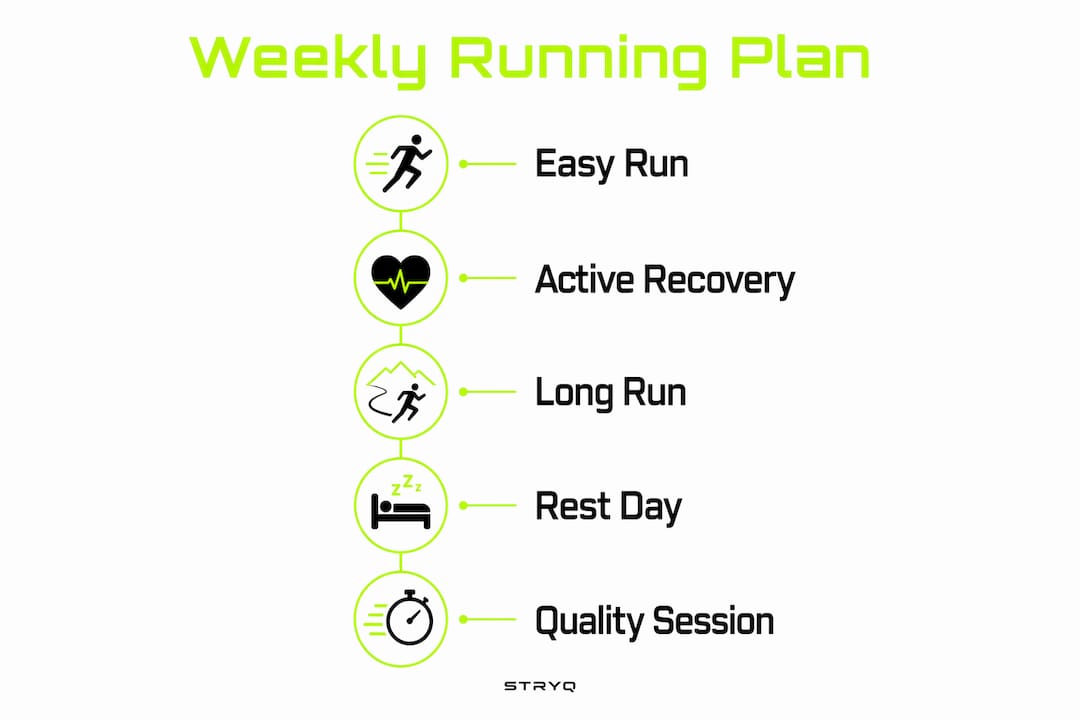
| Day | Session | Duration | Intensity | Key cue |
|---|---|---|---|---|
| Monday | Easy run | 25–30 min | Low | Short, soft steps; relaxed arms |
| Tuesday | Active recovery | 20–30 min | Very low | Walk, swim, or light cycling |
| Wednesday | Moderate run | 30–40 min | Moderate | Focus on cadence; avoid fatigue |
| Thursday | Rest | — | — | Light mobility or stretching |
| Friday | Easy run | 25–30 min | Low | Abdominal brace; upright posture |
| Saturday | Longer easy run/walk | 40–50 min | Low–moderate | Walk breaks if needed |
| Sunday | Full rest | — | — | Recovery is part of the plan |
Harvard Health recommends that roughly 25% of yearly exercise time be spent at lower intensity to allow tissue repair and maintain long-term consistency. Active rest days are not optional extras.
Progression rules:
- Add no more than 10% to total weekly duration each week
- The ACSM recommends targeting a cadence increase of 5–10% if you notice heavy footfalls or overstriding
- Introduce one new habit at a time (cadence, then step length, then posture) rather than overhauling form all at once
- Add kinetic chain strengthening (glutes, calves, core) alongside any form changes
Pro Tip: Attach your run to an existing daily habit — shoes on immediately after your morning coffee, or a lunchtime loop before you eat. Habit stacking removes the decision entirely and makes three runs a week feel automatic within a fortnight.
Music can also reduce perceived effort on those early runs. Research on how music reduces running fatigue shows it meaningfully lowers how hard a run feels, which matters most when you are still building the habit.
Which accessories genuinely help everyday runners?
Prioritise items that improve comfort and safety without interfering with your stride. The ACSM stresses that gear should complement natural biomechanics, not attempt to correct fundamental form problems.
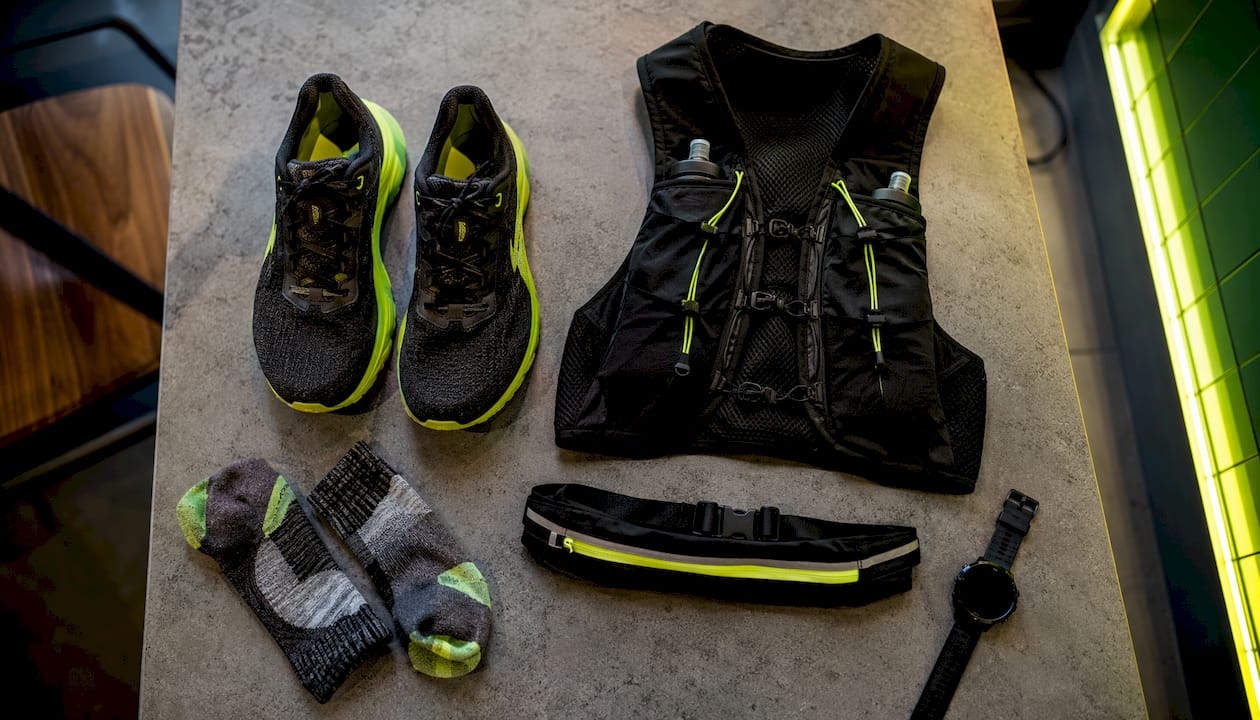
- Running socks: The single most overlooked accessory. A well-fitted, cushioned sock reduces friction, manages moisture, and prevents blisters. Stryq’s Running Socks in Black and Running Socks in White are developed through multiple sample revisions and field testing, sitting between budget options and expensive specialist brands.
- Running belt: Keeps your phone, keys, and a gel secure without bounce. A stable belt means you are not adjusting kit mid-run, which disrupts cadence and posture.
- Hydration vest: Useful for runs over 45 minutes, particularly in summer or on trail routes. Distributes weight evenly and keeps hands free.
- Soft flask: Pairs with a vest or belt for on-the-go hydration without the bulk of a rigid bottle.
- Safety lights: Front and rear lights are non-negotiable for UK autumn and winter running. More on this in the safety section below.
- Running gloves: Hands lose heat quickly in British weather. Lightweight gloves add comfort without adding weight or changing your arm swing.
Pro Tip: Before buying, check the fabric composition. Merino wool and technical synthetics (polyester/nylon blends) outlast cotton in every category. A sock or vest that survives 200 washes costs far less per use than a cheaper item replaced every few months.
How do you choose gear that supports your running form?
Lead with fit. Gear that moves with you, rather than against you, is the only gear worth buying. The ACSM’s healthy running habits guidance is clear: introduce form changes gradually and pair them with strengthening work. Equipment alone cannot fix a gait problem.
Checklist before you buy:
- Fit: No bunching, no pressure points, no excess material at the toe or heel
- Weight: Lighter is better; heavy kit shifts your centre of gravity and affects cadence
- Compression: Mild compression in socks aids circulation; avoid anything that restricts ankle movement
- Adjustability: Belts and vests should have simple, one-handed adjustment
- Visibility: Reflective panels or attachment points for lights matter for UK conditions
- Interference: If you have to think about the kit mid-run, it is not the right kit
For a practical overview of what you actually need, Stryq’s running gear guide covers the essentials without the noise.
Pro Tip: Test new socks or a vest on a short 20-minute run before committing to a long one. Most fit issues (heel slip, vest bounce, sock seam pressure) show up within the first kilometre. If something feels off early, it will feel worse at 8km.
How do you make premium kit last and justify the cost?
Premium kit is cost-effective when you care for it. A pair of running socks at £14 used 150 times costs less than 10p per run. A budget pair at £4 that lasts 30 washes costs more per use and performs worse throughout.
Practical care habits:
- Wash socks and technical fabrics inside out, on a cool cycle (30°C), with no fabric softener
- Air dry rather than tumble dry; heat degrades elastic and technical fibres
- Rotate between two pairs of socks and two pairs of shoes to extend the life of both
- Inspect seams and fastenings after every 20 washes; a loose seam caught early is a five-minute repair
- Replace shoes at 500–800km of use; worn midsoles change your landing mechanics before you notice the wear visually
Fit checks that prevent damage: socks should sit flat with no bunching under the ball of the foot; a running belt should be snug enough not to rotate but loose enough to breathe. Both issues, if ignored, cause chafing that damages fabric and skin simultaneously.
Most reputable running brands offer a warranty on manufacturing defects. If a seam fails within normal use, contact the brand before replacing the item.
How do you stay safe running in the UK?
UK conditions — short winter days, wet roads, and busy commuter routes — require specific habits. Visibility is the priority.
- Fit a white front light and a red rear light for any run before 8AM or after 4PM between October and March
- Wear a reflective vest or jacket with 360-degree coverage; a single reflective strip is not sufficient on unlit roads
- Choose grass, trail, or dedicated paths over pavements next to fast roads where possible
- Avoid peak traffic hours (7–9AM and 5–7PM) on routes that share space with vehicles
- Tell someone your route and expected return time, or share your live location via your phone
For new runners, Stryq’s safety gear guide covers lights, hi-vis, and what to prioritise first.
Local resources: parkrun organises free, timed 5km events every Saturday morning at hundreds of UK locations. England Athletics’ club finder lists affiliated running clubs by postcode. Both are free to join and provide structured, social running without any commitment to race.
A brief health check with your GP before starting is sensible if you are over 40, have a pre-existing condition, or have been inactive for more than a year.
How do you integrate running into a balanced lifestyle?
Running works best as one part of a broader routine, not the whole of it. Three or four runs per week, combined with strength work, mobility, and genuine rest, produces better long-term results than daily running with no recovery.
Rest days are physiologically productive. Tissue repair, hormonal reset, and neuromuscular adaptation all happen during recovery, not during the run itself. Light mobility work (10 minutes of hip flexor and calf stretching) on rest days maintains range of motion without adding load.
Sleep is the most underused recovery tool. Running improves sleep quality, and better sleep improves running performance. The two reinforce each other when the training load is sensible.
Nutrition does not need to be complicated at everyday distances. Eat a balanced meal 2–3 hours before a run, carry water for anything over 30 minutes, and refuel with a normal meal afterwards. Gels and sports drinks are unnecessary below 60 minutes of easy running.
For guidance on running frequency and recovery, including when daily running helps and when it hinders, Stryq’s training blog covers the evidence clearly.
Stryq: practical running kit for everyday UK runners
Stryq sits between budget marketplace products and expensive specialist brands, offering field-tested kit at an accessible price. Every product goes through multiple sample revisions and strict quality control before it reaches a runner.
The Stryq Running Socks in Black and Running Socks in White are the starting point for most runners: cushioned, breathable, and built to last through regular washing. The full running socks range covers different weights and fits.
Beyond socks, Stryq’s running belts and hydration vests are designed for everyday use: no bounce, simple adjustment, and no unnecessary bulk. Soft flasks pair with the vests for runs over 45 minutes.
Browse the full range at stryq.co.uk and pick the one item that addresses your biggest current friction point.
Key takeaways
A running lifestyle built on three consistent weekly runs, sensible rest, and one quality accessory delivers measurable mood, sleep, and fitness benefits within weeks.
| Point | Details |
|---|---|
| Consistency over intensity | Three runs per week, kept short and regular, outperforms sporadic hard efforts. |
| Rest is part of the plan | Active recovery and full rest days allow tissue repair and sustain long-term adherence. |
| Gear supports, not fixes | Choose kit that fits naturally and complements cadence; it cannot substitute for gradual form work. |
| Cost-per-use justifies quality | A £14 sock used 150 times costs under 10p per run; cheap kit replaced frequently costs more. |
| Stryq for everyday UK runners | Stryq’s field-tested socks, belts, and vests offer premium quality at an accessible price point. |
Why small, consistent choices beat all-in plans
The runners who sustain the habit longest are rarely the ones who overhaul everything at once. They add one run, buy one useful accessory, and repeat the week. That pattern compounds.
The evidence supports it. Harvard Health’s cohort data shows that even small amounts of running produce meaningful health benefits, and that active rest preserves those benefits over years. The ACSM’s clinical guidance recommends introducing one form habit at a time, not several simultaneously, precisely because sequential change sticks where wholesale overhaul does not.
The practical implication: pick one thing this week. A Tuesday run before work. A pair of socks that actually fit. A cadence cue you focus on for ten minutes. Stack the next thing the following week. Within a month, the routine exists. Within three months, skipping it feels strange.
Journalling one line after each run (distance, how it felt, one observation) adds a feedback loop that most runners underestimate. It turns a vague habit into a record, and a record into motivation. Community check-ins via a local club or parkrun add accountability without pressure.
The kit matters, but only as far as it removes friction. A sock that blisters, a belt that bounces, or a vest that chafes will end a run early. Gear that works quietly in the background lets you focus on the run itself. That is the only standard worth buying to.
Further reading and sources
Research and clinical sources:
- Running and mortality: Harvard Health
- BJSM meta-analysis: running and all-cause mortality
- Running as lifestyle medicine for longevity: Progress in Cardiovascular Diseases
- ACSM healthy running habits infographic
- ACSM clinical review: PubMed
- Cedars-Sinai: benefits and risks of running
Stryq training and gear guides:
- How running improves mental health
- Running gear: what you actually need
- How to prevent running injuries
- New runner safety gear guide
- Is running every day bad for you?