Running socks range from a few pounds in a multipack to a premium price per single pair, and the sensible spend sits in the middle: a well-made pair that holds its shape, keeps your feet dry and lasts many runs. The way to judge any pair is cost per run, not the number on the tag. Our STRYQ Running Socks are built for that middle ground: cushioning, arch support and breathability at a price that stays accessible.
This guide shows what the market charges, what you pay extra for, and how to work out whether a pair is good value for your running, whether that is Couch to 5K, parkrun, a 10K or a marathon build.
TL;DR
- Prices span a wide range: premium single pairs cost roughly five times the cheapest budget socks, according to Men’s Health’s 2025 guide.
- Multipacks cut the price per pair, but a pair that blisters or loses its shape costs you runs, not just money.
- Fibre blend, cushioning, fit and seam design explain most of the price gap.
- Compare socks on cost per run: price divided by the number of runs before the cushioning flattens or the fabric thins.
- A mid-priced, purpose-built pair suits most beginners and long-distance runners alike.
Table of Contents
- What running socks actually cost
- Why some running socks cost more than others
- Are cheap multipacks the better deal?
- How to work out the real cost of a pair
- How often you will need to replace them
- Are running socks worth paying more for?
- Perspective
- Where our socks fit
- FAQ
- Sources
What running socks actually cost
There is no single price, because the category covers three different products: cheap cotton multipacks, mid-range technical socks and premium specialist pairs.
The widest evidence comes from US testing and retail guides, which is a fair guide to how the market is shaped even though currencies differ. In iRunFar’s 2026 testing, the cheapest tested pair was a lightweight toe-sock style and the dearest was a tall compression sock costing a little over three times as much. Most of the everyday trainer socks in between sat close together, within a few dollars of each other.
Men’s Health’s 2025 athletic sock guide draws the line more starkly: lower-priced athletic socks cost about a quarter of what premium pairs do, and the premium ones may use higher-quality fabrics for comfort, durability and moisture wicking.

The Independent’s 2026 US guide shows the same spread among single pairs, from about the mid-teens up to nearly double that for a fashion-led pair. Its three-pack picks from major brands worked out noticeably cheaper per pair than most of the singles.
The three price bands
| Band | What you get | Typical trade-off |
|---|---|---|
| Budget multipack | Mostly cotton or thin blends, sold in packs of six or more | Low cost per pair, but cotton holds moisture and can bunch |
| Mid-range technical | Synthetic or merino blends, zoned cushioning, arch support | Best balance of comfort, durability and price |
| Premium and compression | Specialist fibres, graduated compression, race-day designs | Highest cost, useful for particular events or preferences |
We sit in the middle band. Our running socks are designed with arch support and cushioning, aimed at runners who want premium quality without the premium-brand price. You can see the current price on the running socks page.
Why some running socks cost more than others
Price follows construction. Four things account for most of the gap.
Fibres
Cotton is cheap and absorbs sweat, then stays wet. Technical running socks use synthetic fibres or merino wool to manage moisture. iRunFar’s guide describes merino as temperature-regulating and moisture-wicking, and adds that wool is typically less durable than synthetics unless it is blended with nylon, polyester or spandex. That blending is part of what you pay for: a sock that feels good and still survives the wash. Our guide to merino versus synthetic running socks goes through the choice in more detail.
Cushioning and structure
Cushioning is not just padding. In a well-made sock it is placed where your foot takes impact and kept thin where it needs to breathe. Arch support keeps the sock from slipping and wrinkling, which is where many blisters start. This knitting is slower and more precise than a flat tube, so it costs more to make.
Fit and seams
iRunFar also covers ventilation, fit, compression and seamless toes. A sock that fits your foot properly, with a flat toe seam and a snug heel, rubs less. Poorly shaped socks save money on the shelf and lose it on your feet.
Brand and distribution
Some of the price is simply marketing and retail margin. This is one reason we sell direct to runners: the money goes into the sock, not into the layers between factory and your drawer.
Are cheap multipacks the better deal?
Sometimes, for some runners, and the reasoning is worth understanding.
Running Insight reported a specialty running retailer’s view that a single pair near the top of the price range causes sticker shock, and that a mid-priced point with two- or three-pair packs works better for many customers. The same piece noted that a big-box six-pack could cost about as much as one premium pair, which makes the multipack look attractive on the shelf.
The retailers in that article also argued that the performance benefits of better socks, in blister prevention and shape retention compared with inferior cotton multipacks, make them a value-driven investment. That matches how most runners experience it: the first time a cheap sock bunches up at mile six, the bargain disappears.
A sensible split for most people:
- Easy runs and short distances. A reliable mid-priced pair is enough. You do not need compression or race-specific socks.
- Long runs, half marathons and marathons. Spend a little more on cushioning and fit. Friction builds over hours, and this is where socks earn their price. Our guide to running socks for marathons covers what to look for.
- Hard workouts needing maximum cushioning. Men’s Health notes that premium socks may be worthwhile here.
How to work out the real cost of a pair
The price on the tag tells you the cost of buying, not the cost of using. Three steps give you a fair comparison.
1. Price per pair
Divide the pack price by the number of pairs. A six-pack at £18 is £3 a pair. A single pair at £12 is £12. This is the number most shoppers stop at, and it is the least useful one.
2. Runs per pair
Estimate how many runs a pair gives you before it thins at the heel and toe, loses elasticity or stops feeling cushioned. Longevity varies a great deal with material, how often you wash and how many miles you cover, so use your own experience: when you notice the sock feeling flat, count the runs. Our piece on what a sock maker tests for running sock durability explains how wear shows up.
3. Cost per run
Divide the price per pair by the number of runs. Here is an illustrative example with round numbers, not real products:
| Budget pair | Quality pair | |
|---|---|---|
| Price per pair | £3 | £12 |
| Runs before it is worn out | 30 | 120 |
| Cost per run | 10p | 10p |
In this example the two cost the same per run, but the quality pair also gives you fewer blisters, less bunching and fewer replacements to think about. If the cheaper pair needs replacing sooner, or you cut a run short because of a hot spot, the maths tips further toward the better sock. If the cheaper pair lasts as well, the budget wins. The point is to run the numbers with your own figures.
A quick comparison checklist
- Price per pair, not price per pack.
- Fibre blend: mostly synthetic or a merino blend, not mostly cotton.
- Arch support or a snug midfoot band.
- Flat toe seam and a defined heel pocket.
- Cushioning placed under the heel and forefoot.
- Your own runs per pair after a month of use.
How often you will need to replace them
Socks wear out gradually. Signs that a pair is done: thin patches at the heel or ball of the foot, a stretched cuff that slides down, fabric that feels rough after washing, or blisters appearing in shoes that used to be fine. Rotate two or three pairs so no single pair takes every run, and wash them according to the label to keep the fibres elastic.
Replacement frequency depends on how much you run. A runner doing three short parkrun-style sessions a week uses a pair far more slowly than someone logging marathon mileage, so the same sock has a very different annual cost for each. That is another reason cost per run beats a flat price comparison.
Are running socks worth paying more for?
For most runners, yes, up to a point. The gains are concrete: less moisture against the skin, less movement inside the shoe, less friction. Our article on whether running socks are worth it for comfort and blisters explains the reasoning, and our complete buyer’s guide covers fit and fabric.
The case is strongest as your distance grows. A 5K beginner gets a lot from simply swapping cotton for technical socks. A marathon runner has four or five hours of repeated impact, and small differences in fit compound.
The last stretch of price, though, buys less. Once you have a sock with the right fibres, cushioning and fit, paying far more usually adds branding or niche features rather than comfort. That is why the middle band is where most runners should shop.
Perspective
We started STRYQ because everyday runners were stuck choosing between budget marketplace socks that fell apart and expensive premium brands where much of the price was the logo.
Our view is that a sock should be judged by what it does on the run. Each of our products goes through multiple sample revisions, extensive testing and strict quality control, and we shape them around feedback from real runners. For socks that means comfort, fit, durability and moisture control come first.
We would rather you spend a fair price on a pair you trust, and wear it again and again, than buy a pack you replace every few weeks. That is the idea behind honest quality over marketing hype, and it is why we price between budget and high-end rather than chasing the cheapest or the most expensive.
martin
Where our socks fit
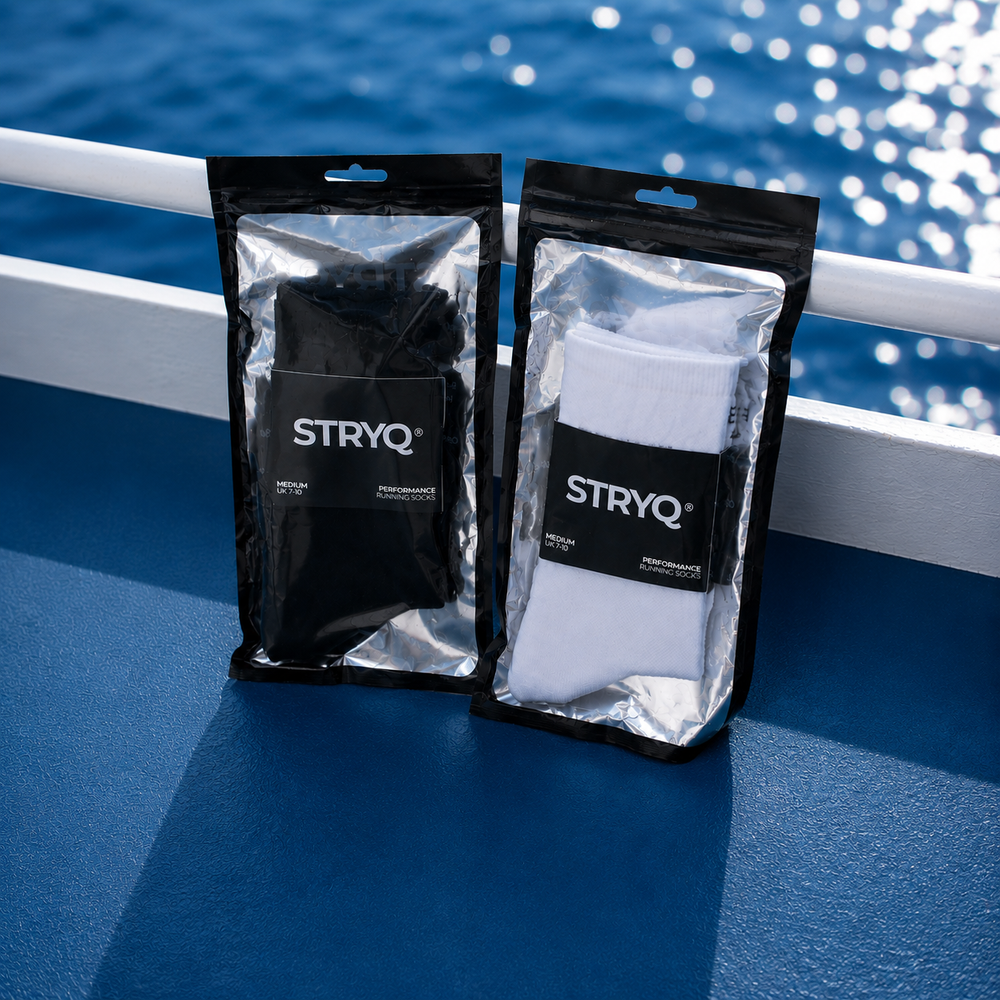
If you want a pair that balances all of this, start with STRYQ Running Socks. They are made for everyday runners: cushioned, with arch support, and designed for breathability and moisture control.

You can choose between black and white. Pair them with a soft flask for longer runs and you have the comfort basics covered without overspending.
FAQ
How much should you pay for running socks?
Pay enough to get technical fibres, proper cushioning and a good fit, which puts most runners in the middle price band. Premium guides such as Men’s Health put the best pairs at roughly five times the price of the cheapest, but the middle of that range covers what most runners need. Work out your cost per run before deciding.
Are cheap running socks bad?
Not automatically, but cotton-heavy multipacks tend to hold moisture and lose shape. For short, easy runs they can do the job. As your runs get longer, a purpose-built pair is more comfortable and usually lasts longer, so the cost per run often evens out.
Should beginners buy the most expensive socks?
No. A beginner on Couch to 5K or parkrun needs moisture-managing socks that fit well, not specialist race-day pairs. Start with a dependable mid-priced pair, then adjust as your distance and mileage grow.
Do I need compression socks for running?
No. Compression is a preference, and it sits at the top of the price range. Most runners do well with a standard technical sock that has cushioning and arch support. Choose compression only if you like the feel of it.
How many pairs should I own?
Two or three pairs is a practical minimum if you run several times a week, so you can rotate them and always have a clean pair. Rotation spreads the wear, which lowers your cost per run.
Sources
- Best Running Socks of 2026, iRunFar
- 11 Best Athletic Socks for Men 2025, Men’s Health
- Best Sock Forward, Running Insight
- Best Running Socks for 2026, The Independent