

Parkrun: the complete guide to joining, volunteering and racing
Parkrun is a free, weekly, volunteer-run 5k community event held in parks and open spaces worldwide, with a 2k junior format for children aged 4–14. Register once at parkrun.com, get your personal barcode, and you can attend any event anywhere in the world. Three things to do right now: register and download your barcode, use the event finder to locate your nearest event, and check whether your local event needs volunteers.
- Register for free at parkrun.com — one account, one barcode, valid globally.
- Find your nearest event using the official event finder on the parkrun UK site or the parkrunner app.
- If you want to help keep events free, sign up to volunteer via your local event page.
Key takeaways
Parkrun is free, weekly, and open to everyone: register once, bring your barcode, and you can attend any event in the world.
| Point | Details |
|---|---|
| Register once, run anywhere | Create one free account at parkrun.com and your barcode is valid at every event globally. |
| Barcode is required | Without a scanned barcode, you will not receive an official result, even if you complete the course. |
| Volunteering keeps it free | Every role is filled by volunteers; signing up via your local event page directly sustains free events. |
| Milestones at 25, 50, 100, 250 and 500 runs | Milestone T-shirts and wristbands are available from the parkrun shop once you hit each threshold. |
| Stryq socks and belts suit parkrun well | Cushioned running socks and a lightweight belt are the two most practical accessories for a comfortable event. |
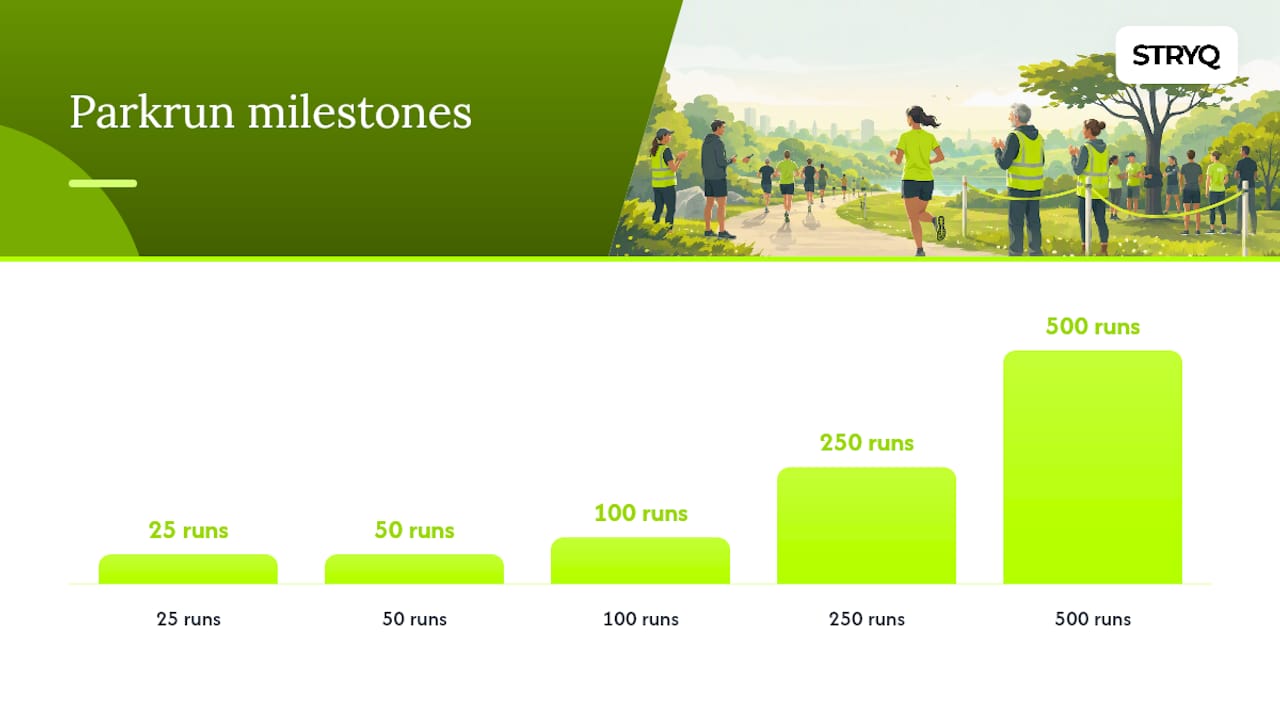
Table of Contents
- How parkrun started and why it feels different to a paid race
- What actually happens at a parkrun on Saturday morning
- How to register and join a parkrun for the first time
- Volunteering at parkrun: roles, how to sign up and why it matters
- What junior parkrun is and how it works for families
- Milestones, milestone clubs and parkrun tourism
- How to find your nearest parkrun and check your results
- Rules, safety and inclusivity: what you need to know before you go
- How parkrun events are organised and how they stay free
- Practical gear checklist for parkrun
- Why people keep coming back to parkrun
- Stryq running socks and accessories for parkrun
- Sources
How parkrun started and why it feels different to a paid race
Parkrun began at Bushy Park in October 2004 as a small timed trial with 13 runners. The early format was competitive, but the shift to an inclusive weekly model around 2008 changed everything. That decision lowered barriers for beginners, families, and anyone who had never considered themselves a runner. International expansion followed, and the same core structure now operates across multiple countries, each running the same free weekly events with volunteer roles and a central registration and barcode system.
The philosophy behind that growth is deliberate. There are no official time limits. Tail Walkers ensure nobody finishes alone. Junior parkrun gives children their own event. The volunteer-led model means nobody profits from attendance, which is why the event can stay free. Parkrun USA runs on exactly the same model, reflecting how consistently the founding principles have been applied across borders.
What actually happens at a parkrun on Saturday morning
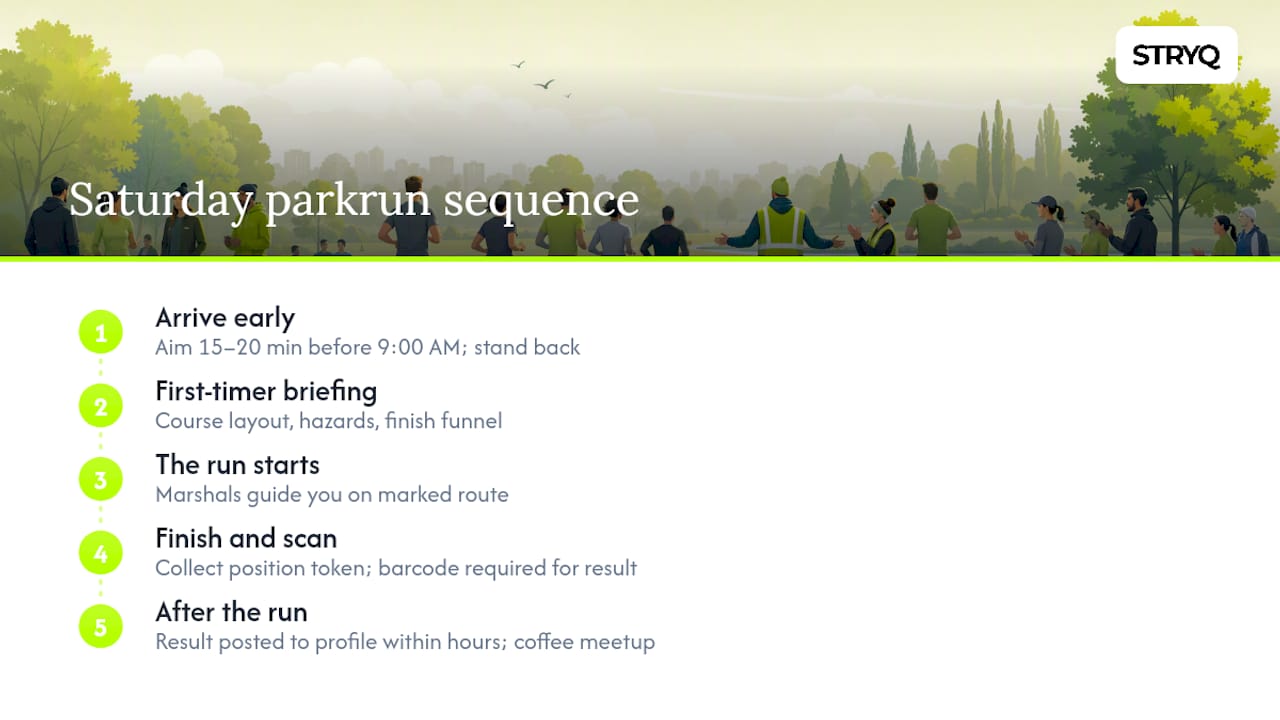
Most UK parkrun events start at 9:00 AM on Saturdays. Arrive at least 15 minutes early, especially for your first visit. The run director will gather first-timers near the start line for a short briefing covering course layout, any hazards such as narrow paths or tree roots, and where the finish funnel is. Local event pages often publish specific safety notes and logistics in advance, so it is worth reading yours before you go.
The run starts, marshals guide you around the course, and you follow the marked route to the finish funnel. At the finish, you receive a position token. A volunteer then scans your token alongside your personal barcode. That pairing is what generates your official time, which is posted to your parkrun profile, usually within a few hours of the event ending. No barcode means no official result, even if you ran every step of the course.
After the run, most events have an informal coffee meetup at a nearby café. Many participants say the post-run social is what keeps them coming back week after week.
Pro Tip: Arrive 15–20 minutes before the start for your first event. Slower runners and walkers typically gather towards the back of the start area, and the Tail Walker will be the last person to cross the finish line, so nobody is left behind. If you are nervous about pace, standing near the back removes that pressure entirely.
How to register and join a parkrun for the first time
Joining is straightforward. The official parkrun site handles registration, and you only ever need to do it once.
- Go to parkrun.com and create a free account.
- Complete your profile, including date of birth and emergency contact details.
- Download or print your unique barcode from your profile page.
- Use the event finder to locate your nearest event and check the start time.
- Arrive 15–20 minutes before the start.
- Attend the first-timer briefing at the start line.
- Run, jog, or walk the course.
- Collect your finish token and have both your token and barcode scanned.
- Check your results online or via the parkrunner app a few hours later.
What to bring:
- Your barcode, printed or saved on your phone (a screenshot works well).
- Suitable footwear for the surface — trail shoes for muddy or uneven courses, road shoes for tarmac paths.
- Weather-appropriate layers, particularly in autumn and winter.
- A small running belt or secure pocket for keys and your phone.
- Water if you prefer to carry hydration, though most 5k events do not require it.
Accessibility: Tail Walkers accompany the last participant to the finish, so there is no pressure on pace. Pushchairs and buggies are welcome at most events, though check your local event page for any restrictions. Guide runners are available at some events for visually impaired participants. If your result does not appear after an event, contact your local event team via the event page and they can investigate a missing scan.
Volunteering at parkrun: roles, how to sign up and why it matters
Parkrun UK describes volunteering as fundamental to delivering free weekly events, and the social and mental-health benefits of volunteering are well documented. Without volunteers, there are no events. That is not a figure of speech; every single role at every event is filled by someone giving their time for free.
Common volunteer roles include:
- Run director: Oversees the entire event, delivers the pre-run briefing, and manages the day.
- Marshal: Positioned at key points on the course to guide runners and flag any hazards.
- Barcode scanner: Scans finish tokens and participant barcodes at the finish area.
- Tail Walker: Walks the course behind the last participant, ensuring nobody is left alone.
- Timekeeper: Records finish times at the finish line.
- Token issuer: Hands out position tokens to finishers in the correct order.
To sign up, visit your local event page on parkrun.org.uk and look for the volunteer roster. Most events post a weekly request for volunteers via email or social media. No prior experience is needed for most roles; the run director will brief volunteers on the day. Some roles, such as run director, require more experience and a handover from an existing director, but entry-level roles like marshalling or token issuing are open to almost anyone. The minimum age for most volunteer roles is 11, though some roles require participants to be 18 or over.
Volunteering also counts towards your parkrun volunteer milestone total, tracked separately from your run count on your profile. Running improves mental health and wellbeing, and volunteering at parkrun carries many of the same social benefits.
What junior parkrun is and how it works for families
Junior parkrun is a 2k event for children aged 4–14, held on Sunday mornings at participating venues. The format mirrors the adult event: free, timed, volunteer-run, and using the same barcode registration system. Children register on the same parkrun.com platform as adults.
Parents and guardians are required to accompany children under a certain age, and the specific rules vary slightly by event. At most junior events, adults may walk or run alongside their child but must not impede other participants. The event is designed to be non-competitive in atmosphere, with the emphasis on participation and habit-building rather than finishing position.
Junior parkrun complements the adult Saturday event well for families. Children who grow up attending junior parkrun often transition to the adult 5k format when they turn 11, creating a natural pathway into regular running. Registration and safety notes for junior events are available on the junior parkrun pages at parkrun.com, and it is worth checking your local event page for any venue-specific guidance before attending for the first time.
Milestones, milestone clubs and parkrun tourism
Parkrun tracks every run on your profile, and the community has built a strong culture around milestone achievements. Common milestones are 25, 50, 100, 250 and 500 runs, each recognised with merchandise or wristbands available to purchase from the parkrun shop.
Milestone T-shirts are ordered through the official parkrun shop using your profile as proof of achievement. Wearing your milestone shirt to an event is a recognised tradition; run directors often acknowledge milestone runners during the pre-run briefing.
Parkrun tourism is the practice of visiting different events rather than always attending your home event. Some participants set personal challenges to complete events in every county, every country, or specific themed lists shared by the community. Your parkrun profile records every event you have attended, making it straightforward to track progress. The parkrunner app also displays your run history and lets you browse upcoming events when travelling.
How to find your nearest parkrun and check your results
The fastest route to finding an event is the official event finder on parkrun.org.uk, which lists every active UK event with its location, start time, and a link to the event page. The parkrunner app provides the same information on mobile and sends push notifications for results.
Official parkrun site and app:
- Authoritative source for results, event cancellations, and volunteer rosters.
- Event pages carry local safety notes, course maps, and organiser contact details.
- Results are posted to your profile within a few hours of each event.
- Use this source to claim a missing result via the “unknown results” process.
Third-party utilities: Various community-built tools offer additional statistics, personal bests, and tourism tracking. These are useful for analysis but are not the official record. Always verify results against your official parkrun profile.
If a result is missing, check your profile first. If it does not appear within 24 hours, contact the event team via the event page. The most common cause is a missed barcode scan at the finish, which is why having your barcode ready before you enter the finish funnel matters.
Rules, safety and inclusivity: what you need to know before you go
Parkrun events operate on a small number of firm rules alongside broader safety guidance. Knowing them before you arrive avoids any awkwardness on the day.
Hard rules:
- You must have your barcode scanned to receive an official result. Running without it means no recorded time.
- Dogs are welcome at most UK events but must be kept on a short lead and must not run with their owner in a way that creates a hazard. Check your local event page, as some venues do not permit dogs.
- Obey marshals at all times. They are positioned to keep participants safe, not to slow you down.
- Headphones are permitted but keep the volume low enough to hear marshal instructions and other participants.
Inclusivity measures:
- Tail Walkers ensure the last participant always has company and the course is never closed before everyone finishes.
- Guide runners support visually impaired participants at many events.
- Pushchairs and buggies are welcome at most events; check your local page for surface suitability.
- Parkrun adapts its public-health guidance as required; current guidance is published on the official safeguarding hub at parkrun.org.uk.
Course surfaces vary widely across events, from tarmac paths to grass, gravel, and woodland trails. Courses differ in difficulty and terrain, so checking the event page before your first visit helps you choose appropriate footwear.
How parkrun events are organised and how they stay free
Every parkrun event is run entirely by volunteers. The run director is responsible for the event on the day, supported by a team of regular volunteers who fill the roles described earlier. Above event level, parkrun operates as a registered charity, providing the infrastructure, insurance, and central systems that individual events rely on.
Events stay free through a combination of donations, grants, partnerships, and income from the parkrun shop. Buying official merchandise, such as milestone T-shirts or branded kit, directly supports the movement. Some participants also make direct donations via the parkrun website. Events do not charge entry fees, and no volunteer is paid.
If you want to start a new parkrun event in your area, the official guidance is available at parkrun.org.uk. The process involves identifying a suitable venue, securing landowner permission, and building a core volunteer team before the event can be approved and launched. Parkrun provides a framework and support for new event directors throughout that process.
Practical gear checklist for parkrun
You do not need specialist kit to attend parkrun, but a few practical items make the experience more comfortable, particularly in unpredictable UK weather.
What to bring:
- Barcode: Printed or saved as a screenshot on your phone. Laminating a printed copy protects it from rain.
- Running shoes: Matched to the course surface. Trail shoes for grass and mud, road shoes for tarmac.
- Weather layers: A lightweight, packable jacket for rain or wind. A base layer in winter.
- Running belt or secure pocket: Keeps your phone, keys, and barcode accessible without bouncing. A lightweight running belt is the most practical option for parkrun distances.
- Socks: Cushioned, moisture-wicking socks reduce blister risk on longer efforts. The Stryq Running Socks in black and white are built with arch support and cushioning suited to 5k distances on varied surfaces.
- Hydration: Optional for most participants at 5k, but a soft flask is useful in warm weather or if you plan to walk the course.
- Post-run warm layer: Temperatures drop quickly after you stop moving. A fleece or hoodie left at the finish area is worth the small inconvenience of carrying it.
For cold-weather events, the parkrun winter running guide covers layering, footwear and visibility in more detail. For pacing context, the average 5k time guide is useful if you are curious about where your finish time sits relative to other participants.
Why people keep coming back to parkrun
The first time you attend, parkrun feels like a running event. By the third or fourth visit, it feels like something else. The regulars know each other by name. The run director remembers who is close to a milestone. The post-run coffee group at the café down the road has been meeting every Saturday for years, and new faces are absorbed into it without ceremony.
That social layer is what the inclusive design decisions actually produce. When there is no time limit and a Tail Walker at the back, nobody feels like a burden for being slow. When volunteering is treated as equally valid as running, the community grows in both directions. People who can no longer run due to injury still show up to marshal. Retired runners become run directors. The event becomes part of a weekly routine in a way that a paid race never quite manages, because a paid race has a finish line in more than one sense.
Parkrun fits naturally into a regular running lifestyle precisely because it asks very little of you: show up, bring your barcode, and the rest takes care of itself.
Stryq running socks and accessories for parkrun
Good socks are the most overlooked item in any parkrun kit bag. After a few events on mixed surfaces, the difference between a cushioned, well-fitted sock and a cheap cotton one becomes obvious, usually around kilometre three.

Stryq’s running socks in black and white are designed with arch support, targeted cushioning, and moisture management built in. They sit at a practical price point between budget supermarket socks and expensive specialist brands. For carrying your barcode and phone without a bounce, the Stryq running belt range offers a secure, lightweight option that works for 5k distances without getting in the way. Browse the full running socks range or pick up a soft flask if you prefer to carry hydration on warmer mornings.