For runs up to around 5K with just a phone, a snug pocket in your shorts or leggings is often enough. Once you add keys, a card, gels or a longer distance, a well-fitted running belt is the steadier choice. The deciding factors are how much you carry, how long you run and how well the gear stays put. This guide helps you choose, then covers two problems that sit just below the waistband: socks that slip and seams that rub.
TL;DR
- Short run, phone only: a snug thigh or side pocket can work, and a zip helps keep things in.
- Phone plus keys, ID or fuel: a belt keeps everything in one place and close to your centre of gravity.
- Either way, the best carry is the one you stop noticing. Bounce is the reason most runners give up on a setup.
- Thicker socks add cushioning and take up room in a loose shoe. Thin socks suit lower-volume shoes.
- Slipping socks and seam rub are usually fit problems in the sock or the shoe, and both can be fixed.
Table of Contents
- The short answer: match the carry to the run
- How shorts pockets perform on the run
- How a running belt performs
- What is a pocket belt?
- Belt or armband?
- Choosing by the run you do most
- How to stop a belt bouncing
- Socks: thickness, slipping and seams
- Our perspective
- Ready to try a belt?
- FAQ
- Sources
The short answer: match the carry to the run
Pockets and belts solve the same problem in different ways. A pocket uses clothing you are already wearing. A belt is an extra piece of kit that sits around your waist and holds items against your body.
Here is the quick version:
| Situation | Better choice | Why |
|---|---|---|
| Parkrun or a 5K, phone only | Snug shorts or leggings pocket | Nothing extra to wear, quick to grab |
| Easy 5K to 10K, phone and keys | Belt | Separate compartments stop items knocking together |
| Long runs, half marathon or marathon training | Belt, or a vest if you need fluids too | More room for fuel, card and ID |
| Wet or cold weather, gloves on | Belt with a closed compartment | Easier to keep the phone dry and secure |
| Running in kit with no pockets | Belt | Gives you storage the clothing lacks |
The rest of this guide explains the reasoning, so you can adjust it to your own runs.
How shorts pockets perform on the run
Pockets are the simplest option. You put the phone in, you run. The trouble is that pockets differ hugely in design.
Loose side pockets are the most likely to bounce. A phone in a loose pocket swings with every stride, and movement can jostle items out, which is why a zip is worth having if you carry anything you cannot afford to lose (Dick’s Sporting Goods is one of several retailers that make this point, but your own test run will tell you more).
Snug thigh pockets on compression-style shorts or leggings behave differently. Guidance for runners notes that compression thigh pockets pin a phone against the leg, which reduces bounce compared with loose shorts pockets, although a heavy phone can sag if the fabric is weak (Runners Blueprint).

Waistband pockets are usually small. They suit a key or a card better than a large modern phone. They also sit against the lower back or hip, so check that a phone there does not dig in when you fold forward.
What to check before you rely on a pocket
- Depth. The phone should sit fully inside, not poke out at the top.
- Closure. A zip or a secure flap beats an open top for anything valuable.
- Fabric tension. Stretchy, tight fabric holds a phone still. Floppy fabric lets it swing.
- Weight distribution. A phone on one thigh can pull the waistband down on that side over a long run.
- The jump test. Before you leave the house, jog on the spot and do ten star jumps. If you feel the phone, you will feel it at mile three.
How a running belt performs
A running belt moves the load to your waist, close to your centre of mass, where it is less likely to disturb your stride. That is the main reason many runners prefer one once the distance grows.
The usual advice on belts is that they should be snug and not overloaded, because a half-empty, tight belt stays put and a stuffed, loose one rides up and bounces (Runners Blueprint). Wirecutter’s testing describes belts as an intuitive, set-and-forget option for newer runners compared with armbands or handheld carriers (Wirecutter).

The same Wirecutter piece quotes physical therapist Alice Holland, who says any extra gear should become imperceptible, because gear that changes your natural running form is not ideal. That is a good standard for both options: if you are holding your phone still with your hand or hunching to stop a pocket swinging, the setup has failed.
Where belts win
- Separate storage. Keys, card and gels do not scrape against your screen.
- Pocketless kit. Many runners find that much of their kit has no usable pockets. A belt works with anything.
- Longer distances. There is space for fuel, and you can add a small item or two without changing your outfit.
- Wet weather. A closed compartment is easier to manage than a pocket when you are layered up.
Where pockets win
- Short, light runs. If you only carry a phone, a belt is one more thing to put on.
- Hot days. Some runners prefer nothing around the waist in the heat.
- Speed sessions and races. Many runners like a clean, minimal setup and a quick grab.
This is a personal choice, and plenty of runners switch between the two depending on the day.
What is a pocket belt?
A pocket belt is generally understood as a slim band worn at the waist with a pocket or sleeve built in, usually just big enough for a phone and a key or card. It sits between the two options: it looks like a belt and behaves like a larger, tighter pocket. If you want something minimal that does not feel like a pack, this style is worth trying, though you will have less room than in a belt with a proper compartment and a bounce-limiting fit.
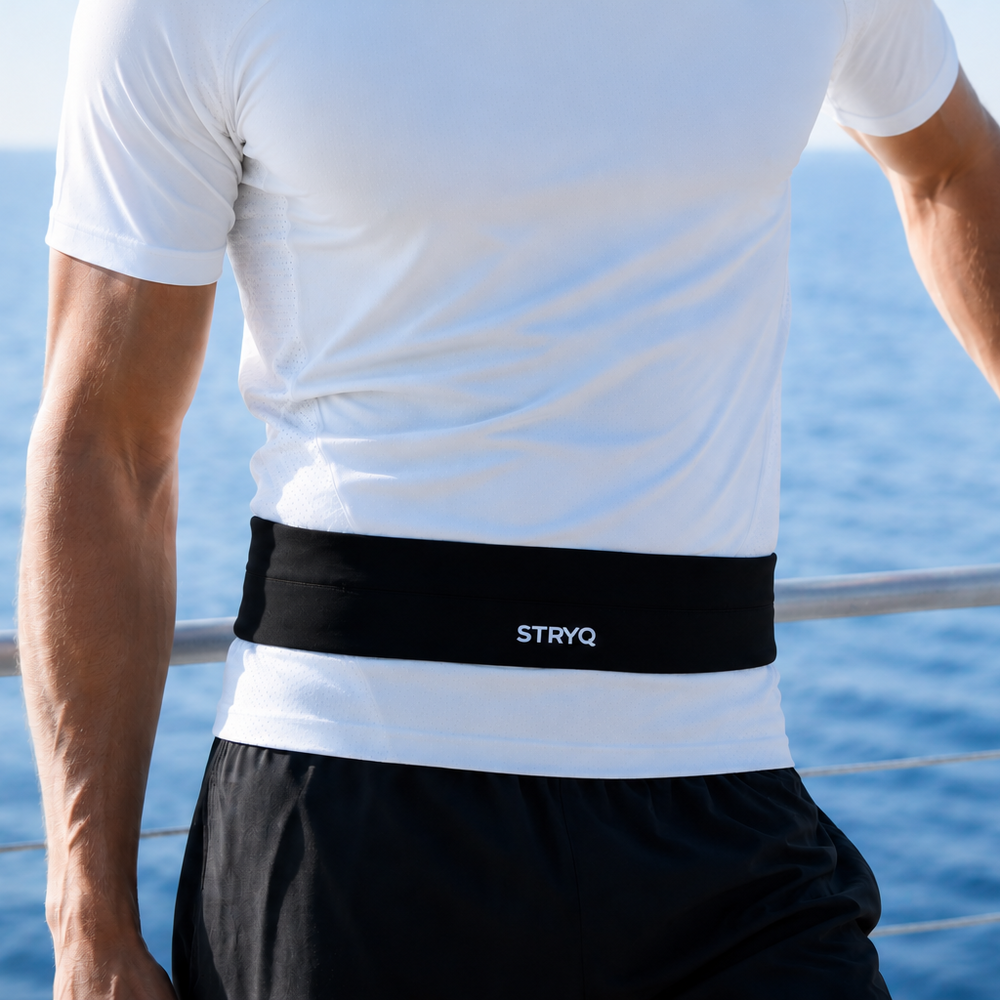
Our own running belt is designed with 360° storage and a no-bounce fit in mind, so items are spread around the waist instead of piled in one spot.
Belt or armband?
Runners often ask about armbands as a third option. An armband gives easy screen access, but it can slip or chafe when the fit is wrong, and it is often less comfortable on longer runs (Runners Blueprint). If you are weighing the two, we compare them in detail in our guide to running belt vs armband.
Choosing by the run you do most
Do not pick for your best day. Pick for your most common run.
Couch to 5K and Parkrun
You probably carry a phone and maybe a key. A snug pocket can be enough. If you are a beginner who finds your phone bouncing, try a belt: it is simple to put on and gives you somewhere to put your key. Our guide on carrying your phone on runs over 5K explains when the switch makes sense.
10K and training runs
Now the list grows: phone, key, card, maybe a gel. This is where belts tend to pull ahead. If keys are your main worry, read why runners choose belts or vests for keys.
Half marathon and marathon
You need fuel, perhaps fluids and a way to carry layers. A belt handles fuel and a phone. If you also want to drink on the move, a vest or a soft flask in a belt-friendly size is the next step. Weigh up how far you run between water points before you decide.
How to stop a belt bouncing
Whichever you choose, a few habits help:
- Wear it low on the waist or hips, not up on the ribs, and tighten it until it is snug but does not restrict breathing.
- Pack light and flat. Put the phone against your body and the lighter items outside.
- Do not overfill. An overloaded belt bounces and rides up.
- Test it on a short run first, then adjust the position and tension.
For more on fit, see our guides to choosing a running belt that stays put and picking a secure phone belt.
Socks: thickness, slipping and seams
The same runners who sweat the phone question often have a second problem lower down. Here is how to fix it.
Running sock thickness
Thickness changes two things: cushioning and fit. Thicker socks can add cushioning and take up room in shoes that fit a little large, while thin socks tend to suit lower-volume shoes (Doctors of Running). If you wear a thicker sock, make sure the shoe still has room. Running shoes should feel comfortable from the first run, with about a thumb’s width of space at the toes, and they will not improve with breaking in (FootCareMD).
Try new socks with the shoes you will race or train in, not with a different pair.
Why running socks slip
Socks that slide down are usually one of three things: too big, too thin or worn out. Low-quality no-show socks can loosen around the heel and lose their grip, particularly after repeated use (Doctors of Running). To keep them in place:
- Choose a sock that matches your shoe size range, not one that is a size up.
- Look for a snug cuff and a defined heel pocket.
- Replace pairs when the elastic or grip has gone slack.
- Avoid cotton, which tends to stretch and lose its shape when wet.
Seam irritation
Seams rub when they sit across a bony or pressure-prone area, or when the sock bunches. Fibre matters too. The American Academy of Podiatric Sports Medicine treats socks as essential athletic equipment, and notes that cotton stretches, loses shape when wet and becomes abrasive, raising the risk of skin irritation compared with synthetic or acrylic fibres (AAPSM).
To reduce rub:
- Pull the sock on smoothly so the toe seam sits flat.
- Choose a moisture-managing synthetic blend over cotton.
- Check that the shoe is not too tight at the toes, as pressure makes any seam worse.
- If one spot keeps blistering or hurting, see a podiatrist rather than guessing.
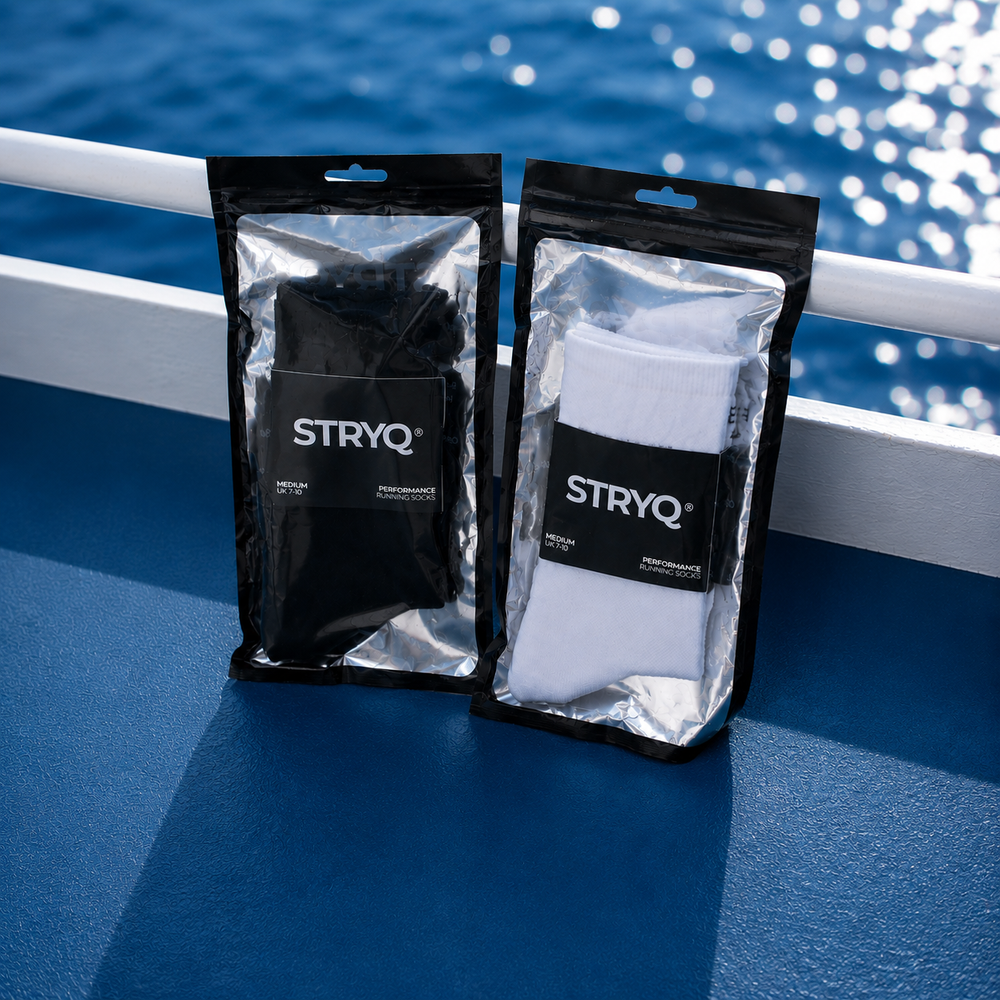
Our running socks are designed with arch support and cushioning, with breathability and moisture control in mind.
Our perspective
We built STRYQ around a simple idea: gear should earn its place by making a run easier, not by sounding clever. The pocket versus belt question is a good example.
A pocket is fine when your run is short and your load is light. We never say otherwise. But most runners we hear from end up carrying more than they planned: a key, a card, a gel, sometimes a second item for a longer weekend run. That is where a belt makes sense, and it is why we spent so long on ours.
Our running belt went through several sample revisions and testing with UK runners before launch. The aim was a fit that stays put with a phone in it and storage that goes all the way round, so the weight is balanced instead of hanging on one side. We want you to forget it is there.
The same thinking applies to socks. A seam in the wrong place or a cuff that slides down will ruin a run faster than a heavy phone. We design for comfort, fit and durability together, and we keep improving based on what customers tell us.
martin
Ready to try a belt?
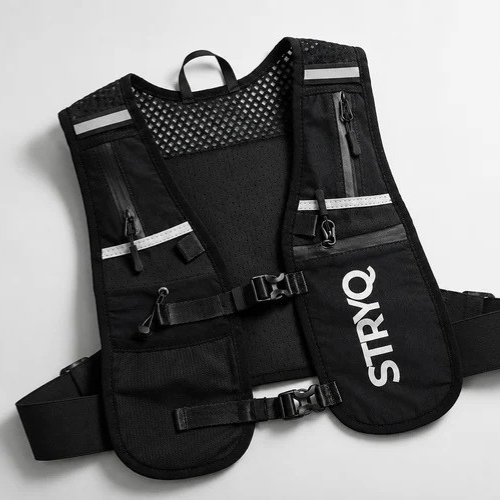
If your pocket test run left you feeling every step, a belt is the easy next move. Our range includes the STRYQ running belt for phone, keys and essentials, plus a hydration vest and a 500ml soft flask for longer efforts. You can see the full range and current prices on our store.

Pair it with a pair of STRYQ running socks and you have covered the two spots where small problems turn into big annoyances.
FAQ
Do I need a belt to run?
No. For short runs with only a phone, a snug pocket may be all you need. A belt becomes worth having when you carry keys, ID, a card or fuel, or when your clothing has no usable pockets.
Is a belt more secure than shorts pockets?
Usually, if it is fitted well. A snug belt keeps items close to your centre of mass, while a loose pocket lets the phone swing. Snug thigh pockets can also hold a phone well, so test whichever you choose with a jog on the spot.
Will a belt bounce?
It can if it is too loose or overloaded. Wear it snug on your waist, pack it lightly and keep the phone flat against your body. Adjust the position over a short test run.
Should my running socks be thick or thin?
It depends on your shoes and what you want. Thicker socks add cushioning and take up space in shoes that fit a little large, while thin socks suit lower-volume shoes. Keep about a thumb’s width of space at the toes.
How do I stop sock seams rubbing?
Pull the socks on flat, choose a synthetic moisture-managing fabric instead of cotton, and make sure the shoes are not too tight. If irritation keeps returning in the same place, see a podiatrist.
Sources
- How to Carry a Phone While Running Without It Bouncing, Runners Blueprint
- Different Ways to Carry Your Gear on a Run, Dick’s Sporting Goods
- The 4 Best Running Belts, Wirecutter
- Best Running Socks for Winter and Summer, Doctors of Running
- Socks and Your Feet: Hosiery is Equipment for the Athlete, AAPSM
- How to Select Athletic Shoes, FootCareMD