Your phone starts sliding down your arm before the first kilometre is done. Or your keys knock against your hip with every stride. The running belt vs armband choice sounds small, but the wrong carrier can become the most distracting part of a run. The right one keeps essentials secure, accessible and out of your mind.
For many runners, an armband is the first solution they try. It is familiar, cheap and designed around a phone. A running belt can look like more kit than you need. But once runs get longer, weather changes or you need to carry fuel as well as a phone, the differences become clearer.
Running belt vs armband: the quick answer
An armband is usually best for short runs when you only need to carry a phone and want it close at hand. A running belt is generally the better all-round choice for runners who carry keys, gels, headphones, a card, tissues or a larger phone, and for anyone who dislikes weight strapped to their upper arm.
Neither option is automatically right for every run. Your preferred carry method depends on what you take out, how far you run and how sensitive you are to movement. A 20-minute easy run needs very little. A long Sunday run or race day can require considerably more.
The biggest practical difference is where the weight sits. An armband puts it on one arm. A belt spreads it around your waist or hips. That changes how the load feels, how easily you can reach it and how likely it is to bounce.
When an armband makes sense
An armband is a simple option for runners who want their phone available without stopping. If you use your phone to follow a route, change a podcast or check messages while waiting for a friend, it is easier to see than a phone tucked in a belt pocket.
For a short run with no extras, that simplicity has real value. Put the phone in, fasten the strap and go. There is no need to decide where to place gels, separate keys from a screen or adjust several pockets.
Armbands can also work well for runners who do not like anything around their waist. Some people find a belt uncomfortable when they are getting used to running, particularly if they tighten it too much or wear it in the wrong position. An armband avoids that feeling entirely.
The limits of carrying a phone on your arm
The problem is that a phone is not weightless, especially with larger modern handsets. Even a secure armband adds weight to one side of your body. On an easy 5K, you may barely notice it. Over an hour or more, a tight strap can rub, trap sweat and leave a pressure mark.
Fit is also less forgiving than it first appears. A strap that is too loose can slide towards the elbow. Tighten it to stop the movement and it can feel restrictive as your arms warm up. Sleeves add another variable. An armband that stays put over bare skin may shift over a technical top or jacket.
Storage is the other limitation. Most armbands are built for one main item. Some have a small key pocket, but they are not ideal for carrying gels, inhalers, tissues or a card. Trying to add more can make the phone harder to access and the arm more uncomfortable.
Why a running belt suits more types of run
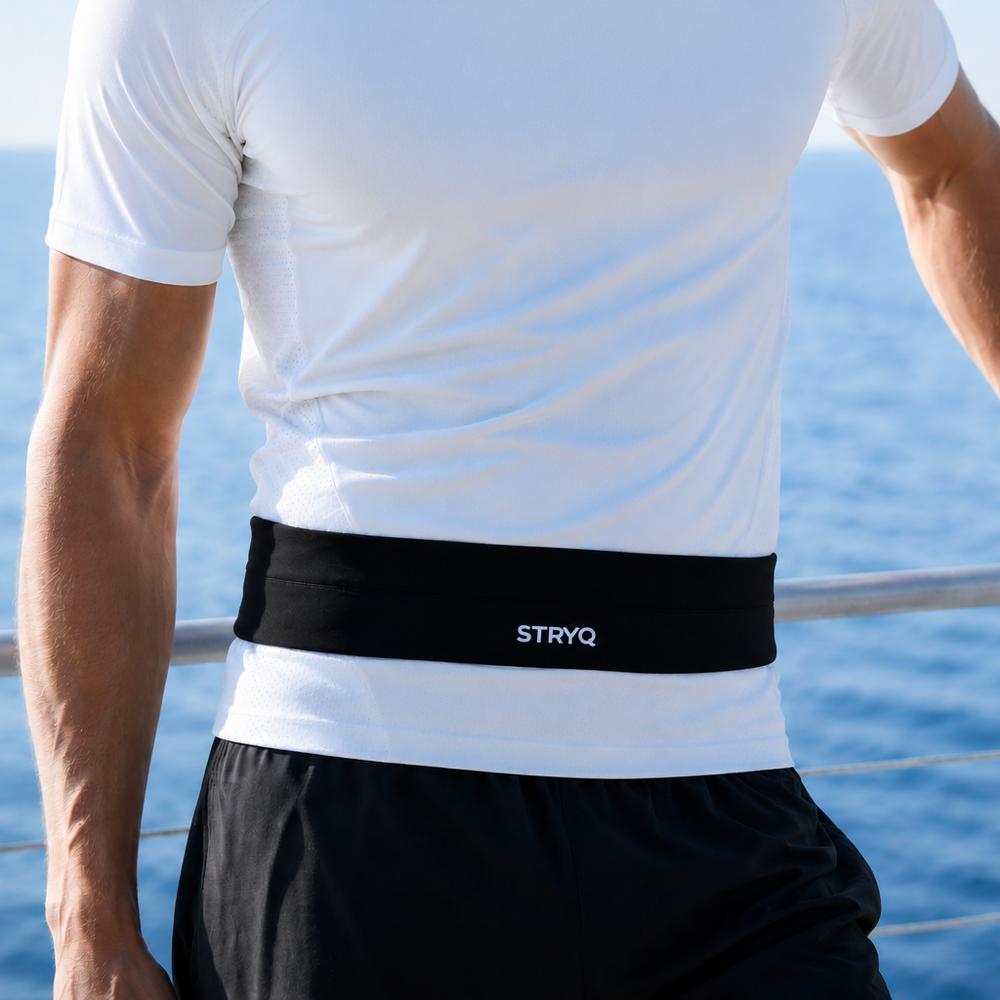
A good running belt carries the load close to your centre of mass. In plain terms, that means your essentials sit near the middle of your body instead of pulling on one arm. When the fit is right, the belt should feel stable rather than noticeable.
This matters most when you carry more than a phone. A belt gives you space to separate items: phone in one pocket, key in another, gel wrappers away from your screen. It is a small detail, but it saves the familiar mid-run rummage when you need something quickly.
Running belts are useful beyond long-distance training too. A dark winter evening may mean taking a phone, keys, ID, a small light and gloves. A parkrun can mean carrying a layer to the start, then storing a key and phone while you run. A belt handles these everyday combinations without forcing your pockets to do the job.
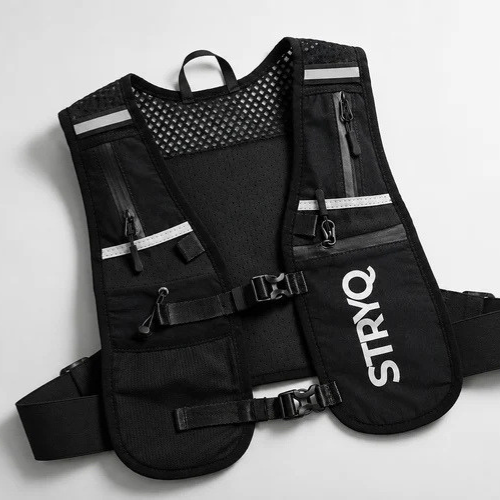
At STRYQ, the focus is on carrying essentials without bounce or bulk. That is the standard worth looking for in any belt, rather than simply choosing the largest pocket available.
Fit decides whether a belt works
A running belt is only comfortable when it fits properly. Too loose, and it moves up and down with every stride. Too tight, and it can dig in around the waist, particularly during a long run or after taking on fuel and water.
Start with the belt sitting where it feels most stable, often around the natural waist or slightly lower on the hips. This varies by body shape and clothing. Load it as you would for a real run, then jog on the spot before heading out. A belt that feels fine empty can behave differently with a phone and two gels inside.
Look for adjustable sizing and soft, low-profile materials. Wide, stiff straps may feel secure initially but can become uncomfortable when wet with sweat. Stretchy pockets that hold items close to the body tend to reduce movement better than loose, deep pouches.
Bounce, chafing and sweat: what runners notice most
Bounce is the point where a carrier stops being useful. It is not only annoying. Repeated movement can change your arm swing, distract you on uneven ground and rub against skin over longer distances.
An armband tends to bounce or slip when the strap loses grip through sweat, when the phone is heavy, or when you wear it over a slippery sleeve. It may stay still for the first mile, then gradually need adjusting as your body warms up.
A belt can bounce when it is oversized, overloaded or worn too high. The solution is not always to pull the belt tighter. First, reduce loose space in the pockets and place heavier items centrally. If a belt has several pockets, balance the contents rather than putting everything on one side.
Chafing is similarly personal. Some runners are fine with an armband but dislike the sensation of a waistband. Others find upper-arm rubbing far worse, especially in a vest or short-sleeved top. Test your chosen carrier on training runs before relying on it for a race. Race day is a poor time to discover that a seam rubs after 10 miles.
Phone access is not the only access that matters
An armband wins if you need to look at your phone regularly. It is useful for navigation in unfamiliar places, although repeatedly checking a screen can interrupt your rhythm and awareness of the route around you.
A belt is usually better when your phone is there for safety, tracking and the occasional photo rather than constant use. You can normally reach it quickly enough at a crossing or stop, while the rest of your kit remains organised.
Think about what you will need with tired hands, cold fingers or wet gloves. A phone locked inside a tight armband sleeve can be awkward to remove. A belt pocket with a simple zip or stretch opening may be easier. Equally, if you rely on touchscreen controls during a run, test whether the armband cover responds properly when damp.
Choose by the run you are actually doing
For a short, familiar run with just a phone, an armband is a reasonable, lightweight choice. It is especially practical if you want to control music or use navigation at a glance.
For regular training, commuting runs, longer distances and races, a running belt offers more flexibility. It carries the bits runners actually end up taking: phone, keys, fuel, card, tissues and sometimes a lightweight layer or soft flask, depending on the design.
If you are training for a half marathon, marathon or beyond, start getting used to your belt early. Practise carrying the same fuel and essentials you plan to use on event day. You will learn where each item sits best and whether anything needs adjusting before it becomes a problem.
There is no prize for carrying the least amount of gear. Take what keeps you safe and comfortable, then choose the carrier that lets you forget it is there. When your kit stays put, your attention can stay on the next mile.