

Why running shoes need replacing: a practical guide
Replace your running shoes after a typical distance range, as recommended by the industry, because midsole foam compresses and loses resilience long before the outsole looks obviously worn. Once cushioning degrades, every stride transfers more impact to your joints, raising injury risk and reducing performance. For most everyday runners, that window arrives sooner than expected.
Quick checks to do now:
- Look at the outsole. If you can see foam beneath the rubber, replacement is overdue.
- Press the midsole. Visible horizontal or diagonal creasing means the foam has compressed.
- Notice new aches in your knees, hips, or Achilles that appeared without a change in training.
- Log your miles. When your shoes have been used extensively, start monitoring closely.
Table of Contents
- Why running shoes wear out: the mechanics of midsole, outsole and upper failure
- Signs it is time to replace your running shoes
- How long do running shoes last? Mileage ranges and realistic timelines
- Practical ways to extend your shoes’ life
- Performance and injury risks of running in worn shoes
- How Stryq tracks shoe wear: a practical monitoring approach
- What to do with old running shoes in the UK
- Key takeaways
- Gear care is injury prevention, not a nice habit
- Stryq running socks: the right fit starts with the right sock
Why running shoes wear out: the mechanics of midsole, outsole and upper failure
The midsole is where shoes fail first. EVA and PEBA foams compress with repeated loading, and once the cellular structure breaks down, the foam cannot spring back. Midsole compression and creasing are the earliest signs of this, often appearing well before the outsole rubber shows obvious wear.
The outsole tells you where you land; the midsole tells you how much protection you have left. A shoe can look fine from above and be functionally dead beneath your foot.
Outsole rubber abrades at a rate determined by surface, foot strike, and weight. As the rubber thins, softer foam beneath becomes exposed, which changes the geometry of your footstrike and alters the forces travelling up through your ankle and knee. Heel-strikers typically wear through the lateral heel first; forefoot runners see wear under the ball of the foot.
Upper failure is less predictable. Glue joints separate, heel counters soften, and mesh panels tear at seams. Any of these changes fit and stability, sometimes subtly enough that you only notice through new blisters or a sense that the shoe has widened.
Signs it is time to replace your running shoes
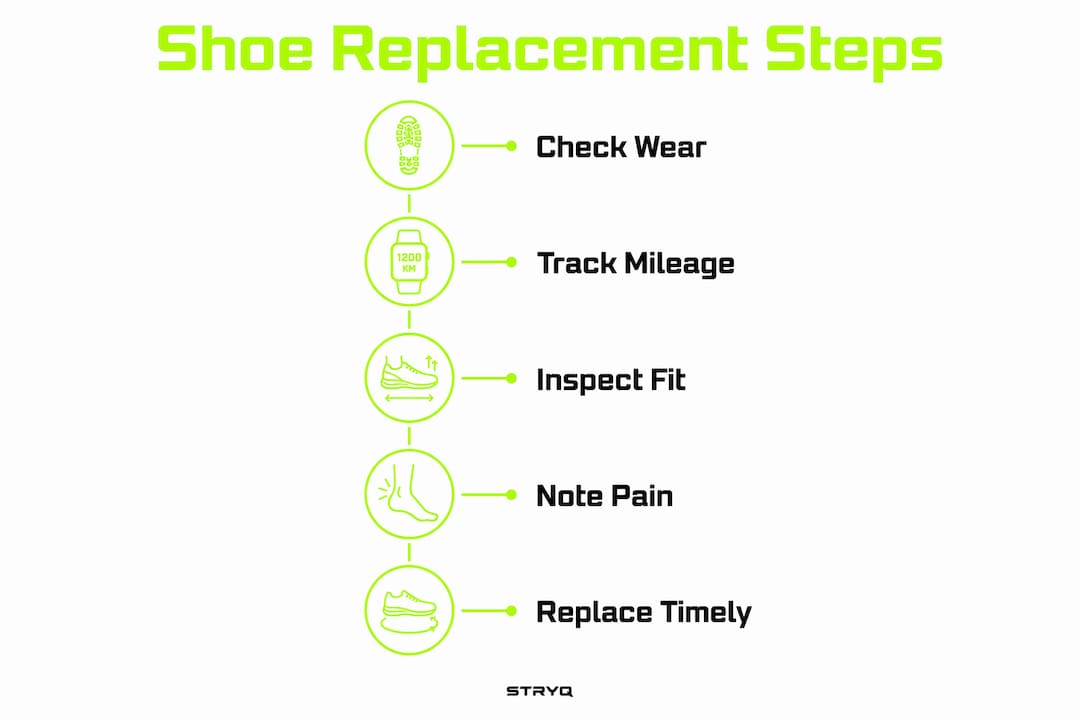
Use this checklist after any run where something feels off, or every four to six weeks as a routine check.
Visual signs:
- Outsole rubber worn through to reveal foam beneath the rubber, particularly at the heel or forefoot.
- Horizontal or diagonal creasing across the midsole sidewall.
- Ripped or separating upper seams, especially around the toe box or heel.
Feel signs:
- The shoe feels flat or “dead” with noticeably less rebound than when new.
- New aches or niggles in knees, hips, shins, or Achilles that appeared without a training change.
- Recurring blisters or hot spots in areas that were previously fine.
Fit and alignment signs:
- The heel slips more than it used to.
- The shoe feels wider or less structured around the midfoot.
- Your gait or foot placement has shifted and correlates with when you started wearing this pair.
When mileage and the checklist disagree, trust the checklist. A shoe at 250 miles that is causing knee pain needs replacing. A shoe at 350 miles that still feels cushioned and shows no creasing can continue, with close monitoring.
Pro Tip: Take a photo of the outsole every 50–100 miles. Side-by-side comparison makes midsole creasing and outsole wear far easier to spot than memory alone.

How long do running shoes last? Mileage ranges and realistic timelines
A typical replacement window based on mileage is a starting point, not a fixed rule. Shoe category, runner weight, foot strike, and surface all shift where within that range a pair actually fails.
| Weekly mileage | Approximate months to reach recommended replacement distances |
|---|---|
| — | Several months |
| — | A few months |
| — | About one to a few months |
Minimalist and racing shoes tend to have shorter lifespans because their thinner foams prioritise lightness over longevity, while sturdier daily trainers with thicker midsoles usually last longer. Heavier runners and strong heel-strikers compress midsole foam faster, often reaching the replacement window earlier regardless of the shoe’s advertised durability.
Everyday wear and mixed surfaces count too. Using road trainers for casual errands adds midsole compression miles that your GPS watch never records. A pair worn to the shops three times a week can lose weeks of functional running life without a single kilometre logged.
Track mileage using a GPS watch or a running app such as Garmin Connect, Strava, or Nike Run Club, which allow you to assign runs to specific shoes. If you prefer a simpler method, weekly-mileage maths works fine: divide 300 by your average weekly miles to get your earliest replacement month.
Practical ways to extend your shoes’ life
- Rotate between two pairs. Allowing 24–48 hours for midsole decompression between runs extends the life of each pair and reduces concentrated wear patterns.
- Use shoes for their intended purpose. Road trainers on road, trail shoes on trail. Cross-use accelerates outsole abrasion and midsole stress in ways the shoe was not designed to handle.
- Keep them dry between runs. Remove insoles after wet runs, stuff loosely with newspaper, and let them air dry at room temperature. Heat sources crack glue joints and degrade foam.
- Store out of direct sunlight. UV exposure degrades rubber and upper materials faster than running does.
- Clean them gently. A soft brush and cold water remove grit that abrades the outsole from the inside out. Avoid machine washing on hot cycles.
- Never use running shoes as everyday casual footwear. This is the single fastest way to shorten a pair’s functional life.
- Avoid pushing through on race day or hard training blocks. A shoe past its window offers less protection precisely when your body is under the most load.
Pro Tip: Label each pair with a start date using a marker pen inside the tongue. Combined with a mileage log, this gives you two independent signals for when replacement is due.
Rotation does more than extend shoe life. Slight differences in stack height and geometry between two pairs expose your muscles and tendons to varied loading patterns, which can reduce repetitive strain and lower overuse injury risk across a training block.
Performance and injury risks of running in worn shoes
Worn cushioning raises the impact forces reaching your joints on every footstrike. Over time, this can aggravate:
- IT band syndrome (ITBS): increased lateral loading from uneven outsole wear.
- Shin splints: higher tibial stress from reduced shock absorption.
- Plantar fasciitis: greater heel impact without adequate midsole support.
- Achilles tendinopathy: altered heel-drop geometry as the midsole compresses unevenly.
Reduced shoe responsiveness also affects running economy. In tempo and interval sessions, a flat midsole returns less energy per stride, which means more effort for the same pace. The effect is subtle at first, but runners often notice it as unexplained fatigue or a sense that their times have plateaued without a change in fitness.
Small gait changes from uneven outsole wear are particularly insidious. The body compensates automatically, shifting load to adjacent structures over weeks until a repetitive stress injury surfaces. If a niggle appeared gradually and correlates with a specific pair of shoes, check the outsole geometry before assuming a training problem.
How Stryq tracks shoe wear: a practical monitoring approach
Consistent monitoring removes guesswork from the replacement decision. These are the steps Stryq recommends, drawn from real-world runner feedback and product testing:
- Log pair-by-pair mileage from day one. Assign every run to a specific shoe in your GPS app or a simple spreadsheet. Do not rely on memory.
- Photograph the outsole and midsole sidewall every 50–100 miles. A dated photo library makes wear progression visible and removes subjectivity.
- Record a comfort score after each run. A simple 1–5 rating for cushioning and fit, noted in your training log, surfaces degradation before it becomes pain.
- Check for new niggles tied to a specific pair. If a niggle disappears when you switch shoes, the shoes are the cause.
- Schedule a gait check every six months. Periodic form analysis separates shoe-related gait changes from technique issues, and helps confirm whether a new pair is the right fit.
What to do with old running shoes in the UK
- Donate usable pairs to sports charities such as Soles4Souls UK or local running clubs that collect kit for community programmes. Shoes should be clean and structurally sound.
- Check retailer take-back schemes. Several UK sports retailers run in-store recycling points; check current availability at your nearest store before travelling.
- Use council recycling centres. Most UK local authorities accept footwear at household waste recycling centres, where shoes are sorted for material recovery.
- Repurpose worn-out pairs for gardening, dog walking, or DIY tasks where grip and protection matter but running performance does not.
- Prepare shoes for donation by cleaning them, re-lacing if needed, and placing them in a bag. Most charities decline shoes with significant structural damage or hygiene concerns.
Pro Tip: Check the charity’s current acceptance criteria before donating. Policies on condition and hygiene vary, and a quick call saves a wasted trip.
A brief note: UK charity law and hygiene guidance means not all pairs will be accepted. When in doubt, your local recycling centre is the reliable fallback.
Key takeaways
Running shoes need replacing because midsole foam loses resilience and outsole rubber wears through, raising impact forces and injury risk well before a shoe looks visibly finished.
| Point | Details |
|---|---|
| Mileage benchmark | Replace running shoes between 300 and 500 miles (approx. 480–800 km); check earlier if niggles appear or outsole foam is visible. |
| Log and rotate | Track miles per pair in a GPS app and rotate two pairs with 24–48 hours between runs. |
| Trust the checklist | Midsole creasing, heel slip, and new aches are reliable signals regardless of mileage. |
| Dispose responsibly | Donate usable pairs to UK sports charities; use council recycling centres for worn-out shoes. |
| Stryq running socks | Pair new shoes with Stryq running socks to reduce friction and get an accurate fit feel from the first run. |
Gear care is injury prevention, not a nice habit
The conventional wisdom treats shoe replacement as a cost to delay. Most runners hold on too long, not because they cannot afford new shoes, but because the degradation is gradual and easy to rationalise. A shoe that felt fine last month still feels roughly fine this month, even when the midsole has lost a meaningful amount of its original resilience.
The smarter frame is this: worn shoes are a training variable you can control. Shin splints, plantar fasciitis, and IT band flare-ups are not random. They often trace back to accumulated load on structures that were absorbing more impact than they should have been, because the shoe stopped doing its job quietly and gradually. Logging miles, rotating pairs, and checking the outsole every few weeks costs almost nothing. Treating a tendinopathy costs weeks of training.
Small habits compound. A runner who rotates two pairs, logs mileage, and replaces on time will almost certainly run more consistently over a year than one who squeezes every last mile from a single pair. The gear mistakes that sideline runners are rarely dramatic. They are usually the quiet, avoidable ones.
Stryq running socks: the right fit starts with the right sock
When you move into a new pair of shoes, the sock you wear during that first run shapes your entire impression of the fit. A poor sock introduces friction, bunching, and pressure points that have nothing to do with the shoe itself, which makes it harder to judge whether the new pair is right for you.

The Stryq Running Socks in Black and Stryq Running Socks in White are built to reduce friction, manage moisture, and hold their position through a full run. No bunching at the toe box, no slipping at the heel. Developed from runner feedback with multiple sample revisions before launch, they sit between budget supermarket socks and expensive specialist brands, at a price that makes rotating pairs practical.
If you are replacing shoes and want to get the fit assessment right from run one, pair the new shoes with a sock that does not get in the way. Browse the full running socks range at Stryq, or explore the running belts and hydration gear that support longer training blocks where shoe rotation and comfort matter most.