For most low-light runs, the answer is both: reflective gear and lights do different jobs, and combining them closes the gaps either one leaves open. Reflectives give drivers long-range, passive recognition of a human shape; lights give active, immediate signals that work in fog, rain or where a driver’s headlights are dipped or absent. The one exception is unlit trails or heavy fog, where a light stops being optional and becomes the main way you see and are seen.
TL;DR:
- Reflective bands on moving joints improved recognition to 319.1 metres, versus 184.5 metres for a vest, while cutting recognition time from 13.9 to 6.4 seconds.
- Some automatic braking systems failed to slow consistently around reflective limb strips, so runners should use lights instead of relying on reflective gear alone.
- On unlit trails, carry a headlamp to see uneven ground; in fog or heavy rain, prioritize flashing lights because reflectors need headlights to work.
- Aim a steady front beam down, place a flashing rear light at hip height, and check its charge before runs over an hour.
- Runners generally face no legal lighting requirement on public roads, but races may require reflective gear or lights, and dark trail events may mandate headlamps.
Table of Contents
- How retroreflective materials work and why biomotion placement improves driver recognition
- How active lights differ and when they become essential
- What the research says about detection distances and vehicle sensors
- Scenario-based kit and how to combine reflectives and lights
- STRYQ evidence: how our testing and products support this guidance
- Legal requirements and regulations for reflective gear and running lights
- Safety considerations across different running environments
- A short routine for night-running visibility
- Get your low-light kit without the guesswork
- FAQ
- Sources
How retroreflective materials work and why biomotion placement improves driver recognition
Retroreflective fabric bounces a vehicle’s headlight beam straight back towards the driver’s eyes rather than scattering it, which is why a reflective strip looks dazzling in headlights but dull under streetlight or daylight. This only works when there is an external light source to reflect: a reflective vest on an unlit trail with no car nearby does nothing.
Where the reflective material sits on your body matters as much as how much of it you wear. Research on night-time pedestrian conspicuity found that biomotion configurations, reflective markers placed on the moving joints (wrists, ankles, elbows, knees) rather than spread across a static vest, let drivers recognise a person from roughly 319.1 metres away, compared with 184.5 metres for a standard reflective vest. Recognition also came through faster, around 6.4 seconds against 13.9 seconds for the vest. The moving reflectors sketch out the swing of arms and legs, which drivers’ brains read as “human” far more quickly than a static block of colour.
Separate work on nighttime pedestrian clothing design confirmed that thin biomotion strips as narrow as 0.75 centimetres kept most of that recognition advantage, meaning you do not need bulky reflective panels to get the benefit.
A sensible placement checklist:
- Wrists and ankles: small reflective bands that move with your stride.
- Knees and elbows: strips or patches that flex with the joint.
- Shoe heels: a reflective tab adds a low, moving point of light.
- Back and chest: a slim panel as a secondary layer, not the main strategy.
One figure worth remembering: drivers recognised runners from 319.1 metres with biomotion placement versus 184.5 metres for a standard vest, nearly double the warning distance at highway speeds.
Reflective strips lose some performance when caked in mud or faded by repeated washing, so check them against a torch beam every few weeks and replace any that look dull.
How active lights differ and when they become essential
A light produces its own beam rather than waiting for a car’s headlights to hit it, which is why lights matter most in fog, heavy rain or on roads without reliable street lighting. Brightness is measured in lumens, but more lumens are not always better: a head-mounted light bright enough to show you the pavement can dazzle an oncoming driver or cyclist if angled badly, so aim it down and slightly ahead rather than straight out.
Steady beams are better for lighting your own path; flashing modes draw attention faster from a distance, which is why a flashing rear light paired with a steady front beam covers both jobs. Mounting position changes what a light communicates: a head lamp shows terrain, a chest light marks your direction of travel, and a light clipped at hip or waist height on a belt or vest sits roughly where a driver’s eye naturally scans for a pedestrian at the roadside.
Practical points for choosing and placing lights:
- Front: steady beam, angled down, for seeing the surface ahead.
- Rear: flashing red, clipped at hip or waist height, for visibility to vehicles overtaking from behind.
- Side or ankle: a small flashing light adds a moving point that helps at junctions.
Battery life should match your longest regular run plus a margin, and cold weather drains batteries faster than the stated runtime suggests, so check your light’s charge before any run over an hour; for more details on what to eat and drink before heading out, see the best foods to eat before running. Our guidance on light battery life covers runtime planning in more detail, and the headlamp versus chest light comparison walks through fit and mounting choices.
Pro Tip: Test any new light on a short loop near home first: ask someone to drive past at low speed and tell you where the beam dazzles or disappears.
What the research says about detection distances and vehicle sensors
The clearest evidence comes from three separate strands: driver recognition studies, a field comparison of lights against reflectives, and vehicle sensor testing. Each points to a different strength, which is why no single product covers every scenario.
| Study type | Finding | Source |
|---|---|---|
| Driver recognition (biomotion vs vest) | 319.1 m recognition distance vs 184.5 m for a standard vest | PubMed |
| Driver recognition time | 6.4 seconds vs 13.9 seconds to recognise a pedestrian | PubMed |
| Field pilot, lights vs reflectives | Flashing bike lights detected farther away than worn retroreflective bands in both day and night conditions | Mobility21 |
| Vehicle pedestrian-detection sensors | Some automated braking systems performed worse or failed to slow when test dummies wore limb-mounted reflective strips | IIHS |
The gap that matters most: IIHS testing found that some pedestrian automatic braking systems did not slow consistently when test dummies wore reflective limb strips, suggesting the same pattern that helps a human driver recognise you can occasionally confuse a car’s sensors.
That is not a reason to drop reflectives. It is a reason not to rely on them alone. A human driver and a car’s automated system read visual information differently, so a kit built only around one signal leaves a blind spot against the other. A flashing light adds a signal that both a driver’s eyes and most vehicle sensors register more consistently than a static reflective pattern, which is why pairing the two closes more gaps than either covers on its own.
Scenario-based kit and how to combine reflectives and lights
What you need changes with the road, the weather and how much ambient light is around. A straightforward way to plan a kit is to match it to the specific run.
- Urban roads with streetlights: biomotion reflectives on wrists and ankles, plus a flashing rear light at hip height for approaching traffic.
- Rural roads with patchy lighting: add a steady front beam to the urban kit, since gaps between streetlights can leave long stretches dark.
- Unlit trails: a head torch becomes the main tool for seeing the surface, with reflectives kept as a backup for any road crossings.
- Fog or heavy rain: prioritise flashing lights front and rear, since reduced visibility cuts the distance at which reflective material can catch a headlight at all.
A quick pre-run check takes under a minute:
- Reflective strips sit on wrists, ankles or knees, not just the torso.
- Rear light is charged and set to flash.
- Front light, if carried, is angled down rather than straight ahead.
- Nothing reflective or lit is obscured by a jacket or bag strap.
Reflective strips are inexpensive and need only the occasional wash and a torch check for fade. Lights need more planning: charge or replace batteries before longer runs, and keep a spare set for anything over an hour in cold weather.
STRYQ evidence: how our testing and products support this guidance
We build our visibility range around the same evidence covered above: reflective placement at moving joints paired with a dependable rear light. Every product goes through multiple sample revisions and feedback from UK runners before it reaches the shop, with the focus kept on features that solve a real problem rather than ones that look good on a spec sheet.
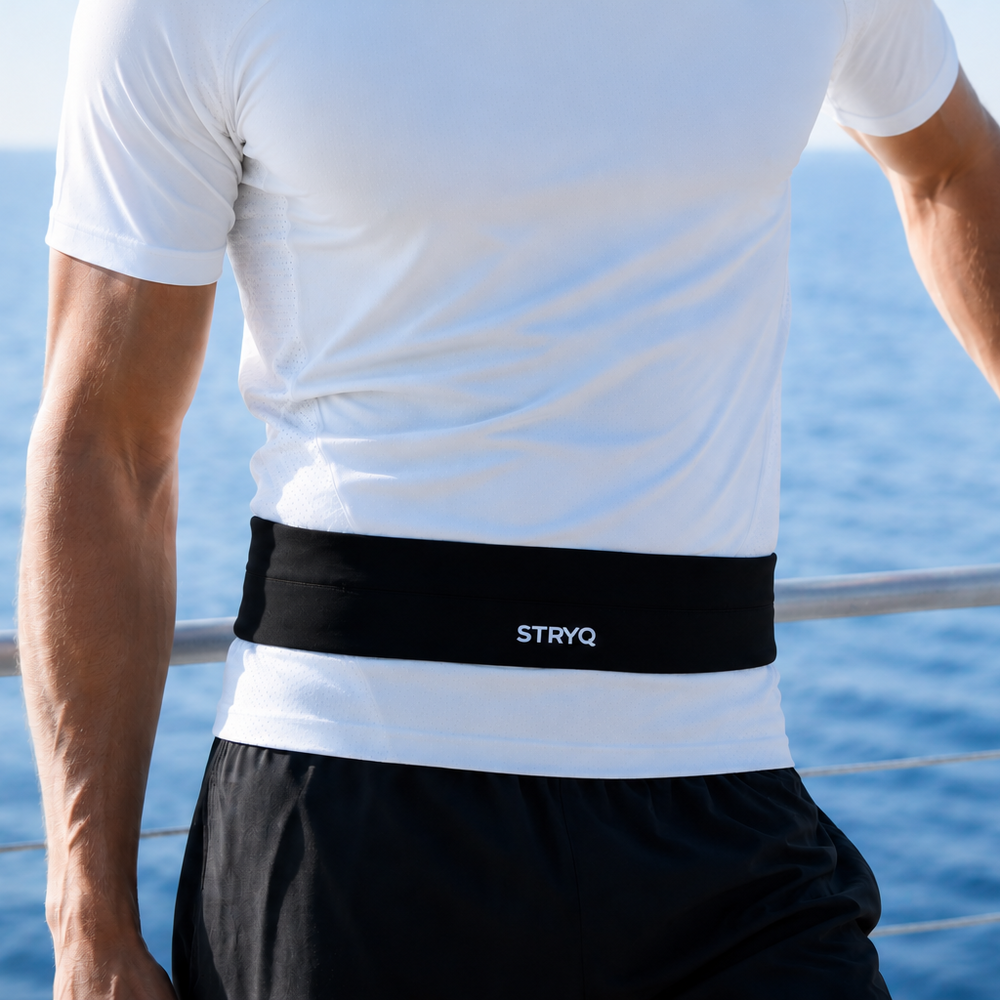
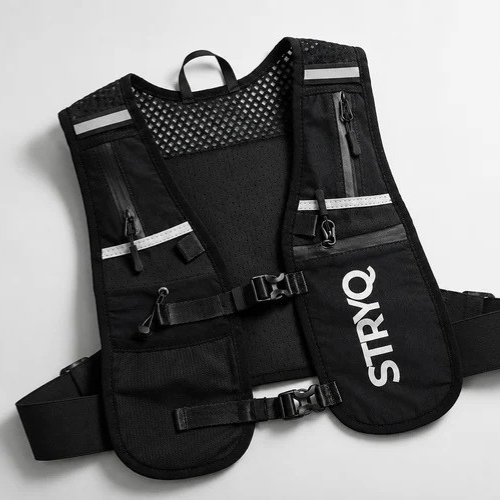
Mapped to the scenarios above, our hydration running vest has mounting points suited to a rear light at hip height, our running belt carries a rear LED and a phone without bouncing, and our reflective bands sit directly on the joints that biomotion research points to.
What this means in practice:
- The vest’s mounting points keep a rear light steady rather than swinging with your stride.
- The belt’s no-bounce fit stops a clipped light from shifting out of position.
- Reflective bands are light enough to wear on wrists and ankles without feeling tight.
Pro Tip: Check your full kit against a dark wall using your phone torch before a night run: anything that does not glow back clearly needs repositioning or replacing.
Legal requirements and regulations for reflective gear and running lights
There is no general legal requirement for runners to wear reflective clothing or carry lights on public roads or pavements, unlike cyclists, who do face specific lighting rules after dark. That said, pedestrian safety guidance consistently recommends high-visibility clothing and a light source in low light, particularly where there is no footpath and you are sharing the carriageway with vehicles.
Where rules do apply more strictly is on organised events: many road races, particularly early-morning or winter evening ones, set their own requirements for reflective elements or rear lights as a condition of entry, and trail and ultra events often mandate a head torch with a minimum runtime for any section run in darkness. Always check an event’s own kit list rather than assuming general guidance covers it.
The practical takeaway is that the absence of a legal requirement is not the same as the absence of risk. The research above shows a clear safety case for reflectives and lights regardless of what the law demands, and organisers who do set rules are usually responding to the same evidence.

Safety considerations across different running environments
Urban roads usually have streetlights, which gives reflective material something to bounce light from even away from direct headlights, but also more junctions, parked cars and distracted drivers to be seen by. Rural roads often have far less ambient light and higher vehicle speeds, which pushes the balance towards lights, since a driver travelling faster needs a longer recognition distance to stop safely.
Unlit trails remove the vehicle risk but introduce a different one: uneven ground you cannot see without your own light source. A head torch here is about your own footing as much as being seen by anyone else, since there may be nobody else around at all.
The general pattern across all three: the less ambient light and the more vehicle traffic, the more a kit should lean on active lights rather than reflectives alone, and the more remote or uneven the ground, the more a head torch earns its place over a chest or waist light.
A short routine for night-running visibility
A routine beats remembering a list every time. Before any evening or early-morning run, I check three things in order: reflective bands on wrists and ankles, rear light clipped on and flashing, and a quick glance at the battery indicator if I am heading out for more than an hour.
The one habit that made the biggest practical difference was moving my main reflective strips off my jacket and onto my wrists and ankles. A jacket panel stays still against your torso, but a band on a moving joint catches a driver’s eye from much further out, exactly what the biomotion research would predict.
— martin
Get your low-light kit without the guesswork

Building a visibility kit does not need to mean buying several unrelated items from several different shops. We sell the three pieces that cover the scenarios above: reflective bands for joint placement, a hydration running vest with mounting points for a rear light, and a running belt that keeps a light and phone steady without bouncing. Every item has gone through repeated revisions based on feedback from UK runners rather than being designed once and left alone.
- High-Vis Running Vest & Reflective Bands Kit, £28, covers the biomotion placement points directly.
- Hydration running vest, £42, gives you a stable mount for a rear light on longer runs.
- Running belt, £32, keeps a rear LED and phone secure on shorter urban routes.
| Kit role | Product | Price |
|---|---|---|
| Biomotion reflectives | High-Vis Running Vest & Reflective Bands Kit | £28 |
| Light and hydration mount | STRYQ HYDRATION RUNNING VEST | £42 |
| Light and phone carry | STRYQ RUNNING BELT | £32 |
We handle fit questions and returns directly, since a kit only works if it fits properly. Browse the full running gear collection to put a kit together for your usual routes.
FAQ
Is a 10 minute mile jogging or running?
A mile pace typically varies widely among adults, and the exact label depends on individual fitness rather than a fixed threshold. What matters more for visibility planning is time spent on the road in low light, not pace.
What is the purpose of reflective clothing?
Reflective clothing bounces light from a vehicle’s headlights back towards the driver’s eyes, making a person visible from much further away than ordinary fabric allows. Placement on moving joints such as wrists and ankles improves recognition distance compared with a static vest, according to driver recognition research.
What are the best reflective running shoes?
There is no single verified ranking of reflective running shoes, since most running shoe reflectivity comes from small heel or side panels rather than dedicated biomotion design. A reflective tab on the heel adds a useful low, moving point of light, best paired with reflective bands on the ankles and wrists rather than relied on alone.
Where can I find a reflective running jacket?
Reflective running jackets are widely available from general running retailers, though a jacket panel alone covers only part of what biomotion research recommends. Our reflective gear guide covers how to combine jacket panels with joint-placed reflective bands for better coverage.
Sources
- Making nighttime pedestrians safer using innovative clothing designs
- Day or night, retroreflective and light-up gear can save pedestrians and cyclists lives