A hydration vest comfort study starts where most runners’ problems begin: not at the checkout, but 30 minutes into a run. A vest can feel light when it is empty and still rub your neck, bounce on descents or become difficult to reach once it is loaded with water, gels and a mobile phone. Real comfort is how it performs when you are warm, moving and distracted by the miles ahead.
For most runners, the best vest is not the one with the biggest capacity or the most pockets. It is the one you stop noticing. That comes down to fit, movement, heat management and the way the load sits against your body.
What a hydration vest comfort study should measure
Comfort is personal, but it is not random. A useful assessment looks at the points where a vest interacts with your body throughout a run: shoulders, collarbones, ribs, sternum, lower back and the sides of the chest. It also accounts for what happens when the vest is full rather than empty.
The most useful question is simple: does the vest stay stable without feeling restrictive? A stable fit reduces bounce. But overtightening the chest straps to stop movement can make breathing feel shallow, especially during intervals, hills or the latter stages of a race.
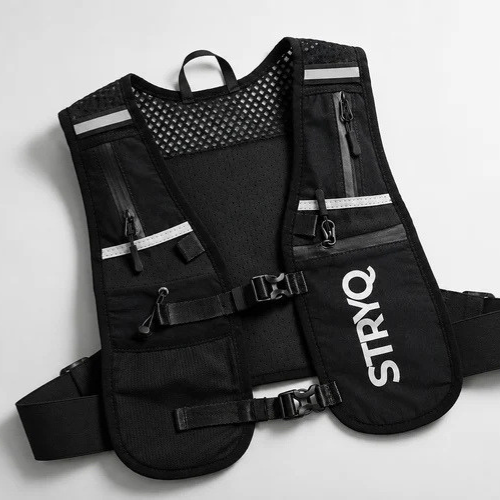
A good vest should spread weight across the torso instead of hanging from the shoulders. The shoulder area should feel supported rather than pulled down. The chest straps should hold the front of the vest close enough to prevent flapping, while still allowing a full breath. If you find yourself constantly adjusting the straps, the size, shape or loading arrangement may not suit you.
Test with the load you will actually carry
An empty vest tells you very little. Two soft flasks can add a kilogram when full, before you include a mobile phone, keys, nutrition, a light jacket or mandatory race kit. That changing weight is exactly why a vest that felt fine in the shop can become frustrating outdoors.
For a realistic test, fill the flasks, pack your usual long-run essentials and jog for at least 20 to 30 minutes. Include a few faster sections, gentle downhill running and arm movement. Notice whether the flasks slosh, whether the load drifts to one side and whether items in the rear compartment move independently from the vest.
How you pack matters too. Place heavier items close to your back and use side compression, if available, to reduce empty space. A spare layer stuffed loosely into a large rear pocket can shift with every stride. It is often the packed load, not the vest itself, that creates bounce.
Fit: secure without squeezing
A hydration vest should fit close to the body, but “close” does not mean tight everywhere. Most runners need a little adjustment between a cool first mile and a warmer final mile. Clothing layers also change the fit. A vest worn over a thin technical top in July will sit differently over a base layer in winter.
Check the fit while standing, then while running. A vest can look centred in a mirror but ride up when your arms swing. The lower edge should not repeatedly lift towards your ribs, and the front panels should not pull inwards against your chest.
Women and runners with a larger chest may need to pay particular attention to strap placement. Chest straps that sit too high or too low can create pressure in a sensitive area, even when the vest is otherwise the correct size. Adjustable straps help, but they cannot always overcome a shape that simply does not work for your body.
There is a trade-off here. A race-focused vest with a close, stripped-back fit may feel excellent for a two-hour event but leave less room for layers and larger loads. A higher-capacity vest gives more carrying flexibility for trail days and ultras, but only if its volume can be compressed down when it is not full.
Bounce is usually a fit or packing problem
Bounce wastes attention. It may not slow you immediately, but it can become maddening over a long run. You should not need to hold the vest with one hand on descents or keep pulling it down after every hill.
Start by adjusting the side and chest straps evenly. Then look at the load. Full front flasks and an almost empty rear compartment can make the vest pitch forwards and backwards. Conversely, a heavy jacket, mobile phone and food at the back with empty front pockets can pull at the shoulders.
Soft flasks should sit deep enough in their pockets that the tops do not repeatedly knock against the chest. As you drink, they may wrinkle or drop lower in the pocket. This is normal, but a well-designed pocket keeps them secure as their shape changes. If the flasks are difficult to replace while moving, that is a comfort issue as well as an inconvenience.
Heat and chafing reveal themselves later
Many comfort problems arrive after sweat builds up. A fabric that feels soft when dry can become abrasive once wet, particularly around the neck, underarms and lower ribcage. Chafing is rarely caused by one thing alone. It is usually a mix of moisture, repetitive movement, a seam or edge, and a vest that is moving more than it should.
Look for a close, low-profile construction with smooth contact areas rather than bulky edges. Breathable mesh can help reduce trapped heat, but more ventilation is not always automatically better. Very open mesh may feel cooler, while a slightly more structured fabric can hold the load more securely. The right balance depends on your pace, usual distance, weather and how much kit you carry.
For longer summer runs, test a vest on a warm day rather than assuming a short winter jog proves it is comfortable. In the UK, conditions can change quickly, so it is worth checking how the vest feels with both a light layer and a shell packed away. Salt from dried sweat can also make a previously comfortable vest feel rough, so wash it according to its care instructions between regular use.
If you are prone to rubbing, use anti-chafing balm before a long run and inspect the usual hotspots afterwards. Do not wait for a race to discover that a seam catches at your collarbone or a strap rubs under the arm.
Storage should be easy to reach while moving
A comfortable vest makes carrying essentials feel simple. That includes access. Stopping repeatedly to find a gel, remove a mobile phone or reach a waterproof interrupts rhythm and can make the whole setup feel more cumbersome than it needs to be.
Think about what you need during the run versus what can stay packed away. Water, fuel, mobile phone and tissues are usually best kept in front or side pockets. A jacket, gloves, head torch and spare food can live at the rear. The point is not to fill every pocket. It is to make the items you use most easy to reach without twisting or fumbling.
Mobile phone storage deserves a proper test. A pocket that technically fits your mobile phone is not necessarily useful if the zip presses into your ribs, the mobile phone bounces, or you cannot get it out one-handed. The same applies to gels. A pocket that is too shallow can let wrappers work loose, while an overfilled pocket can create pressure against the chest.
A simple comfort test before race day
Use at least two runs to assess a new hydration vest. The first should be an easy run of 30 to 45 minutes with flasks filled and your normal essentials packed. Use it to adjust the straps and identify obvious movement or rubbing.
The second should reflect the run or race you bought it for. If it is for marathon training, wear it on a longer run at your expected fuelling level. If it is for hilly trails, include climbs and descents. Change pace a few times and practise taking out a gel and replacing a flask.
After each run, ask three direct questions: did anything rub, did anything bounce, and could I reach what I needed? If the answer is no, adjust the load or straps before assuming the vest is wrong. If the issue remains, do not hope it will disappear over more miles.
A comfortable hydration vest does not need constant attention. Set it up properly, test it under realistic conditions and it should carry the essentials without becoming another problem to manage. That leaves you free to focus on your breathing, your pace and the run in front of you.