A dark country lane, a wet pavement and a driver’s dipped headlights can make a runner almost disappear. The best reflective running items do more than add a silver strip to your kit. They help other road users spot you early enough to react, while keeping your own stride, comfort and routine unchanged.
For most runners, the answer is not one oversized high-vis top. It is a few well-placed items that work together: light on the body, reflection in motion and bright colours where they are useful. Here is what makes a real difference on early mornings and evening runs.
What makes running gear visible?
Reflective material does not create light. It sends light from a car, bike or streetlamp back towards its source. That makes it very effective when headlights catch it, but less useful on an unlit path with nobody nearby.
Lights make you visible in those conditions because they produce their own light. High-vis colours, usually fluorescent yellow, orange or pink, are most useful in dull daylight, at dawn and at dusk. Once it is properly dark, reflective details and lights take over.
The strongest setup uses all three. Think of bright kit for low light, reflective points for headlights, and a light for everything else. You do not need to look like a Christmas tree, but relying on one small reflective logo is rarely enough.
The best reflective running items to prioritise
A reflective running gilet or jacket
A lightweight gilet or jacket with large reflective panels gives drivers a broad target to see. It is one of the most useful choices for road runners, especially in autumn and winter when you may already want a windproof outer layer.
Look for reflective detailing on the front, back and sleeves rather than a single strip across the shoulders. Your body is not always facing traffic square-on. Coverage at the sides helps when crossing junctions or running along winding roads.
There is a trade-off. Fully reflective jackets can be less breathable than a simple technical layer, and a waterproof shell can become clammy during harder efforts. For milder conditions, a reflective gilet over a breathable long-sleeve top often gives a better balance of visibility and temperature control.
A chest light or head torch
A head torch helps you see the surface ahead. A chest light can make you visible to others while giving a steadier beam closer to the ground. Either can be a sensible choice for unlit pavements, canal paths and trails.
For road running, avoid aiming a powerful beam directly at oncoming traffic. Angle it down so you can pick out kerbs, puddles and uneven ground without dazzling drivers or other runners. A flashing rear light is also useful, but keep a front-facing white light if you are running where vehicles approach from ahead.
Fit matters more than extra brightness. A light that bounces with every stride is distracting and can make it harder to judge the ground. Choose adjustable straps and test the light on an easy run before relying on it for a long session.
Clip-on lights for your back and lower body
Small LED lights clipped to a waistband, hydration vest or the back of a running belt are simple and effective. A red rear light is particularly useful on roads, where it gives traffic another clear cue that someone is ahead.
Lower-body lights can help because they move as you run. Motion catches the eye. Lights on ankles, shoes or a belt can be easier to notice than a static light high on your back, particularly when you are partially hidden by a parked car or hedge.
Check the attachment before every run. A clip-on light is only helpful if it stays facing outwards rather than twisting into your clothing. If you carry your phone, keys and fuel in a belt, make sure the light has its own secure point rather than pulling the belt down or creating bounce.
Reflective running belt or vest
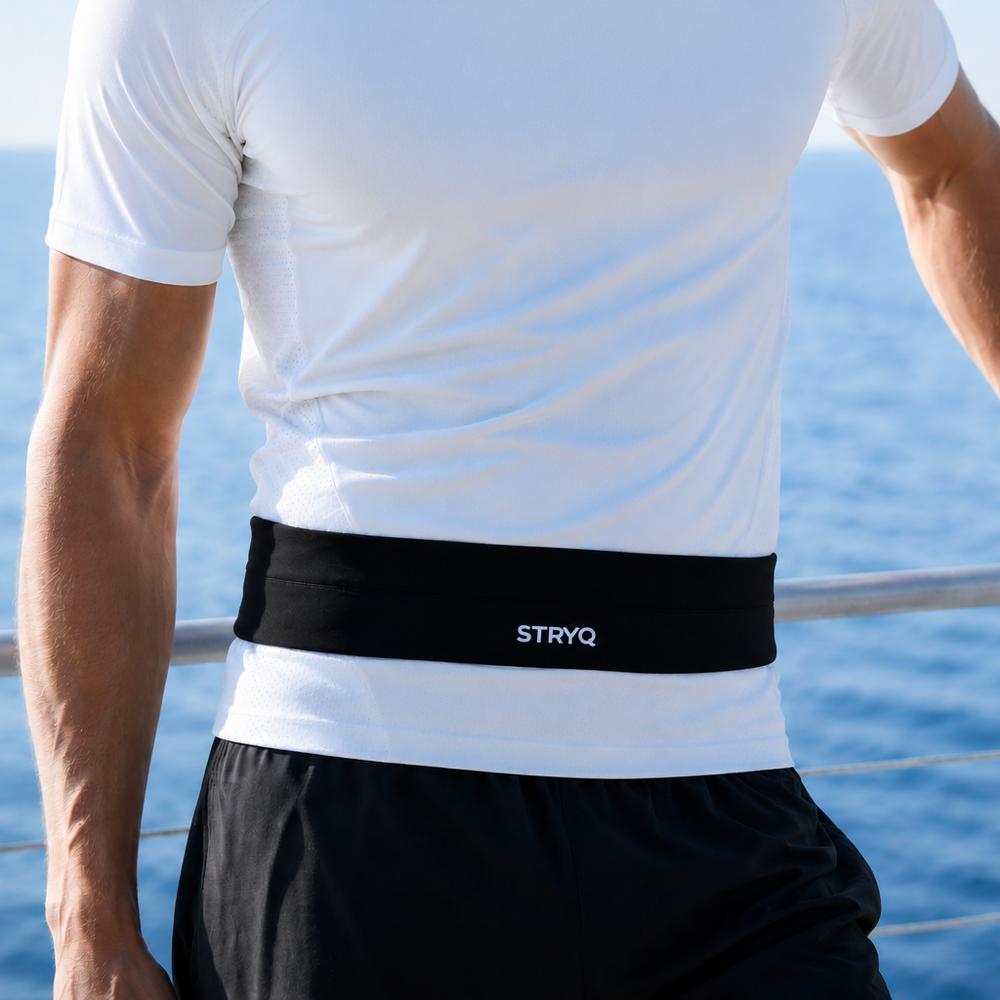
A running belt is an easy place to add reflective detail because it sits where headlights naturally catch it. It can also keep your essentials close to your body, rather than leaving you to choose between safe storage and being seen.
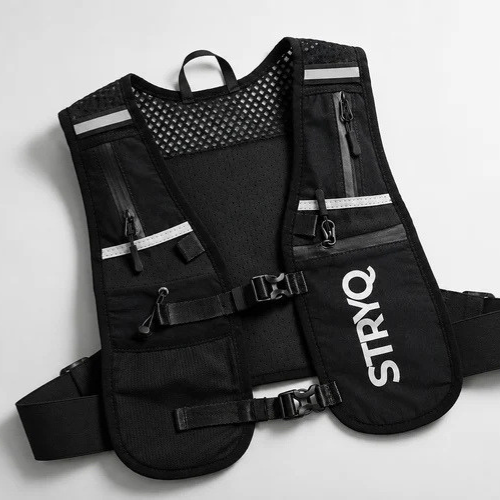
The key is a close, stable fit. A loose belt that rides up, rubs or bounces soon becomes something you leave at home. For runners who need water on longer dark runs, a hydration vest with reflective details and a rear light attachment can be more practical. It spreads the load and leaves your hands free.
STRYQ running accessories are designed around this kind of real-world problem: carrying what you need without bulk or bounce. Visibility features are most useful when they fit naturally into kit you already wear consistently.
Reflective ankle bands and shoe details
Ankle bands are small, affordable and surprisingly noticeable. Your feet are constantly moving, so the reflected light creates a clear rhythm that can catch a driver’s attention sooner than a reflective logo on the chest.
They are particularly useful if your usual running kit is dark. Put them over tights or around the lower leg, where they will not interfere with your stride. Reflective laces and shoes with reflective overlays add another moving point of visibility, although they should be an extra rather than your only safety measure.
Reflective gloves, arm bands and caps
Smaller accessories fill the gaps. Gloves with reflective markings are useful when you signal to turn or cross a road. An arm band can add visibility if you run in a short-sleeve top, while a cap with reflective detailing can help in drizzle and low light.
These items work best as part of a layered approach. They are not a replacement for a light or large reflective area, but they improve your outline from different angles without adding much weight.
Build your kit around where you run
The right setup depends on your route, not just the time on the clock. A well-lit town centre needs a different approach from an exposed rural road.
For lit pavements and park paths, a reflective top or gilet, a belt with reflective details and a small rear light may be enough. If you run on roads without pavements, add a front light and aim for visible reflective coverage on your front, back and sides.
On trails, your first priority is seeing where you place your feet. A reliable head torch or chest light is essential, supported by reflective details for road sections and car parks. On misty, wet or overcast mornings, wear a high-vis outer layer too. Reflective material only works when light reaches it.
If you run with a dog, remember that your visibility system needs to include them. A reflective lead, collar light or illuminated harness makes it easier for others to understand what they are seeing and gives you more control near traffic.
Details that are easy to miss
Clean reflective panels work better than panels covered in mud, road spray or fabric conditioner residue. Wipe down lights and reflective areas after wet runs, and check batteries or charging levels before heading out. Cold weather can shorten battery life, so do not assume a light that lasted last week will last for the same duration tonight.
Avoid dressing head to toe in black and assuming a head torch solves the problem. A driver can struggle to judge your position and direction, especially in rain. Put reflective elements on moving parts of the body and make sure there is a clear light or reflective area at the rear.
Also consider your route choices. Visibility gear improves your chances of being seen, but it cannot remove every risk at blind bends, narrow country lanes or busy crossings. Run facing oncoming traffic where it is safe to do so, reduce headphone volume and be ready to step aside.
A practical dark-running setup
For most runners, a simple combination is enough: a bright outer layer for twilight, reflective detailing on your torso and legs, a white front light for unlit sections, and a red light at the back. Add ankle bands if your kit is mostly dark or your route has frequent road crossings.
Start with the item that solves the biggest problem on your usual route. If you cannot see the ground, buy a dependable torch. If traffic approaches from behind, add a rear light. If cars do not seem to notice you until late, increase the amount of reflective material across your body.
The best kit is the kit you will wear every time the light fades. Keep it by the door, charge it after use and make being seen part of the same routine as lacing your shoes.