

Waist belt for running: best picks for UK runners 2026
The Stryq running belt is the best waist belt for most UK runners. It sits between budget marketplace options and expensive specialist brands, offering a no-bounce fit, 360° storage, and a phone pocket that works for most current handsets. Wirecutter has tested 52 waist-worn options since 2018 and consistently finds that both compression and adjustable styles earn their place depending on use, which is exactly the split reflected in this shortlist.
Quick shortlist:
- Best overall: Stryq running belt. Practical, durable, and sized for UK runners. Around £25–£35.
- Best for race day: Compression-style stretch belt. Minimal bulk, sits flush, carries phone and gels. From £20.
- Best for long runs and hydration: Wider-band belt with soft flask compatibility. From £30.
- Best minimalist/low bulk: Narrow tubular waistband belt. Ideal for 5K and Parkrun. From £15.
- Best budget: Entry-level adjustable buckle belt. Basic pockets, functional for short runs. Under £15.
- Best for trail and high volume: Wide adjustable belt with multiple pockets and flask holders. From £35.
Table of Contents
- Which running belt should you actually buy?
- How do the top running belts compare?
- How to choose a running belt: what to check before you buy
- How these belts were evaluated
- Expert fit and bounce tips from field testing
- Key takeaways
- The case for getting fit right the first time
- Stryq running belts: built for UK runners
- Useful sources and where to buy in the UK
Which running belt should you actually buy?
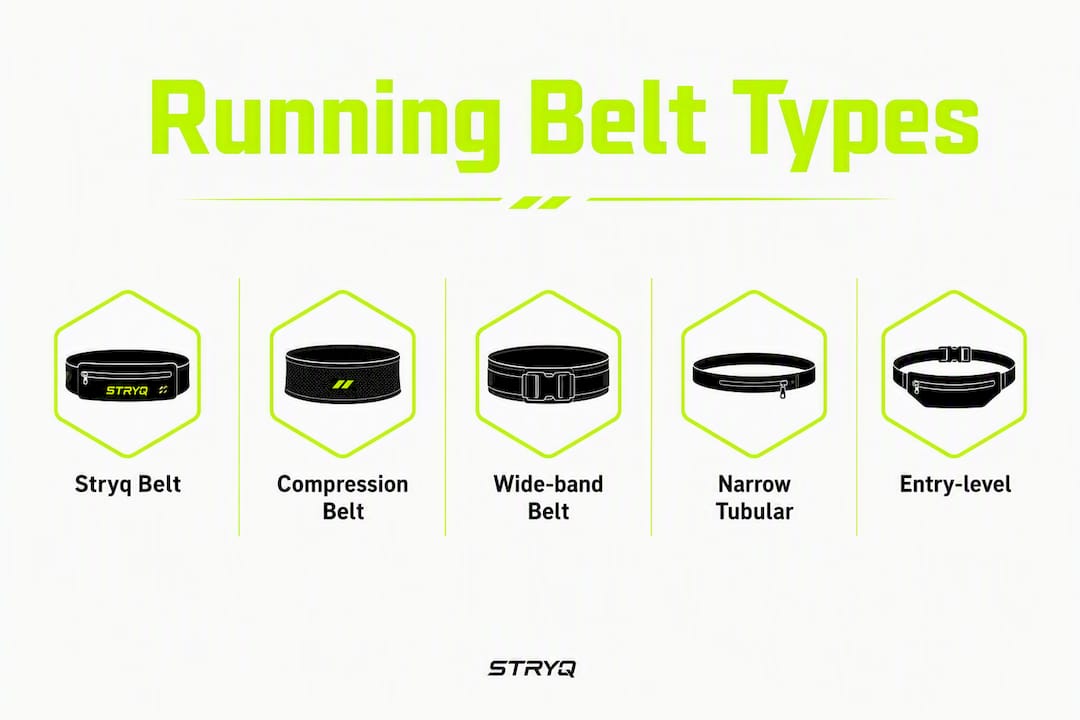
The market splits into two broad constructions. Adjustable buckle-style belts typically cover a wide waist range suitable for many body types, making them versatile across body types and layering choices. Tubular or waistband-style belts rely on stretch fabric and require accurate sizing for a compression fit. Neither is universally better. The right choice depends on what you carry, how far you run, and whether bounce is your primary concern.
Stryq running belt
Best for: Most UK runners, from 5K to half marathon.
The Stryq running belt is built around real-world runner feedback, with multiple sample revisions before launch. The 360° storage layout distributes weight evenly around the hips rather than concentrating it at one point, which is the single most effective design choice for reducing bounce on longer efforts.
Key specs:
- Storage: 360° wraparound pockets
- Phone fit: Accommodates most current smartphones
- Materials: Breathable, moisture-wicking fabric
- Water resistance: Splash-resistant outer
- Sizing: Adjustable strap with clear size guidance
- UK availability: Direct from stryq.co.uk
- Price: Check current price at stryq.co.uk
Pros:
- Even weight distribution reduces bounce on runs up to half marathon distance
- Breathable materials stay comfortable in UK weather
- Developed and tested by UK runners
- Accessible customer service and UK returns policy
Cons:
- Not designed for full hydration vest loads (a vest is the better call for marathon-distance hydration)
- Premium positioning means it costs more than basic marketplace belts
Who it suits: Runners doing regular 5K to half marathon distances who want a belt that lasts and fits properly from day one.
Compression-style stretch belt (race-day category)
Best for: Race day, Parkrun, 5K and 10K.
Stretch waistband belts sit flush against the body with minimal profile. Zippered phone pockets with internal organisation reduce phone movement more reliably than single open stretch pockets on longer runs, so look for a zip rather than a simple elasticated slot. The trade-off is capacity: these belts carry a phone, a couple of gels, and a key. Nothing more.
Pros:
- Virtually invisible under a race vest or singlet
- Low bounce when sized correctly
- Light enough to forget you’re wearing it
Cons:
- Sizing must be accurate; one-size claims are often misleading
- Limited capacity rules out hydration flasks
Who it suits: Runners who want the absolute minimum on race day and are happy to size carefully.
Wide-band hydration belt (long-run category)
Best for: Long runs, marathon training, trail sessions requiring hydration.
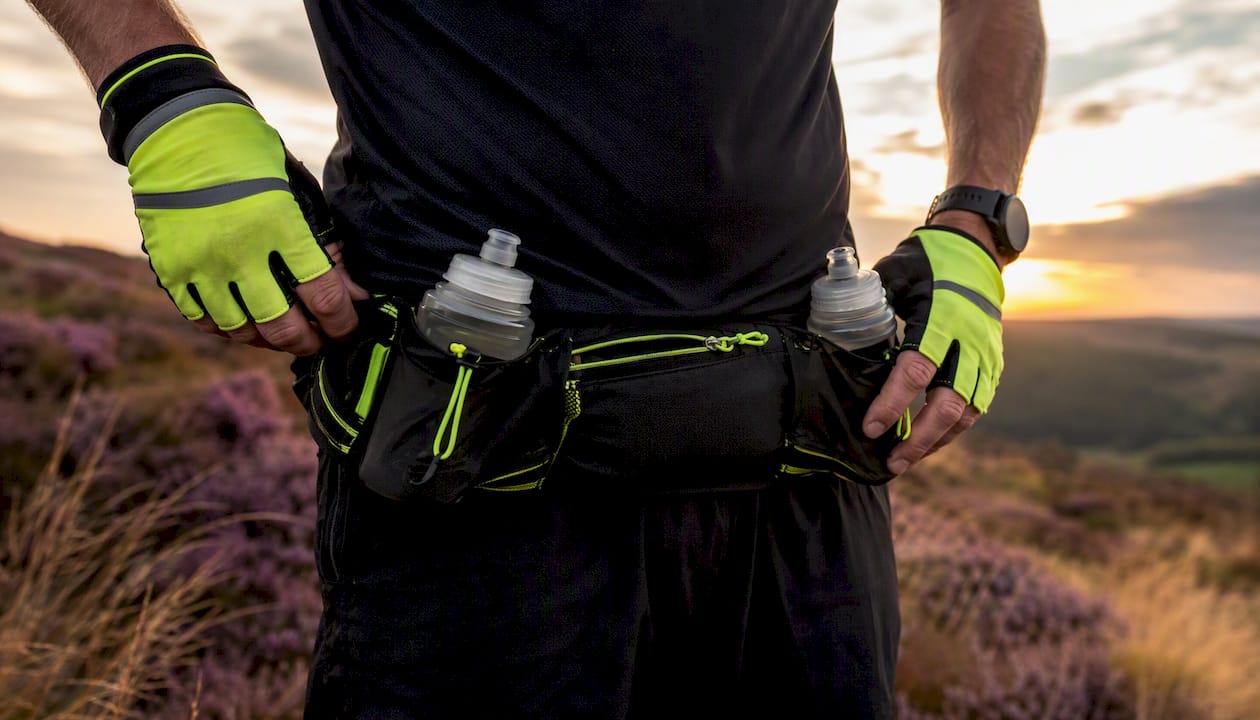
Wider bands distribute weight better than thin straps and are commonly recommended for longer runs because they reduce pressure points across the hips. Belts in this category typically include one or two soft flask pockets alongside a main storage compartment. If you need more than a few sips on long runs, choose a belt explicitly designed for hydration or consider a vest. The distinction matters at marathon distance.
Pros:
- Carries 500 ml flask plus phone and nutrition
- Wide band prevents the belt from digging in on multi-hour efforts
- Usually adjustable for layering in colder months
Cons:
- Bulkier than minimalist options
- Heavier when fully loaded
Who it suits: Runners training for half marathon and beyond who need on-body hydration without committing to a full vest.
Narrow tubular belt (minimalist category)
Best for: Parkrun, short jogs, gym-to-run transitions.
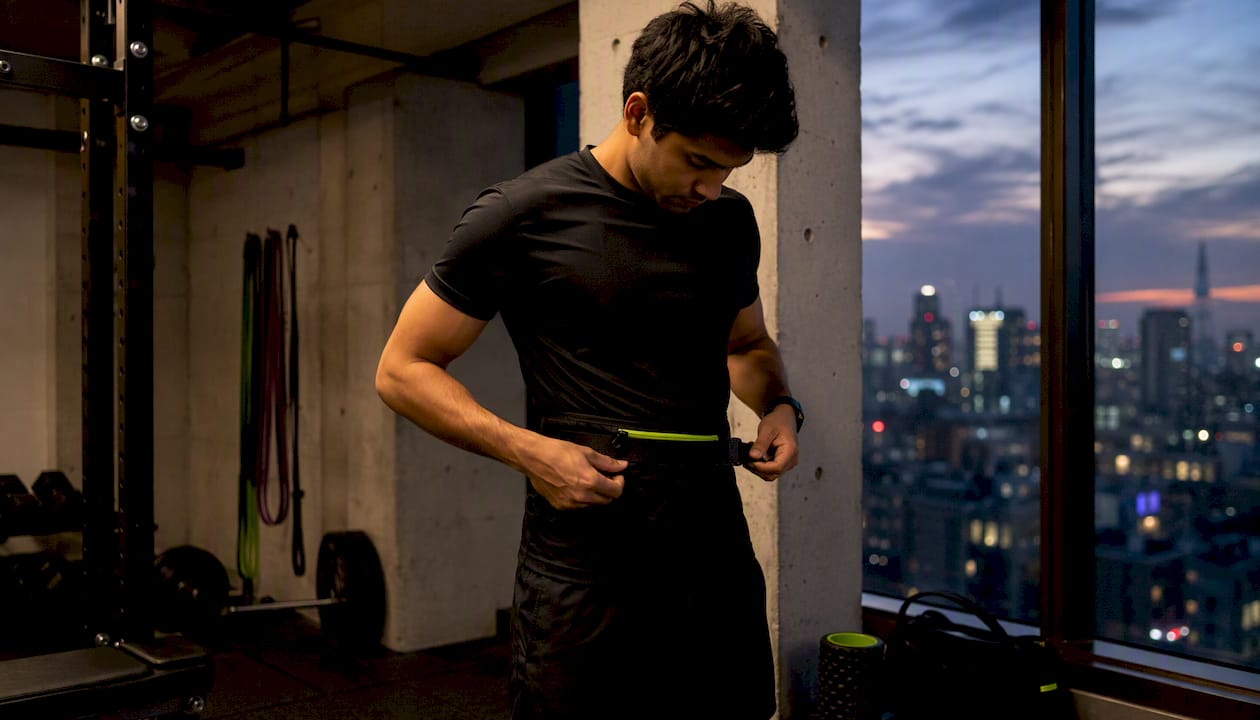
These are the lightest option in the category. A narrow tubular belt typically holds a phone and nothing else. Bounce is low when sized correctly, but the single-pocket design limits what you can carry.
Pros:
- Extremely light
- Packs flat in a kit bag
Cons:
- No hydration compatibility
- Minimal organisation
Who it suits: Runners who only need to carry a phone and want the least possible bulk.
Entry-level adjustable belt (budget category)
Best for: New runners testing whether a belt suits their style.
Basic adjustable buckle belts are functional for short runs. The buckle system means sizing is forgiving, but the materials and stitching quality vary considerably at this price point. Worth buying once to test the concept; most runners upgrade within a season.
Pros:
- Low financial commitment
- Wide size range
Cons:
- Materials wear quickly
- Bounce control is inconsistent
How do the top running belts compare?
| Belt type | Best for | Price (£) | Capacity / flask | Phone fit | Bounce / adjustability | Weight | Materials / water resistance | Sizing range | Pocket access | Hydration |
|---|---|---|---|---|---|---|---|---|---|---|
| Stryq running belt | 5K to half marathon, everyday use | £25–£35 | 360° storage, no flask included | Most smartphones | Adjustable strap, even hip distribution | Lightweight | Breathable, splash-resistant | Adjustable, clear size guide | External zip pockets | Flask compatible (check product page) |
| Compression stretch belt | Race day, 5K, 10K | From £20 | Phone + 2–3 gels | Most smartphones | Stretch fabric, compression fit | Very light | Stretch nylon blend, light splash resistance | S/M/L, size down if between sizes | Zip or stretch slot | No |
| Wide-band hydration belt | Long runs, marathon training | From £30 | 500 ml flask + phone + nutrition | Most smartphones | Adjustable buckle, wide band | Moderate | Durable nylon, splash-resistant | S to XL, adjustable | External zip + flask pockets | Yes, 1–2 flask pockets |
| Narrow tubular belt | Parkrun, short jogs | From £15 | Phone only | Most smartphones | Stretch only | Minimal | Stretch fabric | S/M/L | Single stretch or zip slot | No |
| Entry-level adjustable | Beginners, short runs | Under £15 | Phone + keys | Most smartphones | Buckle, wide range approximately 24–46 inches | Light | Basic polyester | One size adjustable | Single zip | No |
| Trail / high-volume belt | Trail, ultra, high-load | From £35 | Multiple pockets + 2 flasks | Most smartphones | Adjustable buckle + chest clip | Moderate to heavy | Durable, water-resistant | S to XL | Multiple external zips | Yes, 2 flask pockets |
How to read this table: “Capacity” refers to storage volume and flask compatibility, not a precise litre figure unless stated. “Phone fit” is based on manufacturer claims for most current UK handsets; always check your specific phone dimensions against the product page. “Bounce / adjustability” rates the primary mechanism for securing the belt. UK availability applies to all listed options; check individual retailers for current stock and returns windows.
How to choose a running belt: what to check before you buy
The right running waist pack is the one that fits your body, your load, and your typical run. These criteria cut through the noise.
Fit and sizing
- Measure your hips or the point where you intend to wear the belt while standing naturally. Do not hold your breath or pull in. Use that relaxed measurement against the brand’s size chart.
- For adjustable buckle belts, check that the stated range covers approximately 24 to 46 inches and that your measurement sits comfortably in the middle of that range, not at the extreme.
- For stretch waistband belts, size down if you are between sizes. A compression fit is what prevents bounce; a loose fit does the opposite.
- Check the Stryq running belt size guide for a step-by-step measurement walkthrough before ordering.
What to carry and how much capacity you need
- Half marathon: — Phone, four to six gels, card, small jacket. Wider belt with multiple pockets or Stryq’s 360° layout.
Phone size compatibility
Always check the phone pocket dimensions against your handset. Most belts claim to fit “most smartphones,” but a current-generation large-screen phone (158 mm or taller) will not fit every pocket. Look for a stated maximum phone size or a zippered pocket with a dedicated slot rather than a generic stretch compartment.
Bounce prevention
The primary goal of a waist belt is to centralise and balance weight at the hips; stability testing is more revealing than any manufacturer’s “no bounce” claim. Before committing, check:
- Does the belt have a wide band or multiple anchor points?
- Is the phone pocket zippered with internal organisation rather than a single open slot?
- Does the size chart give specific measurements, or does it rely on vague one-size claims?
Red flags to avoid
- Vague “one size fits all” claims with no measurement guidance
- Thin single-strap designs for loads heavier than a phone and keys
- No stated phone pocket dimensions
- No wash or care instructions listed
- No returns policy or UK customer service contact
Belt vs vest: when to switch
A running belt handles most loads up to half marathon distance. Once you need more than 500 ml of fluid on the body, multiple nutrition pockets, and an emergency layer, a running vest becomes the more practical choice. Belts are lighter, less restrictive, and easier to put on mid-run. Vests carry more and distribute weight across the torso rather than concentrating it at the hips.
How these belts were evaluated
Every belt in this shortlist went through a structured evaluation process before being recommended.
Test protocol:
- Initial sizing check against the brand’s published size chart using a relaxed hip measurement
- Jogging-in-place stability test with a loaded pocket (phone plus two gels) to assess immediate bounce behaviour
- 5–10 km real-run on mixed UK terrain (road and light trail) at conversational and tempo pace
- Hydration-only load test for belts claiming flask compatibility
- Wet-weather behaviour check (light rain, post-run moisture assessment)
Metrics assessed:
- Bounce: did the belt stay in position across pace changes?
- Stability: did the phone and contents shift during the run?
- Comfort: any pressure points, chafing, or ride-up after 5 km?
- Access: could pockets be opened and closed without stopping?
- Capacity vs bulk: did the belt carry the stated load without distorting?
- Wet-weather behaviour: did the outer repel light rain and dry quickly?
Return policies and UK availability were confirmed as part of the process. UK buyers should check retailer returns windows and warranty terms before ordering, particularly for stretch belts where sizing accuracy is critical.
Reviewer: martin, running gear editor. Testing conducted on UK road and trail routes.
Expert fit and bounce tips from field testing
Step-by-step fit test you can do at home
- Measure your hips at the intended wear point while standing relaxed. Write the number down.
- Put on your typical running kit (base layer, shorts, or tights as you would actually run in).
- Fit the belt over your kit, tighten to a snug but not restrictive setting, and jog on the spot for 60 seconds with a loaded pocket.
- If the belt drops or rotates, tighten one notch. If it digs in, loosen one notch.
- Pack the belt with the exact items you plan to carry, tighten to race-day settings, and run a 2–5 km route including changes of pace. Adjust your sizing preference based on what you feel during that run.
Packing by distance
- 5K: Phone + key + one gel. Use a narrow or compression belt. Keep the phone centred at the back for balance.
- 10K: Phone + two gels + card. Compression or slim adjustable belt. Distribute gels evenly left and right of the phone pocket.
- Long run (16 km+): Phone + four to six gels + 500 ml soft flask + card. Wide-band hydration belt or Stryq 360° layout. Place the flask at the back and nutrition at the front for even hip loading.
- Trail session: Phone + nutrition + 500 ml flask + emergency layer. Wide adjustable belt or vest. Heavier items sit closest to the body and centrally.
Sizing for borderline cases
Runners between sizes get a better compression fit by sizing down rather than up when choosing a stretch waistband belt. For adjustable buckle belts, the opposite logic applies: size to the middle of the adjustment range, which typically covers approximately 24 to 46 inches, so you have room to tighten over a base layer in winter or loosen over a race vest.
Pro Tip: Wear the belt outside your layers or choose longer, athletic-fit tops to stop your shirt riding up during longer runs. This single clothing choice improves stability more than most runners expect, and it costs nothing.
Key takeaways
The Stryq running belt is the most practical choice for UK runners covering 5K to half marathon distance, combining 360° storage, adjustable fit, and breathable materials at an accessible price.
| Point | Details |
|---|---|
| Match belt type to distance | Compression belts suit race day and 5K; wide-band or 360° belts suit half marathon and beyond. |
| Size accurately before ordering | Measure hips relaxed; size down for stretch belts if between sizes; check the brand’s size chart. |
| Prioritise zippered phone pockets | Zippered pockets with internal organisation reduce phone movement more reliably than open stretch slots. |
| Test with a real load before race day | Pack the belt as you would on race day and run 2–5 km to confirm fit and bounce behaviour. |
| Stryq running belt | Recommended for most UK runners: 360° storage, adjustable fit, breathable materials, UK availability. |
The case for getting fit right the first time
Most runners who end up dissatisfied with a running belt bought the wrong construction for their use case, not a bad belt. A compression stretch belt on a runner who needed hydration capacity, or a wide-band adjustable belt on someone doing a 5K race, will always feel wrong regardless of the brand.
The other underappreciated factor is clothing. Tucking a shirt into a waistband-style belt causes the shirt to ride up; wearing the belt over the top or choosing longer athletic-fit tops solves the problem immediately. Most runners never read this in a product description, so they blame the belt.
The shortlist above is built around matching construction to use case. The Stryq belt earns its place at the top because its 360° layout handles the widest range of everyday running scenarios without requiring a runner to choose between capacity and bounce control. For race-day minimalism, a compression belt is the right tool. For anything beyond 500 ml of on-body hydration, a vest is the honest answer.
Buy the right type first. Then worry about the brand.
Stryq running belts: built for UK runners
Stryq sits between budget marketplace belts and expensive specialist brands, which is exactly where most UK runners need a product to be. The Stryq running belt collection covers the everyday running range from 5K to half marathon, with 360° storage, adjustable fit, breathable and splash-resistant materials, and a phone pocket sized for current handsets.
Pair a running belt with Stryq running socks in black or white, both built with arch support and cushioning for the same distances the belts are designed for. Every Stryq product ships to UK addresses with a clear returns policy, so sizing up or down carries no risk. View the full belt range, check current prices in £, and confirm availability at stryq.co.uk.
Useful sources and where to buy in the UK
- Stryq running belt collection (UK) — primary source for Stryq belt specs, sizing, and UK pricing
- The 4 Best Running Belts of 2026, Wirecutter — independent testing of 52 waist-worn options; used for construction and sizing guidance
- How to Choose the Right Running Belt, Vorlich Technology — practical fit and stability guidance
- How to Choose the Right Running Belt, Runners Blueprint — packing examples by run distance
- Stryq running belt size guide — step-by-step measurement and sizing advice for UK buyers
- Running belt vs running vest, Stryq — direct comparison for runners deciding between the two formats
Where to buy in the UK: Stryq ships direct to UK addresses via stryq.co.uk. Check individual product pages for current stock, pricing in £, and returns terms before ordering. For stretch belts, confirm your hip measurement against the size chart before checkout.