

Types of running belts for half marathon runners: 2026 guide
A running belt is a hands-free storage and hydration accessory worn around the waist or hips, and choosing the right type is one of the most practical decisions a half marathon runner can make. The types of running belts suited to half marathon training fall into three main categories: tubular stretch belts, adjustable buckle or Velcro belts, and hydration-specific belts. Each category suits a different combination of run length, weather, and personal comfort. Get the category wrong and you will spend 13.1 miles adjusting, bouncing, and chafing. Get it right and you will forget the belt is there at all.
1. What are the main types of running belts for half marathon training?
Running belts fall into three main types: tubular stretch belts, adjustable buckle or Velcro belts, and hydration-specific belts. Each one addresses a different runner profile and training scenario.
Tubular stretch belts are seamless, elasticated tubes that sit flat against the body. They offer a second-skin fit with minimal bounce, making them the preferred choice for runners who carry only a phone, keys, and a couple of gels. They suit training runs up to around 10 kilometres and parkrun distances well, but their fixed sizing means you need to measure carefully before buying.
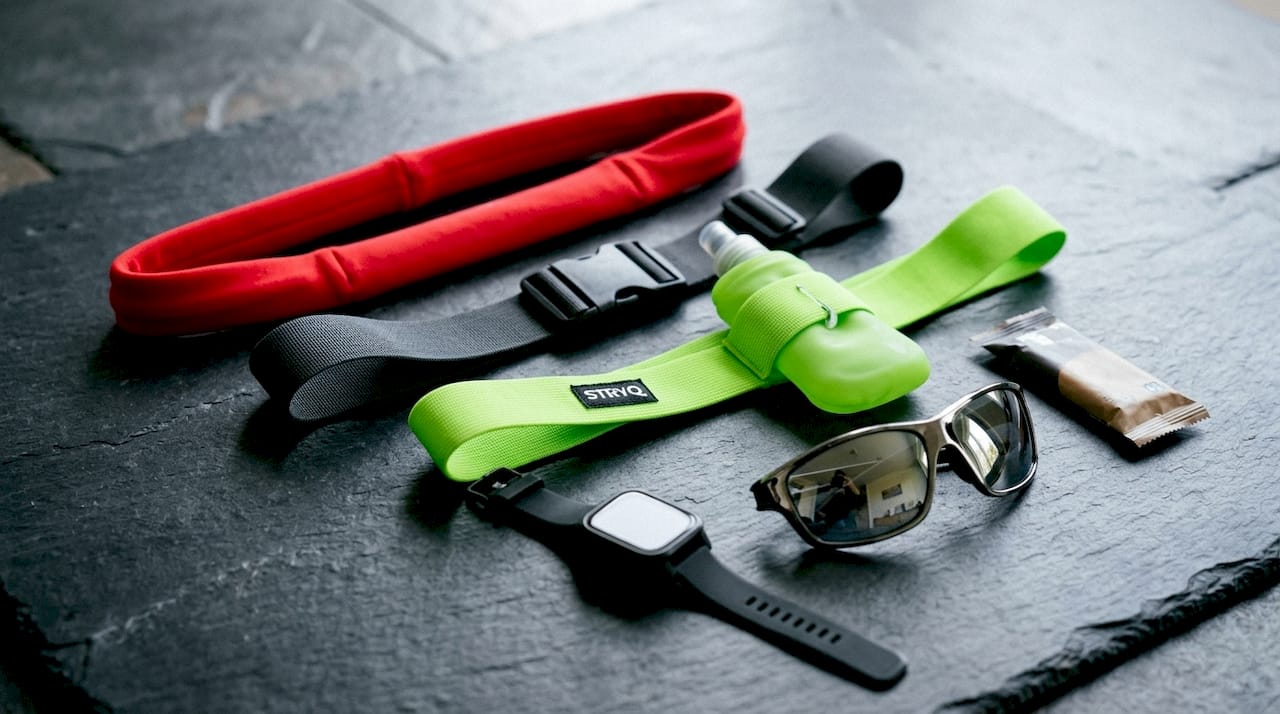
Adjustable buckle or Velcro belts use a clasp or hook-and-loop system to let you fine-tune the fit. They offer more storage than tubular belts, typically with one or two zippered pockets, and they accommodate a wider range of body shapes. They are a strong choice for runners choosing their first running belt, as the adjustability gives you room to experiment with positioning.
Hydration-specific belts carry one or two soft flasks or a small bladder alongside storage pockets. Hydration belts are recommended for runs over 90 minutes, which covers most half marathon long runs and race day itself. A single-bottle belt suits moderate distances on cooler days; a double-bottle belt is the better call on hot routes with no water stops.
- Tubular belts: best for short to mid-distance training, minimal carry, maximum comfort
- Adjustable belts: best for versatility, moderate storage, and first-time belt buyers
- Hydration belts: best for runs exceeding 90 minutes, race day, and warm weather training
For runs where you need more than one litre of fluid or extensive kit, a hydration vest becomes the more practical option than any belt type.
2. How to choose the right running belt size for bounce-free comfort
Correct fit is the single biggest factor in whether a running belt works or ruins your run. A belt that bounces will alter your stride, increase fatigue, and irritate your skin over 21 kilometres.
Step 1: Measure accurately. Measure your waist or hips standing naturally, without tensing or holding your breath. Use a soft tape measure and note the number in inches or centimetres. For tubular belts, sizing is rigid: a medium typically covers a 27.5–29.5 inch waist, a large covers 29.9–33.8 inches, and an extra-large covers 33.8–39.3 inches. Cross-reference the brand’s own size chart rather than assuming standard sizing applies.
Step 2: Apply the two-finger rule. Slide two fingers between the belt and your skin. If they slide in comfortably, the fit is correct. If there is more room than that, the belt will bounce. If you cannot fit two fingers, the belt will restrict your breathing over distance.
Step 3: Size down when in doubt. Sizing down secures a more bounce-free fit when you fall between sizes. A slightly snug belt that stays put is always preferable to a looser one that shifts mid-run.
Step 4: Consider belt width. Wider belts distribute pressure more evenly across the hips and abdomen. Thin straps tend to dig in during longer efforts. For half marathon distances, a belt with a band of at least 5 centimetres is worth prioritising.
Step 5: Plan for chafing. Belts worn against bare skin can chafe on runs over 90 minutes. Wearing a technical shirt between your skin and the belt is one solution, though shirts often lose their tuck during motion. A belt made from soft, moisture-wicking fabric is the more reliable fix for long training runs.
Step 6: Test before race day. Wear the belt on at least three training runs before committing to it for a race. Fit can feel different at mile 10 than it does in your hallway.
Pro Tip: If you are between sizes on a tubular belt, always go smaller. The fabric will stretch slightly over the first few runs and settle into a secure, bounce-free position.
3. What features should half marathon runners look for?
The right features depend on your route, the weather, and how much you need to carry. Buying more belt than you need adds weight and bulk without benefit.
Hydration capacity is the starting point. A single soft flask of 500ml suits most half marathon training runs in mild UK conditions. A double-bottle setup is worth considering for race day or summer long runs where water stops are spaced far apart. Choosing a hydration belt based on water access and route duration is the most practical approach.
Storage pockets vary significantly between belt types. Look for:
- A main zippered pocket large enough for your phone. Check the pocket dimensions against your phone model before buying. Phones over 6.5 inches may not fit standard belt pockets, so measure first.
- Gel loops or a secondary pocket for energy gels. Most half marathon runners carry 2–4 gels, so dedicated loops prevent fumbling mid-run.
- A small key clip or loop to secure your house key without it rattling.
Material and breathability matter more over longer distances. Neoprene holds moisture against the skin; technical mesh or stretch fabric wicks sweat away and reduces friction. For half marathon training, prioritise fabric that stays comfortable at mile 12, not just mile 1.
Weight is a practical consideration. Carrying unnecessary bulk reduces running efficiency and increases fatigue. Buy the smallest belt system that reliably covers your route’s needs.
| Feature | What to look for |
|---|---|
| Hydration capacity | 500ml single flask for most training runs; double flask for hot or remote routes |
| Phone pocket size | Check dimensions against your phone before buying |
| Gel storage | Dedicated loops or secondary pocket for 2–4 gels |
| Fabric | Moisture-wicking, soft-edged material to reduce chafing |
| Belt width | Wider band for better pressure distribution over long distances |
| Adjustability | Buckle or Velcro for versatile fit; tubular for a fixed, low-profile carry |
4. Running belts vs hydration vests: which suits a half marathon?
The choice between a belt and a vest comes down to how much you need to carry and how much contact with your upper body you can tolerate in training.
Belts sit at the hips, leave the torso free, and run cooler in warm weather. They are lower profile and less restrictive, which makes them the default choice for most half marathon runners. Their limitation is capacity: even a double-bottle belt carries less fluid than a vest, and storage is limited to what fits around your waist.
Hydration vests distribute weight across the shoulders and back, which reduces hip fatigue on very long runs. They carry significantly more fluid and kit, making them better suited to marathon training, trail runs, or races with no water stops. For a standard road half marathon, most runners find a vest is more kit than the distance requires.
- Choose a belt if: you run road half marathons, have access to water stops, and prefer a cooler, lower-profile carry
- Choose a vest if: you run trail halves, train in heat, or regularly exceed 90 minutes without water access
- Try both during training if you are unsure. The decision is personal, and comfort at mile 10 is the only metric that matters.
For runners who want to understand the full range of hydration vest options before deciding, comparing belt and vest capacity side by side is a useful exercise.
5. Practical tips for using running belts during training and races
Getting the most from a running belt requires more than buying the right type. How you wear and load it matters just as much.
Placement: Wear the belt on the hips, not the waist. Hip placement lowers the centre of gravity and reduces bounce. The belt should sit level all the way around, not tilted forward or back.
Load distribution: Place heavier items centrally and close to the body to minimise sway. Put your phone at the back or centre, and distribute gels evenly on either side rather than loading one pocket.
Pre-run checks: Adjust the belt before you leave the door, not after the first kilometre. Check the two-finger rule, confirm all zips are closed, and make sure soft flasks are seated securely.
Maintenance: Rinse the belt after every run, particularly if you carry sports drinks or gels. Salt and sugar residue degrades elastic fabric and zips over time. Air-dry flat rather than tumble-drying.
- Rinse after every run to remove sweat and gel residue
- Air-dry flat to preserve the elastic
- Check zip pulls and buckles monthly for wear
- Replace soft flasks every 6–12 months if used regularly
Pro Tip: Test your race-day belt setup on your longest training run, fully loaded with the gels, phone, and fluid you plan to carry on race day. A belt that works empty often behaves differently when fully loaded.
Key takeaways
The best running belt for a half marathon is the one that stays still, fits correctly, and carries exactly what your route requires without adding unnecessary weight.
| Point | Details |
|---|---|
| Three main belt types | Tubular, adjustable, and hydration-specific belts each suit different run lengths and carry needs. |
| Fit determines bounce | The two-finger rule and sizing down between sizes are the most reliable ways to eliminate bounce. |
| Hydration belts for 90+ minutes | Runs exceeding 90 minutes require a dedicated hydration belt or vest to maintain fluid intake. |
| Match features to your route | Single flask suits most UK training runs; double flask for hot or remote routes with no water stops. |
| Test before race day | Wear your belt on at least three training runs, fully loaded, before committing to it for a race. |
What I have learned from getting running belts wrong
The first belt I ever bought was an adjustable buckle style, one size too large, because I assumed looser meant more comfortable. By kilometre 8 of a long run, it had migrated halfway up my back and I spent the rest of the run holding it in place with one hand. That is not a running belt. That is a liability.
The lesson I took from that, and from testing a range of belt types since, is that the two-finger rule is not a suggestion. It is the only reliable way to know whether a belt will stay put at race pace. Tubular belts converted me. The fixed sizing feels restrictive in the shop, but on the road they disappear in a way that adjustable belts rarely do.
The other thing I underestimated early on was hydration. For a 10-kilometre training run, a slim belt with no bottle is fine. But for anything approaching 90 minutes, particularly in summer, the absence of fluid becomes a performance issue, not just a comfort one. A single 500ml soft flask changes that calculation entirely without adding meaningful bulk.
My honest recommendation: start with a tubular belt for shorter training runs to understand what bounce-free actually feels like. Then add a hydration belt for your long runs. You will quickly learn which type suits your body shape, your pace, and your route. No article, including this one, replaces that first-hand experience.
— martin
Stryq running belts built for half marathon training
Stryq designs running belts specifically for the problems real runners encounter: bounce, chafing, poor phone fit, and belts that shift mid-run. Every belt in the Stryq range is tested through multiple revisions before launch, with fit and fabric chosen to perform at half marathon distances, not just on a short test jog.
The Stryq running belt collection includes options suited to runners at every stage, from first-time belt buyers to experienced half marathon runners who know exactly what they need. Adjustable fit, soft moisture-wicking fabric, and phone pockets sized for current handsets are standard across the range. If you are building your kit for a 2026 race, the collection is a practical starting point.
FAQ
What type of running belt is best for a half marathon?
A hydration-specific belt with a single soft flask suits most half marathon runners. For runs exceeding 90 minutes, carrying fluid is more important than minimising bulk.
How do I stop my running belt from bouncing?
Apply the two-finger rule when fitting: two fingers should slide between the belt and skin with light resistance. If you fall between sizes, size down for a more secure fit.
Can I use a slim tubular belt for a half marathon?
A tubular belt works well for half marathon race day if water stops are available on the course. For training runs over 90 minutes without water access, a hydration belt is the better choice.
How much should I spend on a running belt?
Entry-level functional belts start from around £20–£25. A well-made belt at a mid-range price will outlast several cheaper alternatives and cause fewer problems on race day.
Do I need a hydration vest instead of a belt for a half marathon?
Most road half marathon runners do not need a vest. A hydration belt with one or two soft flasks covers the fluid needs of a standard 13.1-mile race. Vests become relevant for trail halves, hot conditions, or runners who prefer to carry more kit than a belt allows.