

Hydration kit for UK runners: the complete buying guide
For most UK runners, a soft-flask hydration vest is the right choice. It handles marathon training, trail runs, and events with aid stations without adding unnecessary bulk. Short runs under 60 minutes need nothing more than a running belt or a handheld flask. Long trail runs and self-supported ultras call for a bladder-equipped vest or pack with ample reserve capacity.
Quick buy by run type:
- Parkrun / 5K–10K training: Running belt with one small flask or a handheld. Stryq’s running belt is built for exactly this: low bounce, 360° storage, no fuss.
- Half marathon and marathon training: Soft-flask vest with two front pockets. Stryq’s hydration vest with adjustable straps and front-pocket design covers most road and trail training needs.
- Long trail runs and ultras: Bladder-equipped vest (1.5–3 L) or a combination of front flasks plus rear bladder. Stryq soft flasks pair directly with the vest for mixed-fluid carrying.
Key takeaways
The right hydration kit is the lightest setup that matches your run distance, terrain, and resupply plan.
| Point | Details |
|---|---|
| Match capacity to run type | Under 90 min needs 250–750 ml; marathon training needs 500 ml–1.5 L; ultras need 1.5–3 L. |
| Soft flasks suit most runners | Front-pocket access, easy cleaning, and collapsible design make soft flasks the best all-round choice. |
| Fit beats capacity | A well-fitting 5–8 L vest outperforms a poorly fitted 12 L pack for most UK training runs. |
| Test before race day | Practise your exact kit, drink mix, and refill method on at least two long runs before tapering. |
| Stryq for UK runners | Stryq’s vest, belt, and soft flasks cover every run type from Parkrun to trail events at mid-range prices. |
Table of Contents
- What to check before you buy hydration kit
- Bladder vs soft flask vs hard bottle: which system suits you?
- Vest vs belt vs handheld: which format fits your running?
- How much fluid should you carry on a run?
- Practical tips for using your kit reliably
- Stryq kit for UK runners: what to buy
- How to fit and test your kit before race day
- Electrolytes and your hydration strategy
- Integrating hydration with endurance nutrition
- Cost and value: what to expect at each price point
- Durability and maintenance across hydration systems
- What most runners get wrong about hydration kit
- Stryq: kit built for UK runners
- Sources
What to check before you buy hydration kit
Run through these before you click purchase:
- Capacity: Under 90 minutes needs 250–750 ml. Marathon training needs 500 ml–1.5 L. Long trail or ultra needs 1.5–3 L.
- How you drink: Sipping on the move suits a front-flask vest. Stopping to drink suits a belt or handheld.
- Aid-station access: Frequent aid stations mean front flasks for fast swaps. Remote routes mean a rear bladder for reserve.
- Fit: Try with a full load. Vests should not bounce. Belts suit short runs but bounce when overfilled.
- Cleaning: Soft flasks and bottles are far easier to clean than bladders.
- Budget: Belts start lower; vests mid-range; full packs higher.
Test your chosen setup on at least one long training run before race day.
Bladder vs soft flask vs hard bottle: which system suits you?
Carrying fluids on a run involves three distinct systems, each with clear trade-offs.
Bladders (reservoirs)
Pros: Largest single-volume option (typically 1.5 L, 2 L, or 3 L); weight sits close to your back for good balance; hands-free sipping via a bite valve.
Cons: Cleaning is fiddly due to long tubing; refilling at aid stations is slow; you cannot easily see how much fluid remains.
Best for: Long trail runs and remote ultras where resupply is limited.
Soft flasks
Pros: Sit in front vest pockets for instant access; collapse as you drink, reducing slosh and bulk; easy to clean with wide openings and no tubing; refill-friendly at aid stations.
Cons: Can feel floppy and awkward to handle when nearly empty; smaller individual capacity (typically 150–500 ml each).
Best for: Marathon training, road events, and any run with regular aid stations.
Hard bottles
Pros: Simple to clean; wide mouth accepts ice; durable.
Cons: Do not collapse as they empty, so bulk stays constant; less packable than soft flasks; volumes typically 250–750 ml.
Best for: Short sessions, track work, or as a secondary bottle in a belt.
Weight matters. One litre of water weighs approximately 1 kg. A 2 L bladder fully loaded adds 2 kg to your pack before you account for the vest itself. That figure is the central trade-off in every capacity decision.
Pro Tip: Carry water in one soft flask and an electrolyte mix in a second. You get both fluids on demand without stopping to mix, and you always know which is which.
Vest vs belt vs handheld: which format fits your running?
Vests, belts and handhelds serve different distances and priorities.
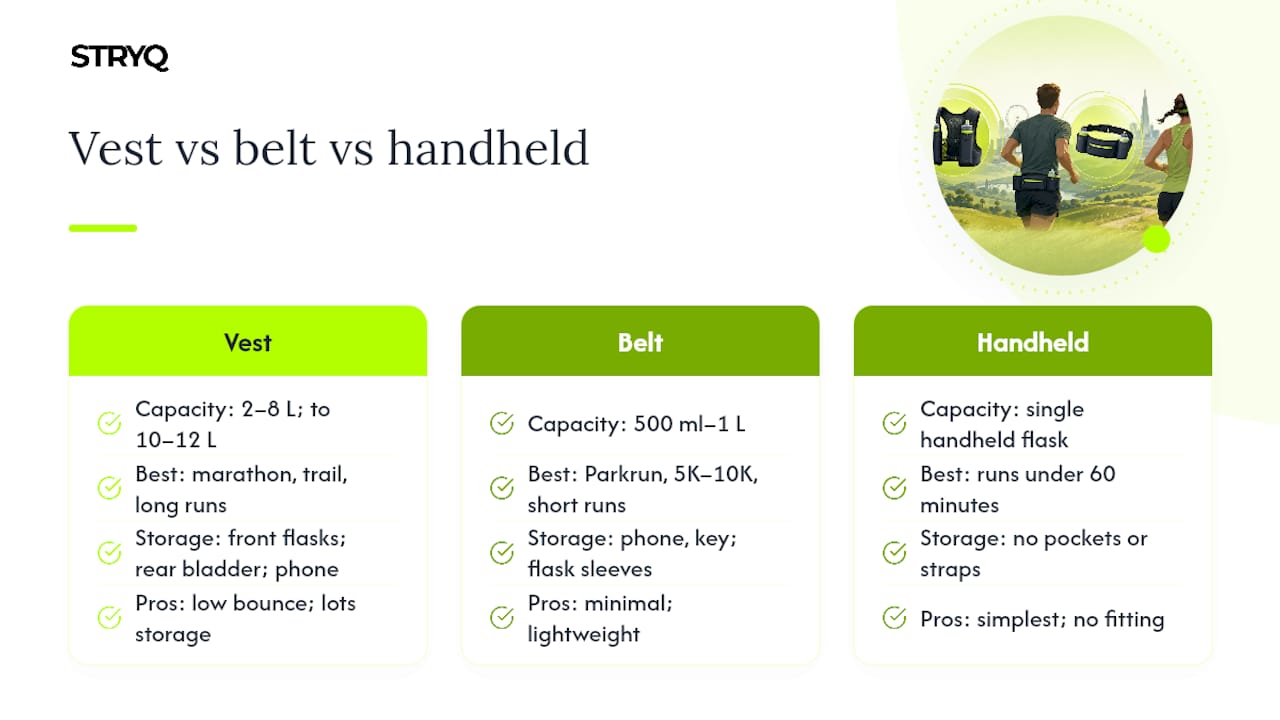
Hydration vest: Low bounce, front-pocket flask access, rear compartment for a bladder or layers. Capacity ranges from roughly 2–8 L for most training needs, rising to 10–12 L for longer ultras. The best balance for marathon training and technical trail runs, where you need fluid, nutrition, and a phone pocket in one place.
Running belt: Minimal and light. Typical capacity is 500 ml–1 L across one or two flask sleeves. Suits Parkrun, 5K–10K training, and any short road run where you want storage for a phone and a key without wearing a vest. Prone to bounce if overfilled or poorly fitted, so keep the load light.
Handheld flask: The simplest option for runs under 60 minutes. No straps, no fitting, no pockets. The trade-off is one occupied hand for the entire run.
Fit notes: A vest should sit snug against your torso with no vertical movement when you run. Chest straps should sit across the sternum, not the collarbone. Women-specific fits offer a narrower shoulder width and shaped chest panels. Chafing almost always comes from a vest that is too loose, not too tight.
As one practical guide notes, a well-fitting 5–8 L vest will outperform a poorly fitted 12 L pack for most UK marathon and trail training sessions. Fit matters more than an extra litre of capacity.
How much fluid should you carry on a run?
Match your carried volume to your run length and the resupply available on the route.
| Run type | Suggested volume | Format |
|---|---|---|
| Under 90 min, supported | 250–750 ml | Belt flask or handheld |
| Marathon training (2–3 h) | 500 ml–1.5 L | Two front soft flasks in vest |
| Long trail / fell run | 1.5–2 L | Rear bladder or combined flasks |
| Remote ultra | 2–3 L | Bladder plus spare front flasks |
Higher-effort sessions (intervals, race pace) increase sweat rate, so carry more than you think you need until you know your own rate.
Prefer multiple smaller containers over one large bladder when you need both frequent sips and a reserve. Two 500 ml front flasks plus a 1.5 L rear bladder gives you immediate access and a backup without committing to a single heavy reservoir. For supported marathons, aid stations reduce the volume you need to carry significantly.
Practical tips for using your kit reliably
Before every run:
- Leak-test soft flasks and bladder connections at home, not at the start line.
- Remove air from soft flasks before loading them into vest pockets to reduce slosh.
- Balance your load: equal weight in both front pockets prevents the vest pulling to one side.
- Check strap tension with a full load. Straps loosen as foam compresses over the first kilometre.
Cleaning:
Soft flasks and hard bottles need a rinse after every use and a thorough wash weekly. Bladders need a brush kit for the reservoir and a long flexible brush for the tube. Dry bladders fully before storage, hanging them open in a warm space. A mildew smell means the bladder was stored damp.
Refilling at aid stations:
For soft flasks, hand-empty the remaining fluid, refill directly from the station tap or volunteer jug, and return to the pocket in one motion. Practise this in training. Bladder refills at stations are slow and awkward; if your event has frequent aid stations, front flasks are the faster choice.
Testing your race-day hydration plan in training is non-negotiable. Use the same kit, the same drink mix, and the same refill method at least twice before tapering.
Pro Tip: Label your flasks with a small strip of tape if you carry different fluids. Water in the left pocket, electrolyte in the right. Simple, and it prevents concentration mistakes mid-race.
Stryq kit for UK runners: what to buy
Stryq builds each product through multiple sample revisions and real-world runner testing before launch. The range covers the three main carrying formats.
- Stryq hydration vest: Adjustable chest straps, two front soft-flask pockets, rear compartment for a bladder or layers, and multiple small pockets for nutrition and a phone. Suits marathon training, half marathons, and trail runs. Available at Stryq.
- Stryq soft flasks: Available in 500 ml. Wide opening for easy cleaning and fast refills. Designed to sit flush in vest front pockets without creating bulk. Pair two for water and electrolyte separation. See the soft flask collection.
The Stryq range sits between budget marketplace products and expensive premium brands. Every item ships with full customer support and is built to last multiple seasons of regular training.
How to fit and test your kit before race day
Fit checklist:
- Put the vest on with full flasks loaded.
- Tighten chest straps until the vest does not move vertically when you jump.
- Check that front pockets are accessible without looking down.
- Confirm the phone pocket closes securely.
- Walk, then jog on the spot. No bounce means the fit is correct.
Three-run test plan:
- Run 1 (60 min): Test fit and flask access at easy pace. Note any chafing points or strap slippage.
- Run 2 (90–120 min): Add full fluid load. Practise refilling a flask mid-run. Adjust strap tension after the first 10 minutes.
- Run 3 (full long run): Replicate race-day conditions exactly: same kit, same drink mix, same nutrition timing.
After each run, adjust strap tension if the vest shifted, rearrange pocket contents if access was awkward, and note whether your fluid volume was sufficient.
Electrolytes and your hydration strategy
Fluid alone is not enough for runs over 60–90 minutes. Sodium is the primary electrolyte lost in sweat, and replacing it helps maintain fluid balance and reduces cramping risk. Look for electrolyte products supplying roughly 200–400 mg of sodium per serving, often alongside potassium and light carbohydrate to support absorption.
Electrolyte powders dissolve directly into a soft flask, which is why carrying a dedicated electrolyte flask alongside a plain water flask is practical. You control the concentration and can adjust it between runs based on heat and effort level.
Never use a new electrolyte product on race day. Stomach tolerance varies, and some products cause GI distress at race intensity. Test your chosen product on at least two long training runs first.
Integrating hydration with endurance nutrition
Fluid and fuel interact directly. Carbohydrate gels and chews require water to absorb efficiently; taking a gel without drinking shortly before or after slows gastric emptying and can cause discomfort. The practical rule is to sip 100–150 ml of plain water with each gel, which is why front-flask access matters during a race.
For runs over two hours, plan your fluid and nutrition intake together rather than separately. A simple approach: set a timer for every 20–25 minutes as a prompt to sip and assess whether a gel is due. This prevents both under-fuelling and the common mistake of drinking too much plain water without replacing electrolytes.
Cost and value: what to expect at each price point
Running belts are the most affordable entry point, typically starting from around £15–£25 for a basic design. A well-made belt with phone storage and two flask sleeves sits in the £25–£40 range.
Soft flasks are low cost individually, usually £8–£15 each, and buying two gives you the mixed-fluid setup described above for under £30.
Hydration vests span the widest range. Budget options start around £25–£35 but often compromise on fit and pocket design. Mid-range vests (£40–£70) cover most training and event needs. Full trail packs with mandatory-kit capacity (10 L+) run higher.
Stryq positions its range in the mid-tier: premium materials and tested fit without the price of specialist trail brands. For most UK runners training for road marathons or moderate trail events, a mid-range vest and a pair of soft flasks is all the kit needed.
Durability and maintenance across hydration systems
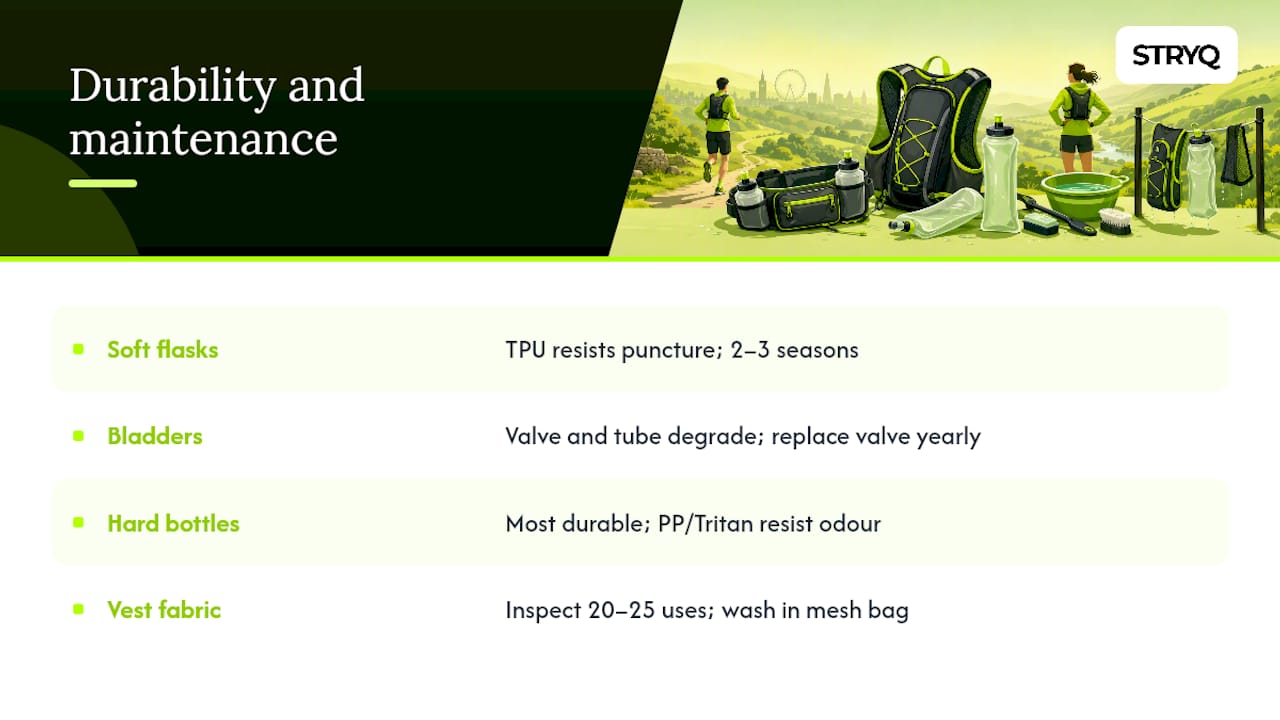
Soft flasks are the most durable in everyday use. The TPU material resists puncture, and the wide opening means thorough cleaning is straightforward. With regular washing and air-drying, a quality soft flask lasts two to three seasons of weekly use.
Bladders are more vulnerable. The reservoir itself is robust, but the bite valve and tube degrade faster, particularly if sugary drinks are used regularly. Replace the bite valve annually if you use a bladder frequently.
Hard bottles are the most durable of the three but the least packable. Polypropylene and Tritan plastic resist cracking and retain no odour if cleaned promptly. They are a good secondary option for a belt or as a backup in a vest rear pocket.
Vest fabrics and mesh panels wear at contact points: shoulder straps and the sternum buckle area. Inspect these after every 20–25 uses and wash the vest in a mesh laundry bag on a gentle cycle to extend its life.
What most runners get wrong about hydration kit
Most runners buy too much capacity for their typical run. A 10 L vest for a runner doing mostly road marathons with aid stations every 5 km is unnecessary weight and unnecessary complexity. The right kit is the lightest setup that covers your actual route and resupply plan.
The second common mistake is skipping the fit test. A vest that bounces for 26 miles is not a vest problem; it is a fit problem. Every vest needs to be tested loaded, not just tried on empty in a shop.
The third: treating hydration kit as a one-size-fits-all purchase. A belt that works perfectly for a 10K will frustrate you on a three-hour trail run. Match the kit to the specific run type, not to a vague sense of what you might do one day.
Stryq: kit built for UK runners
Stryq offers a direct route from this article to the right kit. The hydration vest, running belt, and soft flasks are each developed through multiple rounds of real-world testing and runner feedback, with strict quality control before anything reaches the store.
For short runs and Parkrun, the Stryq running belt gives you phone storage, flask capacity, and a no-bounce fit without the weight of a vest. For marathon training and trail events, the Stryq hydration vest with two 500 ml soft flasks covers most UK runners’ needs from a 10K to a fell race. The full range, including running socks designed for the same training demands, is available at Stryq. Browse the range and order directly with full customer support behind every purchase.
Sources
- The Best Ways to Carry Fluids on a Run
- How to stay hydrated during the long run
- How to choose the right running vest or backpack
- Hydration pack vs. running vest vs. running belt: A factory insider’s guide