

What is an easy run? Pacing, effort and benefits
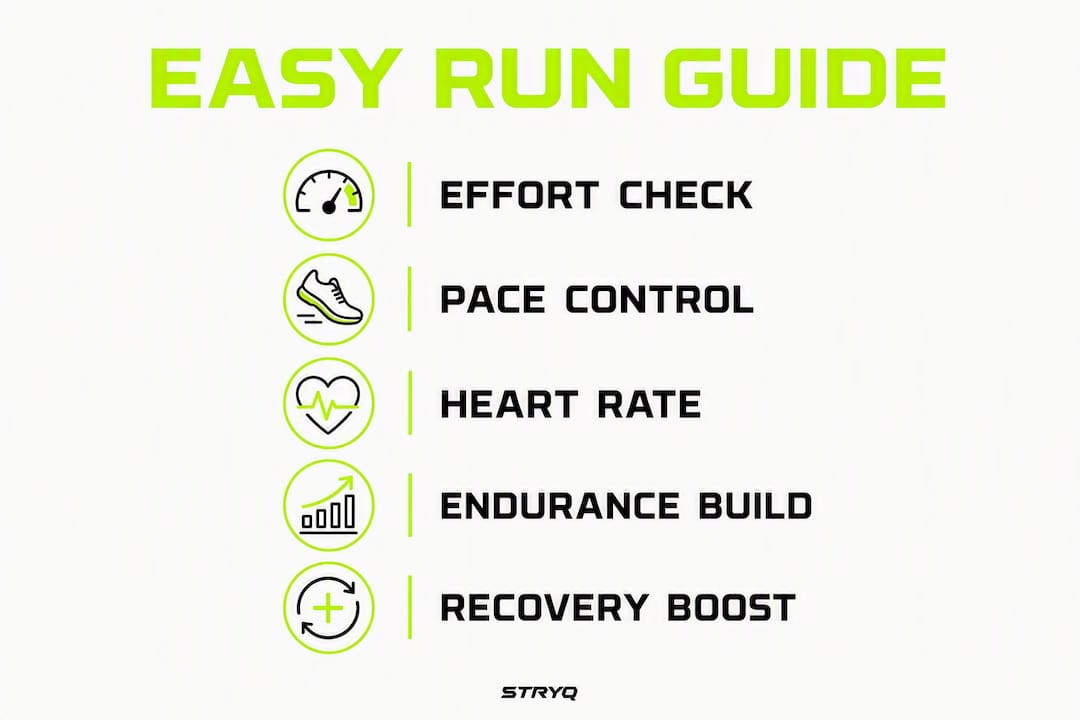
An easy run is a low-intensity, aerobic run designed to build fitness and support recovery. You can check your effort with three quick metrics right now: a Rating of Perceived Exertion (RPE) of 2–4 out of 10 and the ability to speak in full, comfortable sentences (the talk test). If you can tick these, you are running easy. Stryq’s coaching contributor Martin uses exactly these markers with recreational runners before introducing any other tool.
- RPE 2–4/10: effort feels light to moderate; breathing is controlled
- Talk test: you can hold a full conversation without pausing for breath
- Duration: most easy sessions last a moderate amount of time; very short runs limit the training effect for most runners
Table of Contents
- What does an easy run actually do for your body?
- How do you judge the right effort on an easy run?
- What pace should an easy run feel like?
- What are the benefits of running easy?
- Easy run vs recovery run: what is the difference?
- How long should easy runs be, and how often?
- Why do easy runs end up too fast, and how do you fix it?
- Practical tips for keeping an easy run genuinely easy
- Stryq coach checklist: how to run an effective easy session
- Key takeaways
- The case for running slower than you think you should
- Gear that makes easy runs more comfortable
- Useful sources
What does an easy run actually do for your body?
The physiology is straightforward. Easy runs are the primary mechanism for increasing capillary density and mitochondrial efficiency in slow-twitch muscle fibres. In plain terms: your muscles grow better at delivering and using oxygen, and they do it without the structural stress that harder sessions create.
Three adaptations drive most of the long-term benefit:
- Capillary density: more blood vessels reach working muscle, improving oxygen delivery
- Mitochondrial efficiency: the energy-producing structures inside muscle cells multiply and work more effectively
- Cardiac stroke volume: the heart pumps more blood per beat, raising aerobic ceiling over time
What makes easy running particularly useful is the cost-to-benefit ratio. Easy mileage protects the nervous system and connective tissue while progressively increasing aerobic capacity. Hours accumulate, adaptations compound, and the body absorbs hard training sessions more effectively as a result. A 45-minute easy run on Tuesday makes Thursday’s interval session land better, not worse.
The key word is accumulated. One easy run does relatively little. Consistent easy running across weeks and months is where the aerobic base actually forms.
How do you judge the right effort on an easy run?
Three methods work. Use them in this order: talk test first, RPE second, heart rate as a guardrail.

The talk test
Speak a full sentence mid-run. If you can do it without pausing for breath, you are at easy effort. The talk test remains the cleanest field tool for separating conversational easy running from harder efforts, and it requires no device. If only short phrases come out, you are above easy effort. Slow down.
RPE 2–4
A genuinely easy pace corresponds to an RPE of around 2–4 and a heart rate around 60–75% of maximum, though individual variation is significant. At RPE 2–4, the run feels comfortable, breathing is rhythmic, and you finish feeling like you could have continued. If you finish feeling depleted, the effort was too high.

Heart rate (Zone 2)
Zone 2 sits at roughly 60–75% of your maximum heart rate (HRmax) or heart rate reserve (HRR). It is a useful guardrail on longer runs, particularly in heat or when fatigue is a factor. That said, wrist-based optical sensors can read 10–15 beats per minute high during faster cadences, so treat the number as a guide rather than a verdict.
Pro Tip: When your watch pace and your talk test disagree, trust the talk test. Pace varies with hills, heat, wind, and fatigue. Perceived effort does not lie in the same way. A blended approach works best: talk test first, RPE second, heart rate as a guardrail, and pace as a record of what happened.
What pace should an easy run feel like?
Pace is the output of effort, not the target. That said, approximate ranges help runners calibrate.
These are illustrative ranges only. Your easy pace on a flat, cool morning will differ from the same run on a hilly route in July. Major modifiers include:
- Hills: add 30–60 seconds per mile equivalent effort on climbs; slow down, do not push
- Heat and humidity: cardiac drift pushes heart rate up even at identical pace; start slower
- Fatigue: the day after a hard session, easy pace will naturally be slower
- Terrain: trail and grass surfaces add effort relative to road at the same pace
If your pace conflicts with the talk test, the talk test wins. Slow down until full sentences come easily, regardless of what the watch says.
What are the benefits of running easy?
Short easy runs build aerobic fitness, reduce injury risk, and let runners add volume without high recovery cost; for related strength and movement tips, see the Grip strength blog. The benefits stack across four areas:
- Aerobic base: consistent easy mileage raises the ceiling for all other training; faster paces become more sustainable as the aerobic engine grows
- Recovery: easy running increases blood flow to muscles without adding significant stress, accelerating repair after hard sessions
- Injury prevention: low-impact accumulation strengthens tendons, ligaments, and connective tissue progressively; well-executed easy runs are one of the simplest and most powerful injury-prevention tools available to recreational runners
- Volume without stress: easy runs allow weekly mileage to grow without the recovery debt that comes from adding more hard sessions
The structural point is this: easy days exist to make hard days work. A runner who turns every session into a moderate effort ends up with no true recovery and no true quality. The performance penalty for replacing planned low-intensity volume with moderate running is well documented in training intensity distribution research. For injury prevention guidance that complements easy running, Stryq’s complete guide covers the full picture.
Easy run vs recovery run: what is the difference?
Runners use the terms interchangeably, but they describe different ends of the same spectrum.
- Easy run: — sits above recovery effort. Duration 30–75 minutes, RPE 2–4, producing a genuine aerobic training stimulus alongside recovery.
Two scenarios to guide the choice:
The practical test: if you are asking whether you should go easier, the answer is almost always yes.
How long should easy runs be, and how often?
Duration range: 30–75 minutes. Very short runs may produce limited aerobic adaptation for most trained runners, though they remain worthwhile for beginners or on days when time is genuinely short. Longer runs begin to function as long runs, with different recovery demands. For absolute beginners, Stryq’s first week running guide covers how to build safely from the start.
Sample weekly placements by runner type
| Runner profile | Days per week | Easy run placement |
|---|---|---|
| Beginner (3 days) | 3 | All three sessions are easy runs, 20–35 min each |
| Recreational (4–5 days) | 4–5 | 2–3 easy runs; 1 tempo or intervals; 1 long run |
| Club / advanced (5–6 days) | 5–6 | 3–4 easy runs; 1–2 quality sessions; 1 long run |
Three practical notes on frequency and progression:
- Increase total easy mileage by no more than 10% per week to reduce injury risk.
- Place easy runs on the days before and after hard sessions to protect quality and recovery.
- Advanced runners sometimes run twice in a day (“doubles”), with both sessions at easy effort. This is an effective way to add volume without extending any single session into long-run territory.
Why do easy runs end up too fast, and how do you fix it?
Many recreational runners run their easy runs too fast. Elite programmes typically spend around 80% of training time at low intensity. Most recreational runners invert this without realising it.
The five most common mistakes, and a direct fix for each:
- Watch obsession: staring at pace per mile and chasing a number. Fix: hide the pace screen; display only heart rate or elapsed time.
- Social pressure: running with a group that is faster than your easy pace. Fix: communicate your effort target before the run, or run solo on easy days.
- Poor pacing after hard sessions: starting the next day at the same pace as yesterday’s workout. Fix: add 60–90 seconds per mile to your hard-session pace as a starting point for easy days.
- Ignoring fatigue signals: pushing through tiredness because the plan says “easy run.” Fix: treat fatigue as data; a genuinely easy run on tired legs may feel harder than RPE 4 at any pace.
- Confusing easy with steady: steady-state running (RPE 5–6) feels comfortable but is not easy. Fix: apply the talk test; if full sentences require effort, you are in steady territory.
For a broader look at pacing errors, Stryq’s guide to common running mistakes covers the full range.
Pro Tip: Log perceived effort (RPE and talk test result) after every run, not just pace. After four weeks, patterns become clear: you will see exactly which sessions drifted above easy effort and on which days.
Practical tips for keeping an easy run genuinely easy
A few on-the-day habits make a real difference.
- Start 20–30 seconds per mile slower than you think you need to. The first kilometre always feels easier than it is.
- Choose flat or gently rolling routes on easy days. Hills force effort up regardless of intention.
- On hot days, move the run to early morning or evening and reduce duration by 10–15 minutes.
- Walk breaks are not failure. On recovery days or in heat, a 60-second walk every 10 minutes keeps effort honest.
For group runs:
- Agree the effort level before you start, not the pace.
- If the group is running faster than your talk test allows, drop back or finish early.
- Use a group easy run as a social run, not a training benchmark.
A short pre-run checklist:
- Hydrate before you leave (200–400ml water in the 30 minutes prior).
- Set your watch to display RPE or heart rate, not pace.
- Confirm your route is appropriate for easy effort (flat or gentle terrain).
- Remind yourself: the goal is to finish feeling like you could have continued.
For form tips that reduce unnecessary effort, Stryq’s guide on how to run without bouncing is worth a read before your next session.
Stryq coach checklist: how to run an effective easy session
Use this before and during every easy run. Contributed by Martin, coaching contributor at Stryq.
Before you start
- Check fatigue level. If RPE at rest feels above 3, consider a recovery run instead.
- Set your watch to heart rate or elapsed time. Hide pace.
- Plan a flat or low-gradient route.
- Carry water for any run over 45 minutes (a soft flask in a lightweight running belt works well for this).
- Wear socks with adequate cushioning and moisture management; blisters on easy days are avoidable.
During the run
- Start slower than feels necessary for the first 5 minutes.
- Apply the talk test at 10 minutes. Speak a full sentence aloud. If you cannot, slow down.
- Check RPE at the halfway point. Target: 2–4. Above 4, reduce pace.
- If heart rate drifts upward on a longer run, consider heat, hydration, stress, and sensor fit before altering training. Start slower next time and let HR settle naturally.
- Walk for 60–90 seconds if effort climbs above RPE 4 on a hill or in heat.
After the run
- Log RPE and talk test result alongside distance and time.
- Note how you felt at finish: “could have continued” is the target outcome.
- Gear check: replace worn socks promptly; cushioning loss is a common contributor to foot fatigue on easy days.
Key takeaways
Easy runs work because consistent low-intensity aerobic volume builds the capillary density, mitochondrial efficiency, and connective tissue resilience that make every other session more effective.
| Point | Details |
|---|---|
| Effort beats pace | Use the talk test and RPE 2–4; if full sentences require effort, slow down regardless of pace. |
| Duration range | 30–75 minutes covers most easy sessions; under 30 limits adaptation, over 75 becomes a long run. |
| Weekly placement | Place easy runs before and after hard sessions; most recreational runners need 2–3 per week. |
| Easy vs recovery | Recovery runs (20–45 min, RPE 1–2) follow hard sessions; easy runs (30–75 min, RPE 2–4) fill standard training days. |
| Stryq gear note | Stryq running socks with arch support and cushioning reduce foot fatigue on easy days without adding weight or bulk. |
The case for running slower than you think you should
Most recreational runners I work with arrive with the same problem: their easy days are not easy. They are moderate. And moderate running is the training zone that gives you the fatigue of hard running without the adaptation of it.
The research on training intensity distribution is consistent. Elite programmes cluster the majority of volume at genuinely low intensity, then spike briefly into high intensity for quality sessions. The middle ground, that comfortable-but-not-easy pace that feels productive, tends to blunt both ends. It is too hard to allow full recovery and too easy to drive meaningful high-intensity adaptation.
The runners who resist slowing down usually cite two things: it feels too slow to be useful, and they worry what other runners will think. Both concerns dissolve once the quality sessions start improving. When Thursday’s intervals feel sharper because Tuesday’s easy run was actually easy, the logic becomes self-evident.
Log effort, not just pace. Four weeks of honest RPE notes will show you more about your training than a year of pace data alone.
Gear that makes easy runs more comfortable
The right kit does not make an easy run faster. It makes it more comfortable, which means you actually do it consistently.

Stryq’s running socks are built specifically for the demands of everyday training runs. The Stryq Running Socks in Black and Stryq Running Socks in White both feature arch support, targeted cushioning, and moisture-wicking construction that reduces blister risk on longer easy sessions. For runs over 45 minutes, a lightweight running belt with a soft flask keeps hydration accessible without bounce or bulk. Gear is optional, but worn-out socks and dehydration are two of the most common reasons easy runs feel harder than they should. Browse the full range at stryq.co.uk and pick up what you actually need.
Useful sources
- The Science of Easy Runs, RunningFront — physiological detail on capillary density, mitochondrial adaptation, and how easy mileage accumulates training effect
- You’re Probably Running Your Easy Run Too Fast, Six Minute Mile — coach and research-backed explanation of why recreational runners drift above easy effort and the performance cost
- How to Find Your Easy Run Pace: Practical Guide, Next Gait — practical hierarchy for combining RPE, talk test, heart rate, and pace
- Find Your Ideal Easy Running Pace, Women’s Health UK — elite coach guidance on the talk test and effort-based pacing
- Discover the Benefits of Short Easy Runs, Realbuzz / Runna — accessible summary of training and health benefits of short easy runs
- Embracing Easy Runs, Great Run — practical training advice from one of the UK’s leading running event organisations
- How to Start Running Safely for Beginners, Cleveland Clinic — medically reviewed beginner guidance on building a running programme safely