A good running pace is the speed at which you run efficiently, comfortably, and in line with your specific goal, whether that is finishing a 5K or completing a marathon. The industry term for this concept is “training pace,” and it is always relative, not fixed. Average running pace globally sits at 5:49 per kilometre for men and 6:32 per kilometre for women in 2026, with the typical run covering 7.7km in just over 46 minutes. Those numbers are a useful reference point, but your ideal pace depends on your fitness level, age, goals, and the type of run you are doing. Understanding this distinction is the first step to training smarter.
What is a good running pace by age, gender, and experience?
Pace benchmarks give you a realistic picture of where you stand. Recreational 5K times average 30–35 minutes for most runners, while competitive runners in the top 25% finish under 20–25 minutes. Marathon averages sit at 4:21–4:32 hours across the general running population.
Age plays a significant role. Runners in the 20–29 age group tend to run 20–25% faster than the overall average. Performance declines gradually through the 30s and 40s, then more noticeably from the 50s onwards. This does not mean older runners cannot be fast. It means age-graded comparisons give a more honest measure of personal performance than raw times alone.

Experience creates the widest gap of all. A first-time runner completing a 5K in 40 minutes is performing well for their stage. A club runner targeting the same distance in 22 minutes is working at a completely different physiological level. Neither pace is wrong. Both are good relative to the runner’s context.
The table below gives a practical reference for common distances:
| Distance | Recreational average | Competitive top 25% |
|---|---|---|
| 5K | 30–35 minutes | Under 20–25 minutes |
| 10K | 60–70 minutes | Under 45–50 minutes |
| Half marathon | 2:15–2:30 hours | Under 1:45 hours |
| Marathon | 4:21–4:32 hours | Under 3:30 hours |
These figures reflect broad population data. Use them as orientation, not as targets that define your worth as a runner.
How to determine your optimal training pace
The most reliable way to find your optimal running speed is to train by effort, not by GPS numbers alone. Two methods stand out: the Rate of Perceived Exertion scale (RPE) and the Talk Test.
RPE runs from 1 to 10. An easy run sits at RPE 3–4, where breathing is controlled and conversation flows freely. A tempo run sits at RPE 6–7, where you can speak in short sentences but not comfortably chat. Intervals and hard efforts push to RPE 8–9, where speaking more than a few words becomes difficult. Matching your pace to the correct RPE zone is more useful than chasing a specific minute-per-kilometre figure.
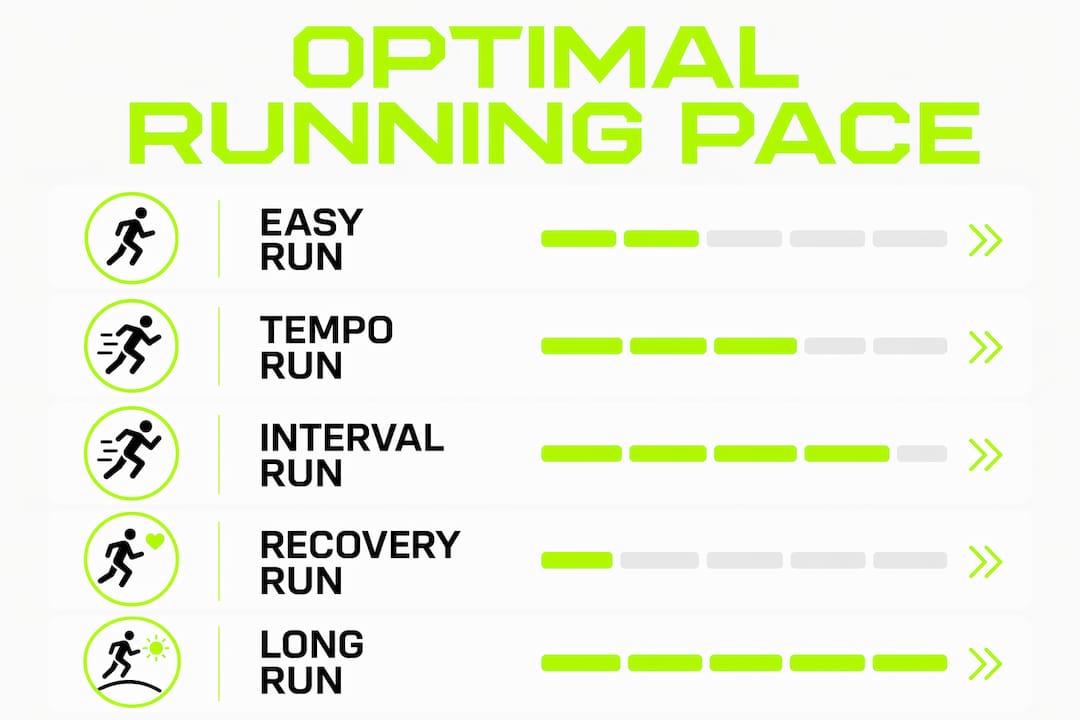
The Talk Test is even simpler. If you can hold a full conversation without gasping, you are in the aerobic zone. This is where easy training pace sits, typically 60–90 seconds per mile slower than your race pace. Running faster than this on easy days pushes you above your aerobic threshold and slows long-term endurance gains.
Key principles for finding your training pace:
- Easy runs should feel genuinely comfortable, not just manageable.
- Tempo runs should feel “comfortably hard,” sustainable for 20–40 minutes.
- Interval sessions are short, hard efforts with full recovery between reps.
- Race pace is the fastest sustainable effort for a specific distance.
75% of weekly mileage should be run at easy, conversational pace. This builds mitochondrial density and capillary growth, which are the physiological foundations of faster running over time. Running hard every day does not accelerate this process. It increases injury risk and leads to burnout.
Pro Tip: If you finish an easy run feeling like you could have gone much further, you have nailed the effort. If you finish feeling relieved it is over, you ran too hard.
How to find a good pace for beginners
New runners consistently make the same mistake: they run too fast, too soon. The result is gasping, discouragement, and often giving up within the first few weeks. The fix is straightforward.
- Start with duration, not distance. Run for 20–30 minutes without worrying about how far you cover. Distance and pace will improve naturally.
- Use the Talk Test from day one. If you cannot speak in full sentences, slow down. There is no shame in slowing to a walk. Many experienced runners use run-walk intervals throughout their training.
- Shorten your stride. Tiny, quick steps reduce impact forces and make running feel more sustainable. Overstriding is one of the most common beginner errors and it wastes energy.
- Expect natural improvement. Aerobic adaptation takes weeks to months. Your pace will improve without you specifically targeting it, as long as you run consistently.
- Resist comparing your pace to others. A beginner running 8:00 per kilometre is building the same aerobic base as an experienced runner doing 5:00 per kilometre. The process is identical; only the starting point differs.
Beginners benefit most from building consistency and duration rather than chasing speed. Speed is a secondary outcome. It arrives on its own when the aerobic base is solid. For more structured guidance, the beginner running tips on the Stryq blog cover pacing, motivation, and training structure in practical detail.
Pro Tip: Set your watch to show elapsed time rather than pace per kilometre for your first month. It removes the temptation to speed up and keeps your focus on effort.
How does terrain and conditions affect running pace?
Pace is not a fixed number. It shifts every time you lace up, depending on conditions you cannot always control.
- Heat and humidity slow pace significantly. Running in 25°C heat can add 30–60 seconds per kilometre compared to running in 10°C conditions, even at the same effort level.
- Elevation gain reduces pace on uphills and can boost it on descents, but net elevation always adds time to overall pace.
- Fatigue and sleep affect output more than most runners realise. A poor night’s sleep can make your easy pace feel like a tempo effort.
- Wind resistance adds measurable effort, particularly on exposed routes.
RPE is the preferred method for managing pace on variable days precisely because it accounts for these factors automatically. Your GPS does not know you slept badly or that there is a headwind. Your body does. On a tough day, easy run pace can legitimately vary by 60–90 seconds per mile without any loss of training quality. Accepting this variability is a sign of experience, not weakness.
Individual physiology also matters. Some runners are naturally predisposed to speed, with a higher proportion of fast-twitch muscle fibres. Others are built for endurance. A pace that feels easy for one runner can feel hard for another at the same fitness level. Tools like the McMillan Running calculator help account for this by generating personalised pace zones from a recent race result.
What does a good pace mean for different running goals?
A good pace for running is always goal-dependent. The same runner needs four different paces across a typical training week.
| Pace type | Effort level | Purpose |
|---|---|---|
| Easy / base run | RPE 3–4, conversational | Aerobic development, recovery |
| Tempo run | RPE 6–7, comfortably hard | Lactate threshold improvement |
| Interval / speed | RPE 8–9, very hard | VO2 max and speed development |
| Race pace | RPE 7–8, sustained effort | Race-specific conditioning |
Pacing strategy differs by distance. A 5K allows a fast, aggressive start because the distance is short enough to sustain high effort. A 10K demands more restraint in the first half. A marathon requires conservative early pacing above all else. Runners who go out too fast in a marathon almost always pay for it after the 30km mark.
The most common race-day mistake is treating race pace as a fixed target regardless of conditions. A good race pace is the fastest effort you can sustain to the finish line on that specific day. Some days that is a personal best. Other days it is not, and that is a legitimate outcome.
Key takeaways
A good running pace is always personal, goal-specific, and effort-driven, not a single number that applies to every runner or every run.
| Point | Details |
|---|---|
| Average pace benchmarks | Global averages are 5:49/km for men and 6:32/km for women, useful as reference only. |
| Easy pace rule | Run 60–90 seconds per mile slower than race pace for most training runs. |
| 75% easy mileage | Three-quarters of weekly running should be at conversational, low-effort pace. |
| Beginners: effort first | Focus on duration and consistency; speed develops naturally with aerobic adaptation. |
| RPE over GPS | Rate of Perceived Exertion adapts to conditions; GPS pace does not. |
Why I stopped chasing pace numbers and started running better
For years I treated my GPS watch as the authority on whether a run was good or not. If the pace was slower than expected, the run felt like a failure, even if I had run hills, fought a headwind, or simply had a hard week. That mindset is counterproductive and, frankly, exhausting.
The shift came when I started using RPE consistently. Suddenly, a run in 28°C heat at 6:30/km felt exactly as hard as a run in 12°C at 5:50/km. Because it was. The effort was the same. The GPS just did not know that.
What I have found is that runners who fixate on pace numbers tend to run their easy days too hard and their hard days not hard enough. The result is a grey zone where you are always moderately tired but never actually adapting. Polarised training, where easy is genuinely easy and hard is genuinely hard, produces far better results.
Patience is the other piece. Aerobic fitness builds slowly. A runner who commits to three or four consistent runs per week for six months will see pace improvements that feel almost effortless, because the underlying physiology has changed. Chasing pace in week two of training does not accelerate that process. It just makes the runs miserable.
Run by feel. Trust the process. The pace will come.
— martin
Gear that keeps up with your pace
Comfort and practicality matter more than most runners expect when it comes to sustaining a good training pace. Carrying your phone awkwardly, overheating, or losing hydration focus all pull your attention away from effort and form.

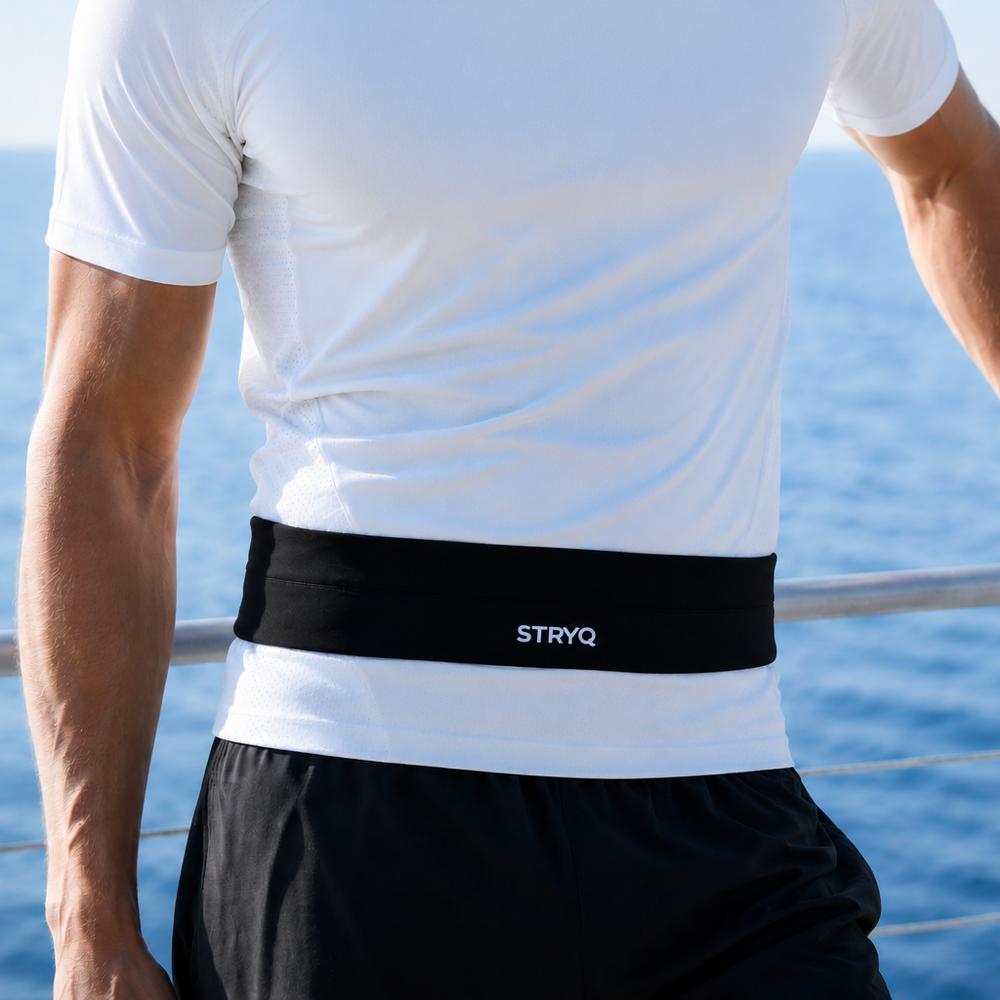
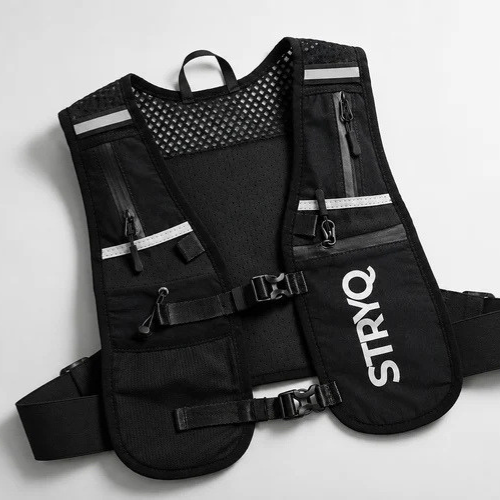
Stryq builds gear specifically for everyday runners who want practical solutions without unnecessary bulk. The no-bounce running belts keep your phone and essentials secure without shifting during faster efforts. The lightweight hydration vests distribute weight evenly so you can focus on pace rather than kit management. Every product goes through extensive real-world testing before launch, because gear that fails mid-run is gear that does not belong in your kit bag. Browse the full running accessories range to find what fits your training.
FAQ
What is a good running pace for a beginner?
A good pace for a beginner is any speed at which you can hold a full conversation without gasping. Most beginners run between 7:00 and 9:00 per kilometre, and that is entirely appropriate for building an aerobic base.
What is considered a fast running pace?
A fast running pace for recreational runners is generally sub-5:00 per kilometre, which equates to finishing a 5K in under 25 minutes. Competitive club runners typically target sub-4:00 per kilometre for 5K efforts.
How do I find my optimal running pace?
Use the Talk Test or RPE scale to identify your effort level. Your easy pace should sit at RPE 3–4, where conversation is comfortable, typically 60–90 seconds per mile slower than your current race pace.
Does running pace change with age?
Yes. Runners in the 20–29 age group average 20–25% faster than the overall population average. Pace naturally slows with age, but age-graded performance tables allow fair comparison across different age groups.
What is a slow running pace?
A slow running pace is generally anything above 7:00 per kilometre for experienced runners, though for beginners this range is perfectly normal and productive. Slow easy running builds the aerobic base that supports faster racing.