

Your complete guide to running a 10K
A 10K is a road running race covering exactly 10 kilometres, or 6.2 miles. It is one of the most popular race distances in the world. It sits comfortably between the 5K and the half marathon, long enough to feel like a genuine achievement and short enough to train for in eight weeks.
Three things to know before you read further:
- Most beginners need 8–12 weeks of consistent training to finish a 10K comfortably.
- Race logistics typically include packet pickup the day before, wave starts by estimated finish time, and chip timing for an accurate personal result.
- On race day, you need running shoes, moisture-wicking socks, a bib, and a simple hydration plan.
The training plan is in Section 4. The race-day checklist is in Section 5.
Key takeaways
A 10K covers 6.2 miles and most beginners can prepare to finish one comfortably with eight weeks of consistent training at three to four sessions per week.
| Point | Details |
|---|---|
| Distance and commitment | A 10K is 10 km (6.2 miles); plan for 8 weeks of training at 3–4 runs per week. |
| Race logistics | Arrive 60–75 minutes before your wave; collect your bib at packet pickup with photo ID. |
| Pacing strategy | Start conservatively and aim for a negative split; chip time is your personal result. |
| Kit essentials | Test shoes and socks in training; never race in kit worn for the first time on race day. |
| Stryq socks | Stryq Running Socks (black and white) offer arch support, cushioning, and moisture control for training and race day. |
Table of Contents
- What exactly is a 10K race?
- What to expect from race-day logistics
- How to train for a 10K: an 8-week beginner plan
- Your race-day checklist and pacing tips
- Notable 10K events worth knowing about
- How to register and what entry typically costs
- Typical finish times and how to set a realistic pace goal
- Gear that actually makes a difference for a 10K
- Why the 10K is worth taking seriously
- Stryq kit for training and race day
- Sources
What exactly is a 10K race?
A 10K run is a road running competition covering 10 kilometres (6.2 miles). The “K” stands for kilometre, a metric unit of distance. That is the full definition, and it matters because the 10K road race is a distinct event from the 10,000 metres track race, even though the distance is identical.
The differences between road and track are significant in practice. A track 10,000m is run on a 400-metre oval, typically by competitive club or elite athletes, with tight tactical pacing and no crowd support mid-race. A road 10K winds through streets or parks, attracts recreational runners of every ability, and usually includes water stations, spectators, and a finish-line festival. The surface, atmosphere, and pacing strategy are entirely different.
Compared to a 5K, the 10K demands more endurance without requiring the specialist speed work of shorter distances. A 5K takes most beginners 30–45 minutes; a 10K typically takes 55–80 minutes for the same group. Training volume roughly doubles, but the intensity of individual sessions stays similar. Many runners move from 5K to 10K as their first step up in distance, and the jump is very manageable with a structured plan.
What to expect from race-day logistics
Most 10K races start between 7:00 AM and 9:00 AM. Early starts reduce heat exposure and allow organisers to clear road closures before midday traffic. Larger events stagger runners into waves, released every few minutes, to prevent bottlenecks at the start and on narrow course sections.
Packet pickup and bib collection
- Most races offer pickup the day before the event at a designated expo or race HQ.
- Some smaller events allow same-day pickup, but this is becoming less common at large city races.
- Bring photo ID and your registration confirmation (printed or on your phone).
- Bibs are usually non-transferable; check the race rules before lending yours to anyone.
Chip timing
Your bib includes a timing chip, either embedded in the bib itself or attached as a separate tag to your shoe. This records your personal start and finish time. Gun time starts when the race officially begins; chip time starts when you cross the start mat. For most recreational runners, chip time is the meaningful number. The gap between the two can be several minutes in a large wave-start event.
Race-day timeline
- Arrive at the venue 60–75 minutes before your wave start.
- Use the first 20 minutes for bag drop and finding the correct start corral.
- Allow 15–20 minutes for a light warm-up jog and dynamic stretching.
- Move to your corral 10 minutes before your wave is called.
- After finishing, collect your medal, use the recovery area, and retrieve your bag before leaving.
The B.A.A. 10K publishes detailed race-week reminders covering start lists, packet pickup windows, and corral assignments. Checking the official race page in the week before your event is the single most reliable way to avoid surprises.
How to train for a 10K: an 8-week beginner plan
Three to four running days per week is the standard recommendation for beginner 10K training. Running every day increases injury risk without proportionally improving fitness; rest and cross-training days allow the body to adapt. Hal Higdon’s novice 10K programme uses three runs per week plus cross-training, an approach that has guided thousands of first-time 10K runners to the finish line.
The Active uses four running days: three easy runs and one long run, building the long run progressively before a taper. The 8-week version below follows the same structure, compressed for runners who can already cover 3–4 kilometres without stopping.
8-week sample beginner plan
- Week 1: Three easy runs of 3 km each; one long run of 4 km; one cross-training day (cycling, swimming, or walking).
- Week 2: Three easy runs of 3.5 km; long run 5 km; one cross-training day.
- Week 3: Three easy runs of 4 km; long run 6 km; one cross-training day.
- Week 4: Recovery week. Reduce all runs by 20%; long run 5 km. Let the body consolidate gains.
- Week 5: Three easy runs of 4 km; long run 7 km; one cross-training day.
- Week 6: Three easy runs of 4.5 km; long run 8 km; one cross-training day.
- Week 7: Three easy runs of 4 km; long run 9 km. This is peak week.
- Week 8 (taper): Two easy runs of 3 km; one short run of 2 km on Wednesday; rest Thursday and Friday; race day Saturday or Sunday.
Run easy sessions at a conversational pace — you should be able to speak in short sentences. If you cannot, slow down. Perceived exertion, not pace, is the right guide for beginners. Consistency across all eight weeks matters far more than any single fast session.
For injury prevention during training, increase weekly mileage by no more than 10% from one week to the next, and address any persistent niggles before they become injuries. Recognising early signs of overuse is one of the most important skills a new runner can develop; an athletic overuse injury guide can help you understand the warning signs before they sideline your training.
Pro Tip: If you can only complete one session in a given week, make it the long run. Endurance is the foundation of a 10K, and the long run builds it more effectively than any other session.
Your race-day checklist and pacing tips
The night before
- Lay out your full kit: bib, shoes, socks, shorts, vest or T-shirt, watch or phone.
- Check the weather forecast and add or remove a layer accordingly.
- Prepare your race-morning breakfast and set two alarms.
- Confirm your travel plan and parking or public transport options.
- Review the course map and note where water stations are located.
Race morning
- Eat a familiar, light breakfast 2–2.5 hours before your start time (porridge, toast, or a banana are common choices).
- Arrive at the venue 60–75 minutes early, as covered in the logistics section.
- Complete a 10–15 minute warm-up: 5 minutes of easy jogging followed by leg swings, hip circles, and a few short strides.
Pacing on the course
Start slower than you think you need to. The most common beginner mistake is going out too fast in the first kilometre, driven by crowd energy and adrenaline. Aim to run the second half of the race slightly faster than the first — a negative split — which almost always produces a better finish time and a stronger feeling at the line.
Walk through water stations if needed. Drinking while running is a skill; slowing to a walk for 15–20 seconds to take on fluid is far better than skipping hydration entirely.
Safety and medical considerations
- Know your own medical history. If you have a heart condition, asthma, or diabetes, carry relevant medication and inform a fellow runner or race marshal.
- In warm weather, prioritise hydration over pace. Heat exhaustion develops quickly in inexperienced runners.
- Most races have St John Ambulance or equivalent medical cover on course. Do not hesitate to stop and flag a marshal if you feel unwell.
Pro Tip: Pin your bib the night before and do a full kit check, including lacing your shoes. Race morning is not the time to discover a missing safety pin or a loose insole.
Notable 10K events worth knowing about
Large 10K events attract participant numbers in the tens of thousands, reflecting the distance’s broad appeal across ability levels. Here are several events that illustrate the range of what a 10K race can be.
-
Peachtree Road Race (Atlanta, Georgia): Held every 4th of July, Peachtree is one of the largest 10K races in the world by participant count. The course runs through Atlanta’s Buckhead and Midtown neighbourhoods, and the event has a strong charity and community identity built over more than five decades.
-
B.A.A. 10K (Boston, Massachusetts): Organised by the Boston Athletic Association, this race draws nearly 10,000 runners and features international representation. It follows a course through Boston’s historic streets and benefits from the B.A.A.'s well-established race infrastructure and communications. Full logistics are published on the official B.A.A. race page.
-
Cap10K (Austin, Texas): One of the largest 10Ks in Texas, the Cap10K is known for its festive atmosphere, live music, and strong community turnout. The Cap10K website publishes course maps, virtual tours, and finish-line festival details well in advance, making it a useful model for what good organiser communication looks like.
-
Vancouver Sun Run (British Columbia, Canada): A large community event that regularly draws tens of thousands of participants through downtown Vancouver. Wave starts are assigned by estimated finish time, and giving an accurate time at registration directly affects your start position and race experience.
-
Smaller community and charity 10Ks: Not every race needs to be a mass-participation event. Local charity 10Ks often have lower entry fees, more relaxed atmospheres, and personal touches that large city events cannot replicate. For a first 10K, a smaller local race can be a less stressful introduction to race-day logistics.
When choosing between events, consider the course profile and expected weather as primary factors. A hilly course in summer heat requires a different race plan than a flat urban route in cool conditions.
How to register and what entry typically costs
Step-by-step registration
- Create an account on the race’s official registration platform (commonly RunSignUp, Active.com, or the race’s own site).
- Select your estimated finish time or start wave during registration. Giving an accurate estimate places you in the correct corral and reduces congestion.
- Enter personal details, emergency contact, and any medical information the organiser requests.
- Pay the entry fee and save your confirmation email, which contains your bib number and race-week instructions.
Transfers, deferrals, and refunds
- Most large races allow bib transfers to another runner up to a set deadline, usually two to four weeks before race day.
- Deferrals (moving your entry to the following year) are offered by some events but not all. Check the policy before purchasing.
- Refunds are rare. Most races are non-refundable, so consider race insurance if your schedule is uncertain.
- Never sell or give your bib to an unregistered runner without completing an official transfer. Medical emergencies on course are handled using bib data; an incorrect name creates a serious safety risk.
Typical entry costs
Entry fees vary considerably. A local charity 10K might cost £15–£25. Mid-size city races typically range from £25–£45. Large flagship events with high demand, such as Peachtree or the B.A.A. 10K, can cost more and may use lottery systems for entry. Signing up early almost always secures a lower price; fees typically increase in tiers as race day approaches.
Typical finish times and how to set a realistic pace goal
Finish times for recreational runners cover a wide range. The table below gives common brackets and the corresponding per-kilometre pace, which you can use to set a realistic goal for your first race.
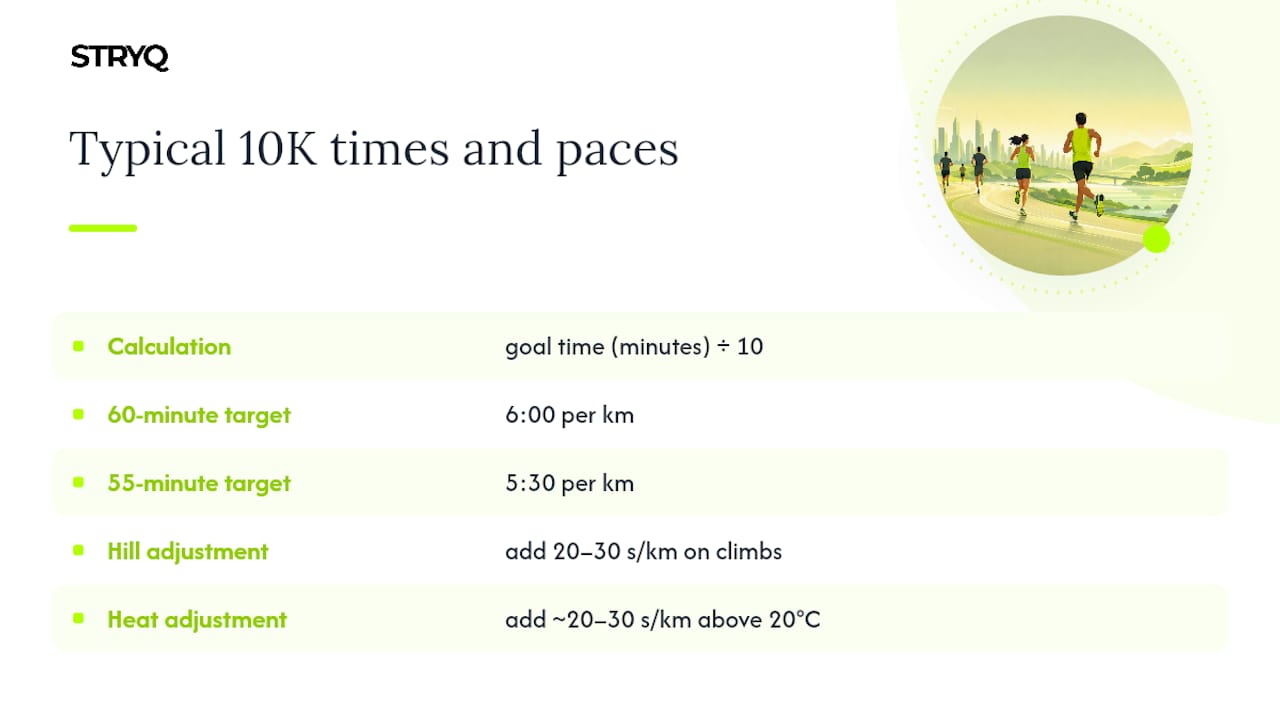
To calculate your target pace, divide your goal finish time (in minutes) by 10. A 60-minute target gives a pace of 6:00 per kilometre. A 55-minute target gives 5:30 per kilometre.
Adjust for course and conditions. A hilly course adds roughly 20–30 seconds per kilometre on climbs compared to a flat equivalent. Racing in temperatures above 20°C typically slows pace by a similar margin. Build these adjustments into your plan before race day rather than discovering them mid-race.
Gear that actually makes a difference for a 10K
The 10K runner gear checklist for race day is shorter than most runners expect. You do not need a hydration vest or a GPS watch with advanced metrics. What you do need is kit that fits correctly and has been tested in training.
Core kit
- Running shoes: Fit and comfort matter more than brand or price. Shoes should have been worn for at least four training runs before race day. Never race in new shoes.
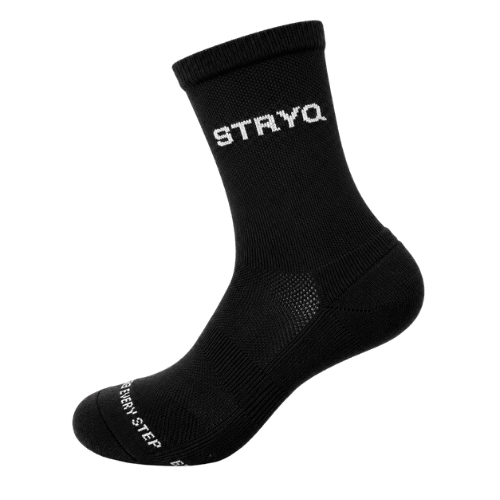
- Running socks: Socks are the most underestimated item in a runner’s kit bag. A poor-fitting sock causes blisters within the first few kilometres; a well-constructed performance sock with arch support and cushioning prevents them. Stryq Running Socks in black and white are built specifically for this: moisture-wicking fabric, targeted cushioning, and a secure fit that does not slip or bunch during a race.
- Shorts and vest or T-shirt: Lightweight, moisture-wicking fabric. Avoid cotton, which holds sweat and causes chafing over distance.
- Watch or phone: For pacing and split tracking. A basic GPS watch is useful but not required; a phone in a running belt works well.
Optional but useful
- Running belt: If you want to carry gels, a key, or a phone without holding it, a lightweight running belt with 360° storage keeps everything secure and bounce-free.
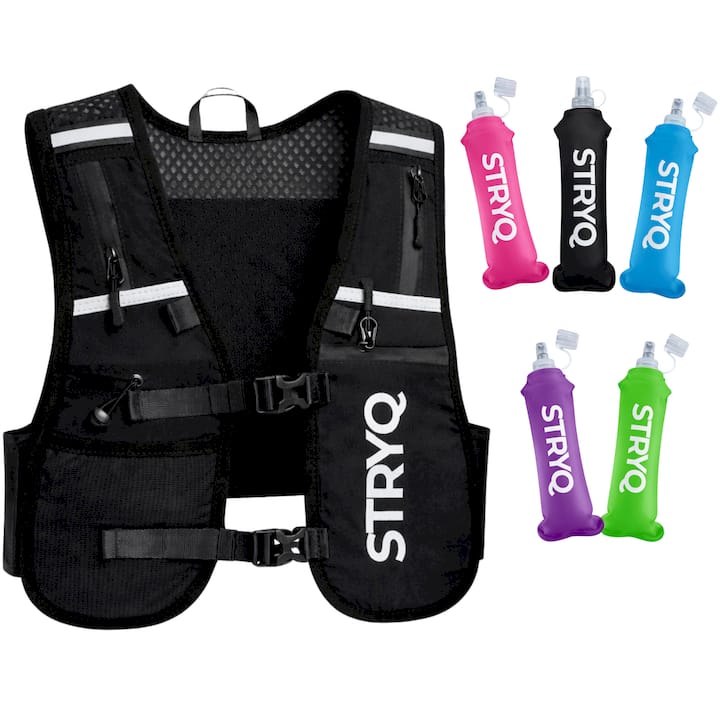
- Soft flask: For training long runs where water stations are not available, a compact soft flask fits neatly into a vest pocket or belt.
- Safety light: For early-morning or evening training runs in low light.
- Weather layer: A lightweight, packable jacket for cold or wet race mornings that can be discarded at the start if needed.
Pro Tip: Wear your race-day socks and shoes for at least three long training runs before the event. This is the only reliable way to identify friction points and confirm your kit is blister-free before it matters.
For a broader race-day accessories checklist, the same principles apply whether you are running 10K or 42K: test everything in advance, carry only what you need, and prioritise comfort over novelty.
Why the 10K is worth taking seriously
The 10K sits in an interesting position in the running world. It is long enough that you cannot bluff your way through on fitness alone, yet short enough that almost any adult who commits to eight weeks of consistent training can finish one. That combination is rarer than it sounds.
What most first-timers underestimate is how much the mental side of a 10K differs from a 5K. At 5K, the race is over before doubt has time to settle in. At 10K, there is a stretch around kilometres 6–8 where the finish is close enough to feel real but far enough that you have to make a decision about how hard to push. That moment is where the training pays off, not in the legs, but in the confidence that you have covered this distance before and you know what it feels like.
The advice to prioritise completion over time on a first attempt is not a consolation prize. It is the correct strategy. A runner who finishes their first 10K in 68 minutes with something left in reserve will almost certainly return for a second race. One who goes out too fast, suffers through the final two kilometres, and crosses the line exhausted may not. The 10K is a distance you can run many times, improving with each attempt, and that long-term relationship with the distance is worth protecting from the start.
Stryq kit for training and race day
Stryq’s performance running socks are the practical starting point for any 10K kit build. The black and white options share the same construction: arch support, targeted cushioning at the heel and forefoot, and a moisture-wicking fabric that keeps feet dry across the full 6.2 miles. Every product in the Stryq range goes through multiple sample revisions and real-world testing before it reaches a runner’s kit bag.

Beyond socks, the Stryq running belt handles phone, gels, and race essentials without bouncing, and the soft flask range covers hydration on training long runs where water stations are not an option. All products sit between budget marketplace options and expensive specialist brands, offering genuine quality at an accessible price point.
Browse the full Stryq running socks range to find the right fit for training and race day, or head to the running belts and soft flasks collections for everything else you need to line up prepared.
Sources
The following official pages and references were used throughout this guide and are worth bookmarking for registration, training, and event-specific details.
- 10K run
- Active
- Novice 10K Training Program | Hal Higdon
- B.A.A. 10K - Boston Athletic Association
- Home - Cap10K
- Runningusa