How Many Running Gels Do You Need for a Marathon or Half Marathon?
How many gels for a marathon? It sounds like a question that should have a simple answer. Five? Six? Eight?
The problem is that counting gels on their own tells you very little.
A runner finishing a marathon in three hours has a completely different fuelling window from somebody running for five and a half hours. Then you have to consider that one running gel might contain 22g of carbohydrate while another contains 30g or 45g. Add sports drinks, chews or other fuel into the equation and simply saying "take one gel every 30 minutes" stops making much sense.
The same applies when working out how many gels for a half marathon. A runner completing the race in around 90 minutes and someone running for three hours are covering the same 13.1 miles, but their fuelling requirements and opportunities are very different.
So instead of giving you an arbitrary number of gels, this guide will show you how to work it out properly.
We will look at carbohydrate per hour, carbohydrate per gel, expected finishing time and other sources of fuel. Then we'll run through some worked half-marathon and marathon examples so you can see how dramatically the number of gels can change.
Important: the calculations below are illustrative examples based on general sports-nutrition guidance. They are not personalised nutrition prescriptions. Your strategy should take account of your own tolerance, experience and any advice you have received from a qualified sports dietitian or healthcare professional.

How Many Gels Do You Need? The Quick Answer
There isn't one correct number.
For endurance exercise lasting around one to two and a half hours, established sports-nutrition guidance commonly recommends approximately 30g to 60g of carbohydrate per hour.
For events extending beyond roughly two and a half to three hours, higher carbohydrate intakes of up to around 90g per hour can be used, particularly when multiple carbohydrate sources are involved and the runner has trained to tolerate them.
That means the useful question isn't:
"How many gels should I take?"
It is:
"How much carbohydrate am I aiming to consume per hour, and how much carbohydrate does each of my gels contain?"
Once you know those two numbers, calculating how many gels you might need becomes much easier.
Why Counting Gels Can Be Misleading
Imagine two runners standing on the start line.
Both say they are planning to take two gels every hour.
Runner A is carrying gels containing 22g carbohydrate each.
Runner B is carrying gels containing 45g carbohydrate each.
Runner A is therefore consuming:
22g × 2 = 44g carbohydrate per hour.
Runner B is consuming:
45g × 2 = 90g carbohydrate per hour.
Same number of gels. More than double the carbohydrate.
This is exactly why copying another runner's gel schedule without knowing what they are actually taking can be useless.
How Much Carbohydrate Do Runners Need During a Race?
Carbohydrate recommendations generally increase with exercise duration.
| Approximate Exercise Duration | General Carbohydrate Guidance | What This Means for Running Gels |
|---|---|---|
| Under around 60 minutes | Carbohydrate during the run is generally unnecessary for most runners | A gel during a short race is unlikely to be necessary for most people |
| 1 to 2.5 hours | Approximately 30–60g carbohydrate per hour | Potentially one or more gels per hour depending on carbohydrate content and other fuel |
| Beyond roughly 2.5–3 hours | Higher intakes, potentially up to around 90g per hour where appropriate and tolerated | Higher-carb gels or a combination of gels, drinks and other fuel may make the target easier to reach |
These numbers are general sports-nutrition guidelines, not targets every runner should automatically chase.
Going from barely fuelling your long runs to attempting 90g of carbohydrate per hour on marathon day is not a clever strategy.
Your stomach needs to be part of the training process too.
The Simple Formula for Calculating Running Gels
Here is the basic calculation:
Target carbohydrate per hour ÷ carbohydrate per gel = gels required per hour.
Then:
Gels per hour × expected race duration = approximate total number of gels.
But there is another important step.
You need to subtract any carbohydrate you are getting from other sources.
If you are drinking a sports drink containing carbohydrate, eating chews or taking another form of fuel, that carbohydrate contributes towards the same hourly total.
A Simple Example
Imagine a runner wants approximately 60g carbohydrate per hour.
Their chosen gel contains 30g.
The maths is:
60 ÷ 30 = 2 gels per hour.
If the runner expects to race for four hours:
2 × 4 = 8 gels.
But if their sports drink already provides 30g carbohydrate each hour, they would only need another 30g from gels to reach the same illustrative 60g total.
That could reduce the requirement to one 30g gel per hour.
This is why you should calculate your whole fuelling plan rather than treating gels in isolation.
Different Gel Sizes Completely Change the Maths
This is particularly relevant now that manufacturers are producing gels with very different carbohydrate quantities.
Veloforte's current energy gel range, for example, includes 22g, 30g and 45g carbohydrate options.
The Veloforte Rosso gel provides 30g carbohydrate per packet.
The higher-carbohydrate Veloforte Limon gel provides 45g carbohydrate per packet.
That gives us an easy real-world example of how gel choice affects how many packets you need.
| Target Carbohydrate Per Hour | 22g Gel | 30g Rosso | 45g Limon |
|---|---|---|---|
| Approx. 30g/hour | About 1–2 gels | 1 gel | Would exceed 30g if taken as a full serving |
| Approx. 45g/hour | About 2 gels = 44g | 1.5 gels = 45g | 1 gel = 45g |
| Approx. 60g/hour | About 3 gels = 66g | 2 gels = 60g | Requires timing/combination across the hour rather than exactly matching 60g with whole packets |
| Approx. 90g/hour | About 4 gels = 88g | 3 gels = 90g | 2 gels = 90g |
This table is not telling you to consume 90g per hour.
It is showing why the carbohydrate number printed on the packet matters.
At the higher end of fuelling, two 45g gels provide the same 90g of carbohydrate as three 30g gels. Veloforte itself positions Limon as its higher-density option for runners deliberately following higher-carbohydrate strategies.
Fewer packets can also mean less to carry, fewer wrappers to open and less faffing around when you are tired.
How Many Gels for a Half Marathon?
The half marathon is where generic advice becomes particularly misleading.
A 90-minute half marathon and a three-hour half marathon are completely different fuelling scenarios.
The distance printed on the medal might be identical, but one runner is exercising for twice as long.
Do You Need Gels for a Half Marathon?
Many runners will choose to use carbohydrate during a half marathon, particularly when they expect to be running for longer than around an hour.
But the amount required can vary significantly.
A faster runner might only have a relatively short window where taking fuel makes sense.
A runner expecting to be on the course for two and a half or three hours has a much longer period to fuel.
Example 1: 90-Minute Half Marathon
Imagine Runner A expects to finish in approximately 1 hour 30 minutes.
For illustration, they decide through training that approximately 30g carbohydrate per hour works well for them.
Across 1.5 hours:
30g × 1.5 = 45g carbohydrate.
That could theoretically be provided by:
- Roughly two 22g gels = 44g.
- One 30g gel plus carbohydrate from another source.
- One 45g gel = 45g.
Again, this isn't saying a 90-minute half marathon runner must consume 45g.
It shows how expected finishing time and gel size affect the calculation.
Example 2: Two-Hour Half Marathon
Runner B expects to finish in approximately 2 hours.
During training they have successfully practised taking around 45g carbohydrate per hour.
The illustrative requirement becomes:
45g × 2 = 90g carbohydrate.
That could look like:
- Four 22g gels = 88g.
- Three 30g gels = 90g.
- Two 45g gels = 90g.
Same race. Very different number of packets depending on the product.
Example 3: 2 Hour 30 Minute Half Marathon
Now imagine Runner C expects to finish in 2 hours 30 minutes.
They have practised consuming approximately 50g carbohydrate per hour.
The calculation is:
50g × 2.5 = 125g carbohydrate across the race.
You are unlikely to hit exactly 125g using whole gel packets, and you do not need to obsess about making the number mathematically perfect.
You might combine gels with a carbohydrate drink, or use different gel sizes across the race.
The point is that Runner C's fuelling plan should not automatically be copied from Runner A simply because both are running a half marathon.
Half Marathon Gel Strategy at a Glance
| Example Finish Time | Illustrative Carb Rate | Approx. Total Carbohydrate | Example Using 30g Gels |
|---|---|---|---|
| 1:30 | 30g/hour | 45g | 1 gel plus another carbohydrate source, or adjust strategy |
| 2:00 | 45g/hour | 90g | 3 gels |
| 2:30 | 50g/hour | 125g | Approximately 4 gels plus another small carbohydrate source |
| 3:00 | 50g/hour | 150g | 5 gels |
These are examples to demonstrate the calculation, not individual nutrition prescriptions.
How Many Gels for a Marathon?
This is where the numbers start getting much bigger.
And it is also where carrying the wrong number of gels becomes a genuine race-day problem.
Marathon finish times vary enormously.
A runner aiming for three hours could finish, shower and be eating their post-race meal while another runner is still somewhere around mile 20.
So telling both runners to "take six marathon gels" makes no sense.
Example 1: Three-Hour Marathon
Runner A expects to finish in approximately 3 hours.
They have trained successfully with approximately 60g carbohydrate per hour.
The illustrative calculation is:
60g × 3 = 180g carbohydrate.
If all of that came from gels:
- 22g gels: roughly 8 gels = 176g.
- 30g gels: 6 gels = 180g.
- 45g gels: 4 gels = 180g.
Four packets versus eight is a substantial difference when you physically have to carry them.
But packet count alone should never determine your nutrition. If your stomach prefers smaller servings more frequently, the 22g approach may suit you better despite requiring more packets.
Example 2: Four-Hour Marathon
Runner B expects to finish in approximately 4 hours.
They have gradually practised a strategy providing approximately 60g carbohydrate per hour.
The calculation becomes:
60g × 4 = 240g carbohydrate.
If supplied entirely through gels:
- Approximately 11 × 22g gels = 242g.
- 8 × 30g gels = 240g.
- A combination of 45g gels and smaller servings could be used to reach roughly the same overall amount.
Eleven gels sounds like a lot because it is.
And this is exactly why many marathon runners use a mixture of gels and carbohydrate-containing drinks rather than trying to get every gram from gel packets.
Example 3: Four-and-a-Half-Hour Marathon
Runner C expects to finish in approximately 4 hours 30 minutes.
During training, they have found that around 60g of carbohydrate per hour works comfortably for them.
The illustrative calculation is:
60g × 4.5 = 270g carbohydrate.
If all of that carbohydrate came from gels, the packet count could look roughly like this:
- About 12 × 22g gels = 264g.
- 9 × 30g gels = 270g.
- 6 × 45g gels = 270g.
This is where higher-carbohydrate gels become particularly interesting from a practical point of view.
Twelve gels is a lot to carry, open and dispose of during a race. Six is obviously much easier.
But do not choose a 45g gel purely because it halves the number of packets.
If you have trained successfully taking smaller servings more frequently, changing your entire strategy on race day just to save pocket space would be a terrible trade-off.
Example 4: Five-Hour Marathon
Runner D expects to be running for approximately 5 hours.
Let's again use an illustrative target of 60g carbohydrate per hour because it makes the comparison easy to understand.
60g × 5 = 300g carbohydrate.
If supplied entirely by gels:
- About 14 × 22g gels = 308g.
- 10 × 30g gels = 300g.
- A combination equivalent to roughly 300g using higher-carbohydrate gels.
Fourteen gels is technically possible to carry.
Would we personally want fourteen sticky packets bouncing around our waist for five hours?
Not particularly.
This is where a mixed strategy starts making much more practical sense for many runners.
Some carbohydrate might come from gels. Some might come from a carbohydrate-containing drink. Depending on the runner and event, chews or other tested fuel might also contribute.
What matters is the total carbohydrate, not whether every gram came from a gel.
Example 5: Six-Hour Marathon
A runner expecting a six-hour marathon has twice the fuelling window of somebody expecting to finish in three hours.
That is why generic advice such as "take six gels for a marathon" is so poor.
Using the same illustrative 60g per hour:
60g × 6 = 360g carbohydrate.
If that came entirely from gels:
- About 16 to 17 × 22g gels.
- 12 × 30g gels = 360g.
- 8 × 45g gels = 360g.
Again, we are not recommending that every six-hour marathon runner should consume 360g of carbohydrate.
The example demonstrates something far more important:
finishing time completely changes the answer to "how many gels for a marathon?"
A runner who will be exercising for six hours needs to think about their race nutrition very differently from someone expecting to finish in three.
Marathon Gel Strategy by Finish Time
Putting those examples together makes the difference much easier to see.
| Example Marathon Time | Illustrative Carb Rate | Approx. Total Carbohydrate | Equivalent 30g Gels | Equivalent 45g Gels |
|---|---|---|---|---|
| 3:00 | 60g/hour | 180g | 6 | 4 |
| 4:00 | 60g/hour | 240g | 8 | Approx. 5–6* |
| 4:30 | 60g/hour | 270g | 9 | 6 |
| 5:00 | 60g/hour | 300g | 10 | Approx. 6–7* |
| 6:00 | 60g/hour | 360g | 12 | 8 |
*Whole 45g packets do not always divide neatly into a 60g-per-hour strategy. They may therefore be spaced differently or combined with other carbohydrate sources. These examples illustrate the maths rather than prescribing a fuelling plan.
This is also why products such as the 30g Veloforte Rosso and 45g Veloforte Limon can fit very differently into exactly the same race.
Look at grams of carbohydrate first. Count packets second.
What If You Are Also Drinking Carbohydrate?
This is one of the easiest mistakes to make when planning marathon nutrition.
If your sports drink contains carbohydrate, it counts.
Imagine you have successfully trained with an illustrative target of around 60g carbohydrate per hour.
Your drink provides 30g per hour.
You therefore only need another 30g from your other fuel to reach that particular total.
A 30g gel would provide it.
If you ignored the carbohydrate in the drink and added two 30g gels as well, you would actually be consuming:
30g drink + 60g gels = 90g carbohydrate per hour.
That is a completely different strategy.
Count everything.
- Running gels.
- Sports drinks.
- Energy chews.
- Bars or solid food.
- Any other carbohydrate-containing race nutrition.
Don't accidentally build one nutrition plan on paper and consume another one on the course.
When Should You Take Your First Marathon Gel?
Another common mistake is treating a running gel like emergency fuel.
Some runners wait until they feel their energy dropping before taking the first one.
By that point, they are already reacting to the problem rather than following the strategy they practised.
For a race where you intend to fuel regularly, your first gel will generally form part of an early and consistent fuelling plan rather than being saved until you feel exhausted.
The exact timing depends on your overall strategy, the amount of carbohydrate in the product, what you ate before the race and what you have successfully practised.
This is another reason a blanket instruction such as "take one every 30 minutes" isn't good enough.
Think in Time Rather Than Miles
For many runners, planning fuel by time is easier than planning it by distance.
Consider two marathon runners.
One covers 10K in 45 minutes.
Another covers it in 75 minutes.
If both take a gel every 10K, the second runner is going considerably longer between servings.
A time-based strategy connects much more naturally to carbohydrate-per-hour planning.
Should You Take a Gel Immediately Before the Start?
Some runners include carbohydrate shortly before racing. Others rely on their pre-race meal and begin their in-race nutrition after the start.
There isn't one rule everyone needs to follow.
If you are planning to take a gel shortly before the gun, practise that exact routine before long training runs.
Race morning is not the time to suddenly add another packet because everyone around you seems to be eating one.
Should You Use the Gels Handed Out at Marathon Aid Stations?
You can, but find out what they are before race day.
Most major races publish information about their aid stations, including which nutrition products will be available and approximately where they will be handed out.
Use that information while planning your training.
If your marathon supplies a particular gel and you want to rely on it, buy some beforehand and use it during your long runs.
Do not spend months training with one product and then switch to something completely unfamiliar at mile 18 because somebody hands it to you.
Different gels can vary in:
- Carbohydrate quantity.
- Carbohydrate sources.
- Caffeine.
- Texture.
- Flavour.
- Sodium.
- Serving size.
- Whether the manufacturer recommends water alongside it.
Your stomach does not care that the race organiser got a good sponsorship deal.
What Are the Best Gels for a Marathon?
The best gels for marathon running are not necessarily the gels with the highest carbohydrate number, the most expensive ingredients or the fanciest packaging.
The best option is one that:
- Provides a useful amount of carbohydrate for your strategy.
- Is easy for you to consume while running.
- Doesn't become unbearable after several servings.
- Agrees with your stomach.
- Fits practically into your race-day kit.
- Has been tested repeatedly during training.
Some runners prefer smaller servings more frequently.
Others like higher-carbohydrate products because they can carry fewer packets.
Some prefer thinner gels. Others like thicker gels or hydrogel textures.
There isn't a universal winner.
If you want to compare individual products rather than the overall strategy, read our separate guide to the best running gels in the UK. [ADD INTERNAL LINK TO BLOG 1 ONCE PUBLISHED]
That article compares Veloforte, SiS, HIGH5, Maurten, GU and TORQ in much more detail without turning this guide into another product comparison.
Where Veloforte's Different Gel Sizes Fit In
Veloforte is useful as an example because its current energy gel collection includes different carbohydrate quantities rather than forcing every runner into the same serving size.
Rosso provides 30g carbohydrate.
Limon provides 45g carbohydrate.
That means a runner could potentially choose a format based on the strategy they have trained with rather than simply counting identical packets.
Veloforte also has a dedicated marathon training hub covering marathon nutrition and preparation if you want to read more specifically about its approach.
How Should You Carry Marathon Gels?
Once you have done all the maths, you eventually arrive at a much more practical question:
Where are you actually putting all these gels?
If your strategy says you need six, eight or ten packets, trying to force everything into the tiny pocket in the back of your shorts probably isn't going to end well.
Shorts and Legging Pockets
If you only need a small number of gels and your running kit has secure pockets, this can be the simplest solution.
Test the pockets fully loaded.
Four gels might technically fit, but that doesn't mean they won't bounce, pull the fabric down or become irritating after ten miles.
Running Belt
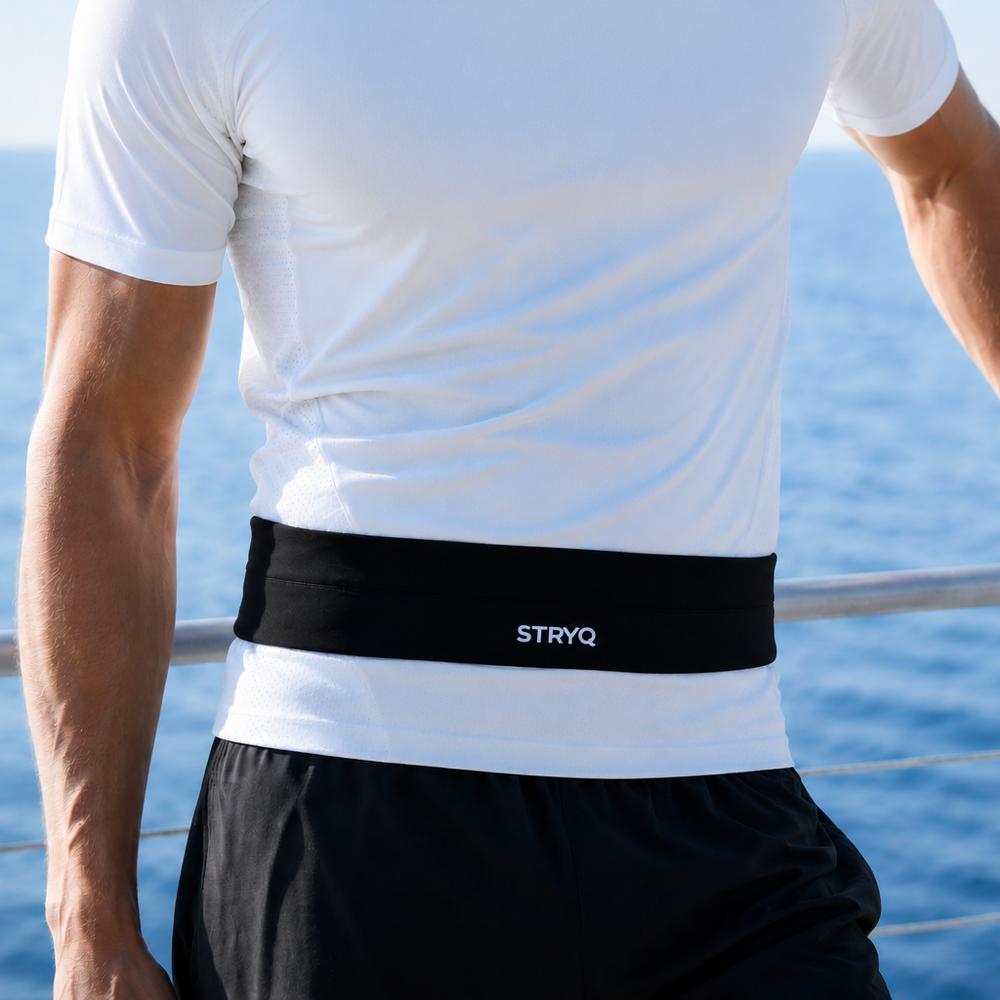
For runners carrying several gels plus a phone, keys or card, a running belt is one of the simplest ways to increase storage without wearing a full vest.
A belt also lets you spread smaller items around your waist rather than putting all the weight into one shorts pocket.
This becomes particularly useful during marathon training because you can practise with exactly the number of gels you expect to carry on race day.
Don't test your belt with two gels if you intend to race with eight.
Put eight in it.
Add your phone and keys if you're carrying those too.
Then go and run.
Running Vest
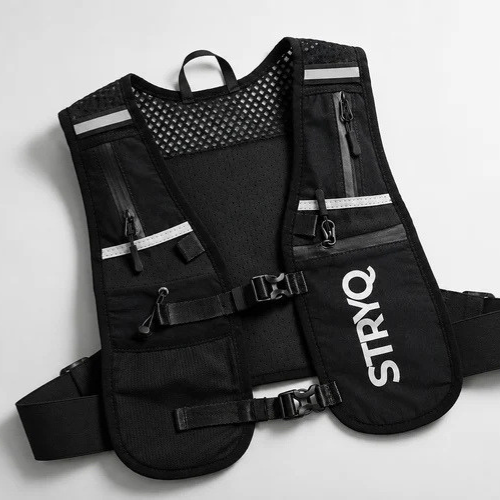
For unsupported long runs where you also need water, a phone, additional nutrition or an extra layer, a running vest gives you considerably more storage.
That is particularly useful during marathon training when you might be out for several hours without aid stations.
A vest can also let you separate your nutrition. For example, you might keep standard gels in one pocket and caffeinated gels somewhere else so you don't have to read tiny packet labels while running.
Race Belt
Traditional race belts are primarily designed to hold your race number, although some models include loops or storage for gels.
If you use one, check how securely the gels are held before trusting it over marathon distance.
How to Organise Your Marathon Gels
If you are carrying several different gels, don't just throw everything into one pocket.
A little organisation makes race day much easier.
- Keep caffeinated gels separate from non-caffeinated gels.
- Know which flavour or product you intend to use first.
- Put early-race fuel somewhere easy to reach.
- Keep emergency/spare fuel secure rather than mixed into everything else.
- Have somewhere to put empty wrappers.
You can even arrange your belt or vest in the same order you plan to consume them.
It sounds obsessive when you're standing in your kitchen.
It feels considerably less obsessive when you're tired at mile 22.
Should You Carry a Spare Gel?
It can be sensible.
Packets can tear. You can drop one. A race can take longer than expected.
Carrying one tested spare gel gives you a little margin without adding much weight.
That doesn't mean stuffing your belt with six unnecessary extras "just in case".
You still want a deliberate plan.
Do You Need Different Gels Later in a Marathon?
Not necessarily, but some runners deliberately change things later in the race.
One common strategy is using non-caffeinated gels earlier and introducing caffeine later.
Another is rotating flavours or textures to reduce flavour fatigue.
If you plan to do this, rehearse the sequence during your longest training runs.
Don't make caffeine a random decision when you are exhausted.
Why Your Long Runs Are Fuelling Rehearsals
Your marathon training is not only about proving your legs can cover the distance.
Long runs are where you discover whether your nutrition plan actually works.
Use them to test:
- Your carbohydrate intake per hour.
- Gel timing.
- Different carbohydrate quantities.
- Flavours and textures.
- Caffeine timing.
- Water intake.
- Your belt or vest.
- Opening packets while running.
- What your stomach tolerates after several hours.
If you intend to consume eight gels on race day but the most you have ever taken in training is three, you haven't properly tested your strategy.
Your Stomach Needs Training Too
Higher carbohydrate intakes should not simply appear on race morning.
If you are gradually working towards a higher hourly intake, practise it across your training block.
That gives you time to discover what works without the pressure of a race.
Veloforte's Perform nutrition hub goes into more detail on its wider performance-fuelling approach, while its running nutrition range includes different fuel formats if gels alone don't suit how you prefer to fuel.
A Simple Race-Week Gel Checklist
By the time race week arrives, your nutrition should be one of the boring parts of your marathon.
That is a good thing.
You should already know:
- Your approximate finishing-time range.
- Your planned carbohydrate intake.
- How much carbohydrate each gel provides.
- How many gels you expect to carry.
- Which gels contain caffeine.
- Whether your gels should be taken with water.
- What carbohydrate you expect from drinks or other sources.
- Where every gel will be stored.
- What you will do if the race takes longer than expected.
Do the maths before race morning.
The start pen is not the place to realise you packed four gels when your training strategy used eight.
So, How Many Gels Do You Actually Need?
If you came here wanting us to say "take six", we haven't.
That's because it would be bad advice.
To estimate how many gels for a marathon or how many gels for a half marathon, you need four pieces of information:
- Your expected race duration.
- The carbohydrate intake you have successfully practised.
- The amount of carbohydrate in each gel.
- Any carbohydrate coming from drinks, chews or other fuel.
From there, the calculation becomes relatively simple.
Hourly carbohydrate target × expected race hours = approximate total carbohydrate.
Then subtract the carbohydrate coming from other sources and divide what remains by the carbohydrate content of your chosen gels.
That gives you a much more useful starting point than copying the number of packets somebody else carries.
And once you've calculated it, take that exact strategy into training.
Because the best marathon fuelling plan isn't the one that looks perfect in a spreadsheet.
It's the one that still works when you're tired, sweaty and several hours into the race.
Frequently Asked Questions
How many gels for a marathon?
There is no universal number. It depends on your expected finishing time, your practised carbohydrate intake, how much carbohydrate each gel contains and whether you are consuming carbohydrate from drinks or other sources. A three-hour runner and a six-hour runner should not automatically carry the same number.
How many gels for a half marathon?
Again, finishing time matters. A 90-minute half marathon creates a very different fuelling window from a three-hour half marathon. Calculate your strategy using time and carbohydrate rather than simply copying a fixed number of gels.
How many gels for a four-hour marathon?
As an illustration, a runner who has successfully trained at 60g carbohydrate per hour would consume around 240g across four hours. That could equal eight 30g gels if gels supplied all of the carbohydrate. If sports drinks also provide carbohydrate, fewer gels may be needed. This is an example, not an individual prescription.
How many gels for a five-hour marathon?
Using the same illustrative 60g-per-hour example gives 300g carbohydrate across five hours. That could equal ten 30g gels if all carbohydrate came from gels. Your actual strategy should be based on what you have practised and any other carbohydrate you consume.
When should I take my first gel during a marathon?
If gels form part of your race strategy, they are generally better treated as planned fuel rather than something you save until you feel exhausted. Your exact timing should reflect the product, your pre-race nutrition and the strategy you successfully rehearsed in training.
Should I take a gel every 30 minutes?
Not automatically. A 22g gel every 30 minutes provides about 44g carbohydrate per hour, while a 45g gel every 30 minutes provides 90g. Look at grams of carbohydrate rather than blindly following a fixed gel interval.
Do I need gels for a half marathon?
Not every runner will use them, but carbohydrate becomes increasingly relevant as race duration increases. Someone expecting a 90-minute half marathon may approach fuelling very differently from someone expecting to run for two and a half or three hours.
What are the best gels for marathon running?
The best marathon gels are products that fit your carbohydrate strategy, agree with your stomach, are practical to carry and have been repeatedly tested during long runs. There is no single gel that is best for every runner.
Can I mix different running gels during a marathon?
Yes, provided you have tested the combination. Check the carbohydrate and caffeine in each product because different gels can contain substantially different amounts.
Should I use caffeinated marathon gels?
Caffeine can form part of an endurance strategy, but it isn't automatically appropriate for everyone. If you use caffeinated gels, know the amount in each packet and include coffee and other caffeine sources when considering your overall intake.
Should I carry an extra marathon gel?
A single spare can be useful in case you drop a packet or the race takes longer than expected. It should complement a planned strategy rather than replace one.
Should I use the running gels provided by the marathon?
Only if you know what product will be supplied and have tested it during training. Race day is a poor time to discover that an unfamiliar gel doesn't agree with your stomach.