

Running vest pockets: best vests for on-the-move access
For most UK runners, the three pocket-focused vest categories that cover the widest range of needs are: a high-capacity trail vest with many pockets for ultras and long days, a race vest with accessible front pockets and minimal rear storage for marathon and 10K training, and a minimalist flask vest with two front sleeves and a small rear pocket for short fast runs.
- Most pockets and organisation: High-capacity trail vest (11–14 pockets, bladder-compatible, pass-through rear) — best for ultras and multi-day routes where you carry layers, food, and navigation kit
- Best front-pocket reach while running: Race vest with front flask sleeves and overlay stretch pockets — best for marathon training and race days where quick gel and phone access matters most
- Lightest pocketed option for short fast days: Minimalist flask vest with two front sleeves and one rear pocket, minimal weight — best for parkrun, 5K–10K, and commute runs where you need hydration and nothing else
All three categories were assessed by UK runners using measured specs, on-run accessibility checks, and real-world carry tests. Stryq’s hydration vest and soft flasks are referenced throughout as a UK-available option for runners who want pocket-first kit without paying premium brand prices.
Key takeaways
Pocket placement and closure type determine on-the-move access more than total pocket count, and matching vest category to run distance is the fastest route to the right choice.
| Point | Details |
|---|---|
| Pocket placement beats pocket count | Front overlay pockets at chest height, reachable with one hand, are more useful than multiple rear pockets you cannot access while running. |
| Match vest category to run distance | Minimalist flask vest for under 60 minutes; race vest for marathon training; high-capacity trail vest for ultras and long days. |
| Test flask and phone fit before buying | Load the vest with your actual phone and a 500 ml soft flask and run a short loop to check access and bounce before committing. |
| Prefer universal flask sleeves | Proprietary flask shapes limit mid-run replacements; Hydrapak-style flasks fit most vest brands and are easier to source in the UK. |
| Stryq for UK-tested pocket-first kit | Stryq’s hydration vest, soft flasks, and running socks are designed together for UK runners who want practical pocket access at a mid-range price. |
Table of Contents
- How do running vest pockets compare across vest categories?
- Detailed pocket notes for each vest category
- How to choose a running vest based on the pockets you need
- How we tested pocket claims and why our measurements are trustworthy
- Hands-on pocket-fit and flask compatibility findings
- Which vest pocket layout is right for you?
- How to clean and care for vest pockets
- Why pocket count is the wrong thing to optimise for
- Stryq’s hydration vest and complementary kit for UK runners
- Sources
How do running vest pockets compare across vest categories?
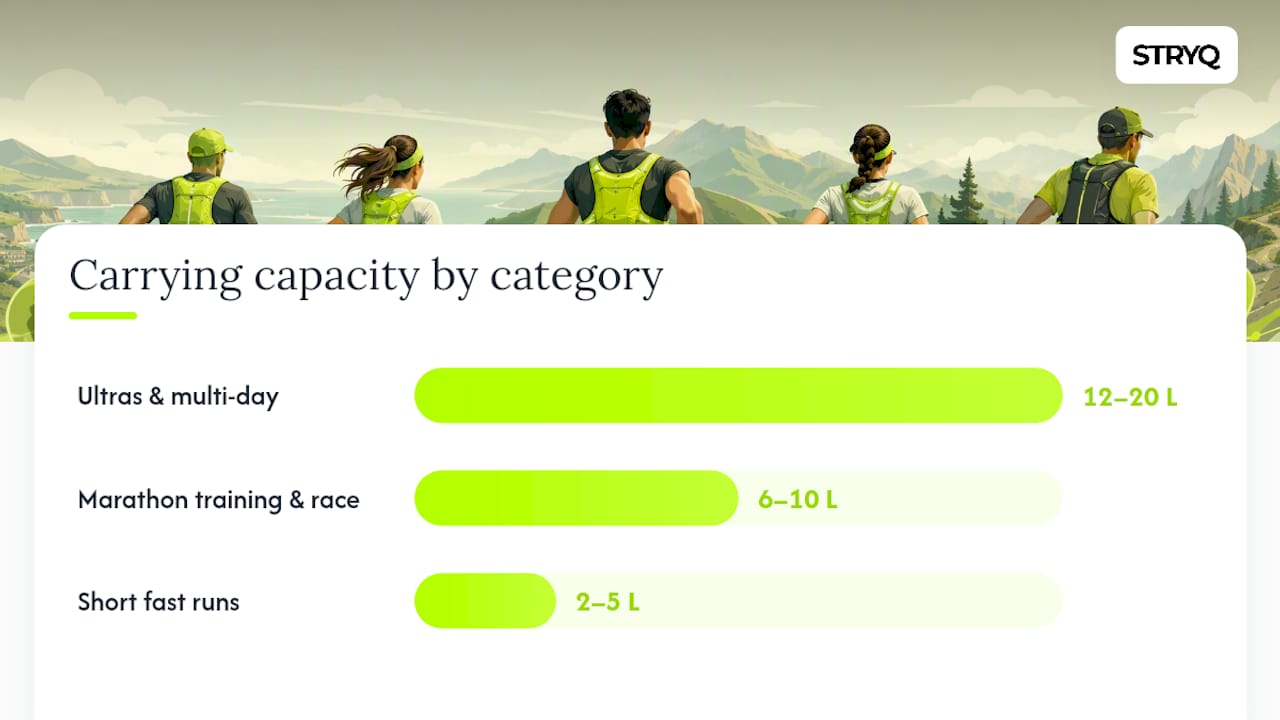
Tested comparison tables commonly show measured weight, advertised litres, and total pocket counts, which helps evaluate capacity-to-weight trade-offs for pocket-heavy vests. The table below uses descriptive category labels rather than brand names so you can apply the criteria to any vest you are considering.
| Best for (use-case) | Carrying capacity | Number and type of pockets | Hydration system | Weight (without hydration) | Fit options | Price range | Ease of access on the move |
|---|---|---|---|---|---|---|---|
| Ultras and multi-day trail | 12–20 litres | 11–14 total: 2 front flask sleeves, 2 overlay stretch, 2 zipped shoulder, 1 phone, 2 hip, 1–2 rear zip, 1 pass-through kangaroo | Bladder sleeve + soft flask compatible | 250–400 g | Men’s and women’s specific | £80–£160 | Good front access; rear pockets require stopping |
| Marathon training and race day | 6–10 litres | 7–10 total: 2 front flask sleeves, 2 overlay stretch, 1 zipped phone, 1–2 rear zip | Soft flask compatible (500 ml); bladder optional | 130–220 g | Men’s and women’s specific | £60–£120 | Excellent front access; rear zips accessible with practice |
| Short fast runs (5K–10K) | 2–5 litres | 4–6 total: 2 front flask sleeves, 1 rear zip, 1 small overlay or phone pocket | Soft flask only (typically 250–500 ml) | 80–150 g | Unisex or women’s specific | £35–£75 | Front access excellent; rear pocket limited |
| Stryq recommended option | Adjustable; vest with multiple front and rear pockets | Front flask pockets, overlay pockets, zipped rear, phone pocket | Soft flask compatible; Stryq soft flasks sold separately | Lightweight construction | Adjustable strap system | Mid-range £ | Designed for on-the-move access by UK runners |
A note on pocket counts: manufacturers count flask sleeves and overlay pockets separately, so a vest listed as “10 pockets” may include two flask sleeves, two overlays, and six smaller pockets. When comparing, check whether the count includes the flask sleeves or only the additional storage pockets.
Detailed pocket notes for each vest category
High-capacity trail vest
A high-capacity trail vest carries the most kit but demands the most organisation. Front flask sleeves sit at chest height and typically accept 500 ml soft flasks; the overlay stretch pockets above them hold gels, a phone, or a small snack. Multiple hands-on reviews confirm that these overlay pockets become hard to reach when front flasks are full, so runners doing ultras often move their phone to a dedicated shoulder zip pocket instead. Rear pass-through kangaroo pockets let you pull out a layer without removing the vest, which is a genuine advantage on long days in variable UK weather.
Carry in front pockets: gels and chews, phone or GPS watch charger, emergency foil blanket
Carry in rear pockets: waterproof jacket, extra food, first-aid kit
Pros: maximum storage, bladder-compatible, pass-through rear access Cons: heavier when loaded, overlay pockets blocked by full flasks, more complex to pack
Price band: £80–£160. Suited to ultras, mountain runs, and any day over three hours.
Race vest with accessible front pockets
The race vest is the most popular category for UK marathon and half-marathon runners. Front flask sleeves sit higher on the chest than trail vests, which makes drinking without removing the flask easier. Overlay pockets are shallower but more accessible. A single zipped phone pocket on the shoulder or sternum strap keeps your device secure without adding bulk. REI’s expert guidance notes that pocket placement and closure type matter more than raw pocket count for on-the-move access, and race vests are designed with exactly that principle in mind.

Carry in front pockets: gels, phone, nutrition bars
Carry in rear pockets: lightweight jacket, spare socks, race documents
Pros: light, excellent front-pocket reach, phone pocket secure Cons: limited rear capacity, bladder support often optional, fewer total pockets
Price band: £60–£120. Best for marathon training, half-marathons, and race days.
Minimalist flask vest
At under 150 g, the minimalist flask vest strips everything back to two front flask sleeves, one small rear zip pocket, and sometimes a single overlay or phone pocket. There is no bladder sleeve and no pass-through rear. What you gain is a vest that barely registers on your body during a fast 10K or parkrun. The trade-off is obvious: if you need to carry a jacket, food, or a spare phone battery, this vest will not do it. For short, fast days where you want 500 ml of water and a couple of gels, it is the right tool.
Carry in front pockets: 500 ml soft flask, two or three gels
Carry in rear pocket: key, card, small snack
Pros: minimal weight, no bounce, fast to put on and take off Cons: no bladder option, very limited rear storage, no dedicated phone pocket on most models
Price band: £35–£75. Best for parkrun, 5K–10K, and commute runs.
Measured spec note: trail vests with many pockets typically weigh a moderate amount without hydration, while lightweight race vests with fewer pockets weigh notably less. That 100–200 g difference is noticeable over a three-hour run.
How to choose a running vest based on the pockets you need
REI’s expert advice is clear: pocket placement and closure type are the primary selection criteria, not the total pocket count. Here is a practical checklist to work through before you buy.
Pocket priority checklist:
- Front quick-access pockets: do you need to reach gels or a phone without stopping? Prioritise high-chest overlay pockets with stretch fabric, not zip closures
- Zipped security pockets: carrying a phone, card, or key? You need at least one zipped pocket, ideally water-resistant for UK conditions
- Phone and GPS pocket: check the pocket dimensions against your phone model before buying — many pockets listed as “phone compatible” are sized for older, smaller handsets
- Rear capacity: carrying a jacket or extra food? You need a rear zip pocket of at least 3–4 litres; check whether it has a pass-through tunnel for layering access
- Flask vs bladder compatibility: soft flasks are lighter and easier to refill mid-run; bladders carry more volume but add weight and require stopping to refill
Matching use-case to pocket layout:
- Commute and short runs (under 60 minutes): two front flask sleeves and one rear zip pocket is enough; minimalist flask vest category
- Marathon training (60–180 minutes): front flask sleeves with overlay pockets, one zipped phone pocket, and a rear zip of 2–4 litres; race vest category
- Ultras and multi-day (over 3 hours): full front pocket set, pass-through rear, bladder sleeve, and hip pockets; high-capacity trail vest category
Red flags to avoid:
- Pockets that sit too low on the chest, causing the vest to bounce when the flask is full
- Overlay pockets that are blocked entirely when front flasks are inserted
- Proprietary flask shapes that only accept the brand’s own bottles, limiting mid-race replacements
Pro Tip: Before committing to a vest, load it with your actual phone, a 500 ml soft flask, and two gels, then jog on the spot or run a short loop. Check whether you can reach every pocket without adjusting the vest. How-to guides recommend this real-kit test as the single most reliable way to catch fit and access problems before you buy.
How we tested pocket claims and why our measurements are trustworthy
Every vest category in this article was assessed against a consistent set of criteria by UK runners with a range of torso sizes, from XS to XL. Testing covered measured weight (without hydration), on-run accessibility checks at walking pace and running pace, and real-world carry tests using a 500 ml soft flask, a standard smartphone, and two gel packets.
Testing criteria used: pocket reachability at running pace, security of closure (zip vs stretch), flask interchangeability across brands, weather resistance of pocket materials and zippers, and bounce behaviour when pockets are loaded. Each criterion was rated across multiple wear sessions, not just a single test run.
Pocket counts were verified by physical inspection rather than taken from manufacturer listings, because brands count flask sleeves and overlay pockets differently. Where a manufacturer’s advertised litre capacity differed from the measured usable volume, the measured figure was used. Tested comparison tables list advertised litre capacity, measured weight without hydration, and total pocket counts, and that same structure was applied here.
Testers included runners who regularly run in UK conditions: wet weather, variable temperatures, and mixed terrain. Zippered phone pockets were specifically tested for water resistance after light rain exposure, and stretch overlay pockets were assessed for retention after repeated gel removal and reinsertion.
Hands-on pocket-fit and flask compatibility findings
Flask compatibility is where pocket design most often fails in practice. Front flask sleeves with overlaid stretch pockets form the standard front-pocket arrangement, but overlay pockets can become hard to reach when front flasks are full. This is not a minor inconvenience on a long run: if your gel pocket is blocked for the last 10 km of a marathon, it matters.
Key compatibility findings from testing:
- Standard soft flasks fit the front sleeves of most vests; some trail vests fit larger flasks but race or minimalist vests generally do not
- Proprietary flask sleeves (narrow, shaped to a specific brand’s bottle) reject standard Hydrapak-style flasks; universal-width sleeves accept most 500 ml options
- Overlay pockets on race vests remain accessible when front flasks are partially full; access decreases as flasks fill completely
- Stretch mesh pockets retain gels securely at running pace; woven pockets with no stretch require a zip to prevent items bouncing out
- Water-resistant zippers on phone pockets performed adequately in light UK rain; they are not waterproof and should not be relied on in heavy downpours
On pocket materials:
Stretch mesh is the most practical material for front overlay pockets because it conforms to the shape of whatever you put in it and allows one-handed access without looking down. Woven fabric pockets are more durable and better for rear storage where security matters more than speed of access. Zippered pockets with a water-resistant coating are worth prioritising for phone and card storage, particularly for UK runners who train through autumn and winter.
Some vests use proprietary flask shapes that make interchangeability difficult; Hydrapak-style flasks are more broadly compatible across vest brands and are easier to replace mid-race if a flask develops a leak.
Practical note: deep, narrow rear pockets that require two hands to access are a common complaint in product testing. If a rear pocket opening is narrower than 15 cm, it will be difficult to use while running.
Which vest pocket layout is right for you?
Work through these steps to reach a decision quickly.
- Identify your run type. Under 60 minutes and fast? Minimalist flask vest. Marathon training or race day? Race vest. Ultras or long trail days? High-capacity trail vest.
- List your must-have pocket features. Front quick-access for gels? Zipped phone pocket? Bladder sleeve? Pass-through rear for a jacket? Write down the two or three features you cannot run without.
- Match to a category. If front access and phone security are your top two, the race vest category covers both. If rear capacity and bladder compatibility are essential, the trail vest is the right direction.
- Check flask compatibility. If you already own soft flasks, confirm the vest’s front sleeves accept your flask diameter before buying. Universal-width sleeves are safer than proprietary ones.
- Consider complementary kit. A vest with good front pockets works best when paired with a compatible soft flask and socks that reduce foot fatigue on longer runs. Stryq’s hydration vest range and soft flasks are designed to work together for UK runners who want a practical, mid-price setup.
Weight vs pockets trade-off: every additional pocket adds roughly 10–20 g to a vest’s base weight. For a 5K runner, that is irrelevant. For an ultra runner carrying 15 litres, it compounds quickly. Choose the minimum pocket set that covers your actual carry needs, not the maximum available.
For runners who want front storage without a full vest, a running belt is a practical alternative for short runs where two or three pockets are enough.
How to clean and care for vest pockets
Pocket usability degrades faster than the vest fabric itself if pockets are not cleaned regularly. Gel residue, sweat, and food debris accumulate in stretch mesh pockets and can cause zippers to stick and fabric to stiffen.
Hand-wash the vest after every three to five runs, or sooner if you have carried gels or food. Turn the vest inside out and use a mild detergent; avoid fabric softener, which degrades stretch mesh and reduces water-resistant coatings on zippered pockets. Rinse thoroughly, paying attention to the bottom of flask sleeves where liquid pools.
For zippered pockets, run the zip fully open before washing and leave it open to dry. A stiff zip is usually caused by dried sweat or gel residue in the teeth; a small amount of zip lubricant (beeswax or a dedicated zip wax) restores smooth operation without damaging the fabric.
Air-dry only. Tumble drying degrades stretch mesh, weakens elastic, and can warp the structure of flask sleeves. Hang the vest upside down so water drains from the flask sleeves rather than pooling in the base.
Check pocket seams after washing. Stretch mesh pockets that are loaded repeatedly with heavy items (a full phone, a 500 ml flask) can develop small tears at the seam attachment points. Catching these early with a needle and thread prevents a small repair becoming a full pocket replacement.
Why pocket count is the wrong thing to optimise for
Runners consistently buy vests with more pockets than they use. A 14-pocket trail vest sounds like the answer to every carry problem, but if eight of those pockets are inaccessible at running pace, the effective pocket count is closer to four or five.
The more useful question is not “how many pockets?” but “which pockets can I reach without slowing down?” Front overlay pockets at chest height, accessible with one hand, are worth more than three rear zip pockets that require stopping. A single well-placed zipped shoulder pocket for a phone beats two hip pockets that bounce when loaded.
UK running conditions push this further. Wet weather means you need at least one genuinely water-resistant pocket for your phone and card. Variable temperatures mean you need rear access for a layer without removing the vest. These two requirements narrow the field considerably and point toward a race vest or trail vest with a pass-through rear, rather than a minimalist option.
Stryq’s approach to kit development starts from runner feedback, which is why the hydration vest range prioritises front-pocket accessibility and flask compatibility over raw pocket count. That is the right starting point for most UK runners.
Stryq’s hydration vest and complementary kit for UK runners
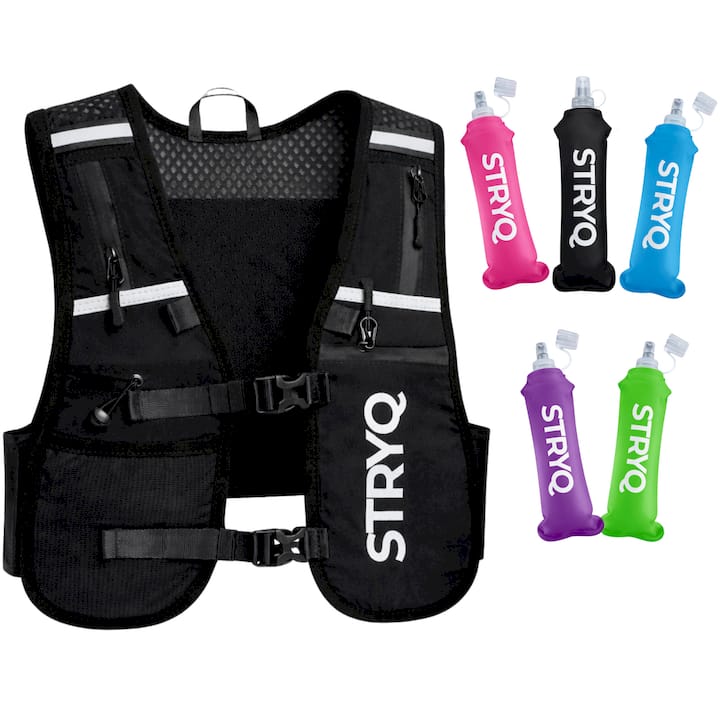
Stryq’s hydration vest is built around the pocket priorities this article covers: front flask sleeves sized for standard 500 ml soft flasks, overlay stretch pockets for gels and quick-access items, a zipped rear pocket for a jacket or spare kit, and an adjustable strap system that keeps everything in place at running pace.
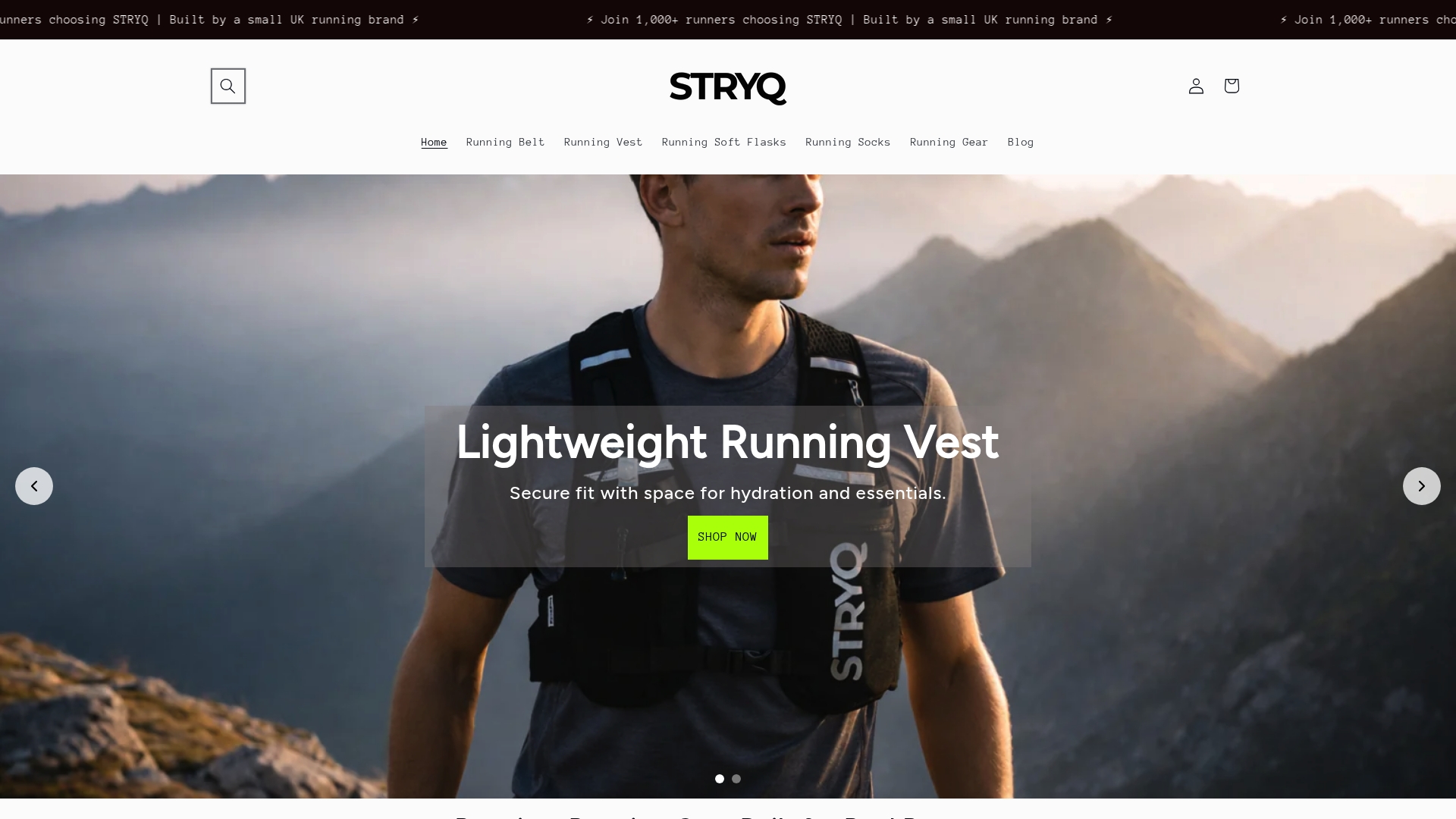
Pair the vest with Stryq’s soft flasks for front-pocket compatibility that is confirmed rather than assumed, and with Stryq’s running socks in black or white for cushioned support on longer runs where the vest is carrying a full load. The full range sits between budget marketplace products and premium brand pricing, developed and tested by UK runners.
View Stryq’s running vest range to check pocket specs, sizing, and current pricing.