

Personal best guide for runners: set and chase a new PB
Pick a PB target from your most recent race, aim to improve it by a small percentage over a focused training block lasting several weeks, convert that time into a per-kilometre pace, and rehearse it until race day feels routine. That is the entire method. Everything else is detail.
The maths behind it isn’t guesswork. A Riegel-style prediction turns a recent race result into an honest baseline at any distance, and the Cleveland Clinic backs the same principle running coaches have used for decades: build speed gradually, alongside strength work, rather than chasing a number that has no relationship to your current fitness.
Four things to do today:
- Pick your baseline: your most recent genuine race result, any distance.
- Choose your improvement window: 2% if you’re experienced, up to 4% if you’re newer to structured training.
- Calculate your target pace per kilometre and per mile.
- Book your first speed session into this week’s diary, not next week’s.
Pro Tip: If your target time looks suspiciously round (a sub-25 5K, a sub-100 half), stop. Check it against an age-grade calculator or a recent longer-distance effort. If the numbers don’t agree, you’ve picked a vanity target, not a real one.
Key Takeaways
| Point | Details |
|---|---|
| Start from a real baseline | Use your most recent genuine race result, not a hoped-for number, as your prediction input. |
| Target 2 to 4% improvement | Newer runners aim higher in that range; experienced runners should expect the lower end. |
| Convert time into pace | Calculate per-kilometre and per-mile pace, then rehearse it in interval and tempo sessions. |
| Follow a structured block | Run one to two speed sessions, one tempo run, one long run, and two strength sessions weekly. |
| Test kit before race day | STRYQ Running Socks, tested across training runs, reduce blister risk before your PB attempt. |
Table of Contents
- How do you set a realistic personal best target?
- Convert your target time into a pace you can practise
- Building a 6 to 12 week training block that actually works
- What should you do in the final race week?
- What gear actually affects your PB attempt?
- How do you know if your training is on track?
- Why simple kit choices matter more than complicated training plans
- Get race-ready: the STRYQ essentials worth buying now
- Sources
How do you set a realistic personal best target?
Your last race is your most honest source of truth. Not last year’s race, not the one where everything went perfectly. The most recent one, run under fair conditions, tells you where your fitness actually sits right now.
From there, a race-prediction formula does the conversion work. The Riegel method estimates your time at a new distance based on a known time at another, and most online pace calculators run this calculation automatically. Run a 10K in 55 minutes and the formula suggests a 5K somewhere around 26 minutes, adjusted slightly because shorter races demand more raw speed relative to endurance.
Once you have that predicted time, apply a modest improvement target across your training block. Newer runners often achieve larger gains; experienced runners should plan for smaller, harder-won improvements. This isn’t arbitrary. It reflects how training research consistently shows diminishing returns as fitness matures.
Here’s how that looks in practice for a runner whose last 10K predicts a 26:00 5K:
| Runner profile | Improvement target | Resulting 5K goal |
|---|---|---|
| New to structured training | 4% | 25:00 |
| Some racing experience | 3% | 25:29 |
| Experienced, well-trained | 2% | 25:29 |
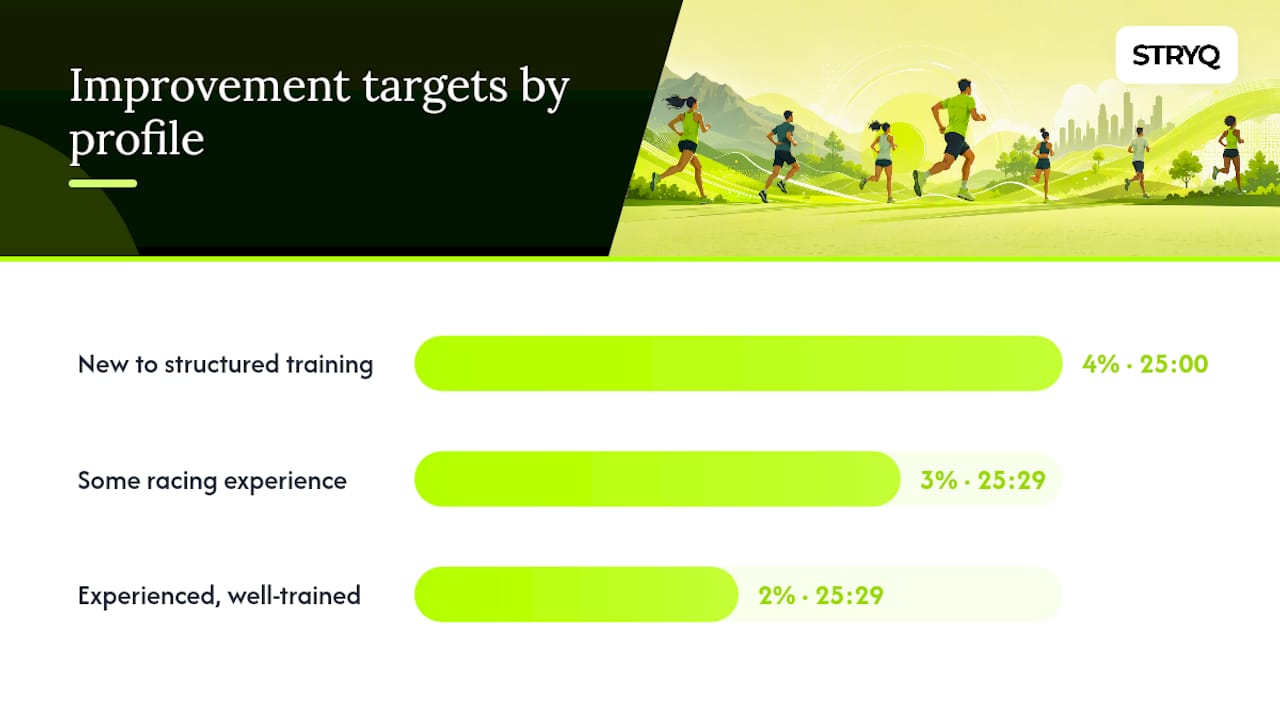
Pro Tip: Round numbers are seductive but meaningless. A 25:00 5K sounds satisfying, but if your prediction says 25:29 is the honest ceiling for this block, chasing 25:00 sets you up to fail. Sense-check any target against an age-grade calculator before committing to it.
Convert your target time into a pace you can practise
A finish time is useless in training. Pace per kilometre or mile is what you actually run against.
Divide your target time by the distance and you get the number that matters. A sub-25 5K means holding 5:00 per kilometre (roughly 8:03 per mile). A sub-24 means 4:48 per kilometre. Push toward sub-20, the benchmark many club runners chase for years, and you’re holding 4:00 per kilometre, no drift, no easing off in kilometre four.
The RunReps guidance on pacing makes a point worth repeating: even or gently negative splits beat fast starts almost every time. Runners who go out 10 seconds per kilometre too fast in the first mile rarely hold it, and the fade in the final third costs far more than the early sprint gained.
Rehearsing goal pace in training removes the guesswork on race day. Try these formats through your build:
- Short intervals: 6 to 8 x 400m at goal pace, 90 seconds recovery jog between reps.
- Longer intervals: 4 to 5 x 800m at goal pace, 2 to 3 minutes recovery.
- Tempo runs: 15 to 20 minutes at slightly slower than goal pace, building comfort with sustained effort.
- Goal-pace mile: one continuous mile at exact race pace, dropped into an easy run.
Building a 6 to 12 week training block that actually works
The weekly shape stays consistent whether you’re running a 6-week sharpening block or a full 12-week build: one to two speed sessions, one tempo or threshold run, one long run, easy recovery days, and two strength sessions worked in around everything else.
A 12-week block gives you room to build gradually, layering intensity in over the first four weeks before hitting the harder middle phase. A 6-week block compresses that progression, which works well if you already have a solid base but suits experienced runners better than beginners.
Concrete sessions worth slotting in: 8 x 400m at 5K pace with 90-second jogs for speed, a 20-minute tempo run at half marathon effort for threshold, and 6 x hill sprints of 15 to 20 seconds for power without the joint stress of flat sprinting. The Cleveland Clinic recommends pairing speed work with two dedicated strength sessions a week to build the durability that stops PB attempts collapsing under fatigue in the final weeks.
| Week | Focus | Key session |
|---|---|---|
| 1 to 2 | Base sharpening | Easy runs plus one tempo run |
| 3 to 4 | Introduce speed | 6 x 400m at goal pace |
| 5 to 6 (6 week finish) | Peak intensity | 8 x 400m plus goal-pace mile |
| 6 to 8 (12 week only) | Build volume | Longer intervals, longer tempo |
| 8 to 10 (12 week only) | Peak block | Race simulation, goal-pace test run |
| 12 (12 week only) | Taper | Reduce volume, keep intensity sharp |
If work or family commitments are tight, protect the long run and one speed session before anything else. Keep weekly mileage increases under 10%, and treat strength training as cross-training that reduces injury risk rather than an optional extra.
What should you do in the final race week?
Taper doesn’t mean stopping. It means reducing volume while keeping intensity sharp so your legs stay switched on. Three days out, run a short session with a handful of reps at goal pace. Two days out, an easy 20 to 30 minutes, nothing more.
Warm up properly on race morning. For a 5K or 10K attempt, that means 10 to 15 minutes of easy jogging followed by four or five short strides at close to race pace. For half marathon or marathon PBs, a shorter warm-up suffices since you’ll settle into rhythm over the opening kilometres anyway. Cool down afterward with 10 minutes of walking or light jogging to start recovery.
Pacing strategy comes down to one decision: even pace or negative split. Both beat a fast start. The RunningState guide to 10K PBs recommends treating the first kilometre as a controlled effort, deliberately 3 to 5 seconds per kilometre slower than goal pace, because adrenaline at the start line makes everyone feel faster than they are.
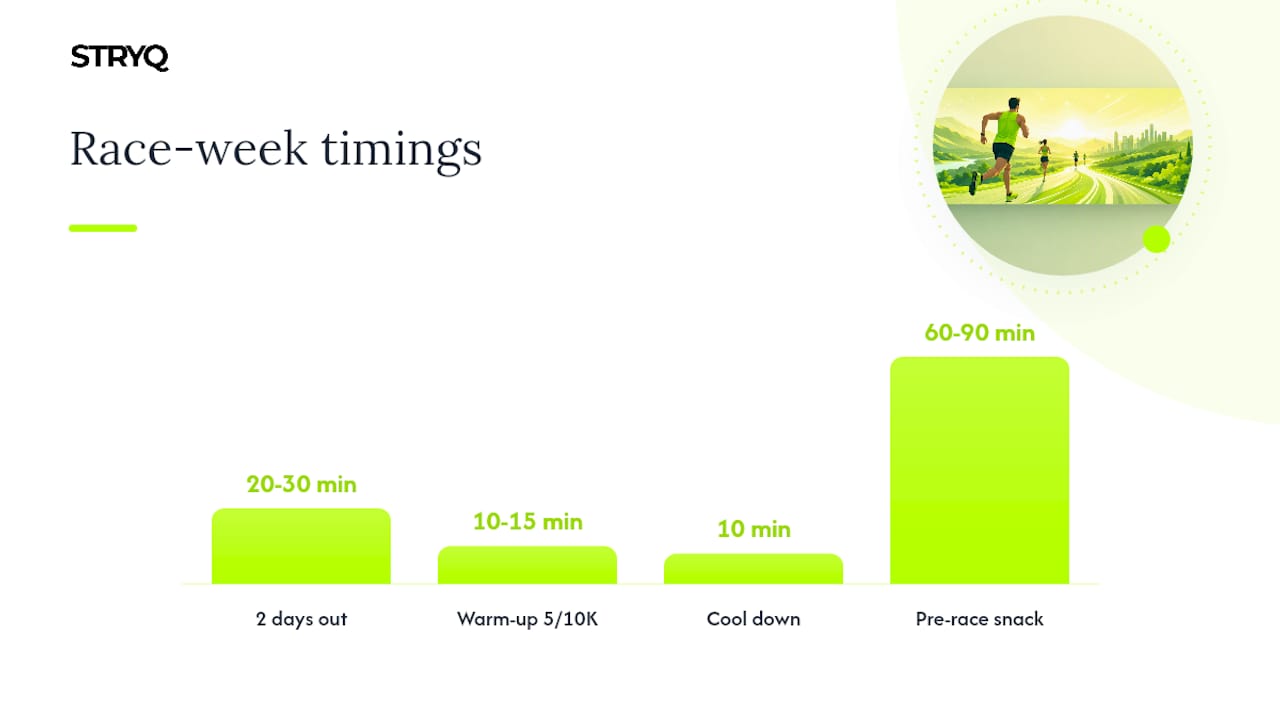
Nutrition in the 48 hours before race day should lean toward familiar carbohydrates, nothing new or experimental. A light snack 60 to 90 minutes before the gun, mostly carbohydrate, settles the stomach without weighing you down. For 5K and 10K distances, you don’t need in-race fuelling. Save gels and hydration strategy for half marathon and marathon efforts.
Pack the night before:
- Race kit tested in at least one training run, not fresh out of the packet.
- Spare socks in a dry bag, in case the forecast turns.
- Watch charged and set to your goal pace zones.
- Gels or a soft flask if racing longer than 10K.
- Belt or pocket for your phone and any race essentials.
Pro Tip: Rehearse your entire race-day kit, from shoes to socks to belt, in at least one training run before the event. The RunningState guide recommends a goal-pace test run three to four weeks out, and that’s the perfect session to double as a full kit dress rehearsal.
What gear actually affects your PB attempt?
Gear isn’t cosmetic. Shoe stack height and drop change how your legs absorb impact over distance, and poorly chosen socks or apparel can undo weeks of training through blisters, chafe, or overheating that forces you to slow down mid-race.
Racing shoes should match your distance. Lighter, more responsive shoes suit 5K and 10K attempts where you want direct ground feel. More cushioned options serve half marathon and marathon efforts better, where fatigue resistance matters more than raw responsiveness. Your daily trainer, separately, should prioritise durability over speed.
Socks matter more than most runners assume. A poor-fitting pair causes hotspots that only show up at kilometre eight, exactly when you can least afford to slow down. STRYQ Running Socks in Black are built with arch support and targeted cushioning to reduce that risk, tested through repeated revisions with feedback from runners logging real training miles rather than a single lab session. The White colourway offers the identical fit and construction, useful if you want a second pair to rotate through wash cycles or to A/B test against your current socks before committing on race day.
Compression-style, moisture-wicking socks can also ease perceived fatigue in efforts beyond about 60 minutes, which matters more the further you race.
A short checklist worth working through before race day:
- Racing shoes tested for at least 20 to 30km before the event.
- Socks proven blister-free across two or more long runs.
- A belt or vest tested with your actual race-day load of gels or phone.
- A GPS watch set to display pace, not just distance, so you can hold goal pace without maths mid-race.
Pro Tip: Pair thinner socks with slightly looser lacing for shorter, faster efforts, and switch to a cushioned pair with firmer lacing for anything over half marathon distance. The one mistake to avoid without exception: never race in shoes or socks you haven’t tested in training. Roughly one in three runners who suffer race-day blisters trace it back to gear worn for the first time on the day itself, according to broader gear-fit guidance on distance-specific kit choices.
How do you know if your training is on track?
A 5K time trial or a goal-pace test run, scheduled three to four weeks before race day, tells you more than any training log. Run it at your actual predicted pace, not flat out, and compare the result honestly against your baseline calculation.
Watch for these common traps derailing PB attempts:
- Chasing a vanity number instead of the prediction-based target.
- Increasing weekly mileage or intensity too fast, inviting injury.
- Skipping recovery runs because a session “felt easy enough” to push harder.
- Never actually rehearsing goal pace before race day arrives.
When interpreting a test run, a smooth, controlled effort at goal pace with heart rate settling into a familiar range signals genuine fitness. Struggling to hold pace, or a heart rate that spikes and won’t settle, signals fatigue rather than readiness, and that’s worth backing off for.
Log three numbers consistently through your block: per-kilometre pace, perceived exertion on a simple 1 to 10 scale, and heart-rate trend across similar sessions. Consistent watch data across weeks tells you far more than any single stand-out run.
Why simple kit choices matter more than complicated training plans
Runners obsess over training plans and treat gear as an afterthought. That’s backwards.
Most PB failures aren’t caused by a training block that was too easy or too hard. They’re caused by a blister at kilometre six, a belt that bounced for 10K, or socks that felt fine in the shop and became agony by mile eight. The training plan gets the credit or blame, but gear is usually the silent variable nobody accounts for.
Product testing and feedback from runners logging real miles, not just a single lab test, is why STRYQ exists as a brand. The philosophy is straightforward: build kit that removes friction, so the fitness you’ve earned over 6 to 12 weeks actually shows up on the clock rather than disappearing into a blister plaster or a readjusted belt strap at kilometre four. That’s the whole point of chasing a personal best properly. The training does the hard work. The gear just needs to get out of the way.
Get race-ready: the STRYQ essentials worth buying now
If your PB attempt is on the calendar, the gear conversation shouldn’t wait until race week. Buy your key items now, test them across two or three training sessions, and you remove the single biggest unknown left in your plan.
Start with STRYQ Running Socks in Black or the White colourway, both built with arch support and cushioning developed through repeated runner feedback rather than a single design pass. If you’re carrying gels, a phone, or keys, a lightweight, no-bounce running belt solves the problem that ruins more long runs than most runners admit. For anything beyond 10K, a soft flask keeps hydration on hand without the awkward bounce of a bottle in hand.
Buy early. Wear each item across at least two training runs before race day, and keep a spare pair of socks packed for the morning itself, just in case. Prices across the range sit well under £30 per item, a small outlay against weeks of training you don’t want undone by a preventable blister.
Browse the full running gear collection and get your race-day kit sorted this week, not the night before.
Sources
- How to become a faster runner | Cleveland Clinic
- How to set a 5K PB goal from recent races | RunReps
- How to run a faster 10K: 10 steps to a new PR | RunningState
- How to choose running gear that actually supports your training | Every Body Can Move
Check any pace target against an online race-prediction calculator before locking in your training block, and revisit it if a test run three to four weeks out tells a different story.