

Why running form matters for beginners
Running form is the way your body moves while you run, and it directly shapes your performance, injury risk, and comfort from your very first session. Most beginners focus on distance or pace, but technique is the foundation that everything else builds on. Research shows that technique differences explain up to 54% of variability in running economy between runners. That figure means form is not a minor detail. It is one of the biggest levers you have as a beginner runner. Understanding why running form matters for beginners is the first step to running further, faster, and with far less pain.
How does running form influence performance and efficiency?
Running economy is the industry term for how efficiently your body uses oxygen at a given pace. Better running economy means you can run further or faster for the same effort. Running form explains up to 31% of performance variability between runners. That is a significant gap that no training plan alone can close.
Three biomechanical factors drive most of that variability:
- Cadence (step frequency). A higher cadence reduces the time your foot spends on the ground. Less ground contact time means less impact force travelling through your ankles, knees, and hips. Higher cadence is linked to lower joint load and reduced overuse injury risk. For most beginners, a cadence of around 160–170 steps per minute is a reasonable starting target.
- Foot strike pattern. Landing with your foot too far ahead of your body creates a braking force with every step. That force slows you down and adds stress to your joints. A midfoot or forefoot strike, landing closer beneath your hips, reduces that braking effect.
- Arm swing and posture. Tension in your shoulders wastes energy that should go into forward movement. Arms swung correctly, bent at roughly 90 degrees and moving forward and back rather than across your body, help stabilise your torso and maintain rhythm.
Running is a full-body movement. Correct posture reduces fatigue and lets you sustain effort for longer. Think of your body as a system where every part affects every other part. Slouching compresses your lungs and reduces breathing capacity. Crossing your arms wastes rotational energy. Small adjustments across the whole body add up to a meaningfully more efficient stride.
Pro Tip: Count your steps for 30 seconds on your next run, then double the number to get your cadence. If it is below 160, try shortening your stride slightly and see if the count rises naturally.

What common running form mistakes should beginners avoid?
Most beginners make the same handful of errors. Knowing what they are makes them far easier to spot and correct.
- Plodding with heavy foot strikes. Slow, heavy steps increase ground contact time and send more impact force through your joints with every stride. This is one of the fastest routes to shin splints, knee pain, and stress fractures.
- Hunched or tense shoulders. Shoulders creeping up toward your ears is a sign of tension. That tension spreads through your neck and upper back, draining energy and restricting arm movement.
- Arms crossing the midline. When your arms swing across your body rather than forward and back, your torso rotates to compensate. That rotation wastes energy and disrupts your forward momentum.
- Looking down at your feet. Dropping your chin pulls your whole spine out of alignment. Keep your gaze about 10–15 metres ahead to maintain a neutral neck and upright posture.
- Trying to fix everything at once. This is the most common mistake of all. Beginners read about cadence, foot strike, arm swing, and posture simultaneously, then attempt to change all of it in one run. The result is mental overload and a stride that feels worse, not better.
The last point deserves emphasis. Focusing on one cue at a time, such as relaxing your shoulders or shortening your stride, produces better results than attempting a wholesale technique overhaul. Your nervous system needs repetition to build new movement patterns. Flooding it with competing instructions slows that process down.
Pro Tip: Pick one form cue before each run and focus only on that for the session. Write it on your hand if you need a reminder. After a few weeks, it will feel automatic.
Is there a single perfect running form?
No. Research is clear that no universally ideal stride pattern exists. Optimal form varies by individual limb length, hip width, flexibility, and injury history. Copying the stride of an elite marathon runner will not automatically make you faster. It may actually make things worse if their mechanics do not suit your anatomy.
This is genuinely liberating news for beginners. You do not need to achieve a textbook stride. You need to find the most efficient version of your own stride.
“Experts recommend outcome-focused imagery to help beginners develop a natural, efficient running style. Thinking of yourself as a bouncy spring, light and quick off the ground, tends to produce better mechanics than consciously trying to land on your midfoot or drive your knees up.”
That imagery approach works because it lets your nervous system self-organise around a goal rather than trying to consciously control dozens of variables at once. Conscious attempts to drastically alter stride characteristics often decrease efficiency. Subtle cues yield better adaptation, particularly for beginners whose movement patterns are still forming.
The practical takeaway is this: use your comfort and injury history as your guide. If a particular foot strike pattern causes knee pain, adjust it. If running tall and relaxed feels natural, build on that. Your form should serve your body, not the other way around. For more foundational guidance, the beginner running guide from Stryq covers the broader picture of starting out safely.
How can beginners start improving their running form?
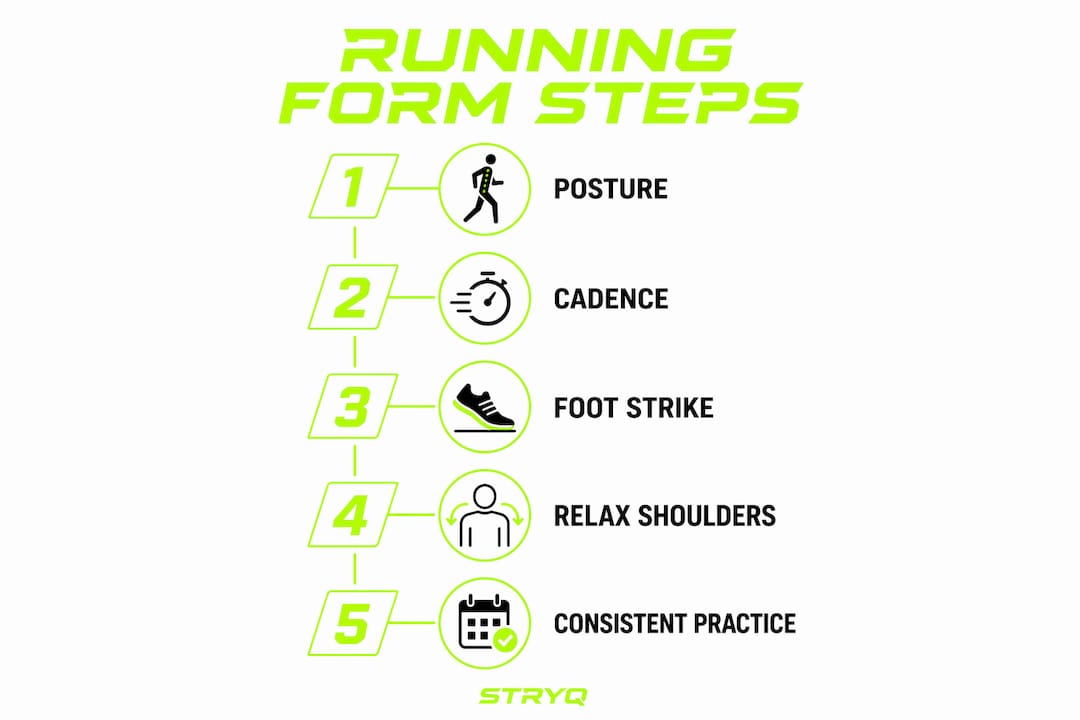
Improving your running technique is a gradual process. Expect it to feel slightly awkward at first. That is normal. Here is a practical sequence to follow:
- Start with posture. Stand tall with a slight forward lean from your ankles, not your waist. Keep your head up, shoulders relaxed, and chest open. Proper posture improves comfort and efficiency and makes breathing easier from the very first run.
- Relax your upper body. Shake out your hands before you start. Imagine holding a crisp packet in each hand without crushing it. That tension level is about right for your fists and forearms.
- Work on cadence gradually. Count your steps for 30 seconds and double the number. If your cadence is low, try shortening your stride slightly rather than speeding up your legs consciously. A shorter stride naturally increases step frequency.
- Focus on one cue per run. Choose a single point of focus, such as keeping your elbows at 90 degrees, and spend the whole session on that alone. Rotate cues across sessions rather than stacking them.
- Give it time. New running form takes 4–6 weeks to feel natural. That is how long the neuromuscular system needs to build reliable new movement patterns. Do not judge the process after one or two runs.
Gear plays a supporting role here too. Running shoes matched to your foot strike can accommodate your biomechanics and reduce injury risk while your form develops. Well-fitted running socks reduce friction and blistering, which means fewer distractions from the physical sensations that good form work requires. For broader advice on building consistent progress, the starting running tips guide from Stryq is worth reading alongside this article.
Pro Tip: Film yourself running from the side for 30 seconds on your phone. You will spot things you cannot feel, such as a forward head position or arms crossing your body. You do not need a coach to benefit from video feedback.
Key takeaways
Good running form is the single most controllable factor in a beginner’s performance and injury risk, and small, consistent adjustments deliver far greater results than trying to overhaul your stride all at once.
| Point | Details |
|---|---|
| Form drives performance | Running technique explains up to 54% of running economy variability between runners. |
| Cadence reduces injury risk | Higher step frequency lowers joint load and cuts overuse injury risk significantly. |
| No perfect stride exists | Optimal form varies by individual anatomy; focus on comfort and efficiency, not elite mimicry. |
| One cue at a time | Focusing on a single adjustment per run produces better neuromuscular adaptation than wholesale changes. |
| Allow 4–6 weeks to adapt | New movement patterns take 4–6 weeks to feel natural; patience is part of the process. |
Why I think beginners underestimate the value of good form
Most beginners I speak to treat running form as something to worry about later, once they can run for 20 minutes without stopping. I understand that instinct. When you are gasping for breath, thinking about your arm swing feels absurd.
But here is what I have observed: the runners who pay attention to technique early, even just one small cue per session, tend to progress faster and get injured less. They also enjoy running more, because efficient movement simply feels better than grinding through a session with tense shoulders and heavy feet.
The research backs this up, but so does common sense. Running with poor mechanics is like driving with the handbrake on. You can still move forward, but everything costs more than it should. Fixing one small thing at a time is not pedantic. It is the most practical approach available to a beginner.
My honest advice: do not overthink it, but do not ignore it either. Pick one habit, practise it until it feels automatic, then move on to the next. That is how good form actually develops. It is not a single revelation. It is a series of small, quiet improvements that compound over months.
— martin
Gear that supports your form as you progress
Good form gets you most of the way there. The right gear removes the small distractions that pull your focus away from it.

Stryq running socks are built for exactly this kind of everyday running. They are cushioned where it counts, breathable enough for longer efforts, and fitted to stay in place so you are not adjusting them mid-run. Blisters and slipping socks are surprisingly effective at breaking your concentration when you are trying to focus on a form cue. The Stryq running socks range covers both black and white options, designed with real runner feedback rather than marketing assumptions. If you carry a phone or keys, a lightweight running belt keeps them secure without bouncing or shifting your centre of gravity. Less distraction means more attention on the things that actually improve your running.
FAQ
Does running form really matter for beginners?
Running form directly affects performance, injury risk, and comfort from the very first run. Research shows technique explains up to 54% of running economy variability, making it one of the most significant factors a beginner can address.
What is the most common running form mistake beginners make?
The most common mistake is trying to fix too many things at once. Focusing on a single cue per run, such as relaxing your shoulders or shortening your stride, produces better results than attempting multiple changes simultaneously.
How long does it take to improve running form?
New running form takes 4–6 weeks to feel natural, as the neuromuscular system needs consistent repetition to build reliable new movement patterns.
Is there a perfect running stride I should copy?
No. Research confirms that no universally ideal stride exists. Optimal form depends on your individual anatomy, limb length, and injury history, so focus on efficiency and comfort rather than copying elite runners.
How do I check my running cadence?
Count your steps for 30 seconds during a run, then double the number. A cadence of 160–170 steps per minute is a practical starting target for most beginners, and shortening your stride slightly is the simplest way to raise it.