

Trail running for beginners: how to start and what to pack
Trail running means running on unpaved, outdoor paths rather than pavement or a track, and it’s usually shaped by hills, roots and loose ground rather than flat, predictable surfaces. Start today with one pair of proper trail running shoes, a short local route you already sort of know, and a plan you’ve told someone about before you leave the house.
That’s genuinely most of it. The rest of this guide fills in the detail, but you don’t need to read all of it before your first outing. The differences from road running come down to terrain and navigation: trails aren’t always marked the way city streets are, the ground moves under your feet, and gradients and course marking conventions vary from one route to the next in a way a pavement never does.
Here’s what to do in the next hour if you’re keen to get moving:
- Pick a short, local, well-trodden route you’ve walked before, ideally under 5km.
- Wear shoes with actual tread, not your worn-out road trainers.
- Tell someone where you’re going and roughly when you’ll be back.
- Keep the first run to somewhere between 15 and 60 minutes, run/walk if you need to.
- Carry water, your phone, and a basic understanding of the route before you set off.
Key Takeaways
Consistent short runs on appropriate terrain, with the right shoes and a simple safety plan, build trail running competence faster than any single piece of gear ever will.
| Point | Details |
|---|---|
| Start short and easy | Keep your first few runs to 15 to 60 minutes on flat, well-marked local trails. |
| Choose shoes for your terrain | Match lug depth and protection to the ground you’ll actually run on, not the toughest trail nearby. |
| Carry basic safety kit | Water, phone, a light, and basic first aid cover most beginner scenarios without overpacking. |
| Follow a gradual progression | An 8-week plan building duration slowly reduces injury risk far more than chasing pace early on. |
| Respect trails and other users | Stick to marked paths and Leave No Trace principles to keep routes open for everyone. |
| Kit that fits properly matters | STRYQ Running Socks and lightweight hydration options solve the fit and comfort issues that end early runs badly. |
Table of Contents
- What kit do you actually need for a first trail run?
- How do you choose the right trail running shoes?
- What layers and hydration gear do you need for longer runs?
- How do you pick the right trail for your first run?
- What’s the right technique for uphill, downhill and technical ground?
- How should you train for your first eight weeks of trail running?
- What safety and navigation basics do beginners need to know?
- How do trail race distances compare, and how do you pick your first event?
- What’s the expert-recommended kit checklist for beginners?
- Why do trails hook people in a way roads rarely do?
- Which STRYQ essentials are worth packing for your first trail runs?
- Where can you find more authoritative trail running resources?
- Sources
What kit do you actually need for a first trail run?
Nobody needs a rucksack full of gear for a 30 minute loop through the local woods. For a short beginner outing, the list is short on purpose.
- Trail shoes. Grip matters more than cushioning on your first few runs, particularly if the ground is wet or uneven.
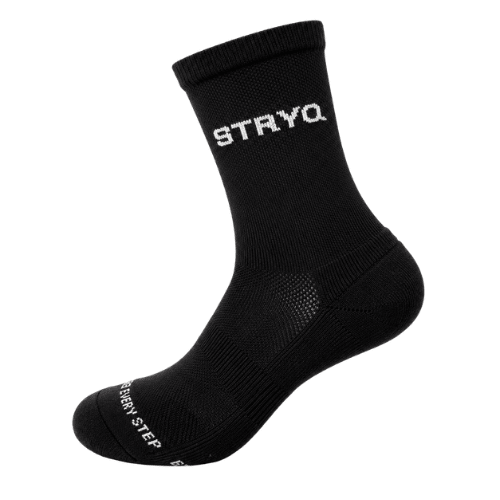
- Proper running socks. Cotton bunches and blisters; something like STRYQ Running Socks in black, or the white version, gives you arch support and cushioning without the seams that rub after twenty minutes on rough ground.
- Water. Even a short run in warm weather adds up faster on trails than on flat pavement because effort is higher.
- Your phone. For navigation, emergencies, and to let someone track where you are.
- A basic first aid item. A plaster and antiseptic wipe covers most minor trail mishaps, like a scraped knee from a stumble.
- A light. Even in daylight hours, trees and cloud cover can make woodland paths dimmer than you expect.
Pro Tip: Stash your phone in a zipped pocket at your hip or lower back rather than a bouncing armband. On uneven ground, anything swinging near your chest throws off your balance exactly when you need your arms free for the trickier sections.
Each of these items solves a specific problem: shoes handle the terrain, socks handle friction, water and first aid handle physical strain, and the phone plus light handle the unexpected. None of it is expensive or complicated, which is rather the point.
How do you choose the right trail running shoes?
Road shoes and trail shoes solve different problems, and the difference isn’t marketing spin. Trail shoes have deeper, more aggressive outsole lugs for grip on mud, loose stone and wet roots. Most also use a firmer, more protective midsole with a rock plate or reinforced toe box, because standard road cushioning gets punished by uneven ground fast.
Trail Runner magazine’s 2026 testing of dozens of trail shoes makes the trade-off plain: more traction and protection generally cost you some of the light, responsive feel road shoes give you on smooth surfaces. There’s no single “best” shoe, only the right compromise for your terrain.
What to weigh up when you’re choosing your first pair:
- Terrain. Gravel fire roads need less aggressive lugs than muddy, rooty singletrack.
- Distance. Longer runs reward more cushioning and protection; short loops can get away with less.
- Weight. Lighter shoes feel faster but usually sacrifice some durability and protection.
- Fit and toe room. Trails involve more lateral movement than roads, so a snug heel with room to splay your toes matters more than it does on tarmac.
- Drop. A lower heel-to-toe drop encourages a more midfoot landing, which suits technical ground; higher drop shoes feel more familiar if you’re coming straight from road running.
Independent shoe reviewers increasingly bucket shoes into categories like all-mountain, road-to-trail, ultra and racing models, and most testers point beginners towards all-mountain options because they balance grip, protection and comfort without over-specialising. If your local trails are a genuine mix of gravel path and rougher woodland, that versatility is exactly what you want.
To check the fit properly, try the shoes on later in the day when your feet have swollen slightly, wear the socks you’ll actually run in, and walk on any uneven surface the shop allows. A short jog around the block or on a treadmill incline tells you far more than standing still ever will.
If your local trails are mostly flat gravel or hard-packed towpaths, a hybrid road-to-trail shoe is a perfectly sensible starting point. Save the aggressive, heavily lugged shoes for when you’re regularly tackling mud or steep, technical ground.
Pro Tip: Break in new trail shoes on short, easy runs before committing them to your first longer outing, and once you’re running regularly, rotate two pairs. Alternating shoes lets the midsole foam recover between runs, which extends the life of both pairs.
What layers and hydration gear do you need for longer runs?
Once your runs stretch past an hour, or you’re heading somewhere more remote, your kit needs to grow with the distance. The basic layering system for trails mirrors hiking logic more than road running: a moisture-wicking base layer against your skin, a light insulating layer if it’s cold, and a packable wind or rain shell you can stuff into a pocket when you don’t need it.
Hydration is where beginners often overthink things. Your options, roughly in order of what suits shorter versus longer efforts:
- Handheld soft flask. Cheap, simple, ideal for runs under an hour where you just need a few sips.
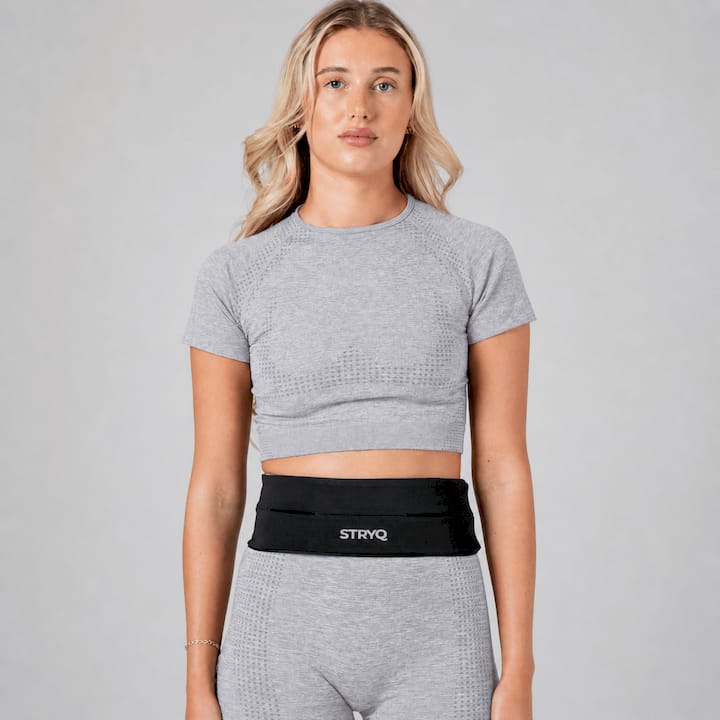
- Running belt. Keeps flasks and small essentials close without anything bouncing on your chest, and works well for runs up to around 90 minutes.
- Hydration vest. Distributes weight across your shoulders and back, and makes far more sense once you’re carrying multiple flasks, food, and extra layers for anything longer or more remote.
For most first runs under an hour, a single soft flask or a light running belt is plenty. You don’t need a full vest until your runs regularly push past 90 minutes or you’re heading somewhere without water access along the way.
Once you’re venturing further from the trailhead, add navigation and safety kit to the layering and hydration basics: a downloaded GPX file or offline map, a fully charged phone, a headlamp if there’s any chance you’ll still be out as light fades, a whistle, and a compact first aid kit. ITRA recommends carrying hydration and navigation tools for exactly this reason once runs get longer or more remote, and its worldwide runner insurance product is worth a look if you’re planning to race or run further afield regularly.
The rule of thumb is simple: the longer and more remote the run, the more of this list you need. A 20 minute loop round a local park needs almost none of it. A three hour outing through unfamiliar hills needs most of it.
How do you pick the right trail for your first run?
Not all trails are created equal, and knowing the categories helps you avoid biting off more than you can chew.
- Fire roads and gravel tracks. Wide, even, and the gentlest introduction to off-road running.
- Singletrack. Narrow paths, often winding through woodland, with more roots and camber changes.
- Technical, rocky terrain. Loose stone, scrambling sections, steep drops. Not where you want to start.
- Coastal and woodland paths. Often well-maintained and clearly marked, making them good beginner territory.
Difficulty on any given trail comes down to three things: distance, total elevation gain, and how technical the ground is underfoot. A short, flat gravel loop is a completely different proposition to a route with steep climbs and loose rock, even at the same distance. Trail listing sites such as AllTrails publish exactly this data, distance, ascent, and estimated time, which is worth checking before you commit to anywhere new.
For your first few outings, look for routes under 5km with minimal elevation gain, clear waymarking, and easy underfoot conditions rather than loose rock or deep mud. Check that the trailhead has proper parking or public transport access, that signage is clear at junctions, and glance at the season. A trail that’s a pleasant woodland jog in July can turn to a mud bath in January.
Trails also aren’t an unlimited resource, and how you use them matters. Leave No Trace principles, staying on marked paths, taking litter home, giving walkers and wildlife space, keep routes open and pleasant for everyone who comes after you. ITRA’s own Green Charter pushes the same environmental stewardship, and it’s a mindset worth adopting from your very first run rather than retrofitting later.
What’s the right technique for uphill, downhill and technical ground?
Trail technique isn’t complicated, but it is different enough from road running that a few habits will save your knees and your confidence.
Going uphill, shorten your stride and lift your cadence rather than trying to power up with big strides. On steeper sections, don’t be afraid to use your hands on rocks or vegetation for extra leverage, and switch to a brisk power-hike when running stops being efficient. Plenty of experienced trail runners walk the steepest pitches and still record faster overall times than those who try to run everything.
Coming downhill rewards quick, light feet over long strides. Lean forward slightly from the ankles rather than sitting back, which feels counterintuitive but keeps your weight over your feet instead of behind them. Pick your line a few steps ahead, and let your arms swing out for balance rather than pinning them to your sides.
On technical ground, roots and loose stone punish heel-striking and reward a lighter midfoot landing. Look several steps ahead rather than directly at your feet. This gives your brain time to plan foot placement rather than reacting a split second too late. When the ground gets genuinely awkward, slowing to a fast walk is not a failure. It’s the difference between finishing upright and finishing with a twisted ankle.
A short warm-up matters more on trails than on roads because you’re asking your ankles and stabilising muscles to work harder from the first stride. Five minutes of leg swings, walking lunges, and ankle circles before you set off, followed by a slow walk and some calf and hip flexor stretches afterwards, covers most of what beginners need.
Pro Tip: Practise technical footing on a short, safe stretch of rooty or rocky path near home, running it slowly and deliberately a few times before you try it at speed. Treat it like a drill rather than a race, and the good habits transfer automatically once you’re moving faster.
How should you train for your first eight weeks of trail running?
Progression on trails needs to be gentler than on roads, because uneven ground and elevation change ask more of your joints and stabilising muscles per kilometre than flat tarmac does.
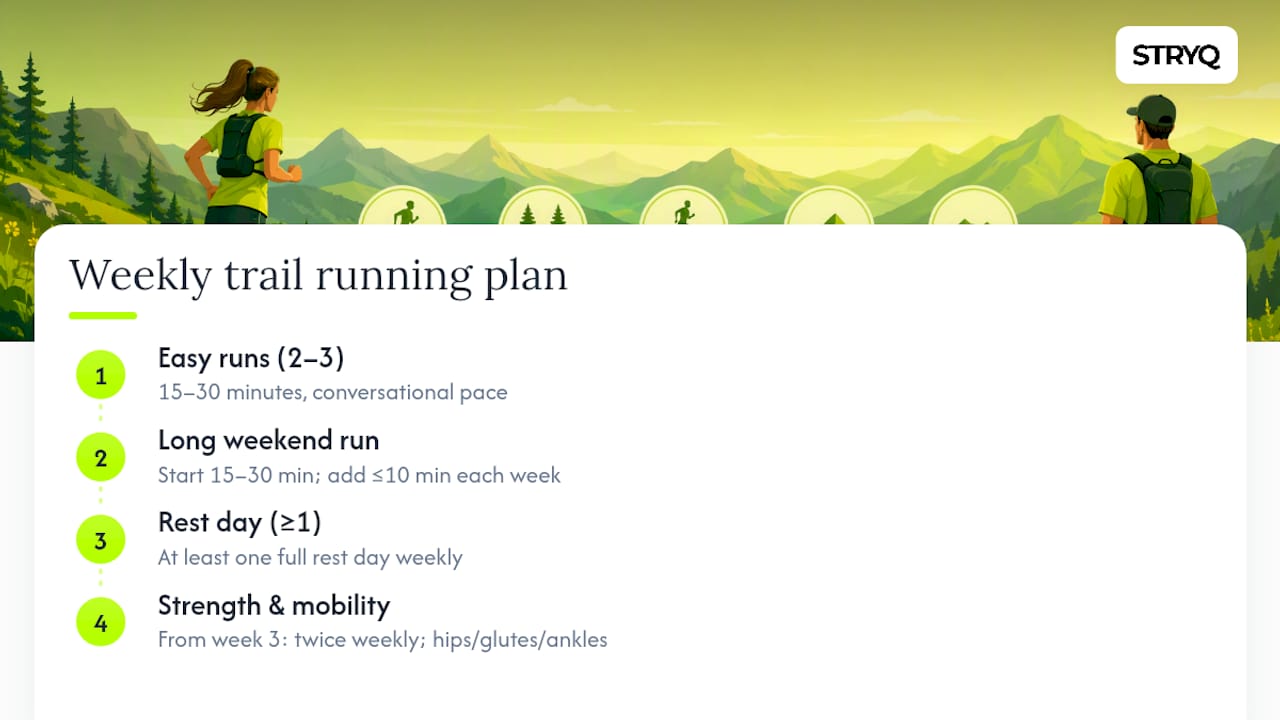
The weekly shape that works for most beginners is two to three easy runs, one slightly longer session at the weekend, and at least one full rest day. Keep every early run conversational in pace. If you can’t hold a sentence while running, you’re going too hard for a trail base-building phase.
Duration matters more than distance at this stage. Start with runs of 15 to 30 minutes and add no more than 10 minutes to your longest weekly run at a time. Trails are forgiving of time spent moving but unforgiving of trying to hit a pace target on ground that won’t allow it.
Strength and mobility work earns its place from around week three onwards. Twice-weekly sessions focused on hips, glutes and ankle stability, think single-leg exercises and calf raises, do far more for injury prevention on uneven ground than extra running alone.
What safety and navigation basics do beginners need to know?
Before every single run, regardless of length, run through the same short checklist: tell someone your route and expected return time, glance at the weather forecast, make sure your phone is charged, and pack kit appropriate to the conditions rather than what you wore last time.
Navigation on trails ranges from trivial to genuinely tricky. Well-waymarked routes need little more than paying attention to signage at junctions. Anything remote or unfamiliar deserves a downloaded GPX file or an offline map saved to your phone, since signal disappears fast once you’re under tree cover or in a valley. A basic understanding of compass direction is worth having even if you never expect to need it.
Weather changes conditions more on trails than roads. Rain turns firm paths into slick mud within an hour, and exposed high ground can drop temperature sharply even in summer. Wildlife is rarely a genuine hazard in most places beginners run, but knowing what’s local, from loose livestock to the odd adder in gorse country, is sensible groundwork rather than paranoia.
For emergencies, carry a basic first aid kit, know how to improvise warmth if you’re caught out in wet weather, and set yourself a clear turn-back point rather than deciding in the moment when you’re already tired and the light is fading.
To put elevation and distance into perspective, California’s Dipsea Trail runs 16.3km with roughly 835 metres of elevation gain, a route that takes experienced hikers upwards of six hours. It’s a useful benchmark for just how much a modest-looking distance can demand once serious climbing is involved, and exactly why checking a route’s elevation profile matters as much as checking its length.
If you’re planning to race, or simply want peace of mind on longer solo outings, ITRA’s runner insurance covers international trail running incidents and is worth investigating once you’re running further from help than a short walk back to the car.
How do trail race distances compare, and how do you pick your first event?
Trail races borrow their distance labels from road running, 5K, 10K, half marathon distances around 10 to 21km, but the numbers mean something different once elevation and technicality enter the picture. A flat 10K on gravel fire roads and a 10K with 600 metres of climbing over rocky singletrack are barely comparable events, even though the entry form lists the same distance.
Beyond half marathon distance, trail racing moves into 50K territory and upwards into full ultramarathon distances, events that typically demand a genuine training base of consistent long runs and hill work well beyond what an 8-week beginner plan provides. These aren’t first-race territory, however tempting the scenery in the race photos looks.
For a first event, look for something short, on runnable rather than technical terrain, with a reputation for good organisation and well-stocked aid stations. Local running clubs and parkrun communities often know which nearby trail events suit newcomers, and race listings will usually flag elevation gain alongside distance so you can judge difficulty before you enter.
What’s the expert-recommended kit checklist for beginners?
Pulling everything together, here’s the shortlist worth having before you commit to regular trail running rather than the occasional one-off outing.
- Trail shoes with enough grip for mixed terrain without being overkill on gentler paths, in line with what Trail Runner’s testing consistently rates well for varied ground. Enough grip for mixed terrain without being overkill on gentler paths, in line with what Trail Runner’s testing consistently rates well for varied ground.
- STRYQ Running Socks. Arch support and cushioning that stop rubbing on longer or rougher runs, available in black and white.
- A soft flask. Lightweight hydration that doesn’t require a full vest until your distances genuinely need it.
- A running belt or light vest. Somewhere secure to carry your phone, snacks and a light layer without bounce.
- A headlamp. Even if you don’t plan to run in the dark, conditions and timings shift, and having one removes the guesswork.
- A basic first aid kit. Small, light, and rarely needed, right up until the one time it matters.
Pro Tip: Check stitching and seam placement on socks and any close-fitting kit before you buy, particularly around the toe box and heel. Poor construction is invisible on the shop floor and painfully obvious somewhere around kilometre four.
None of this needs to be expensive to be good. The point of testing gear properly, rather than just reading a spec sheet, is finding out what actually holds up over repeated runs in real conditions, which is precisely the standard worth applying before you buy anything.
Why do trails hook people in a way roads rarely do?
There’s a specific moment most trail runners remember: the point where the path narrows, the trees close in, and road running’s constant awareness of traffic and pavement cracks just falls away. It’s not really about fitness at that point. It’s about attention shifting entirely to the ground in front of you and nothing else.
That’s the appeal underneath all the technical advice above. Learning to read a root-strewn descent or judge a climb properly isn’t a chore you push through to get to the reward. It is the reward, and it’s why the beginner habits in this guide, short routes, sensible shoes, a bit of patience with pacing, matter more than any single piece of kit ever will.
Which STRYQ essentials are worth packing for your first trail runs?
This guide is published on STRYQ’s own site, so it’s only fair to say plainly that the recommendations below are for kit STRYQ makes and sells. That said, they’re picked because they solve real problems beginners hit on their first trail outings, not because they’re the only option going.
Blisters and hotspots are one of the most common reasons a first trail run turns unpleasant, and it usually comes down to socks that shift or bunch on uneven ground. STRYQ Running Socks are built with arch support and targeted cushioning specifically to stay put over rough terrain, and they come in black or white depending on your preference. For carrying water and small essentials without a bulky vest you don’t yet need, a running belt keeps everything secure and bounce-free on shorter runs, and a lightweight soft flask covers hydration without adding weight you’ll notice.
If you’re ready to sort your kit before your next outing, browse the full running socks range and pick the pair that suits your first few weeks on the trail.
Where can you find more authoritative trail running resources?
For race scoring, global event listings and guidance on environmental stewardship, the International Trail Running Association is the reference body most serious trail runners eventually consult. Its site also covers runner insurance options for those planning longer or international events.
For shoe research beyond this guide, Trail Runner magazine’s ongoing testing tracks new releases and trade-offs between grip, protection and weight throughout the year. And for judging a specific route before you commit to it, trail listing pages such as AllTrails’ Dipsea Trail entry show exactly the distance, elevation and time data worth checking before any unfamiliar outing.
Sources
- ITRA - Runner insurance (About insurance)
- Trail running - Wikipedia
- We’ve Run in Dozens of Trail Running Shoes This Year. These are the Best of 2026 (So Far)
- Dipsea Trail, California - AllTrails