

Best phone holder for running: 2026 UK buyer's guide
For most UK runners, the STRYQ running belt is the strongest all-round choice. It carries your phone and small essentials with a 360° anti-bounce design, sits close to the body, and costs less than the premium vest options. If you run long distances or need hydration on the move, the STRYQ hydration running vest steps up with multiple pockets and soft-flask compatibility.
Here is the shortlist at a glance:
- Best overall: STRYQ running belt — 360° storage, anti-bounce fit, suits most run distances (£)
- Best for long runs and hydration: STRYQ hydration running vest — adjustable straps, multiple pockets, soft-flask ready (££)
- Best no-bounce minimalist: Tubular no-bounce belt — compresses phone against the body, very low profile (£)
- Best for big phones: Compact pocket belt — zippered storage with room for large handsets, gels and cards (£–££)
- Best armband: Lean armband — lightweight, immediate screen access, ideal for short runs and gym sessions (£)
Table of Contents
- How do these phone holders compare side by side?
- Why the STRYQ running belt suits most UK runners
- What makes the tubular no-bounce belt worth considering?
- When does a lean armband make sense?
- Is a compact pocket belt the answer for large phones?
- Armbands versus clip options: which works for you?
- How to choose the right phone holder for your runs
- How we chose and tested these holders
- How to fit and adjust your phone holder for zero bounce
- Keeping your phone holder clean and in good condition
- Key takeaways
- The holder you ignore is the one doing its job
- Stryq running belts and vests: built for UK runners
- Useful sources and further reading
How do these phone holders compare side by side?
According to Runner’s World, the right style depends on run length and storage needs. Armbands suit short efforts; belts and vests suit longer distances where stability and storage matter more.
| Product | Style | Best for | Phone compatibility | No-bounce | Storage | Weather resistance | Comfort/adjustability | Price band (£) |
|---|---|---|---|---|---|---|---|---|
| STRYQ running belt | Waist belt | Most runners, all distances | Fits large phones | 360° compression | Phone + small essentials | Moisture-wicking fabric | Adjustable waist strap | £ |
| STRYQ hydration running vest | Vest | Long runs, trail, races | Fits large phones | Vest-body contact | Phone + gels + water | Weather-ready, breathable | Adjustable shoulder and chest straps | ££ |
| Tubular no-bounce belt | Waist belt | Minimalist runners, short–long | Fits most phones with case | Excellent compression | Phone only | Moderate | Stretch-fit, one-size-adjusts | £ |
| Compact pocket belt | Waist belt | Large phones, long runs | Fits large phones | Good (zippered) | Phone + gels + cards | Moderate | Adjustable waist clip | £–££ |
| Lean armband | Armband | Short runs, gym, tempo | Fits most phones | Moderate | Phone only | Low | Adjustable arm strap | £ |
Key points from the comparison:
- Vests offer the most storage and the most stable phone carriage for long distances.
- Tubular belts win on pure anti-bounce performance for runners who carry nothing else.
- Armbands are the fastest to put on but the least stable over longer efforts.
Why the STRYQ running belt suits most UK runners
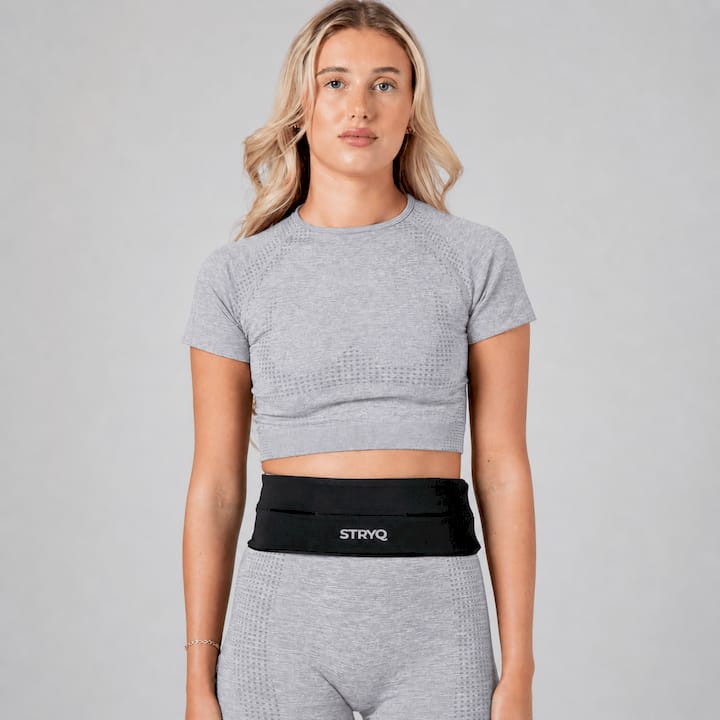
The STRYQ running belt uses a 360° storage design that keeps the phone close to the body’s centre of gravity. Phones held away from the midline cause asymmetric arm swing; this belt’s compression reduces that disruption. It is developed from real-world runner feedback with multiple sample revisions before launch, which shows in the fit.
Pros:
- 360° anti-bounce construction keeps the phone stable across all paces
- Low-profile fit sits flush against the body without riding up
- Moisture-wicking fabric handles sweat and light rain
- Adjustable waist strap fits a wide range of body sizes
- Backed by UK returns and customer support
Cons:
- Storage is focused on phone and small essentials; not suited to carrying gels on a marathon
- Runners with very large phones should check dimensions before ordering
Price band: £ (accessible mid-range, neither budget marketplace nor premium)
Use cases: 5K and 10K runs, Parkrun, half-marathon training, everyday commuter runs.
Pro Tip: Measure your phone with its case on before ordering. The belt’s pocket depth matters more than width for tall phones. Fit the belt snugly at the natural waist, not the hips, to get the anti-bounce benefit.
What makes the tubular no-bounce belt worth considering?
The tubular design works differently from a structured pocket belt. Instead of a zippered pouch, it uses a continuous stretch-fabric tube that compresses the phone against the body all the way around. Testing by Verywell Fit confirms that high-stretch fabrics actively compressing the phone outperform strap-only or loose-pouch designs for bounce control.
Pros:
- Outstanding anti-bounce performance, especially at faster paces
- Very low profile; barely visible under a running top
- Lightweight and quick to put on
Cons:
- No external pockets; gels and cards must go elsewhere
- Inserting and removing the phone mid-run takes more effort than a zippered pocket
- Sizing can be less forgiving than an adjustable clip belt
Price band: £
Pro Tip: Before a long run, slide your phone in and jog on the spot for 30 seconds. If you feel movement, the tube is too large for your phone-and-case combination. Size down or try a case-free fit.
When does a lean armband make sense?
Armbands are the right choice for a specific type of runner: short distances, interval sessions, or gym treadmill work where you want immediate screen access without unclipping anything. Run to the Finish groups armbands as a distinct style category suited to brief, fast efforts rather than long-distance running.
Pros:
- Instant touchscreen access without stopping
- Minimal interference with stride on short runs
- Lightweight and easy to put on and take off
Cons:
- Potential for chafing on the inner arm during longer efforts
- Phone can bounce if the strap is not tight enough, or restrict circulation if too tight
- Sweat accumulates under the band in warm or wet conditions
Phone-size note: Check the armband’s listed dimensions against your phone with case. Most slim armbands fit up to 6.7-inch screens, but bulkier cases reduce that.
Use cases: 5K tempo runs, gym sessions, interval training, short commuter runs.
Sizing tip: Measure your upper arm circumference at the widest point. Add roughly 2 cm for comfort, then check the strap’s adjustment range before buying.
Is a compact pocket belt the answer for large phones?
If you carry a phone larger than 6.5 inches, or you need to take gels, a bank card and keys on a half-marathon, a zippered pocket belt is the practical choice. The key difference from a tubular belt is the structured pocket: it holds its shape and gives more internal volume, which suits large handsets and multi-item loads.
Pros:
- Accommodates large phones, including models with chunky cases
- Zippered closure keeps contents secure on technical terrain
- Multiple compartments for gels, cards and keys
Cons:
- Slightly heavier than a tubular belt
- A loose-fitting pocket without internal tension allows the phone to shift; choose one with a snug internal lining
- Bulkier profile under a race vest
Phone-size guidance: Measure your phone’s height with case. Prioritise pocket depth over width for tall phones; a pocket that is wide but shallow will let a tall phone tilt and bounce.
Price band: £–££
Use cases: Half-marathon and marathon training, trail runs, races where you carry nutrition.
Armbands versus clip options: which works for you?
These two styles serve a similar niche: quick access, minimal bulk, suited to short efforts. Neither replaces a belt or vest for long runs.
Armband (covered above in detail):
- Good for: gym, intervals, short runs under 10K
- Watch for: chafing, sweat pooling, bounce if strap loosens
Clip or holster options:
- Clips attach to a waistband, shorts pocket or bra strap
- Pros: very fast to attach and remove, no body contact
- Cons: exposed to rain, less secure on uneven ground, phone can swing freely if the clip loosens
UK availability: Both styles are widely available from UK running retailers and online. Clips tend to be cheaper but offer less weather protection.
Practical note: Avoid hand-held carrying for any run over 5K. Holding a phone in one hand creates an asymmetric arm swing that alters gait and increases fatigue over distance.
How to choose the right phone holder for your runs
The right choice comes down to five factors. Work through them in order and the decision usually becomes clear.
1. Phone size and fit Measure your phone with its case on (height × width × depth). Check the holder’s listed internal dimensions against those measurements. A pocket that is too large lets the phone shift; one that is too small stresses the fabric and zip.
2. No-bounce and security High-stretch fabrics that compress the phone against the body outperform loose pouches. For belts, the pocket should sit at the natural waist, not the hips, where movement is greater. See the no-bounce fitting guide for step-by-step adjustment.
3. Moisture and weather protection 220 Triathlon’s UK-focused roundup highlights moisture-wicking and breathable fabrics as priorities for British conditions. Sweat and rain are constants here; a holder that traps moisture against the skin causes chafing and risks your phone.
4. Storage needs Short runs: phone only is fine. Long runs and races: look for space for gels, a card and keys. For hydration on runs over 90 minutes, a vest with soft-flask pockets is the practical step up. Compare the two approaches at hydration vest vs belt.
5. Comfort and adjustability A holder you can adjust on the move is worth more than one that fits perfectly at the start but loosens after 5 km. Reflective details matter for early-morning and evening runs in the UK.
Quick pre-buy checklist:
- Fit test: does it sit snugly at the natural waist or arm without pinching?
- Bounce test: jog on the spot for 30 seconds; any movement means a tighter fit or different size
- Comfort check: no pressure points or sharp edges after 2 minutes of wear
- Touchscreen access: can you operate your phone through the material or open the pocket without stopping?
- Waterproofing: is the fabric water-resistant or just moisture-wicking?
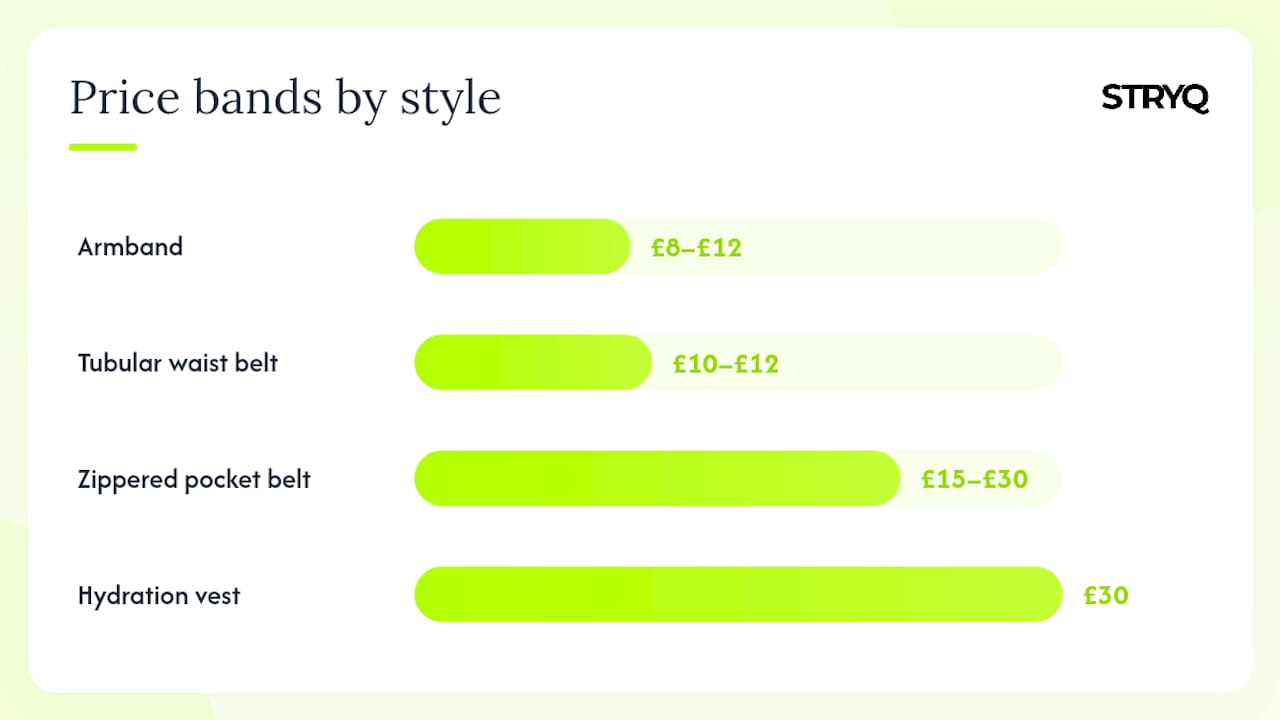
Price ranges by style:
| Style | Typical price band (£) |
|---|---|
| Armband | £8–£12 |
| Tubular waist belt | £10–£12 |
| Zippered pocket belt | £15–£30 |
| Hydration vest with phone pocket | £30 |
Pro Tip: For UK running, prioritise a holder with a water-resistant outer and a breathable inner lining. A fully waterproof shell with no breathability will leave you with a sweat-soaked phone by kilometre 5.
How we chose and tested these holders
The shortlist is built on a combination of structured evaluation criteria and real-run testing, drawing on Verywell Fit’s 40+ hours of mixed-condition testing across pavement, concrete and uneven trails in warm and wet conditions.
Testing steps:
- Fit checks across multiple phone sizes (including large-screen models with cases)
- Bounce and ride-up tests at easy, tempo and race paces
- Sweat and light-rain exposure to assess moisture management
- Storage access tests: how quickly can you retrieve your phone or a gel mid-run?
- Comfort assessment after 60+ minutes of continuous wear
How ratings were weighted:
- No-bounce performance: highest weight; a holder that moves is a distraction and a chafing risk
- Comfort and adjustability: second; a perfect anti-bounce design that chafes is still a poor choice
- Storage: third; matched to the use case (short run vs. long run)
- Weather resistance: fourth; critical for UK conditions
- UK availability: all picks are available to buy in the UK
How to fit and adjust your phone holder for zero bounce
Getting the fit right takes five minutes and makes the difference between a holder you forget about and one you adjust every kilometre.
For waist belts:
- Put your phone (with case) in the pocket before fitting the belt.
- Position the belt at the natural waist, roughly 2–3 cm above the hip bones.
- Tighten until the pocket does not shift when you push it sideways with one finger.
- Jog on the spot for 30 seconds. If the belt rotates or the pocket bounces, tighten by one notch.
- Check that the belt does not restrict breathing; you should be able to take a full breath comfortably.
For armbands:
- Slide the phone in before putting the band on your arm.
- Position on the upper arm, not the forearm; the upper arm moves less during the arm swing.
- Tighten until the band does not slide when you shake your arm, but does not leave a red mark after 2 minutes.
- Run your thumb under the strap; you should be able to do so with slight resistance.
Common fit mistakes:
- Wearing the belt too low on the hips (more movement, more bounce)
- Over-tightening an armband to compensate for a phone that is too large for the pocket
- Not re-tightening after the first kilometre, when belts often settle and loosen slightly
For a detailed step-by-step, the how runners carry their phone guide covers no-bounce tips tested across multiple run types.
Keeping your phone holder clean and in good condition
A running phone holder absorbs sweat, rain and trail grime on every outing. Neglecting it shortens the fabric’s life and creates an unhygienic contact surface. Gripnatic’s guidance on durable training gear notes that regular washing and correct drying protocols are the single most effective way to extend the performance life of running accessories.
After every run:
- Remove your phone and any cards or keys.
- Turn the holder inside out if possible and rinse under cool water to flush out sweat salts.
- Air dry away from direct heat; tumble drying degrades elastic fibres and water-resistant coatings.
Weekly (or after muddy runs):
- Hand wash in cool water with a mild detergent, or machine wash on a gentle cycle in a mesh laundry bag at 30°C.
- Do not use fabric softener; it clogs moisture-wicking fibres and reduces breathability.
- Check zips and buckles for grit; rinse and dry them open to prevent corrosion.
Every few months:
- Re-treat water-resistant fabrics with a DWR (durable water repellent) spray, following the product instructions. Heat-activating the treatment with a cool iron or tumble dryer on low restores the beading effect.
- Inspect seams and stitching for wear, particularly at stress points around the phone pocket and waist adjuster.
Key takeaways
The STRYQ running belt is the most practical all-round phone holder for running for UK runners: anti-bounce 360° storage, moisture-wicking fabric, and an adjustable fit that works from 5K to half-marathon distance.
| Point | Details |
|---|---|
| Best overall choice | The STRYQ running belt suits most runners: anti-bounce, adjustable, and moisture-wicking for UK conditions. |
| Best for long runs | The STRYQ hydration vest adds soft-flask pockets and multiple storage compartments for runs over 90 minutes. |
| Best for big phones | A compact zippered pocket belt with internal tension fits large handsets and carries gels and cards. |
| One essential fit test | Jog on the spot for 30 seconds with the phone loaded; any movement means the fit needs tightening. |
| Moisture control matters | For UK weather, prioritise a water-resistant outer with a breathable inner lining to protect your phone and skin. |
The holder you ignore is the one doing its job
Most runners underestimate how much a poorly fitted phone holder affects a session. It is not just the annoyance of constant adjustment. A phone bouncing at the hip shifts your attention away from pace and form on every stride. Over a long run, that adds up to a measurably disrupted effort.
The conventional wisdom is to buy the cheapest option and see how it goes. The problem is that a loose, bouncing holder usually gets abandoned after two runs, which means spending twice. The better approach is to match the holder to the run type from the start: a slim belt for everyday training, a vest for long runs where you need hydration, and an armband only when screen access is the priority.
One thing worth noting: the best phone holders share a quality that is easy to overlook in a spec comparison. According to Verywell Fit’s testing, the most successful designs “feel easy to ignore.” That is the actual benchmark. If you finish a run and cannot remember the holder was there, it worked.
Stryq running belts and vests: built for UK runners
Stryq sits between budget marketplace products and expensive premium brands. The STRYQ running belt delivers 360° anti-bounce storage with moisture-wicking fabric at a price that does not require a second thought at checkout. Every product goes through multiple sample revisions and real-runner testing before it reaches the shop, which is why the fit is consistent across sizes.
For longer efforts, the STRYQ hydration running vest adds adjustable shoulder and chest straps, multiple pockets, and compatibility with the STRYQ 500ml soft flask and green hydration bottle. Both products ship within the UK with straightforward returns. Pair either with STRYQ running socks for a complete kit that handles British weather without fuss.
Browse the full belt range and check your size at stryq.co.uk/collections/running-belt.
Useful sources and further reading
- The 9 Best Phone Holders of 2026 for Running, Tested
- The 8 Best Phone Holders for Running (Runner’s World)
- 8 Best Phone Holders for Running (6 Different Styles)
- Best phone holders, armbands, and belts for running in 2026
- What Makes Durable Training Gear Last Longer - Gripnatic
- STRYQ
- STRYQ HYDRATION RUNNING VEST
- STRYQ Running belt
Retailer links and product availability should be checked periodically; stock and pricing change. All prices quoted are in £ and reflect typical UK retail at time of writing.