

What is a rest day in running and why it matters
A rest day in running is a deliberately scheduled day without high-intensity training, designed to allow the body to repair, adapt, and prepare for future effort. Most runners understand the concept in theory, yet many still treat rest as optional. The science says otherwise. Runners who take two to three rest days weekly show significantly lower injury rates than those who rest once or less per week. Rest days are not a gap in your training. They are where the training actually takes effect.
What is a rest day in running, really?
A rest day is a planned break from strenuous running or high-intensity training. The formal term used in exercise science is planned recovery, and it sits alongside progressive overload and specificity as a core principle of any sound training programme.

The distinction matters because many runners confuse rest with doing nothing. A rest day can include light movement, good nutrition, and quality sleep. What it excludes is any activity that adds meaningful physiological stress to a system that is already under repair.
Connective tissues, specifically tendons and ligaments, require significantly longer recovery than muscle fibres. Muscles can begin meaningful repair within 24 hours. Tendons and ligaments, with their limited blood supply, may need weeks or months for full collagen turnover. This is why running every day without adequate rest creates chronic injury risk even when muscles feel fine.
What happens in your body on a rest day?
Rest days trigger a cascade of physiological changes that hard training cannot produce. The most important shift is neurological.
Running, especially at high intensity, activates the sympathetic nervous system, the body’s stress response. Rest days shift the nervous system from sympathetic to parasympathetic dominance. That shift is the condition under which human growth hormone peaks, protein synthesis accelerates, and neuromuscular adaptation occurs.
Rest days do not interrupt your training. They complete it. The physiological adaptations that make you faster and stronger happen during recovery, not during the run itself. Without planned rest, the stress accumulates without the adaptation.
Muscle fibres torn during hard efforts undergo repair through a process called myofibrillar remodelling. This process requires adequate sleep, hydration, and caloric intake. Skimping on any one of these on a rest day slows the entire repair cycle.
Hormonal recovery is equally important. Cortisol, the primary stress hormone, drops during rest, creating the conditions for protein synthesis. Elevated cortisol from insufficient rest suppresses this process directly.
Pro Tip: Aim for 7–9 hours of sleep on rest day nights. Human growth hormone release peaks during deep sleep, making sleep quality the single most effective recovery tool available.
How often should runners take rest days?
The right number of rest days depends on training volume, experience level, and individual recovery capacity. There is no universal answer, but there are clear evidence-based guidelines.
A 48–72 hour gap between hard sessions is the standard recommendation for adequate muscle and connective tissue recovery. That window alone implies that most runners need at least two rest or easy days per week.
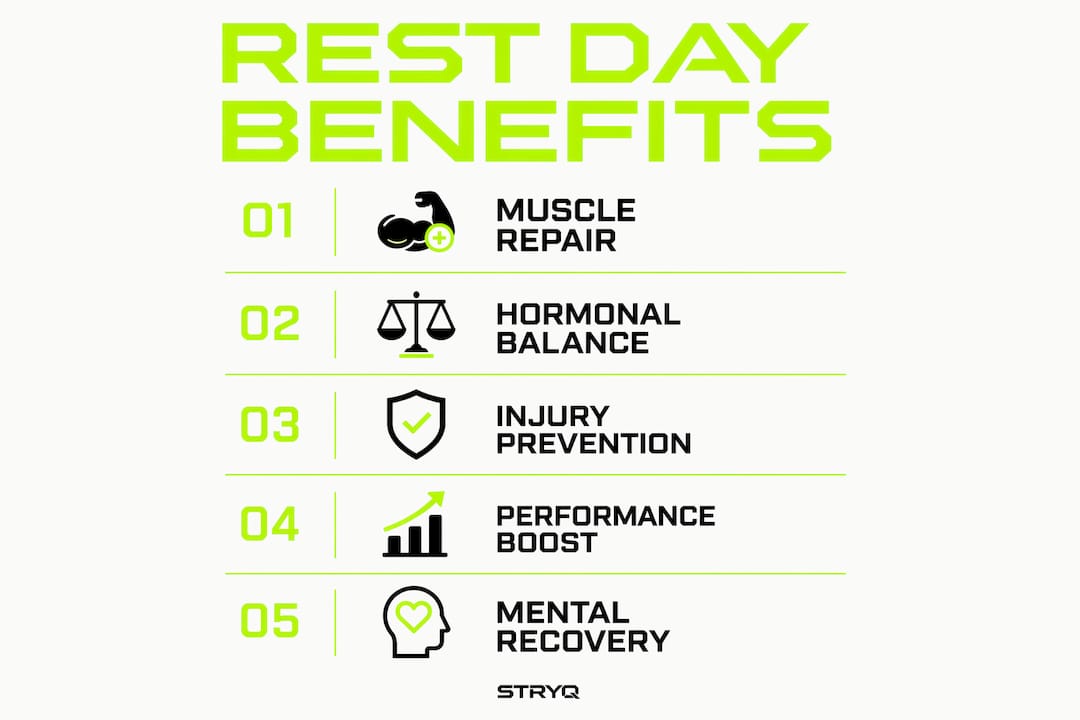
Runners who take one or fewer rest days per week face a 2.5 times higher injury rate than those who rest two to three times weekly, even at identical mileage. The volume is not the problem. The absence of recovery is.
| Runner level | Recommended rest days per week | Key consideration |
|---|---|---|
| Beginner (under 6 months) | 2–3 | Connective tissue adaptation lags behind cardiovascular fitness |
| Intermediate (6 months to 3 years) | 1–2 | Introduce cutback weeks every 3–4 weeks |
| Advanced (3+ years, high mileage) | 1–2 | Monitor resting heart rate and gait quality as readiness signals |
Cutback weeks, where total mileage drops by roughly a third, serve as a longer-term version of the same principle. They allow accumulated fatigue to clear before the next training block begins. Most structured marathon and half-marathon plans build these in automatically.
Pro Tip: Track your resting heart rate each morning. A reading consistently elevated by more than five beats above your baseline is a reliable signal that your body needs more recovery, not more miles.
Signs that you need an extra rest day include persistent muscle soreness beyond 48 hours, disrupted sleep, reduced motivation, and a noticeable drop in pace at your usual effort level. These are not signs of weakness. They are data.
What to do on rest days: active recovery versus passive rest
The choice between active recovery and complete rest depends on how fatigued you are and how hard your recent training has been.
Passive rest means no structured training at all. It is appropriate after a race, a particularly hard long run, or during periods of illness or injury. The body directs all available resources toward repair rather than movement.
Active recovery involves light, low-stress movement that promotes circulation and clears metabolic waste without adding physiological load. Light activities like walking or an easy 20–30 minute jog improve blood flow to recovering tissues without stressing them further. The key word is light. If you need to check your pace or effort, you are probably going too hard.
Practical active recovery options for runners include:
- A 20–30 minute walk at a comfortable pace
- Easy cycling on flat terrain, keeping heart rate below conversational effort
- Gentle yoga or mobility work focused on hips, calves, and hamstrings
- Swimming at a relaxed pace, avoiding high-intensity intervals
- A warm-up style jog of 15–20 minutes at genuinely easy effort
Nutrition on rest days deserves the same attention as on training days. Post-run recovery nutrition combining 30–40g of carbohydrates with 15–25g of protein within 30–45 minutes of your last hard session improves glycogen resynthesis by 30% compared to carbohydrates alone. That window matters even on the day after a hard run.
Hydration is the most commonly neglected element of rest day recovery. Reduced activity can mislead runners into drinking less. Neglecting fluid intake on rest days increases physiological stress and slows the repair processes that rest days are meant to support.
Common mistakes runners make on rest days
The biggest mistake is treating a rest day as a free pass to neglect recovery entirely. Rest is not passive by default. It requires deliberate choices.
-
Mistaking 24-hour readiness for full recovery. Runners frequently feel subjectively fine the day after a hard session and return to intense training too soon. Subjective readiness often lags behind true physiological recovery, which requires 48–72 hours. Feeling okay is not the same as being ready.
-
Filling rest days with physical stress. A day of heavy manual work, standing for eight hours, or carrying heavy loads adds load to the same musculoskeletal system you are trying to recover. The body does not distinguish between running stress and other physical stress.
-
Relying on recovery modalities instead of rest. Cold water immersion, massage, and compression garments support recovery. They do not replace it. Using them as a substitute for adequate rest days misses the point entirely.
-
Ignoring nutrition and hydration. Skipping meals or undereating on rest days deprives the body of the raw materials needed for repair. Protein intake remains just as important on non-training days.
-
Applying a rigid schedule regardless of how you feel. A plan that says “rest on Mondays” is a starting point, not a rule. Physiological readiness is better gauged by resting heart rate, energy levels, and movement quality than by the day of the week.
Pro Tip: If you are unsure whether to run or rest, ask yourself: “Could I run this session well?” If the honest answer is no, the rest day will do more for your fitness than the run.
Key takeaways
Rest days are where running adaptation happens. Without planned recovery, training stress accumulates without producing the physiological gains that make you faster, stronger, and more resilient.
| Point | Details |
|---|---|
| Rest days are physiologically active | The body repairs muscle, remodels collagen, and releases growth hormone during rest, not during running. |
| Connective tissue needs more time | Tendons and ligaments recover far more slowly than muscles, making rest days critical for injury prevention. |
| Two to three rest days reduce injury risk | Runners with one or fewer rest days per week face a 2.5 times higher injury rate at the same mileage. |
| Active recovery beats complete inactivity | Light walking or easy movement on rest days improves circulation and clears waste without adding stress. |
| Hydration and nutrition still matter | Neglecting fluids and protein on rest days slows repair and undermines the recovery you are trying to achieve. |
Why I think most runners get rest days completely wrong
Most runners I speak to treat rest days as something to get through rather than something to get right. The mindset is understandable. Running culture rewards consistency, and a day off can feel like falling behind.
The reality is the opposite. The runners I have seen improve most consistently are those who treat recovery with the same seriousness as their hard sessions. They plan their rest days. They eat well on them. They sleep deliberately. They do not fill the day with errands and stress and then wonder why they feel flat on Tuesday.
The hardest lesson to accept is that fitness is not built during the run. The run is the stimulus. The adaptation happens afterwards, in the hours and days of recovery that follow. A hard session without adequate rest is like planting seeds and never watering them.
Rigid schedules are another trap. A plan is a guide, not a contract. If your resting heart rate is elevated, your legs feel heavy, and your motivation has dropped, that is your body asking for more time. Giving it that time is not weakness. It is the most intelligent training decision you can make.
Embrace rest days as a core part of your programme. Not as a concession to tiredness, but as a deliberate investment in what comes next. The runners who do this consistently are the ones who stay healthy, improve year on year, and actually enjoy the process.
— martin
Gear that supports your training and recovery
Recovery starts the moment your run ends, and the right gear makes a real difference to how well you recover between sessions.

Stryq builds running gear around the practical needs of everyday runners. The Stryq running socks are cushioned and breathable, reducing foot fatigue during training and keeping your feet comfortable on active recovery days. For runners who carry hydration on longer efforts, the Stryq hydration vests are built for comfort and minimal bounce, so you can focus on the run rather than your kit. Every product is developed from real runner feedback and tested thoroughly before launch. Quality without unnecessary cost.
FAQ
What is a rest day in running?
A rest day in running is a planned day without high-intensity training, designed to allow the body to repair muscle fibres, remodel connective tissue, and restore hormonal balance for improved performance.
How many rest days does a runner need per week?
Most runners benefit from one to three rest days per week depending on experience and training load. Beginners need two to three, while advanced runners can manage with one to two, provided they include cutback weeks every three to four weeks.
Can I do light exercise on a rest day?
Yes. Active recovery such as walking, easy cycling, or gentle yoga promotes circulation and clears metabolic waste without adding physiological stress. Keep intensity genuinely low, well below your normal running effort.
Why do I feel fine but still need a rest day?
Feeling subjectively ready at 24 hours does not mean the body has fully recovered. Tendons, ligaments, and the nervous system require 48–72 hours after hard sessions, regardless of how you feel in the short term.
Does nutrition matter on rest days?
Nutrition on rest days is just as important as on training days. Adequate protein supports ongoing muscle repair, and staying hydrated prevents the physiological stress that comes from reduced fluid intake on lower-activity days.